


- Meaning: a polished, rounded gemstone with no facets.
- Shape: usually an oval or round dome on a flat base.
- Best for: opaque or translucent stones (moonstone, tiger's eye), opals, and star or cat's eye stones.
- Not for: clear stones whose sparkle comes from facets. Those are usually faceted instead.
- Value: the cut does not make a stone valuable or cheap. The stone itself does.
You will meet the word on product pages ("bezel-set moonstone cabochon"), in jewelry-making supply lists and in gem glossaries, and it is rarely explained. This page covers what a cabochon is, why some stones are cut this way, the four basic forms, how it compares with a faceted stone and how to look after one. For the wider picture of how stones are valued, see our guide to the rarest gems.
What Does Cabochon Mean?
Cabochon means a gemstone cut and polished into a smooth, rounded shape rather than faceted. An encyclopedia entry we read says it usually has a convex top and a flat back, and traces the word to the Middle French caboche, meaning "head." A jewelry glossary we read defines it as a stone with a smooth rounded surface and no facets, highly polished.
How Do You Pronounce Cabochon?
It is pronounced KAB-uh-shon, with the stress on the first syllable. The encyclopedia entry gives a phonetic spelling that matches this. You will sometimes hear "ka-bo-SHON" in casual speech, which is also understood.
What Shapes Do Cabochons Come In?
Most cabochons are oval or round. The encyclopedia entry says ellipses are common because the eye is less sensitive to small asymmetries in an oval than in a circle, and the glossary adds that rectangular and triangular versions exist too. The glossary also describes four basic forms:
| Form | What it looks like |
|---|---|
| Simple cabochon | A dome on a flat base, the most common form |
| Double cabochon | Domed on both sides, with the lower dome flatter than the top |
| Hollow cabochon | A shell-like form with the inside cut away, often with foil added behind |
| Tallow-topped cabochon | A shallow, gently domed top |
Why Are Some Stones Cut as Cabochons?
Stones are cabochon-cut when a smooth dome shows them off better than facets would. Sources we read give three reasons.
- The stone is opaque or translucent. The encyclopedia entry says opaque gems are usually cut as cabochons, while transparent stones are usually faceted, because facets only help when light can pass into the stone and bounce back.
- The stone is soft. Both the encyclopedia and the glossary say softer gems, those below 7 on the Mohs scale, are often cabochon-cut because facet edges scratch easily and a rounded finish hides scratches better.
- The stone has an optical effect. Star sapphires and cat's eye chrysoberyl are cut as domes so the star or eye shows, which a faceted cut would not display. The glossary lists asteria, opal and moonstone among stones valued this way.
Which Gemstones Are Usually Cabochons?
The glossary names almandine garnet (the old "carbuncle" cut), cat's eye, tiger's eye and amazonite, and notes that some emeralds, amethysts and garnets have also been cut en cabochon. Opal and moonstone are the examples most often seen in modern jewelry. If you are curious about individual stones, we have guides to moonstone vs opal, jewelry with opals and tiger's eye.
How Old Is the Cabochon Cut?
It is very old. The encyclopedia entry says cabochon cutting was the default method before faceting developed, and the glossary says the cut was common until the fifteenth century, when faceting began to replace it, then returned to fashion in Art Nouveau jewelry. One cited source in the encyclopedia suggests gem cutting and carving were probably first done in ancient Babylon, but that rests on a single source, so treat it as likely rather than settled.
Cabochon vs Faceted Stone: What Is the Difference?
A cabochon gives a soft glow, a faceted stone gives sparkle. A faceted cut uses many flat planes to return light, so it suits clear stones. A cabochon has one smooth curve, so it shows color, sheen and patterns instead. Neither is better; it depends on the stone and the look you want. In our view cabochons also read as calmer and softer than faceted stones.
Is a Cabochon Stone Valuable?
It can be, but the cut alone does not make it so. Value depends on the stone, its quality and whether it is natural, lab-created or simulated. A fine natural star sapphire is a different object from a glass cabochon, even though both are domes. Ask the seller what the stone is and how it was made. We did not find a source that prices cabochons as a class, so we do not quote figures.
How Is a Cabochon Made?
Making one is a lapidary craft. The encyclopedia entry describes the steps: the rough material is sliced with a slab saw, a shape is traced from a template, and the piece is trimmed and ground. For hand finishing, the stone is attached with wax to a wooden dop stick, the edges may be beveled, and the top is sanded and polished into an even dome.
How Do You Care for Cabochon Jewelry?
This is our own advice rather than a sourced rule. Many cabochon stones are softer or more porous than faceted gems, so keep them away from knocks, chemicals and long soaks. Take rings and bracelets off before washing up or swimming, wipe with a soft dry cloth, and store the piece separately so harder stones do not scratch it. Opal and moonstone have their own cautions, covered in can moonstone go in water and our wider jewelry care tips.
A Cabochon Piece at AJLuxe
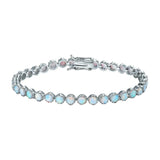
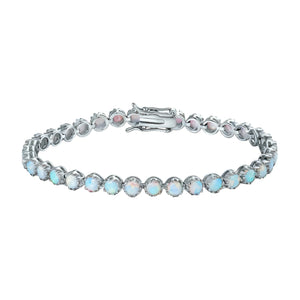
The Rainbow Moonstone Tennis Bracelet is bezel-set with round rainbow moonstone cabochons along a stainless steel band, 21 cm with a lobster clasp. Honest note from the listing: "rainbow moonstone" is a trade name for the shifting, iridescent flash, and we have not independently confirmed whether these particular stones are natural or lab-created. You can also browse gemstone necklaces, gemstone earrings and our moonstone bracelet guide.
More gemstone and craft guides
Frequently Asked Questions
What is a cabochon?
A cabochon is a gemstone polished into a smooth dome with no facets, usually with a curved top and a flat back.
What does cabochon mean?
The word comes from the Middle French caboche, meaning "head," and describes a gem with a rounded, head-like top rather than a faceted one.
How is cabochon pronounced?
It is pronounced KAB-uh-shon, with the stress on the first syllable.
What gemstones are cut as cabochons?
Opaque and translucent stones such as moonstone, opal, tiger's eye and amazonite, plus star sapphires and cat's eye stones, are commonly cut as cabochons. Softer stones are often cut this way too.
Is a cabochon stone valuable?
It depends on the stone, not the cut. A natural, good quality gem can be valuable, while a glass or simulated cabochon is not. Ask what it is made of.
What do people use cabochons for?
They are set in rings, pendants, earrings and bracelets, and the encyclopedia entry also notes cabochons used on watch crowns. Jewelry makers use them in bezel settings.
Why are star sapphires cut as cabochons?
The star effect would not show in a faceted cut. A dome displays it, so star sapphires are cut as cabochons.
What is the difference between a cabochon and a faceted stone?
A cabochon is smooth and domed and shows color and glow. A faceted stone has flat planes cut to return light and shows sparkle.
Sources
An encyclopedia entry on the cabochon (definition, etymology, pronunciation, shapes, why opaque, soft and optical-effect stones are cut this way, making process, history) and an antique jewelry glossary entry (definition, four forms, gems named, fifteenth century and Art Nouveau history), both read 2026-10-08. The care and valuation comments, and the comparison with faceted stones, are our own practical advice. Product details come from our listing.
Written by AJLuxe Team. Last updated: October 2026
All third-party trademarks, brand names and product names are the property of their respective owners. AJLuxe is not affiliated with, endorsed by, sponsored by, or otherwise connected to any third-party brand referenced in this article. Brand names are used solely for accurate comparative reference, and material descriptions reflect each brand's own published product specifications at the time of writing.
You Might Also Like
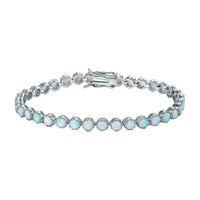
The piece they're describing → Rainbow Moonstone Tennis Bracelet for Women — Stainless Steel, Bezel Set, Gift Boxed with Message Card
Personalize Yours


