


Last updated: July 2026
Moonstone vs Opal: What's the Difference?
You've narrowed it down to two stones that both seem to glow from the inside — moonstone and opal. They get confused constantly, and honestly, in dim light, an untrained eye can mix them up. But once you know what to look for, they're nothing alike. This guide breaks down exactly how moonstone and opal differ in appearance, hardness, price, meaning, and everyday wearability, so you can pick the one that fits your life and not just your Pinterest board.
We'll also cover something most articles gloss over: which stone actually holds up in a ring you wear every day, and which one is better saved for earrings or a pendant you take off before bed.
Moonstone vs Opal: Quick Comparison Table
Here's the full side-by-side before we get into the details.
| Category | Moonstone | Opal |
|---|---|---|
| Mineral group | Feldspar (orthoclase) | Amorphous hydrated silica |
| Mohs hardness | 6–6.5 | 5.5–6.5 (often softer in practice) |
| Light effect | Adularescence — a floating blue-white glow | Play-of-color — shifting rainbow flashes |
| Common colors | White, grey, peach, with blue sheen | White, black, fire orange, crystal, with rainbow flashes |
| Origin (main sources) | Sri Lanka, India, Madagascar, USA | Australia (90%+ of world's opal), Ethiopia, Mexico |
| Price range (per carat) | $20–$200 for high quality | $10 for common opal to $2,000–$10,000+ for black opal |
| Ring durability | Better for daily wear, still needs care | More fragile — prone to cracking, sensitive to dryness |
| Birthstone month | June (modern birthstone) | October (traditional and modern birthstone) |
| Zodiac association | Cancer, and considered lucky for Leo | Libra and Scorpio |
| Healing / meaning association | Intuition, emotional balance, new beginnings | Creativity, emotional expression, hope |
| Best jewelry type | Rings, everyday pieces | Pendants, earrings, occasional-wear rings |
| Care difficulty | Moderate — avoid ultrasonic cleaners and knocks | High — avoid heat, dry air, and chemical exposure |
Shop Moonstone and Crystal Charm Necklaces at AJLuxe — Shop at AJLuxe →
What Is Moonstone?
Moonstone belongs to the feldspar mineral family, specifically the orthoclase and albite varieties. It forms when these two feldspar types grow together in fine, alternating layers deep within cooling igneous rock. As light enters the stone, it scatters between those layers and produces adularescence — the soft, billowing glow that gives moonstone its name.
The best moonstone shows a blue sheen that seems to float just beneath the surface and shifts position as you tilt the stone. Lower grades show a whiter, hazier glow. Sri Lanka produces most of the world's fine blue moonstone, while India, Madagascar, and the United States supply more affordable commercial-grade material.
Moonstone has been worn as a talisman for centuries. Ancient Roman writers believed it was formed from moonlight itself, and it's remained tied to lunar symbolism — intuition, cycles, and emotional tides — ever since. If you want the full history and healing breakdown, see our complete moonstone meaning guide.
What Is Opal?
Opal isn't a crystal in the traditional sense — it's an amorphous hydrated silica, meaning it has no fixed internal crystal structure. It forms when silica-rich water seeps into cracks in sedimentary rock and slowly deposits microscopic silica spheres, layer by layer, over millions of years.
When those spheres are stacked in a precise, evenly spaced grid, they diffract light into the spectrum of colors known as play-of-color — opal's signature effect and one found in no other gemstone. Opal without this effect is called "common opal" or "potch," and it's far less valuable.
Australia produces more than 90% of the world's precious opal, including the rare and highly prized black opal from Lightning Ridge. Ethiopia has become a major secondary source since the early 2010s, known for vivid play-of-color at a lower price point. For the full symbolism and history, see our complete opal meaning guide.
The Science Behind the Glow: Adularescence vs Play-of-Color
This is the single biggest thing people misunderstand about these two stones. They both "glow," but the physics behind it is completely different — and once you understand it, you'll never confuse them again.
Moonstone's adularescence happens because moonstone is actually two feldspar minerals (orthoclase and albite) grown together in ultra-thin, parallel layers. Light passing through the stone scatters off the boundaries between these layers, creating a soft, diffuse glow that appears to move as a single sheet of light across the surface. It's always a cool tone — blue, white, or silvery — regardless of the base color of the stone.
Opal's play-of-color works on a completely different principle. Opal is made of billions of tiny silica spheres, each about 150–300 nanometers across, stacked in a repeating grid. When light hits this grid, it diffracts — splits into its component wavelengths — the same way a prism splits sunlight into a rainbow. The exact colors you see depend on the size of the spheres: smaller spheres produce blue and violet flashes, larger spheres produce red and orange. This is why no two opals show quite the same colors.
A third phenomenon sometimes gets confused with both: labradorescence, seen in labradorite. If you're comparing all three "glowing" stones, our moonstone vs labradorite guide breaks down that comparison too.
Durability and Hardness: Which Survives Daily Wear?
Neither stone is hard by gemstone standards, but the difference between them matters more than the numbers suggest.
Moonstone sits at 6–6.5 on the Mohs hardness scale. That's harder than opal on paper, and moonstone also has a more stable internal structure — it doesn't contain water and isn't sensitive to temperature swings. It can still chip along its cleavage planes if you knock it hard against a counter or car door, so it's not indestructible, but it tolerates normal daily activity better than opal does.
Opal sits at 5.5–6.5 on the Mohs scale, and in practice it behaves softer than that range suggests. Opal contains 3–21% water by weight (typically 6–10%). That water content is what makes opal vulnerable: extreme dryness can cause the stone to crack (a defect called "crazing"), rapid temperature changes can shock it, and everyday chemicals — lotion, perfume, dish soap — can dull its surface over time. Opal also scratches more easily than moonstone against harder materials like quartz dust in household grit.
For comparison, sapphire and ruby sit at 9 on the Mohs scale, and diamond sits at 10 — the hardest natural material. Both moonstone and opal are far softer, which is why jewelers of America and most fine jewelry guides classify them as "special care" stones rather than everyday-durable stones like sapphire.
The bottom line for rings specifically: if you want one stone to survive years of daily wear — washing dishes, typing, gym days — moonstone is the safer bet. Opal can absolutely be worn daily, but it needs more mindfulness: no ultrasonic cleaners, no extreme heat, and occasional care to keep it from drying out.
Price Comparison: What Drives the Cost
Moonstone is the more budget-friendly stone across almost every quality tier. Commercial-grade moonstone with a hazy white sheen can cost just a few dollars per carat, while fine blue-sheen moonstone from Sri Lanka — the top of the market — typically sells for $20–$200 per carat. Even the best moonstone rarely crosses into four-figure territory.
Opal's price range is far wider because quality varies so dramatically. Common opal or opal with weak play-of-color can sell for under $10 per carat. Mid-grade crystal or white opal with decent color runs $50–$300 per carat. At the top of the market, black opal from Lightning Ridge, Australia — especially pieces with strong red flash — can command $2,000 to $10,000+ per carat, occasionally more for exceptional stones. Fire opal and boulder opal fall somewhere in the middle, typically $50–$500 per carat depending on color intensity and clarity.
What this means for a buyer: a beautiful moonstone piece is accessible at almost any budget, while an opal piece can range from an affordable everyday stone to a serious investment purchase, depending entirely on which type you choose.
Zodiac and Birthstone Differences
Moonstone is the modern birthstone for June, sharing that month with pearl and alexandrite. It's traditionally linked to the moon and, by extension, to Cancer — the zodiac sign ruled by the moon. Some astrological traditions also consider moonstone lucky for Leo, believing it helps balance that sign's fire with a calmer, more intuitive energy.
Opal is both the traditional and modern birthstone for October, alongside tourmaline. Astrologically, opal is associated with Libra, valued for enhancing charm and balance, and with Scorpio, where it's believed to intensify emotional depth and transformation. In Vedic astrology, opal is linked to Venus, while moonstone is linked to the moon itself — two very different planetary energies, which is part of why some traditions advise wearing them separately rather than stacked in the same piece.
If your birth month is June, moonstone carries the more literal birthstone connection. If it's October, opal does. Outside of birth month, the choice comes down to which energy you're drawn to: the moon's steady, reflective pull, or Venus's more expressive, creative spark.
Healing Properties and Meaning: How They Differ
Both stones are considered "stones of the self," but they point in different emotional directions.
Moonstone is associated with intuition, emotional balance, and new beginnings. Crystal healing traditions describe it as a stone for tuning into your own inner rhythm — useful during transitions like a new job, a move, or a relationship change. It's often recommended for calming anxiety before sleep and for helping with emotional regulation during hormonal cycles, which is part of why it's historically been called a "woman's stone."
Opal is associated with creativity, emotional expression, and hope. Where moonstone is calming, opal is considered activating — traditionally given to artists, writers, and performers who want to unlock inspiration. It's also tied to hope and optimism; the name itself may derive from the Sanskrit "upala," meaning precious stone. Some traditions caution that opal amplifies whatever emotional state you're already in, so it's described as a stone that requires more emotional awareness to wear well.
Neither of these is a substitute for medical or mental health care — they're traditions of meaning, not clinical claims. For the full breakdown of each stone's chakra associations and healing lore, see our dedicated moonstone meaning and opal meaning guides.
Which Stone for Which Jewelry Type?
This is where the durability data actually matters for a buying decision.
Rings: Moonstone is the better default for a ring you'll wear daily — it tolerates knocks, doesn't dry out, and holds its glow indefinitely with basic care. Opal rings are gorgeous but work best as occasional-wear pieces, or set in protective bezel settings that shield the stone's edges from impact.
Earrings: Both stones do well here since earrings see far less impact than rings. Opal earrings let you enjoy dramatic play-of-color without the daily wear risk a ring carries.
Necklaces and pendants: This is the safest setting for either stone. A pendant rarely gets knocked against hard surfaces, so both moonstone and opal can be worn constantly with minimal risk. It's also the most popular way to wear either stone for exactly this reason.
Bracelets: Skip fragile opal here if you're active — bracelets take more incidental impact than any other jewelry type. Moonstone tolerates bracelet wear better, though a bezel or protective setting still helps either stone last.
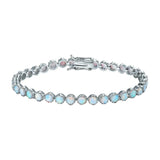
Our rainbow moonstone tennis bracelet uses exactly this kind of protective bezel setting around every stone, for what it's worth given the caution above.
Care Instructions: Moonstone vs Opal
Caring for these stones isn't difficult, but the rules are different enough that treating them the same way will damage one of them.
Moonstone care: Clean with a soft cloth and mild soapy water. Avoid ultrasonic and steam cleaners, which can crack the stone along its internal feldspar layers. Take it off before workouts, cleaning, or activities where it could get knocked. Store it separately from harder stones like diamond or sapphire to prevent surface scratches.
Opal care: Clean gently with a soft, damp cloth — never soak it, and never use ultrasonic cleaners, steam, or harsh chemicals. Avoid direct heat sources (hot water, hair dryers, direct sunlight for extended periods) since rapid temperature change can crack the stone. In very dry climates, some opal owners occasionally place their stone in water for a few minutes to help maintain its moisture content, though this isn't necessary for most modern, well-cut opals. Store opal away from other jewelry to prevent scratching, ideally in a soft pouch rather than loose in a box.
Neither stone should go into a jewelry cleaner marketed for diamonds — that guidance applies to both, but it's especially critical for opal.
Verdict: Which Should You Choose?
Choose moonstone if you want a stone you can wear every day without thinking about it, you're drawn to a subtle, romantic glow rather than bold color, you're shopping on a moderate budget, or you were born in June. It's the lower-maintenance, higher-durability choice, and it still delivers genuine "how does it do that" visual magic.
Choose opal if you want a statement piece with no two stones alike, you're comfortable with a bit more care and a bit more caution around daily wear, your budget allows for a wider price range, or October is your birth month. Opal rewards a buyer who wants drama and individuality over subtlety.
If you genuinely can't choose, that's a real option too — many jewelry lovers own both, wearing moonstone for daily pieces and saving opal for pendants and special-occasion rings where its fragility matters less.
Related reading: Rainbow moonstone meaning.
Related reading: The complete guide to gemstone meanings all 8 stones explained.
Related reading: Gemstone for July: Ruby, Sardonyx, and How to Choose (2026).
Frequently Asked Questions
Is moonstone or opal more expensive?
It depends on quality. At the low end, common opal and commercial moonstone cost about the same, just a few dollars per carat. At the high end, opal is far more expensive — black opal from Australia can sell for $2,000–$10,000+ per carat, while even the finest blue moonstone tops out around $200 per carat. If you're comparing typical mid-range stones, moonstone is generally the more affordable choice overall.
Can you tell moonstone and opal apart just by looking?
Yes, once you know the tell. Moonstone shows a single, soft, floating glow — usually blue or white — that moves as one sheet of light across the stone. Opal shows multiple distinct flashes of different rainbow colors that appear and disappear in patches as you move it. If you see more than one color flashing at once, it's opal. If you see one soft glow moving across the surface, it's moonstone.
Which is more durable, moonstone or opal?
Moonstone is more durable in practice. It rates 6–6.5 on the Mohs hardness scale versus opal's 5.5–6.5, and unlike opal, it contains no water, so it isn't vulnerable to cracking from dryness or temperature swings. Both stones still need gentle handling compared to harder gems like sapphire or diamond.
Is opal or moonstone better for an engagement ring?
Moonstone tends to hold up better for a ring worn every single day, since it's less prone to cracking and doesn't require humidity control. Opal can work beautifully as an engagement stone too, but it's better suited to a protective bezel setting and an owner who's comfortable with a higher level of care.
Can I wear moonstone and opal together?
Yes, physically there's no issue wearing both at once — they don't damage each other. Some astrological traditions suggest caution because moonstone is linked to the moon and opal to Venus, two different planetary energies, and recommend consulting an astrologer before combining them in a ring. From a style standpoint, they actually complement each other well, since both share that soft, glowing quality.
What is the difference between adularescence and play-of-color?
Adularescence, seen in moonstone, is a single soft glow of light caused by light scattering between layered feldspar minerals. Play-of-color, seen in opal, is caused by light diffracting through a grid of microscopic silica spheres, producing multiple distinct rainbow flashes. Adularescence always looks like one moving sheet of light; play-of-color looks like scattered patches of different colors.
Is moonstone or opal a birthstone?
Both are. Moonstone is the modern birthstone for June, alongside pearl and alexandrite. Opal is both the traditional and modern birthstone for October, alongside tourmaline. If you're buying for someone's birth month, that's often the simplest way to decide between them.
Does opal really need to stay near water?
Not in the dramatic way old folklore suggests. Opal naturally contains 3–21% water within its structure, and extreme dryness over a long period can cause cracking, called crazing. But well-cut, modern opal doesn't need to be stored in water or misted regularly — normal humidity is fine. The bigger risks are sudden temperature changes and direct heat, not everyday indoor air.
Why do moonstone and opal look similar in photos but different in person?
Photography flattens the 3D movement that makes both stones special. In person, adularescence shifts as you tilt the stone under different light angles, and opal's play-of-color changes color entirely depending on viewing angle. A photo captures one frozen moment of that movement, which is why both stones can look deceptively similar — or even dull — in a still image compared to seeing them in hand.
Which stone is rarer, moonstone or opal?
Fine-quality opal, especially black opal with strong play-of-color, is significantly rarer than fine moonstone. Moonstone with strong blue adularescence is uncommon but still more consistently available from established sources like Sri Lanka. Black opal specifically comes from a small number of mines in Lightning Ridge, Australia, which limits global supply and helps explain its high top-end price.
Do moonstone and opal have the same healing properties?
No, they're associated with different emotional themes in crystal healing traditions. Moonstone is linked to intuition, emotional balance, and calming energy — often used for stress and transitions. Opal is linked to creativity, emotional expression, and hope — often used for inspiration and unlocking artistic thinking. These are traditional associations, not medical claims.
Final Thoughts
Moonstone and opal both earn their reputation as gemstones that seem to hold light itself, but they get there through completely different physics, and they ask for different things from the person wearing them. Moonstone is the calmer, tougher, more budget-friendly choice — ideal if you want one stone you barely have to think about. Opal is the bolder, more delicate, more expensive choice — ideal if you want a piece that's genuinely one of a kind and don't mind a little extra care.
At AJLuxe, we work with moonlit and crystal-inspired designs across our collection, and we've handled enough of both stones to know the durability difference isn't just textbook advice — it shows up in how a piece actually wears over months of daily life. Whichever stone speaks to you, choose a setting that protects it, and it'll reward you with years of that glow that makes people ask, "wait, how is it doing that?"
Written by the AJLuxe team — specialists in personalized sterling silver jewelry. Last updated: July 2026.
Sources: Jewelers of America, National Jeweler.
Shop Moonstone and Crystal Charm Necklaces at AJLuxe — Shop at AJLuxe →
All third-party trademarks, brand names and product names are the property of their respective owners. AJLuxe is not affiliated with, endorsed by, sponsored by, or otherwise connected to any third-party brand referenced in this article. Brand names are used solely for accurate comparative reference, and material descriptions reflect each brand's own published product specifications at the time of writing.
You Might Also Like
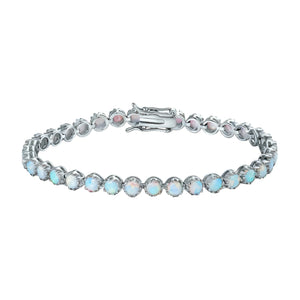
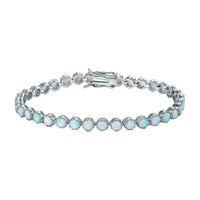
The piece they're describing → Rainbow Moonstone Tennis Bracelet for Women — Stainless Steel, Bezel Set, Gift Boxed with Message Card
Personalize Yours


