


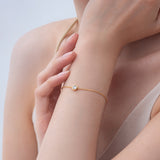
- Security and ease pull in opposite directions: the clasps that are hardest to open by accident are usually the hardest to fasten alone.
- Lobster claw is the common all-rounder for chain bracelets; box and tongue with a safety latch suits heavier pieces.
- Toggle, magnetic and slide-on designs are the easiest on stiff fingers, but each has a specific weak point (see the table).
- Most lost bracelets fail at the clasp or the small ring next to it, so check both every few weeks.
- Necklace closures overlap with these, but the weight and wrist movement differ: see our necklace clasp guide for those.
A bracelet moves more than almost any other piece of jewelry. It knocks into desks, sleeves and door frames all day, so the closure is the part most likely to let you down. This guide compares every common type, shows how to fasten each one alone, and helps you choose by need. If you want a deeper look at the single most common type, read our lobster clasp guide. For the wider picture of bracelet styles, see types of bracelets.
The 10 common bracelet clasp types
There are ten closures you will meet on most bracelets, and each works by a different mechanism.
- Lobster claw: a hook with a spring-loaded lever. You press the lever to open a gap, slip the hook through a ring or chain link, and release. Our lobster clasp guide covers sizes and repairs.
- Spring ring: a small hollow ring with a spring-loaded sliding pin (a "trigger") you pull back with a fingernail. It is lighter and flatter than a lobster claw, which is why it is common on very fine chains.
- Toggle: a bar that passes through a ring and then sits across it. It holds by tension and by the bar sitting crosswise, not by a lock.
- Magnetic: two halves held together by magnets, often in a tube or button shape. Strength varies a lot between makers and sizes. If you use a medical device, ask a doctor before wearing magnetic jewelry.
- Box and tongue: a flat tongue slides into a small box and springs against a catch. Many are paired with a figure-eight safety latch that folds over the outside.
- Fold over: a hinged flap that presses closed over the fastening, common on wider bands and some watch-style bracelets. Some have a push button to release.
- Hook and eye: a simple open hook that drops into a loop. It is light but has little to stop it slipping out if the bracelet slackens.
- Slide lock: a tube or box that one end slides into, often used on multi-strand bracelets where several strands share one closure.
- Barrel (screw): two threaded halves you twist together. Very secure once tightened, but fiddly to do with one hand.
- Bayonet (twist lock): a push-and-turn fitting, more often seen on cord and leather bracelets, that locks into a notch.
The eleventh item is not a clasp but an extender chain: a short run of extra links after the clasp, so you can choose the fit. It is not a lock at all, which is why it appears on anklets and chain bracelets next to a lobster claw. Our necklace extender guide explains the same idea on necklaces.
Bracelet clasp comparison table
The table below ranks each type by how securely it holds, how easy it is to use with one hand, and where it tends to fail. These are general ratings; build quality varies a great deal within every category.
| Clasp | Security | One-handed | Best for | Weak points | Wear signs |
|---|---|---|---|---|---|
| Lobster claw | High | Medium | Fine to medium chains | Tiny spring, small sizes hard to grip | Lever feels sticky or does not snap back |
| Spring ring | Medium to high | Low | Very fine chains | Pin is small and can get clogged or bent | Gap at the pin, weak spring |
| Toggle | Medium | High | Medium to heavy chains, arthritis-friendly use | Can flip open on a very light bracelet | Bar rocking loose, ring stretched |
| Magnetic | Varies | High | Anyone who struggles with small parts | Can pull apart on a knock; weak ones slide off | Halves no longer snap together firmly |
| Box and tongue | High with safety latch | Low to medium | Heavier or wider bracelets | Tongue can lose tension | Tongue slides out without a click |
| Fold over | High | Medium | Wide bands, watch-style | Hinge can loosen over time | Flap sits proud or rattles |
| Hook and eye | Low to medium | Medium | Light, decorative pieces | Slips out when slack | Hook opened wider than the eye |
| Slide lock | Medium to high | Low | Multi-strand bracelets | Needs both hands, small catch | Slides out more easily than before |
| Barrel (screw) | High if tight | Low | Pieces you rarely remove | Can unscrew itself if not tightened | Threads feel gritty or loose |
| Bayonet | Medium to high | Low | Cord and leather bracelets | Needs aligned turn to lock | Turns without catching |
Treat the ratings as a starting point, not a guarantee: a well-made spring ring beats a badly made lobster claw. For the mechanics behind these differences, see the engineering behind every jewelry clasp.
How to put on a bracelet by yourself, by clasp type
The trick for every clasp is the same: fasten it with your dominant hand against a stable surface, then rotate the bracelet so the clasp sits on the underside or outer wrist. Our full walkthrough is how to put on a bracelet by yourself; here is what changes by type.
- Lobster and spring ring: drape the bracelet on your wrist with the clasp end near your fingers, hold the ring end between thumb and finger of the same hand, press the lever or pull the pin with the other thumb, and hook it on. Resting the wrist on a table helps.
- Toggle: pass the bar through the ring with your free hand, then let the bracelet tighten so the bar turns crosswise.
- Magnetic: bring the two halves close; they align and snap. Check it with a gentle tug.
- Box and tongue: hold the box, push the tongue in until you feel or hear a click, then close the safety latch.
- Hook and eye, slide lock: these usually need both hands. Slip the bracelet on loosely, hook or slide the ends, then pull the bracelet back down the wrist.
- Barrel and bayonet: align the halves, push, and twist until snug. Rest the wrist on a surface so both hands can work.
If you do this often, a bracelet with a longer tail of links makes the clasp easier to grip. Our bracelet size chart shows how much slack to allow.
How to choose a clasp for your needs
Match the clasp to the problem you are actually trying to avoid. This is general information, not medical advice; if hand pain or a skin reaction is a concern, ask a doctor or a hand therapist.
- Heavy bracelet: choose box and tongue with a safety latch, fold over, or a large lobster claw (the bigger sizes in the lobster guide). A small clasp under a heavy piece wears faster.
- Thin or delicate chain: a small lobster claw or spring ring. A clasp bigger than the chain looks clumsy and can drag the chain around the wrist.
- Sensitive wrist: look at the metal in and under the clasp, not only the chain. Our guides to jewelry for sensitive skin and hypoallergenic jewelry explain what to check. Skin reactions vary by person.
- Arthritis-friendly or limited grip: toggle, magnetic, a slip-on bangle, an open cuff or a stretch design avoids fiddly parts. These are general suggestions only.
- Active days: favor a locking design (lobster, box and tongue with latch, barrel) over magnets or hook and eye.
What fails, and how to spot it before you lose a bracelet
Most bracelet losses start at a small, visible fault: a worn spring, a stretched ring, or an open jump ring. A thirty-second check every few weeks catches nearly all of them.
- Press and release the lever or pin: it should snap back instantly. If it lags, it is on its way out.
- Look for a gap between the hook and the clasp body when closed. Even a hairline gap means it can catch and open.
- Check the small ring or jump ring the clasp hangs from. If the ends are not flush, it can open.
- Tug each link near the clasp; stretched or thinned links are weak links.
- Listen for a rattle in hinges and flaps.
- Hold a magnetic clasp by one half and see whether the other half stays on without help.
Repair advice for chains is in how to fix a broken chain and what to do when a necklace clasp breaks. Plated finishes also wear gradually around clasps, which is where there is most friction; see how to make gold plated jewelry last longer. Store bracelets fastened or in a lined box to avoid tangles (how to store jewelry).
What about necklace clasps?
Necklace and bracelet closures overlap, but a necklace sits still while a bracelet is knocked around, so the ranking differs. For necklace-specific advice, see our guide to types of necklace clasps.
An honest note on our range
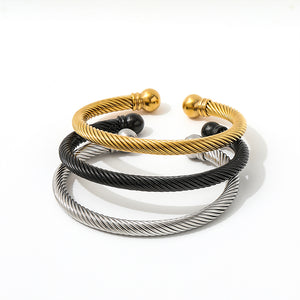
We sell chain bracelets, anklets, bangles and cuffs, and not every piece has a clasp. We state a closure below only where the product page names it. The Dainty 18K Gold Plated Anklet ($33.99) lists a lobster clasp and an extender chain, as does the Adjustable Gold Bracelet or Anklet ($31.99), which lists a lobster clasp with an extension chain. If you want no clasp at all, the Gold Elastic Bangle ($39.99) is a stretch design, and the Cable Chain Cuff Bracelet ($36.99) is an open cuff its page describes as clasp-free. We do not offer a magnetic, toggle or box and tongue bracelet that we can point you to right now. Browse the full bracelets collection; you may also like best bangle bracelets and how to stack bracelets.
More in this guide
Related reading: lobster clasp guide, types of necklace clasps, how to put on a bracelet by yourself, bracelet size chart and which wrist to wear bracelet.
Frequently Asked Questions
What is the most secure bracelet clasp?
A box and tongue clasp with a figure-eight safety latch, a fold over clasp, or a well-made lobster claw are generally the most secure. Security still depends on build quality and wear, so check the spring and rings regularly.
What is the easiest bracelet clasp to use with one hand?
Toggle and magnetic clasps are usually the easiest, followed by lobster claws in a larger size. No-clasp designs such as stretch bangles and open cuffs need no fastening at all.
Are magnetic clasps safe for bracelets?
Magnetic clasps are common and many people use them without trouble, but strength varies between makers. Strong ones can still come apart on a knock. If you use a medical device, ask a doctor before wearing magnetic jewelry.
What is a bracelet with a clasp called?
Any chain, link or beaded bracelet that fastens with a closure is simply a clasp bracelet; the closure may be a lobster claw, toggle, magnet or another type. Bangles and cuffs are the main styles that normally have none.
What is the difference between a lobster clasp and a spring ring?
A lobster claw opens with a lever on a hook shaped body, while a spring ring is a small round ring with a sliding pin. Lobster claws are easier to grip; spring rings are lighter for very fine chains. Our lobster clasp guide compares them in detail.
What are the parts of a bracelet called?
Typical parts are the chain or links, the clasp, the jump ring that joins them, and sometimes an extender chain and a charm or bail. See the jewelry parts glossary for all of the names.
Why does my bracelet keep coming undone?
The usual causes are a weak spring, an open jump ring, a clasp too small for the piece, or a slack bracelet. Check the closure for a gap, tighten the fit, and consider a different clasp type if it keeps happening.
Which wrist should I wear a bracelet on?
There is no rule; many people choose the non-dominant wrist so the clasp is easier to reach with the dominant hand. See which wrist to wear a bracelet on.
Written by AJLuxe Team. Last updated: October 2026
All third-party trademarks, brand names and product names are the property of their respective owners. AJLuxe is not affiliated with, endorsed by, sponsored by, or otherwise connected to any third-party brand referenced in this article. Brand names are used solely for accurate comparative reference, and material descriptions reflect each brand's own published product specifications at the time of writing.
You Might Also Like

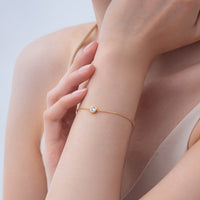
The piece they're describing → Gold Anklet for Women — 18K Gold Plated, Dainty Beach Ankle Bracelet
Personalize Yours


