


- Steady the end first. A paper clip, a small piece of tape, a bobby pin or a clip on your sleeve all do the same job.
- Rest your wrist on a table with the clasp facing up, and work over a soft cloth.
- Match the clasp to your hands. Magnetic and toggle are easiest alone, a large lobster is workable, spring ring and box clasps are hardest.
- A bracelet helper is worth buying if you wear a bracelet daily or your fingers are stiff.
- No clasp at all is an option: open cuffs, stretch styles and sliders go on in a second.
Fastening your own bracelet is a two-handed job that you are trying to do with one. You cannot see the clasp, the end ring slides around your wrist, and the hand holding the bracelet is also the hand you need to close it. This guide is about technique: how to get each kind of bracelet on and off alone. For how the clasp mechanisms themselves work, see the engineering behind every jewelry clasp. A tight bracelet is also harder to close, so if yours always fights back, check the length against our bracelet size chart.
What Is the Fastest Way to Put On a Bracelet With One Hand?
The fastest method is the paper clip hook: it holds the end ring still and puts it where you can see and reach it, so the clasp goes on in one try. Three published how-to guides we compared describe the same idea in different words, a way to hold one end steady while the other hand fastens.
- Unfold a paper clip into a hook or a loose S shape.
- Hook it through the end ring or last link on the side opposite the clasp.
- Rest your wrist on a table with the palm up and the clasp side facing you, and drape the bracelet around it.
- Hold the paper clip loop steady against your wrist with the fingers of the same hand.
- Close the clasp with your free hand. Press the trigger with your fingertip pad, hook the open gate over the ring the paper clip is holding, and release the trigger so the gate snaps shut.
- Slide the paper clip out, then give the bracelet a gentle tug to confirm it is closed.
If you have no paper clip, tape works the same way. Stick the plain end of the bracelet to the inside of your wrist with a small piece of tape, fasten the clasp with your free hand, then peel the tape off and wipe the bracelet with a soft cloth. A lobster clasp, a spring ring and a lightweight chain are the pieces these tricks suit best.
Which Bracelet Clasps Are Easiest to Close Alone?
Magnetic clasps are the easiest to close alone, toggles come next, and spring ring and box clasps are the hardest, with a large lobster clasp in the middle. The ranking follows what published guides and our own clasp engineering guide say about dexterity, and the table is organized by what you actually do with each one. If you want to compare how each clasp holds up under strain on a necklace, see types of necklace clasps.
| Clasp | Closing it alone | Taking it off | Watch out for |
|---|---|---|---|
| Magnetic | Bring the two ends near each other and they pull together. No pinching or aiming. | Slide the ends apart sideways instead of pulling straight. | Less secure under a hard tug, so it suits everyday pieces you are not worried about snagging. |
| Toggle | Pass the bar through the ring, then let it turn sideways across the opening. | Straighten the bar and slide it back through. | Needs the bar to stay crosswise, so it works best on a heavier piece. |
| Adjustable slider or no clasp | Slip the loop over your hand and adjust until it sits comfortably. | Loosen the loop and slide it off. | Nothing to fasten, so it is the most forgiving option. |
| Lobster | Hold the end steady (paper clip or tape), press the trigger with a fingertip pad, hook the gate over the ring, release. | Press the trigger and lift the gate away from the ring. | A larger lobster clasp and ring are easier to handle than a tiny one. |
| Spring ring | Same steady-end trick, but you pull a tiny lever. Expect more fiddling than a lobster clasp. | Pull the lever back and slip the ring out. | Small lever, so it is the hardest of the spring clasps to use alone. |
| Box clasp with safety latch | Slide the tongue into the box until it clicks, then close the safety latch. Usually a two-handed job. | Open the safety latch first, then press the release and pull the tongue out slowly. | Never pull on the bracelet while the safety latch is closed, since that bends the metal. |
Two trade-offs are worth keeping in mind. The easiest clasps (magnetic, toggle) are generally less secure under a hard pull, and the most secure (box with a safety latch) are the fiddliest alone. If you are choosing a bracelet mainly for daily wear on your own, choose a large lobster, a toggle or a magnetic clasp.
What Tools Help You Put On a Bracelet Yourself?
A paper clip, a small piece of tape, a bobby pin, a clip on your sleeve or a bracelet helper all solve the same problem, which is holding one end of the bracelet still. Choose by what is already in your drawer and how often you wear a bracelet.
| Helper | How to use it | Best for | Caution |
|---|---|---|---|
| Paper clip | Straighten it into a hook, pass it through the end ring, and hold the loop against your wrist. | Lobster and spring ring clasps | Hook the end ring or last link, not a clasp part. |
| Small piece of tape | Stick the plain end of the bracelet to the inside of your wrist, close the clasp, peel the tape off. | Light chains | Use a small piece, and wipe away any residue afterward. |
| Bobby pin | Clip it to the free end so you have something to hold. | Lightweight chains | Remove it as soon as the clasp closes. |
| Clothespin or binder clip | Clip the end to a sleeve cuff or table edge while the other hand fastens the clasp. | Heavier bracelets | Needs a flat surface. |
| Wrist on a table | Rest your wrist on a flat surface with the clasp facing up so the bracelet stays put. | Any chain bracelet | Lay a cloth down first so a dropped bracelet does not scratch. |
| Bracelet helper (clasp aid) | A small handle with a clip that holds one end steady while your free hand works the clasp. | Daily wearers and stiff or sore hands | Pick one with a clip that opens wide enough for your chain. |
There is also a home version of a bracelet helper: wrap a rubber band around the end of a pencil eraser, hook one end of the bracelet over it, and use it as the anchor. Commercial clasp aids are a small handle with a clip, sold for people with limited dexterity or a bracelet they wear daily.
When to use a helper instead of a trick: if you put the same bracelet on every day, if the improvised methods still leave you fumbling, or if pinching small parts is uncomfortable. Needing a helper says nothing about you, it is simply a better tool for the job.
How Do You Put On a Bracelet With Long Nails or Stiff Fingers?
Press the clasp trigger with the pad of your fingertip instead of the nail tip, choose a bracelet with a large lobster clasp and a large end ring, or switch to a magnetic clasp or a no-clasp style, which need no pinching at all.
- Use the pad, not the nail. A guide for jewelry makers says to use the pad of a fingertip rather than the nail tip, or a small jewelry tool, to press the lever safely.
- Choose bigger hardware. Larger lobster clasps and larger end rings are easier to see and hold.
- Use a helper. A clip-style bracelet helper holds the end so your fingers only have to work the trigger.
- Choose a magnetic or toggle clasp when pinching is the difficult part.
- Add a little slack. Hook the clasp into the farthest ring of the extension chain first. That gives you the most room to fasten it, and you can move it to a tighter ring afterward.
This is practical, not medical, advice. If hand pain or stiffness makes everyday tasks difficult, an occupational therapist can suggest dressing aids. For a ranking of clasps by how much grip strength they need, see our clasp guide.
Which Bracelets Need No Clasp at All?
Open cuffs, bangles, stretch bracelets and adjustable sliders need no clasp, and they are the easiest bracelets to put on alone. They also forgive a small sizing miss, which makes them useful gifts.
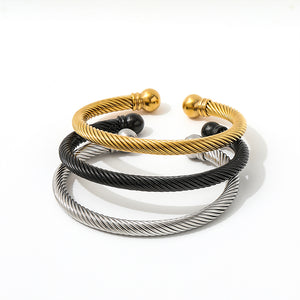
- Open cuffs slide onto the wrist from the side and can be gently shaped to fit. Our Cable Chain Cuff Bracelet is an open cuff listed as 18K gold plated, and its listing describes it as easy to put on independently.
- Stackable open bangles work the same way. The Bamboo Bangle Bracelet is an open cuff listed as 18K gold plated that you slide on and shape gently to your own wrist.
- Stretch bracelets flex over your hand and spring back.
- Adjustable sliders let you open the loop, slip it over your hand and tighten it.
For a closed bangle, size matters because it has to clear your hand, so use the hand-measurement table in our bracelet size chart. To compare the cuff, slider and extender styles, see our adjustable bracelets guide and cuff bracelets for women.
How Do You Take Off a Stuck, Box or Hard-to-Open Clasp?
Open any safety latch first, release the main catch with light pressure, and pull the bracelet apart slowly without forcing it. A bracelet that will not give is a reason to stop, not to pull harder.
- Look at it in good light with dry hands, and work over a table or a soft cloth.
- Open the safety latch on a box clasp: flip the catch up or outward gently.
- Press the release tab or lift the latch, keep it pressed, and ease the tongue out.
- Pull the two ends apart slowly.
- On a lobster clasp, press the trigger and lift the gate away from the ring.
Never pull on the bracelet while a safety clasp is still closed, since that can bend the metal permanently, and use light, steady pressure throughout. If a lobster clasp feels stiff, a guide for jewelry makers says a very light touch of jeweler's lubricant on the spring restores smooth operation, though for a plated piece it is wise to ask a jeweler first. If a clasp is truly stuck, take it to a jeweler instead of forcing it.
What If the Clasp Will Not Close or Is Broken?
If the clasp will not snap shut or the trigger has stopped springing back, the spring or the end ring is worn and the clasp needs replacing, which a jeweler can do and a repair kit can handle for a simple chain. Our guide to what to do when a clasp breaks covers the options and applies to bracelet clasps too.
How Do You Make a Bracelet Easy to Put On Every Day?
Choose a clasp that matches your hands, a length with a little room, and a place to sit: a bracelet that is slightly longer is easier to close than one that is snug, and a magnetic, toggle or no-clasp style removes the problem altogether.
- Put it on while seated with your wrist resting on a table.
- Pick a fit with room. Standard fit is wrist plus 0.5 inch, and relaxed fit adds up to 1 inch (see the bracelet length chart).
- Choose an adjustable chain. Our adjustable gold plated chain bracelet is listed at about 6 to 7.5 inches with a lobster clasp and an extension chain.
- Keep a clasp helper where you dress, for the days your fingers are slow.
If you would rather skip the clasp altogether, the Cable Chain Cuff Bracelet is a one-motion bracelet. It is an open, adjustable cuff, one size fits most wrists per its listing, so there is nothing to fasten.
Keep Reading
- Bracelet Size Chart: Length by Wrist Size
- The Engineering Behind Every Jewelry Clasp
- Types of Necklace Clasps
- Adjustable Bracelets Guide
Frequently Asked Questions
What tool can I use to put a bracelet on myself?
A paper clip is the simplest. Straighten it into a hook, pass it through the end ring opposite the clasp, and hold it steady against your wrist while your free hand closes the clasp. A small piece of tape, a bobby pin, a clip on your sleeve or a dedicated bracelet helper all do the same job.
How do I make a bracelet easy to put on?
Choose a larger lobster clasp, a magnetic or toggle clasp, or a no-clasp style such as an open cuff. Give yourself a little extra length so the bracelet is not tight when you close it, and fasten it while seated with your wrist resting on a table.
How do I put on a bracelet with a lobster clasp by myself?
Hold the end ring steady with a paper clip or a small piece of tape, lay the bracelet around your wrist, press the lobster trigger with the pad of your fingertip, hook the open gate over the held ring, and release the trigger so the gate snaps shut. Tug gently to check it is closed.
How do you put on a bracelet with one hand?
Use a helper to hold one end still: a paper clip hook, tape on the inside of your wrist, a bobby pin or a clip attached to your sleeve or table edge. Your wearing hand holds that anchor and your free hand closes the clasp. Resting your wrist on a table makes it steadier.
How do I put on a bracelet with long nails?
Press the clasp trigger with the pad of your fingertip instead of the nail tip, or use a small jewelry tool, and choose a bracelet with a large lobster clasp and a large end ring. A magnetic clasp or an open cuff avoids the problem completely.
What is the most secure clasp for a bracelet?
A box clasp with a safety latch is among the most secure, because it uses two mechanisms, and a lobster clasp is a strong everyday choice. The more secure a clasp is, the more fiddly it tends to be alone, so choose the most secure one you can still fasten comfortably.
How do box clasps work?
A box clasp has a folded metal tongue that slides into a box-shaped housing and locks in place, and many also have a side safety latch. To open one, release the safety latch, press the release tab or lift the latch, and slide the tongue out slowly. See our clasp engineering guide for the mechanism.
How do I release a clasp?
For a lobster clasp, press the trigger and lift the gate away from the ring. For a box clasp, open the safety latch first, then press the release tab and ease the tongue out. Use light, steady pressure and never force a clasp that feels stuck, since that can bend it.
How do I get a bracelet off by myself?
Rest your wrist on a table, use the pad of your fingertip to press the trigger on a lobster clasp or open the safety latch on a box clasp, and pull the ends apart slowly. If you struggle, a bracelet helper holds one end so your free hand can work the clasp.
Which bracelets need no clasp?
Open cuffs, bangles, stretch bracelets and adjustable sliders. They slide or stretch on and are the easiest bracelets to wear alone, and an open cuff can be shaped slightly to fit your wrist.
How We Put This Guide Together
The techniques here are the ones consistent across several published how-to guides (paper clip, tape, bobby pin, clip and table-support methods) and guides to handling lobster and box clasps, including their cautions about force. We did not film our own demonstration, so practice over a table and a soft cloth. Product details come from each product's own listing.
Written by AJLuxe Team. Last updated: October 2026
All third-party trademarks, brand names and product names are the property of their respective owners. AJLuxe is not affiliated with, endorsed by, sponsored by, or otherwise connected to any third-party brand referenced in this article. Brand names are used solely for accurate comparative reference, and material descriptions reflect each brand's own published product specifications at the time of writing.
You Might Also Like

The piece they're describing → Cable Chain Cuff Bracelet — 18K Gold Plated, Open Cuff, Adjustable
Personalize Yours


