


- Standard fit is wrist plus 0.5 inch. Snug is plus 0.25 inch, relaxed is plus 0.75 to 1 inch, loose is plus 1.25 inches.
- The average adult woman's wrist is about 6.1 inches (15.5 cm) in the US Army's open ANSUR II dataset, so most standard-fit bracelets land at 6.5 to 7 inches.
- A chain bracelet's size is its length. A bangle's size is an inner diameter set by your hand, not your wrist.
- Published guides disagree on one point. Some call plus 0.5 inch "standard," others call plus 0.75 to 1 inch "comfort." We show both so you can pick.
- Adjustable chains, open cuffs and stretch styles forgive a miss and are the safest choice for a gift.
A bracelet that is too long slides to the back of your hand, and one that is too short will not close. The fix is a number, not a guess, and the number comes from two measurements: your wrist, and how snug you want the bracelet to sit. Below is the full length chart, how to measure, how the main guides differ, and how to size chains, bangles, cuffs, tennis styles and children's bracelets. For a petite wrist under 5.5 inches, see our dedicated small wrist bracelet size guide.
Bracelet Length Chart: Wrist Size to Bracelet Size
Find your wrist measurement in the first column and read across for the bracelet length at each fit. Every cell shows inches first and centimeters in brackets, converted at 2.54 centimeters per inch, the exact definition in the NIST unit conversion tables.
| Your wrist | Snug (+0.25 in) | Standard (+0.5 in) | Relaxed (+1 in) | Loose (+1.25 in) |
|---|---|---|---|---|
| 5 in (12.7 cm) | 5.25 in (13.3 cm) | 5.5 in (14.0 cm) | 6 in (15.2 cm) | 6.25 in (15.9 cm) |
| 5.5 in (14.0 cm) | 5.75 in (14.6 cm) | 6 in (15.2 cm) | 6.5 in (16.5 cm) | 6.75 in (17.1 cm) |
| 6 in (15.2 cm) | 6.25 in (15.9 cm) | 6.5 in (16.5 cm) | 7 in (17.8 cm) | 7.25 in (18.4 cm) |
| 6.5 in (16.5 cm) | 6.75 in (17.1 cm) | 7 in (17.8 cm) | 7.5 in (19.1 cm) | 7.75 in (19.7 cm) |
| 7 in (17.8 cm) | 7.25 in (18.4 cm) | 7.5 in (19.1 cm) | 8 in (20.3 cm) | 8.25 in (21.0 cm) |
| 7.5 in (19.1 cm) | 7.75 in (19.7 cm) | 8 in (20.3 cm) | 8.5 in (21.6 cm) | 8.75 in (22.2 cm) |
| 8 in (20.3 cm) | 8.25 in (21.0 cm) | 8.5 in (21.6 cm) | 9 in (22.9 cm) | 9.25 in (23.5 cm) |
| 8.5 in (21.6 cm) | 8.75 in (22.2 cm) | 9 in (22.9 cm) | 9.5 in (24.1 cm) | 9.75 in (24.8 cm) |
The standard column matches the wrist-to-bracelet rows in several published jeweler size guides, which pair a 6 inch wrist with a 6.5 inch bracelet and a 6.5 inch wrist with a 7 inch bracelet. In between sizes, round to the nearest half inch, and choose the longer one if you wear rings, watches or other bracelets that add bulk.
How Do You Measure Your Wrist for a Bracelet?
Wrap a soft tape measure, or a strip of paper or non-stretch string, once around your wrist just below the wrist bone, where the bracelet will sit, keep it flat against the skin without squeezing, and read the number where the ends meet. With string or paper, mark the overlap and lay it against a ruler.
- Use a flexible tape, or a strip of paper, ribbon or string you can measure afterward.
- Wrap it once around the wrist at the spot where you will wear the bracelet.
- Keep it flat and snug, with just enough tension to stay in contact with the skin.
- Read the measurement where the end meets the tape, or mark the string and measure it on a ruler.
- Measure twice, ideally in the evening, since one published guide notes wrist size can change through the day with temperature and activity.
Guides disagree slightly about where on the wrist to place the tape: some say just below the wrist bone, one says just above it where a bracelet naturally rests, and others say the widest part of the wrist. The research method is more precise. In the US Army's 2012 anthropometric survey (ANSUR II), the top edge of a steel tape sat just below the wrist's bony prominence and the bottom edge just above the pisiform bone on the little-finger side, using only enough tension to keep the tape in contact with the skin. The practical rule is to measure where you will actually wear it and to use the same spot every time.
How Much Bigger Than Your Wrist Should a Bracelet Be?
A bracelet should be 0.25 to 1.25 inches longer than your wrist depending on how it should wear, and the single most common allowance across the guides we compared is 0.5 inch for a standard fit.
| Fit style | Add to your wrist | In centimeters | How it wears |
|---|---|---|---|
| Snug | 0.25 to 0.5 in | 0.6 to 1.3 cm | Sits close to the skin and moves little. Suits fine, delicate chains. |
| Standard | 0.5 in | 1.3 cm | Gentle movement, stays put. The most common default across the guides compared. |
| Relaxed (comfort) | 0.75 to 1 in | 1.9 to 2.5 cm | A little slack, slides slightly. The table above uses the 1 in end. |
| Loose | 1.25 in or more | 3.2 cm or more | Hangs and swings. Fine for charm or statement styles, and it can slide toward the hand. |
Here is where the published guides differ, stated plainly. One group calls plus 0.5 inch the "classic" or standard fit, and plus 0.25 inch "snug." A second group splits it differently: snug is plus 0.25 to 0.5 inch, "comfort" is plus 0.75 to 1 inch, and loose is plus 1.25 inches. The first group lands you at a bracelet about half an inch shorter than the second, which is why two charts can give different answers for the same wrist. Neither is wrong. If you like jewelry that stays put, use standard. If you like it to move, use relaxed. If you are between sizes, a fine chain does best snug and a heavier or charm style does best with room.
For a quick fit check, one jeweler guide says you should be able to slip a finger between a tennis bracelet and your wrist. If you cannot, it is too snug, and if the bracelet slides over the hand when you lift your arm, it is too loose.
What Is the Average Bracelet Length for Women?
Most women's bracelets run 6.5 to 7 inches (16.5 to 17.8 cm), which is what a standard fit on an average wrist produces: the average adult female wrist measures about 6.1 inches (15.5 cm), and adding 0.5 inch gives roughly 6.6 inches. One jeweler's size guide gives the same 6.5 to 7 inch range for typical women's bracelets and 7.5 to 8.5 inches for men's.
The wrist figure comes from data we computed ourselves instead of quoting a summary. ANSUR II is the US Army's 2012 anthropometric survey, and its public file for women has 1,986 women aged 17 to 58 with a measured wrist circumference for each. We read the file directly:
| Percentile of women measured | Wrist circumference (mm) | Inches | Centimeters |
|---|---|---|---|
| 5th | 142 | 5.6 | 14.2 |
| 25th | 150 | 5.9 | 15.0 |
| 50th (median) | 154 | 6.1 | 15.4 |
| Mean | 154.8 | 6.1 | 15.5 |
| 75th | 160 | 6.3 | 16.0 |
| 95th | 168 | 6.6 | 16.8 |
About nine in ten of the women measured fell between 5.6 and 6.6 inches (14.2 and 16.8 cm). Fewer than 1 percent measured 7 inches or more, and under 2 percent measured under 5.5 inches. One caution: these are US Army personnel, a working-age group measured with a steel tape, not a sample of the general population. Treat the numbers as a reliable guide to where most wrists sit, not a promise about any one wrist. It also explains why 7 inches is the common default: a 7 inch bracelet is a standard fit for a 6.5 inch wrist and a relaxed fit for a 6 inch wrist, which together cover most of the range.
Does Bracelet Size 7 Mean 7 Inches?
For chain and link bracelets, yes: a size 7 bracelet is 7 inches (17.8 cm) long, measured end to end with the clasp included, and it is meant for a wrist of roughly 6 to 6.5 inches, not a 7 inch wrist. For bangles the number means something else, an inner diameter or a small, medium or large label, so check which scale a listing uses.
A 7 inch bracelet suits a wrist of about 6.75 inches at a snug fit, 6.5 inches at standard, 6 to 6.25 inches at relaxed and 5.75 inches at loose. If a listing states its length, check whether the clasp is included. One published guide says to lay a bracelet flat and measure end to end, clasp included, and that total is its size. That is also how to read the size of a bracelet you already own.
Bracelet Length by Style: Chain, Bangle, Cuff, Tennis and Stretch
Each style is sized against a different measurement, so a number that works for a chain can be wrong for a bangle or a cuff.
| Bracelet type | What size means | How to size it |
|---|---|---|
| Chain or link bracelet | Total length in inches, end to end | Wrist plus 0.5 to 1 in. Delicate chains and smaller wrists lean to the low end. |
| Tennis or rigid line bracelet | Total length in inches | Wrist plus 0.25 to 0.75 in. One finger should slip under it. |
| Charm bracelet | Total length in inches | Allow extra room so charms can swing without pulling the chain tight. |
| Closed bangle | Inner diameter, set by your hand, not your wrist | Measure your hand across the knuckles with the thumb tucked in (chart below). |
| Open cuff | Wrist circumference, with a gap that flexes | Measure the wrist. A cuff should hug the wrist without pinching. |
| Stretch or elastic | Wrist circumference, with give | Pick the size nearest your wrist measurement and check the stretch range in the listing. |
| Adjustable slider or extender chain | A range, not a single number | Pick a range that holds your standard-fit length near the middle. |
Two published guides give slightly different tennis allowances (0.25 to 0.75 inch), which is a reminder that rigid pieces leave less room for error than chains. If you are choosing between sizes on a rigid style, take the smaller one only if you can still slip a finger underneath.
How Do You Size a Bangle Bracelet?
A closed bangle has to pass over your hand, so you size it from the hand, not the wrist: tuck your thumb into your palm, wrap a tape around your knuckles including the thumb knuckle, and match that circumference to the bangle's inner diameter.
| Hand circumference (thumb tucked) | Closed bangle inner diameter |
|---|---|
| 5.5 to 7 in (14 to 17.7 cm) | 2.13 to 2.25 in (54 to 57 mm) |
| 7 to 8 in (17.7 to 20.3 cm) | 2.38 to 2.5 in (60 to 64 mm) |
| 8.5 to 9 in (21.5 to 22.6 cm) | 2.63 in (67 mm) |
The chart follows one published size guide. A second guide gives a smaller bangle for a 7.5 inch hand (2.25 inches), and a third says to divide your hand circumference by 3.14 to get the diameter, which gives 2.39 inches for 7.5 inches. So the sources disagree by up to about 0.15 inch, and for a rigid closed bangle, choose the size that just clears your knuckles. One guide notes it is generally a good idea to go a little tight, since the bangle slides over the hand and then stays put without squeezing the wrist.
An open cuff takes the stress out of this. Our Bamboo Bangle Bracelet is an open cuff with an inner diameter of about 2.5 inches (6.35 cm) and a cuff width of about 8 mm, listed as 18K gold plated. Read as a closed bangle, a 2.5 inch diameter matches a hand of about 7.5 to 8 inches around. Because it is open, you can shape it gently to fit your wrist.
What Bracelet Size Fits a Child?
Children's bracelets run roughly 4 to 6.5 inches (10 to 16.5 cm), starting near 4 inches for a newborn and reaching about 6 inches by age 6 to 8, but the published guides do not agree age by age, so measure the wrist and add a half inch instead of relying on age alone.
| Age | Chain bracelet length (guide A) | Wrist to bracelet (guide B) |
|---|---|---|
| Newborn to 6 months | 4 to 4.5 in (10.2 to 11.4 cm) | Not given |
| 6 to 12 months | 4.5 to 5 in (11.4 to 12.7 cm) | Not given |
| 1 to 4 years | 5 to 5.5 in (12.7 to 14.0 cm) | Not given |
| 4 to 7 years | 5.5 to 6 in (14.0 to 15.2 cm) | Not given |
| 6 to 8 years | Not given | 5.1 to 5.5 in wrist, 6 in bracelet (15.2 cm) |
| 7 to 10 years | 6 to 6.25 in (15.2 to 15.9 cm) | Not given |
| 9 to 13 years | Not given | 5.9 in wrist, 6.5 in bracelet (16.5 cm) |
| Teen | 6.5 to 7 in or more (16.5 to 17.8 cm) | Not given |
Guide A says to add 0.5 inch to the wrist for a chain bracelet, and guide B's rows work out to about 0.5 to 0.9 inch. For bangles, one adds 0.5 inch for babies and a full inch for children and teens. Age charts are only a starting point because wrists vary a lot between children of the same age. For babies and toddlers, one guide also flags a choking hazard, so supervise any bracelet. The AJLuxe pieces mentioned on this page are adult sizes, so this section is reference only.
How Do Adjustable Chains and Extenders Change the Size?
An adjustable chain gives you a range instead of a single length, and the right way to read it is to find the range that holds your standard-fit length comfortably in the middle. Our adjustable gold plated chain bracelet is listed at about 6 to 7.5 inches with a lobster clasp and an extension chain, so you choose the hook position that fits.
| Fit style | Wrist the 6 to 7.5 in range covers |
|---|---|
| Snug (+0.25 in) | 5.75 to 7.25 in (14.6 to 18.4 cm) |
| Standard (+0.5 in) | 5.5 to 7 in (14.0 to 17.8 cm) |
| Relaxed (+1 in) | 5 to 6.5 in (12.7 to 16.5 cm) |
| Loose (+1.25 in) | 4.75 to 6.25 in (12.1 to 15.9 cm) |
At standard fit, that range covers wrists from 5.5 to 7 inches, which includes about 97 percent of the women in the ANSUR II sample. Measure yours, then check that the fit you want falls inside the range. Hooking the lobster clasp into the farthest ring first also gives you the most slack to fasten it, then you can move to a tighter ring.
How Do You Buy a Bracelet for Someone Else?
The most reliable way is to borrow a bracelet she already wears, lay it flat, and measure it end to end with the clasp included: that number is the length she has already chosen, so you can match it directly. If you cannot, choose a style that forgives size.
- Adjustable chains and extenders cover a range, such as the 6 to 7.5 inches above, so a wrong guess of half an inch still fits.
- Open cuffs can be shaped slightly to the wrist.
- Stretch styles flex over the hand.
- Avoid rigid closed bangles and tight tennis bracelets unless you know her hand and wrist measurements.
If a bracelet does not fit, AJLuxe accepts returns within 30 days for unworn items in their original packaging, and the customer pays for the return label. Our Cable Chain Cuff Bracelet is an open, adjustable cuff listed as 18K gold plated and one size fits most wrists, which makes it a low-risk choice when you do not know the wrist. Once you have the bracelet, see how to put on a bracelet by yourself for clasp-by-clasp tips. If you wear several together, our guide to stacking bracelets covers how much extra room to allow, and our adjustable bracelets guide compares the slider, extender and cuff styles. If you are buying an anklet instead, ankles are sized differently: see the anklet size guide.
Keep Reading
- Bracelet Size for a Small Wrist
- How to Choose a Bracelet for Women
- How to Put on a Bracelet by Yourself
- Anklet Size Guide
Frequently Asked Questions
What is a standard bracelet length?
A standard women's bracelet is 6.5 to 7 inches (16.5 to 17.8 cm) long, with 7 inches the most common default. That length is a standard fit for a wrist of about 6 to 6.5 inches, and the average adult female wrist is about 6.1 inches in the US Army's ANSUR II data.
My wrist is 6 inches. What size bracelet should I get?
For a 6 inch (15.2 cm) wrist, a standard-fit bracelet is 6.5 inches (16.5 cm). Choose 6.25 inches (15.9 cm) for a snug fit, or 7 inches (17.8 cm) for a relaxed fit that moves a little.
What size wrist will a 7 inch bracelet fit?
A 7 inch (17.8 cm) bracelet fits a wrist of about 6.5 inches (16.5 cm) at a standard fit. Depending on how snug you like it, the range runs from about 5.75 inches (loose) to 6.75 inches (snug).
Is 8 inches long for a bracelet?
Yes, 8 inches (20.3 cm) is long for most women. It is a standard fit for a 7.5 inch (19.1 cm) wrist, and since fewer than 1 percent of the women in the ANSUR II sample measured 7 inches or more, it is usually worn as a loose, draped bracelet on an average wrist.
Does a size 7 bracelet mean 7 inches?
For chain and link bracelets, yes: size 7 means a bracelet about 7 inches long including the clasp, made for a wrist of roughly 6.5 inches at standard fit. For bangles the size describes the inner diameter or a small, medium or large label instead.
Is a 7 inch bracelet small?
No, a 7 inch bracelet is the common default and sits on the roomy side for an average wrist. It is a standard fit for a 6.5 inch wrist and a relaxed fit for a 6 inch wrist, so only a wrist near the average will see it move slightly.
Is a 6 inch bracelet small?
A 6 inch (15.2 cm) bracelet is small for adults but right for a wrist of about 5.5 inches at a standard fit. Roughly 5 percent of the women in the ANSUR II sample measured 5.6 inches or less, so it fits a smaller number of adult wrists than a 7 inch bracelet does.
Is a 9 inch bracelet too big?
For most women, yes. A 9 inch (22.9 cm) bracelet is a standard fit for an 8.5 inch wrist, which is far above the ANSUR II sample range, so on an average wrist it hangs loosely and slides toward the hand. It suits a larger wrist or a deliberately draped style.
What is the average female wrist size?
About 6.1 inches (15.5 cm) around. In the US Army's ANSUR II public file for women (1,986 women), the median was 154 mm and about nine in ten measured between 142 and 168 mm (5.6 to 6.6 inches). It is a military sample, so it is a guide, not a population rule.
How do I measure my bracelet size at home?
Wrap a soft tape measure, or a strip of paper or string, around your wrist just below the wrist bone, keep it flat and snug, and read the number where it overlaps. Add 0.5 inch for a standard fit. To copy a bracelet you already own, lay it flat and measure end to end with the clasp included.
Sources and How We Checked the Numbers
Fit allowances, chart rows, tennis, cuff, bangle and children's guidance were compared across published jeweler and medical-ID size guides, and where they disagree we say so above. The wrist statistics were computed by AJLuxe from the public female file of the 2012 US Army Anthropometric Survey (ANSUR II), with the measuring method taken from the survey's measurer's handbook. Unit conversions use 1 inch = 2.54 cm exactly, per NIST Special Publication 811. AJLuxe product specifications come from each product's own listing.
Written by AJLuxe Team. Last updated: October 2026
All third-party trademarks, brand names and product names are the property of their respective owners. AJLuxe is not affiliated with, endorsed by, sponsored by, or otherwise connected to any third-party brand referenced in this article. Brand names are used solely for accurate comparative reference, and material descriptions reflect each brand's own published product specifications at the time of writing.
You Might Also Like
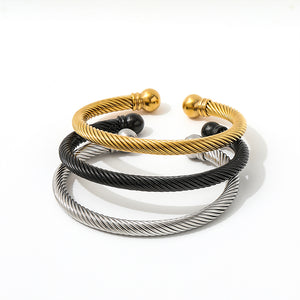

The piece they're describing → Cable Chain Cuff Bracelet — 18K Gold Plated, Open Cuff, Adjustable
Personalize Yours


