


The evil eye bracelet is one of the most widely recognized protective symbols in jewelry — worn across cultures, centuries, and continents. Whether you wear it for genuine protection, cultural connection, or simply because you love its striking blue-and-white design, understanding what it means adds a layer to wearing it.
The bracelets and anklets we carry at AJLuxe are made from 925 sterling silver — lightweight enough for everyday stacking without irritating the skin.
This guide covers everything: the history, the color meanings, which wrist to wear it on, what it means when it breaks, and the difference between the evil eye and the nazar.
Where Does the Evil Eye Come From?
The evil eye — the belief that an envious or malicious gaze can cause harm to the person being watched — is one of the oldest and most widespread superstitions in human history. Evidence of the belief appears in ancient Mesopotamia (modern-day Iraq) over 5,000 years ago, in ancient Greek and Roman texts, in ancient Egyptian artifacts, and in the Old Testament.
The nazar boncugu — the blue glass eye amulet most closely associated with the evil eye today — originates in Turkey and the broader Ottoman Empire. The word "nazar" comes from the Arabic and Persian word for sight or gaze. Turkish artisans have hand-crafted glass nazar beads for centuries using the same sand-core technique, creating the characteristic concentric circle design: deep cobalt blue outer ring, white inner ring, light blue secondary ring, and a dark center pupil.
In Turkish culture, nazar beads are hung in homes, cars, businesses, and worn on jewelry to protect against the evil eye. Today, the symbol has spread globally and is worn by millions across cultures who may have no personal connection to its origin traditions.
What an Evil Eye Bracelet Actually Means
An evil eye bracelet doesn't mean you believe you're cursed or in danger. It means you want protection from something real — the envy, ill will, and negative attention of others. In the cultures where the belief is strongest, the evil eye is treated as a practical concern: people who receive unusual amounts of compliments or attention are considered at risk of unintentionally drawing harmful energy.
The bracelet serves as a deflector. The eye on the amulet is believed to watch for incoming negative energy and reflect it back before it can reach you. Many people also wear evil eye jewelry as a symbol of mindfulness — a daily reminder to stay aware of their surroundings and protect their peace.
In contemporary fashion, evil eye bracelets are worn for all of these reasons at once: genuine belief, cultural connection, aesthetic appeal, or simply because someone who cares about you gave you one.
Evil Eye Color Meanings (The Complete Guide)
For the full breakdown of every shade and its exact spiritual meaning, see our complete evil eye color meanings guide.
While the classic nazar is cobalt blue and white, evil eye jewelry now comes in every color — each with its own attributed meaning. Here's what each color represents:
| Color | Meaning | Best For |
|---|---|---|
| Dark blue (classic) | General protection, good karma, fate | All-purpose protection, daily wear |
| Light blue / turquoise | Open-minded thinking, sky energy, health | New beginnings, clarity |
| Green | Good health, growth, abundance | Health goals, career growth |
| Red | Courage, energy, vitality, strength | Confidence, challenging situations |
| Yellow / gold | Health, strength, protection from illness | Wellness intentions, positivity |
| White | Purity, clarity, concentration, fresh starts | Mental clarity, new chapters |
| Pink | Friendship, romantic protection, love | Gifting to friends or partners |
| Purple | Transformation, balance, spiritual protection | Life transitions, spiritual practice |
| Orange | Happiness, motivation, creativity | Creative work, lifting mood |
| Black | Power, protection from dark forces, absorption | Absorbing negative energy, strong protection |
The classic deep blue and white remains the most widely worn and recognized. When in doubt — or when buying for someone else — the traditional cobalt blue nazar is always appropriate.

Which Wrist to Wear an Evil Eye Bracelet On
Traditional belief divides the body's sides by direction of energy flow:
- Left wrist: The left side is the receiving side — the side that takes in energy from the outside world. Wearing the evil eye on your left wrist is thought to offer the strongest inward protection, shielding you from negative energy before it reaches you.
- Right wrist: The right side is the projecting side — the side that sends energy outward. Wearing it on the right wrist is thought to deflect negativity in your environment and protect the people around you as well as yourself.
Most people who wear evil eye bracelets for protection choose the left wrist. But there is no universal rule — both wrists are worn, and many people simply choose the wrist where it feels most comfortable or where it stacks best with their other bracelets.
What It Means When Your Evil Eye Bracelet Breaks
A broken evil eye bracelet is widely considered a good sign, not a bad one. In Turkish and Greek tradition, it means the bracelet absorbed a significant amount of negative energy — it protected you from something — and broke under the weight of doing so.
Think of it as the amulet completing its purpose. The correct response is to discard the broken bracelet (don't wear a broken one — it's considered spent), thank it for its protection, and replace it. Some traditions specify disposing of it at a crossroads or burying it in the earth.
Replacing a broken evil eye bracelet as soon as possible is generally recommended — you've just been protected from something, which suggests your protection is needed.
Giving and Receiving an Evil Eye Bracelet
An evil eye bracelet given as a gift carries additional meaning beyond a self-purchased piece. It communicates: "I want good things for you. I want to protect you from harm." In Turkish culture, giving someone a nazar is one of the most common expressions of care and protection between friends and family.
Many people believe a gifted evil eye bracelet carries stronger energy than one bought for yourself — because it's imbued with someone else's genuine wish for your wellbeing. This makes evil eye bracelets a meaningful gift between close friends, romantic partners, new parents, or anyone going through a significant life change.
Evil Eye vs. Nazar: What's the Difference?
The terms are often used interchangeably but technically mean different things:
- The evil eye is the curse itself — the harm caused by an envious or malicious gaze. You don't want the evil eye cast on you.
- The nazar (nazar boncugu in Turkish) is the protective amulet — the blue-and-white eye-shaped symbol that deflects the evil eye. You do want to wear the nazar.
When someone says "evil eye bracelet," they mean a bracelet featuring a nazar amulet as protection against the evil eye. The marketing language has blurred the distinction, and both terms are now broadly understood to refer to the protective jewelry piece.

Evil Eye Belief Across Cultures
While the nazar is most associated with Turkey and Greece, the evil eye belief appears in nearly every major world culture:
- Turkey: The nazar boncugu is the most widely sold souvenir and protective amulet. It's in homes, cars, businesses, and jewelry.
- Greece: Called "mati" (eye). Blue eyes on foreigners were historically associated with casting the evil eye. Spitting on attractive babies was a traditional protection method.
- Middle East: Mentioned in the Quran and Hadith. The belief is mainstream across Arab cultures.
- India and South Asia: Called "nazar" or "drishti." Protective circles of black and dark blue are used to protect children and new homes.
- Latin America: Called "mal de ojo." Protective red bracelets, particularly on infants, are common across Mexico and Central America.
- Italy: The "malocchio" (bad eye). The horn amulet (cornicello) is the Italian counterpart to the nazar, used for similar protection.
The cross-cultural reach of the evil eye belief is why evil eye jewelry resonates with such a wide range of people — it connects to deep roots in human history regardless of where you're from.
How to Wear and Style an Evil Eye Bracelet
Evil eye bracelets come in every style from simple cord-and-bead to 14K gold chain with enamel nazar charms. They work in three ways:
- Alone as a statement piece: A single blue and gold evil eye bracelet reads as a meaningful talisman rather than a fashion accessory. Wear alone on the left wrist for the most intentional look.
- Stacked with other bracelets: Evil eye bracelets stack beautifully with fine chain bracelets, thin bangles, and beaded pieces. Stack with complementary gold tones for a curated wrist look.
- Coordinated with earrings or rings: Evil eye motifs appear across all jewelry categories. An evil eye bracelet paired with evil eye stud earrings or an evil eye ring creates a cohesive symbolic look.
For more on bracelet styles and how to layer them, see our complete guide to types of bracelets.
Related reading: Best evil eye bracelets.
Related reading: Evil eye necklace meaning.
Related reading: Hamsa vs evil eye.
Related reading: Kabbalah bracelet meaning.
Related reading: Evil eye jewelry guide.
Related reading: Evil eye bracelet guide.
Related reading: Spiritual jewelry guide.
Frequently Asked Questions
What does an evil eye bracelet mean?
It's a protective talisman featuring a nazar amulet — the blue-and-white eye symbol believed to deflect harm caused by envious or malicious stares. Wearing one means you're seeking protection from negative energy, jealousy, and ill will from others. It's one of the oldest protective symbols in human history, originating in the ancient Middle East and Mediterranean.
What do the different evil eye colors mean?
Classic dark blue means general protection and good karma. Light blue symbolizes health and open-minded thinking. Green represents growth and abundance. Red means courage. Yellow means health and strength. White represents purity. Pink protects relationships. Purple signals transformation. Orange brings happiness. Black absorbs negative energy. The classic blue and white nazar is the most universal and widely worn.
Which wrist should you wear an evil eye bracelet on?
The left wrist for protection from incoming negative energy (the left is the receiving side). The right wrist for projecting protection outward. Most people choose the left wrist. In everyday practice, wear it wherever it's most comfortable.
What happens when an evil eye bracelet breaks?
In tradition, a broken evil eye means it absorbed and neutralized significant negative energy meant for you — it protected you. Discard the broken piece respectfully (don't continue wearing it) and replace it. It's seen as a positive sign, not an omen.
What does it mean if someone gives you an evil eye bracelet?
It means they want to protect you and bring you good energy. A gifted evil eye carries the giver's positive intentions and is believed to be especially potent as protection. It's a meaningful way to say "I care about your wellbeing."
Can anyone wear an evil eye bracelet?
Yes. While rooted in Mediterranean, Middle Eastern, and South Asian traditions, evil eye bracelets are worn globally across cultures and religions. Wearing one is widely considered respectful of the tradition rather than appropriative — the protective symbolism is accessible to everyone.
How do you activate an evil eye bracelet?
No specific ritual is required. Many believe it activates simply by being worn, especially if gifted. Some people set an intention when first wearing it — acknowledging the protection they're seeking. The most important factor is wearing it with awareness of its meaning.
What is the difference between an evil eye and a nazar?
The evil eye is the curse — harm from an envious gaze. The nazar is the amulet that protects against it — the blue-and-white eye-shaped symbol. "Evil eye bracelet" is the common name for a bracelet featuring a nazar amulet for protection against the evil eye.
Is it bad luck to buy yourself an evil eye bracelet?
No. Self-purchased evil eye bracelets are completely accepted in most traditions. While some believe a gifted bracelet carries stronger energy, buying one for yourself is widely practiced everywhere, including Turkey where the symbol originated.
What is the classic evil eye color and why blue?
Classic blue comes from the ancient Middle East and Mediterranean where blue eyes were rare and associated with unusual power. The nazar uses blue to match and deflect the harmful gaze. The specific deep cobalt blue of the traditional nazar bead is made from cobalt-rich sand-core glass — a centuries-old Turkish craft.
If you're drawn to meaningful jewelry, see our guide to moonstone meaning — the June birthstone with 2,000 years of symbolic history.
Explore the meaning and properties of another powerful stone: Citrine Meaning: The Merchant's Stone, Healing Properties & How to Use It.
Read our full guide to another powerful protection and meaning stone: Turquoise Meaning: Symbolism, Healing Properties & the World's Best Mines.
Read our full guide to another powerful gemstone: Amethyst Meaning: Symbolism, Healing Properties & February Birthstone Guide.
Learn how to build the perfect bracelet stack: How to Stack Bracelets: The Complete Layering Guide.
Explore the broader world of charm symbolism: Charm Bracelet Meaning: The Ancient Art of Wearing Your Intentions.
Discover the meaning behind tennis bracelets: What Does a Tennis Bracelet Mean?
For the complete bracelet reference — every type, meaning, sizing, and stacking guide: The Complete Bracelet Guide: Every Type, Style, Meaning & How to Wear Them.
Final Thoughts
The evil eye bracelet is both ancient and contemporary — rooted in 5,000 years of human belief about protection and envy, now worn by millions globally as jewelry with meaning. Whether you're drawn to it for its symbolism, its cultural resonance, or simply its striking blue-and-white design, wearing one carries a story worth knowing.
For more on jewelry meanings and symbolism, see our guides on anklet meaning and symbolism and our complete guide to all types of bracelets.
Written by the AJLuxe team. Last updated: May 2026.
All third-party trademarks, brand names and product names are the property of their respective owners. AJLuxe is not affiliated with, endorsed by, sponsored by, or otherwise connected to any third-party brand referenced in this article. Brand names are used solely for accurate comparative reference, and material descriptions reflect each brand's own published product specifications at the time of writing.
You Might Also Like

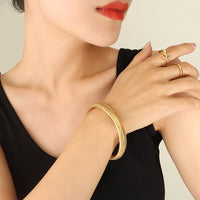
The piece they're describing → Gold Elastic Bangle Bracelet for Women — 18K Gold Plated, Stretch Fit, Stackable
Personalize Yours


