


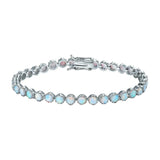
- A tennis bracelet symbolizes eternal love, commitment, and elegance — the unbroken diamond line represents a bond with no beginning and no end. See also: tennis necklace vs tennis bracelet — which to buy first.li>
- It also carries meanings of strength, personal achievement, and resilience — rooted in its athletic origin story.
- The name comes from a real moment: tennis champion Chris Evert lost her diamond bracelet mid-match at the 1987 US Open and stopped play to find it.
- Before 1987, the style was called an eternity bracelet — a name that still captures its symbolism perfectly.
- As a gift, it signals deep appreciation, lasting commitment, or celebration of a major milestone — depending on who gives it and why.
A tennis bracelet means more than just diamonds on a wrist. It carries over a century of symbolism — love that doesn't end, strength earned through effort, and elegance that never goes out of style. When someone gives you a tennis bracelet, or when you give one to yourself, there's a specific message behind it. This guide breaks down exactly what a tennis bracelet means, where the name comes from, what it signals as a gift, and what it says when you wear it on your left wrist versus your right.
Why Is It Called a Tennis Bracelet?
The name has nothing to do with the sport itself. It comes from a single moment at the 1987 US Open in New York. Curious why it’s called that in the first place? See why it's called a tennis bracelet.
Chris Evert — the world's top-ranked women's tennis player at the time — was mid-match when her thin diamond bracelet slipped off her wrist and landed on the court. She stopped play. She asked officials to pause the match while she searched for it. They did. She found it. She put it back on and kept playing.
That moment was broadcast to millions of viewers. The style of bracelet she wore — a slender, flexible line of individually set diamonds — had existed for decades. But after that match, jewelry retailers noticed a surge in customers asking for "the bracelet Chris Evert was wearing." The name "tennis bracelet" stuck almost overnight.
Before 1987, the same design was called an eternity bracelet. That name came from its Art Deco origins in the 1920s, when flapper-era high society women wore continuous diamond line bracelets as symbols of unending love. The word "eternity" was built into the design from the start — a circle of stones with no clasp visible, no beginning, no end.
The name changed. The symbolism didn't.

What Does a Tennis Bracelet Symbolize? (The 6 Core Meanings)
1. Eternal Love and Commitment
This is the original and most widely recognized meaning. The continuous diamond line — every stone identical, every link unbroken — is a visual metaphor for a love that has no gaps and no end point. It mirrors the symbolism of an eternity ring or a wedding band. In fact, many couples give tennis bracelets as anniversary gifts specifically because the design communicates the same thing as a wedding ring, but on the wrist.
The uniform stones matter too. Each diamond is the same size and cut. That uniformity signals equality — a relationship between two people where neither love is greater than the other's.
2. Strength and Resilience
Because the bracelet's name comes from an act of determination — stopping a professional tennis match to retrieve something precious — wearing a tennis bracelet carries a secondary meaning of resilience. You hold on to what matters. You don't let go easily.
This meaning has grown stronger over time as the bracelet became associated with high-achieving women. Serena Williams, Beyoncé, and Zendaya have all worn tennis bracelets publicly. The association with athletic and professional excellence reinforces the "earned strength" narrative.
3. Grace Under Pressure
There's something specific about Chris Evert's behavior in that 1987 moment that embedded itself in the bracelet's cultural meaning. She didn't panic. She didn't abandon the match. She calmly stopped, retrieved what was hers, and continued. The bracelet became associated with composure and grace — the ability to handle high-stakes moments without losing your elegance.
4. Milestone Achievement
A tennis bracelet is one of the most common "milestone gifts" in fine jewelry. Graduating from college, landing a promotion, completing a difficult year, becoming a mother — these are all occasions where a tennis bracelet is given or bought as a marker of something earned.
The self-gift framing has grown significantly in the last decade. Women increasingly buy tennis bracelets for themselves as a deliberate act of acknowledging their own achievement. The message is: I worked hard, I reached this point, and I'm marking it. That meaning is entirely distinct from the romantic gifting context — and equally valid.
5. Individuality Within Elegance
Despite being a "classic" piece, the tennis bracelet adapts. Colored gemstones, mixed metals, asymmetric settings — these variations let the wearer express personal style while keeping the core symbolism intact. Choosing a blue sapphire tennis bracelet over a white diamond one isn't just a style decision. It's a statement about who you are within a tradition.
6. Timeless Femininity (and Increasingly, Genderless Luxury)
Tennis bracelets have historically been framed as women's jewelry. That's shifting. Lenny Kravitz, Brooklyn Beckham, and several professional basketball players have worn tennis bracelets prominently in public appearances. The design reads as refined and intentional regardless of gender — a continuous line of stones says "I value quality" without gendered decoration like hearts or florals.
What Does It Mean When Someone Gives You a Tennis Bracelet?
The meaning shifts based on who gives it and in what context. Here's a clear breakdown:
| Who Gives It | Occasion | What It Communicates |
|---|---|---|
| Romantic partner | Anniversary / Valentine's Day | Lasting commitment; I choose you permanently |
| Romantic partner | No specific occasion | Strong romantic signal; often precedes or follows a major relationship milestone |
| Parent | Graduation / 18th or 21st birthday | Pride in achievement; you've become someone remarkable |
| Parent | Push present (after childbirth) | Recognition of enormous strength and sacrifice |
| Close friend | Major life event | Deep, enduring friendship — often mirrors the "forever" eternity symbolism |
| Yourself | Personal milestone or self-reward | Self-worth, independence, acknowledgment of your own strength |
A tennis bracelet is one of the few jewelry pieces that reads as romantic in one context and maternal in another — without losing meaning in either. The design is flexible enough to carry different emotional weights depending on the relationship.
What Wrist Do You Wear a Tennis Bracelet On?
There's no universal rule, but there are common conventions worth knowing.
Most people wear a tennis bracelet on their non-dominant wrist. Right-handed wearers typically choose the left wrist; left-handed wearers often choose the right. The practical reason: your non-dominant hand moves less aggressively, so the bracelet stays in place and experiences less friction against hard surfaces.
The left wrist also carries the historical association with love and romance — the left hand is traditionally associated with the heart in Western jewelry culture, which is why engagement rings and wedding bands go on the left ring finger. Wearing a tennis bracelet on the left wrist can reinforce its romantic symbolism.
The right wrist carries a different cultural signal in some traditions — it's seen as the "active" or self-directed wrist, associated with personal strength and independence. Wearing a bracelet on your right wrist can be read as a self-gift or personal statement rather than a romantic token.
Neither choice is wrong. The distinction is subtle enough that most wearers simply choose whichever wrist feels more comfortable. For a deeper look at wrist symbolism across bracelet styles, see our guide to anklet meaning and symbolism, which explores similar directional significance in ankle jewelry.

Tennis Bracelet vs. Eternity Bracelet: What's the Difference?
Functionally, there's no difference. Both terms describe the same design: a flexible bracelet where a continuous line of matched gemstones runs around the full circumference of the wrist, set in a precious metal frame.
The distinction is cultural and historical:
- Eternity bracelet — the original term, used from the 1920s through the 1980s. Emphasizes the symbolic meaning: love without end, a circle with no break.
- Tennis bracelet — the post-1987 name, dominant in North American retail. Emphasizes the cultural story and the aspirational sport-luxury crossover.
In Europe and Australia, "eternity bracelet" remains more commonly used. In the US, "tennis bracelet" is nearly universal. If a jeweler refers to an "eternity bracelet," they're describing the same piece — just using the older vocabulary.
How the Design Reinforces the Meaning
The symbolism of a tennis bracelet isn't accidental. Every element of the design communicates something:
| Design Element | What It Communicates |
|---|---|
| Continuous unbroken line | No end point — love, commitment, or connection that doesn't stop |
| Identical matched stones | Equality and uniformity — each moment, each day equally valued |
| Flexible, form-fitting drape | Adaptability — fits every wrist, every occasion, every phase of life |
| Precious metal setting | Permanence and lasting value |
| Close to the skin (wrist) | Intimacy — worn against the pulse point, the most personal placement in jewelry |
The closest parallel in jewelry is the eternity ring — a band set with stones all the way around with no break. The types of bracelets guide on our blog covers how the tennis bracelet compares structurally to other bracelet styles, including bangles, cuffs, and charm bracelets.
Is a Tennis Bracelet Appropriate for Everyday Wear?
Yes — and that's actually part of its meaning. A tennis bracelet isn't reserved for formal occasions. It's designed to move with you. The flexible link construction means it sits flat against the wrist and doesn't catch on fabric or snag. Chris Evert wore hers during a professional tennis match, which says everything about the design's durability-meets-elegance philosophy.
AJLuxe's own rainbow moonstone tennis bracelet — bezel-set stones on stainless steel, gift-boxed with a free message card — is built for exactly this kind of everyday wear. You don't need to reserve it for special occasions.
The GIA (Gemological Institute of America) notes that the tennis bracelet's enduring appeal stems partly from its versatility — it transitions from casual to formal wear without effort, which is a rare quality in fine jewelry design. (GIA — Diamond Tennis Bracelet)
AJLuxe carries a rainbow moonstone tennis bracelet in stainless steel, bezel-set stones, at $54.99 — gift-boxed with a free printed message card chosen at checkout.
Curious about the name's real backstory? We cover in a separate guide.
Frequently Asked Questions
Q: Why is it called a tennis bracelet?
It's named after a moment at the 1987 US Open when Chris Evert — the world's top women's tennis player — stopped her match to search for her lost diamond bracelet. Viewers watching the broadcast flooded jewelry stores asking for "the bracelet Chris Evert wore." The name "tennis bracelet" became standard almost immediately after that match. Before 1987, the same design was called an eternity bracelet.
Q: What does a tennis bracelet symbolize?
A tennis bracelet primarily symbolizes eternal love and commitment — the continuous diamond line represents a bond with no beginning and no end. It also symbolizes strength and resilience (from its athletic naming story), personal achievement (as a milestone gift), grace and elegance, and increasingly, self-worth when bought as a self-gift. The specific meaning depends on who gives it and the occasion.
Q: What does it mean when someone gives you a tennis bracelet?
It depends on the relationship. From a romantic partner, it signals deep and lasting commitment — often given at anniversaries or to mark a significant relationship milestone. From a parent, it typically celebrates an achievement like graduation or a major birthday. From yourself, it marks a personal milestone you've earned. In all contexts, it communicates that the giver sees you as someone worth honoring with something lasting.
Q: What wrist do you wear a tennis bracelet on?
Most people wear it on their non-dominant wrist for practical comfort — it moves less and experiences less wear. The left wrist carries traditional romantic associations in Western culture, linking it to the heart and to wedding jewelry. The right wrist is sometimes chosen as a deliberate self-expression choice, especially for self-gifted pieces. There's no rule — choose whichever feels right for you.
Q: Is a tennis bracelet a good gift?
Yes — it's one of the most versatile fine jewelry gifts available. It works for romantic partners, mothers, daughters, and close friends. It suits occasions from graduations and birthdays to anniversaries and "just because" moments. The symbolism is universally positive (love, elegance, achievement), and the classic design means it won't look dated in ten years.
Q: What is the difference between a tennis bracelet and an eternity bracelet?
There's no structural difference — both describe the same design: a continuous line of matched gemstones set in a flexible metal bracelet. "Eternity bracelet" is the original name from the 1920s, still commonly used in Europe and Australia. "Tennis bracelet" is the post-1987 North American name. If a jeweler uses either term, they're describing the same piece.
Q: Can a man wear a tennis bracelet?
Absolutely. Tennis bracelets are increasingly worn by men as part of a broader shift toward genderless fine jewelry. Lenny Kravitz, Brooklyn Beckham, and several professional athletes have worn them publicly. The design — a clean, continuous line of stones — doesn't carry any inherently gendered symbolism. A wider setting or bolder stone size can read as more masculine if desired.
Q: Is a tennis bracelet appropriate for everyday wear?
Yes. The flexible link construction is designed for movement — it was literally named after a piece worn during competitive tennis. It sits flat against the wrist, moves with your arm, and doesn't snag on fabric. An 18K gold-plated sterling silver version is particularly well-suited to daily wear because the base metal resists deformation and the plating is durable with normal care.
Q: What does a tennis bracelet mean as a gift for a woman?
Given to a woman, a tennis bracelet communicates that she is seen, valued, and worth something beautiful and lasting. The romantic meaning (eternal love) is the most common framing between partners, but the achievement meaning (you've earned this) is equally significant when given by a parent or when self-gifted. It's a piece that says "this moment matters and so do you."
Q: What occasion is a tennis bracelet given for?
Common occasions include anniversaries, Valentine's Day, Mother's Day, graduations, milestone birthdays (18th, 21st, 30th, 40th), push presents (after childbirth), promotions, and as a "just because" romantic gesture. It's also increasingly popular as a self-gift to mark a personal achievement or life transition. There's no wrong occasion — the symbolism adapts to the context.
Q: What is the significance of the continuous diamond line in a tennis bracelet?
The unbroken line is the core of the bracelet's meaning. A circle or continuous band in jewelry has represented eternity since ancient times — a shape with no start and no finish maps directly onto the idea of love or commitment that doesn't end. The matching stones add a layer of equality: every stone is identical, suggesting that every moment and every part of the relationship carries equal weight.
Q: Is a tennis bracelet a romantic gift?
It can be one of the most romantic jewelry gifts you can give, specifically because the continuous diamond line mirrors the symbolism of a wedding band. When given by a partner on an anniversary or Valentine's Day, it sends a clear message about permanence and depth of feeling. That said, it's versatile — context shapes meaning, and it works as a non-romantic gift for mothers, daughters, and friends without losing its elegance.
Q: What does it mean to give yourself a tennis bracelet?
Self-gifting a tennis bracelet is a meaningful and increasingly common act. It signals self-worth and independence — the recognition that you've achieved something significant and deserve to mark it. The achievement symbolism (rooted in its athletic naming story) makes it a natural fit for a self-gift after a promotion, degree completion, a difficult personal chapter, or simply deciding you've earned something beautiful.
Q: How much should a tennis bracelet cost?
Fine diamond tennis bracelets from luxury brands typically range from $1,500 to well over $10,000 depending on diamond carat weight and metal. High-quality 18K gold-plated 925 sterling silver versions with cubic zirconia or lab-created stones range from $25 to $100 and offer the same visual impact and symbolism at an accessible price. The meaning doesn't change with the price tag — the design and what it communicates are identical across price points.
Q: What is the history of the tennis bracelet?
The design originated in the Art Deco period of the 1920s, when continuous diamond line bracelets became fashionable among high-society women as symbols of refined taste and eternal love. They were called eternity bracelets. The name "tennis bracelet" emerged in 1987 after Chris Evert's mid-match incident at the US Open. Since then, the design has remained one of the bestselling fine jewelry styles globally, worn by everyone from royalty to athletes to everyday jewelry lovers.
Final Thoughts
A tennis bracelet carries more meaning than most people realize. It started as an eternity bracelet — a 100-year-old symbol of love without end — and gained a second layer of meaning in 1987 when a world champion stopped a match to hold on to hers. Today it represents love, resilience, achievement, and self-worth, depending on who wears it and why. Whether you're giving one to someone you love, receiving one as a recognition of what you've built, or buying one for yourself because you've earned it — the tennis bracelet says something specific and lasting. That's exactly why it's still here.
- What Does Wearing a Bracelet Mean? Complete Symbolism Guide
- Bracelet on Left Wrist Meaning: Symbolism & Traditions
- Bracelet on Right Wrist Meaning: What It Symbolizes
- Which Wrist to Wear a Bracelet On: Left vs Right Guide
- Friendship Bracelet Meaning: What It Symbolizes
- Charm Bracelet Meaning: What Each Charm Symbolizes
Written by the AJLuxe team — specialists in personalized 925 sterling silver jewelry. Last updated: June 2026.
All third-party trademarks, brand names and product names are the property of their respective owners. AJLuxe is not affiliated with, endorsed by, sponsored by, or otherwise connected to any third-party brand referenced in this article. Brand names are used solely for accurate comparative reference, and material descriptions reflect each brand's own published product specifications at the time of writing.
You Might Also Like
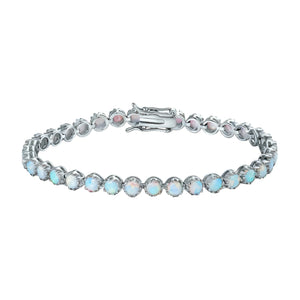
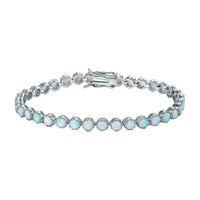
The piece they're describing → Rainbow Moonstone Tennis Bracelet for Women — Stainless Steel, Bezel Set, Gift Boxed with Message Card
Personalize Yours


