


By AJLuxe Team
Short answer: a "tennis bracelet" is a line bracelet, a flexible strand of stones set edge to edge in a continuous row, and it got that name after a professional tennis player's diamond bracelet broke and fell off her wrist during a U.S. Open match in the late 1970s. Play stopped while she looked for it, the story circulated, and by the mid-1980s the press had started calling that bracelet style a "tennis bracelet." The style itself is much older than the name. Here's the real timeline, and where the popular version of the story gets a little fuzzy.
Before "tennis bracelet": the eternity bracelet
The bracelet style existed for decades before it had anything to do with tennis. A continuous line of same-size stones, usually diamonds, set in a flexible strand meant to circle the wrist with no visual break, has been made since roughly the 1920s, when it was sold as an "eternity bracelet," a name that leaned on the unbroken circle of stones as a symbol of a relationship without end. That's the style a professional tennis player happened to be wearing on court decades later.
The moment: a diamond bracelet, a paused match, and a search
The incident most often credited with the name change happened during the U.S. Open, and it involves the American tennis star Chris Evert. According to her own publicist, Tami Starr, speaking in 2018, the bracelet actually broke and fell off during an early-round match in 1978, the tournament's first year at its Flushing Meadows venue, not in 1987 as the story is frequently retold. Starr's account: Evert was wearing a diamond and gold bracelet, it broke and fell onto the court, and officials had to stop play while she looked for it. It's worth being precise about what's solid here and what isn't: the broken-bracelet moment itself, and the pause in play, are well documented through Evert's own team's account. What's less certain is exactly how directly that specific 1978 match, which wasn't nationally televised and didn't generate contemporary press coverage tying it to a new bracelet name, drove the term into circulation, versus Evert's broader, highly visible association with diamond line bracelets throughout her career simply rubbing off on the style's name over time.
When "tennis bracelet" actually entered print
The name took a few years to catch on in writing. References to "tennis bracelet" as a term appear in newspapers by the mid-1980s. A December 1986 newspaper item described the bracelet as having been "born," and by the summer of 1987, major publications were covering the style under that name. That gap between the reported 1978 incident and the term's mid-1980s appearance in print is exactly why some retellings place the whole story in 1987 instead: 1987 is closer to when the name was actually everywhere, even though 1978 is the year the bracelet-breaking moment itself is said to have happened.
So which year is right, 1978 or 1987?
Both years show up because they mark two different things. 1978 is when Evert's team says the bracelet broke on court at the U.S. Open. 1987 is closer to when "tennis bracelet" became the name the jewelry industry and press were actually using in print, roughly a decade later. Most careful modern retellings, including Evert's own publicist's account, point to the earlier date for the incident itself, with the name catching on afterward rather than instantly.
What makes a bracelet a "tennis bracelet" today?
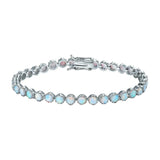
A tennis bracelet is a flexible line of same-size stones, traditionally diamonds, prong- or bezel-set edge to edge around a metal chain so the strand reads as one continuous line of sparkle rather than individual charms or links. The name has nothing to do with playing tennis today. It's simply the industry-standard term for this specific construction, whether the stones are diamonds, cubic zirconia, moissanite, or colored gemstones, and whatever the metal.
Frequently asked questions
Was the player's bracelet actually a "tennis bracelet" at the time it broke? No. At the time of the 1978 incident, the style was still generally called an eternity bracelet or simply a diamond line bracelet. The "tennis bracelet" name is something the style acquired afterward, once the story started circulating.
Did the player design or sell the bracelet style? No. The player was simply wearing a bracelet in that style when it broke; she didn't design it, and the incident is a naming origin story, not an endorsement or a product she created. We're intentionally not naming any specific jewelry brand or retailer tied to that bracelet here, since the point of this article is the name's history, not a product recommendation.
Is a tennis bracelet only made with diamonds? No, not anymore. The original style was diamond, but "tennis bracelet" today describes the construction, a continuous line of matched stones, not the specific gem. Modern versions use cubic zirconia, moissanite, sapphires, and other stones in the same line-set format.
Why did the "tennis" name stick instead of "eternity bracelet"? There's no single documented reason the newer name won out, but a vivid, retellable story, a bracelet falling off during a nationally recognizable sport, gave the style a catchier, more specific hook than the more generic "eternity bracelet," and that kind of story tends to spread faster in fashion press than a plain descriptive name.
A modern take on the style
The name's origin is a tennis-court story, but you don't need to play a single match to wear the look. AJLuxe's rainbow moonstone tennis bracelet follows the same continuous-line construction in bezel-set stones on stainless steel, and our guide to what a tennis bracelet actually means goes further into how people wear and gift the style today.
Sources
- Mental Floss, "Why Is It Called a 'Tennis Bracelet'?"
- Monica Rich Kosann Journal, "8 Things You Don't Know About Chris Evert and the Tennis Bracelet Story"
- Alex Cooper Auctioneers, "The (True) Origin of the Tennis Bracelet"
- Taylor & Hart, "A Brief History of Tennis Bracelets"
All third-party trademarks, brand names and product names are the property of their respective owners. AJLuxe is not affiliated with, endorsed by, sponsored by, or otherwise connected to any third-party brand referenced in this article. Brand names are used solely for accurate comparative reference, and material descriptions reflect each brand's own published product specifications at the time of writing.
You Might Also Like
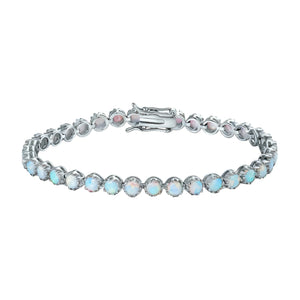
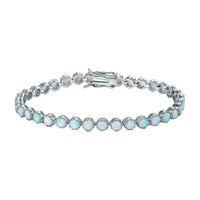
The piece they're describing → Rainbow Moonstone Tennis Bracelet for Women — Stainless Steel, Bezel Set, Gift Boxed with Message Card
Personalize Yours


