



TL;DR — Moissanite vs Cubic Zirconia: The Verdict
- Daily wear jewelry: Moissanite wins. It's harder (Mohs 9.25 vs 8–8.5), doesn't cloud, and stays brilliant for decades.
- Fashion / travel / costume jewelry: CZ is fine. If you'd be upset losing it, CZ is the right call — it's far cheaper.
- CZ clouds within 2–5 years of daily wear. Moissanite never clouds.
- Sparkle type: CZ = whiter, more diamond-like. Moissanite = more rainbow fire. Neither is objectively better — it's personal preference.
- Price: CZ stone costs pennies. Moissanite costs $300–600/ct. But finished jewelry price is closer than you'd expect, since metal setting dominates cost.
They both sparkle. They both come from a lab. But if you buy CZ expecting it to look good in five years, you'll be disappointed.
Cubic zirconia and moissanite look similar in a jewelry store display. Side by side in good lighting, most people can't tell them apart from a manned distance. The difference shows up later — in daily wear, in durability, in whether the stone still sparkles the same way after two years of regular use.
Here's the honest comparison, with no spin in either direction.
What Are Moissanite and Cubic Zirconia?
Cubic zirconia (CZ) is zirconium oxide (ZrO₂). It was developed in the Soviet Union in the 1970s as a synthetic diamond alternative and has been used in jewelry ever since. The raw material is extremely inexpensive — a CZ stone costs a few cents to a few dollars to produce.
Moissanite is silicon carbide (SiC). It was discovered in a meteorite in 1893 by Henri Moissan and is lab-grown for jewelry use. All commercial moissanite comes from a lab, perfected in the 1990s by Charles & Colvard. It costs $300–600 per carat, putting it in a different price tier than CZ but still a fraction of natural diamond pricing.
Both are entirely lab-created. Neither is mined. Neither is a natural stone. The difference is what they're made of, and how those materials perform under the conditions of everyday life.
Moissanite vs Cubic Zirconia: Full Comparison
| Property | Moissanite | Cubic Zirconia (CZ) |
|---|---|---|
| Chemical composition | Silicon carbide (SiC) | Zirconium oxide (ZrO₂) |
| Mohs hardness | 9.25 | 8–8.5 |
| Scratch resistance | Excellent — won't scratch from daily wear | Good, but dulls over years of daily contact |
| Refractive index | 2.65–2.69 | 2.15–2.18 |
| Fire / light dispersion | 0.104 — vivid rainbow flashes | 0.060 — more white sparkle |
| Clouds over time | No | Yes — within 2–5 years of daily wear |
| Density | 3.21 g/cm³ (close to diamond) | 5.6–6.0 g/cm³ (heavier) |
| Stone price | $300–600/ct | $5–50 (cents to a few dollars for loose) |
| Origin | Lab-grown (meteorite discovery 1893) | Lab-grown (synthesized 1970s) |
| Durability rating | Permanent fine gemstone | Fashion / disposable (2–5 year look) |
| Best for | Fine jewelry, daily wear, long-term pieces | Fashion jewelry, travel, pieces you'll replace |
For independent gemological standards on both materials, see the Gemological Institute of America (GIA).
The Durability Gap — Why CZ Clouds and Moissanite Doesn't
This is the most important section. The durability difference between moissanite and CZ is significant — and most buyers don't find out about it until it's too late.
CZ has a Mohs hardness of 8–8.5. That sounds solid, but Mohs hardness is a measure of scratch resistance — and the scale is logarithmic. The gap between 8.5 and 9.25 is larger than the numbers suggest. Over time, everyday contact with surfaces, skin, clothing, and environmental particles creates micro-abrasions on the surface of CZ. Those micro-abrasions scatter light instead of refracting it cleanly, causing CZ to appear hazy or "fogged."
This process takes 2–5 years of daily wear to become noticeable. For occasional wear (a few times a year), CZ looks fine indefinitely. But for rings, necklaces, or bracelets worn every day, CZ will inevitably lose its brilliance. You can't fully restore it — cleaning removes surface dirt, not micro-scratches.
Moissanite at Mohs 9.25 doesn't have this problem. The only thing hard enough to scratch moissanite is diamond itself (Mohs 10). Normal daily wear doesn't touch it. A moissanite set in a necklace today will look identical in 15 years — same fire, same brilliance, no fogging.
There's also a weight difference worth knowing. CZ is significantly denser than diamond or moissanite — 5.6–6.0 g/cm³ vs moissanite's 3.21 and diamond's 3.52. A CZ in the same setting as a diamond or moissanite will feel noticeably heavier. Experienced jewelers can detect this immediately.

Sparkle Comparison: Different, Not Better or Worse
CZ and moissanite sparkle differently — and which one you prefer is genuinely a matter of taste.
CZ sparkle: CZ has a refractive index of 2.15–2.18 and a fire dispersion of 0.060. This gives it a white, bright flash that closely resembles diamond. If you want a stone that looks most like a diamond's clean white sparkle, CZ actually does a better job than moissanite in this specific area. It's less flashy, more restrained.
Moissanite sparkle: Moissanite has a refractive index of 2.65–2.69 and a fire dispersion of 0.104 — more than double diamond's 0.044. In direct light or sunlight, moissanite throws vivid rainbow flashes. Some people love this. Others find it too flashy compared to diamond. Moissanite is also doubly refractive (birefringent), meaning light bends twice through the stone — contributing to its distinctive fire but creating a slight "doubling" of facets visible under magnification.
If you're trying to replicate a diamond's look as closely as possible, CZ is actually the better visual match — at the cost of durability. If you want maximum brilliance and fire and don't care about perfect diamond mimicry, moissanite is the clear choice. Our moissanite vs. diamond ring guide breaks down that comparison against diamond specifically.
Price Comparison: Stone Price vs Jewelry Price
The raw stone price difference between CZ and moissanite is enormous. A CZ stone costs cents to a few dollars. A moissanite stone costs $300–600 per carat. That gap sounds decisive until you realize how finished jewelry is actually priced.
In a sterling silver or gold-plated necklace, the setting — the metalwork, design, and labor — accounts for the majority of the price. A 6.5mm CZ in a sterling silver pendant might cost $20–40. A 6.5mm moissanite in the same setting might cost $80–150. The ratio narrows dramatically when you factor in the setting cost.
For pieces where you're spending $200+ on the setting itself, the stone price premium for moissanite becomes proportionally smaller. At that price point, upgrading to moissanite for permanent brilliance is usually worth it.
For fashion jewelry under $30 — pieces you'd wear a season and replace — CZ makes economic sense. There's no reason to put a $300 stone in a $15 setting you'll tire of in six months.
When Should You Choose Cubic Zirconia?
CZ gets unfairly dismissed as junk. There are legitimate situations where it's the smarter choice:
- Travel jewelry: Don't want to risk losing a valuable stone? CZ lets you wear something sparkly on vacation without the anxiety.
- Fashion / trend pieces: If you're wearing a design you'll replace in 12 months anyway, there's no point paying for a permanent stone.
- Children's jewelry: Kids outgrow jewelry quickly. CZ is perfectly fine for pieces that won't be worn long-term.
- Very low budgets: Sometimes the priority is sparkle at a specific price point. CZ delivers that.
- Occasional wear: CZ's fogging problem is a daily-wear issue. A ring or necklace worn a few times a year will hold up for a long time.
The key word is "disposable." If you're buying jewelry you might replace, lose, or stop wearing within a few years, CZ is an honest and practical choice.
When Should You Choose Moissanite?
Moissanite is the right choice when you want a gemstone that lasts as long as the piece it's set in:
- Daily wear necklaces, rings, bracelets: Anything worn every day needs a stone that won't dull. Moissanite qualifies. CZ doesn't.
- Engagement rings or anniversary pieces: If the piece carries emotional weight, it deserves a stone that won't let it down visually in year three.
- Heirloom gifts: A piece you're giving with the intent of lasting decades needs moissanite, not CZ.
- High-quality settings: A beautiful sterling silver or 18K gold-plated setting deserves a stone that won't look worse than the metal in five years.
- Lab-grown, conflict-free priority: Moissanite is an ethical, sustainable choice — no mining, consistent quality, no ethical ambiguity.
What About Sterling Silver Settings?
Sterling silver is one of the most popular settings for both CZ and moissanite. AJLuxe pieces use 925 sterling silver as the base metal with 18K gold plating — a combination that gives you warmth, durability, and hypoallergenic properties.
The issue with CZ in a sterling silver setting: the setting itself will outlast the stone's optical performance. Sterling silver, properly cared for, lasts decades. A CZ set in sterling silver will fog and dull long before the setting shows significant wear. You end up with a beautiful setting holding a stone that no longer looks its best.
Moissanite in a sterling silver setting is a permanent match — both the stone and the metal age well with normal care. The investment in a quality setting makes more sense when the stone inside will still be brilliant in 20 years.
For pieces in our gemstone necklace collection, we use lab-created stones that hold their brilliance long-term. No CZ fogging risk — the stone you buy is the stone you'll still have.
Related Reading
- What Is Moissanite? The Complete Guide
- Moissanite vs Diamond — Full Comparison
- Lab Diamond vs Moissanite — Key Differences
- Moissanite vs White Sapphire — Which Should You Choose?
- Is Moissanite Worth It? Honest Review
- Shop Gemstone Necklaces →
- Shop Crystal Jewelry →
Related reading: Cubic zirconia vs diamond.
Related reading: Cubic zirconia vs zirconium.
Related reading: Is cubic zirconia real.
Related reading: Is cubic zirconia hypoallergenic.
Related reading: How to clean cubic zirconia jewelry.
Related reading: Moissanite vs Cubic Zirconia: Which Actually Holds Up to Daily Wear? (2026).
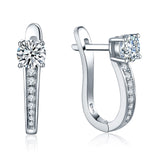
Shop AJLuxe Moissanite Hoop Earrings
925 sterling silver hoops set with lab-created CZ in a hinge-and-latch closure — nickel-free, unplated, 18.5mm.
Shop the Moissanite Hoop Earrings →Frequently Asked Questions: Moissanite vs Cubic Zirconia
Is CZ the same as moissanite?
No. CZ (cubic zirconia) is zirconium oxide (ZrO₂). Moissanite is silicon carbide (SiC). They have different chemical compositions, different hardness levels, different refractive indices, and different long-term durability. CZ clouds over years of daily wear; moissanite does not. They look similar in a display case but perform very differently over time.
Does moissanite look fake?
Moissanite doesn't look fake — it looks like a very sparkly gemstone. Its fire (rainbow light dispersion) is actually more vivid than diamond, which can look different from the diamond some people expect. If someone is looking for a stone that exactly replicates diamond's restrained white sparkle, CZ is closer. But moissanite's brilliance is genuinely impressive and doesn't look cheap or artificial — it looks like a premium gemstone, because it is one.
Does CZ get cloudy?
Yes. CZ loses its brilliance with daily wear over time, typically becoming noticeably hazy within 2–5 years. This happens because its Mohs hardness of 8–8.5 allows micro-abrasions to build up on the surface, scattering light instead of refracting it. Cleaning can remove surface oils and dirt but cannot reverse scratch-related fogging.
Can you clean CZ to restore its sparkle?
Cleaning CZ with soap and water or ultrasonic cleaners removes surface oils and dirt, which helps. But if the CZ has developed a foggy appearance from micro-abrasions due to years of wear, cleaning won't restore it — that haziness is structural, not just surface grime. The only fix is replacing the stone.
Is moissanite better than CZ for an engagement ring?
Yes, significantly. An engagement ring is worn daily for years or decades. CZ will dull and look hazy within 2–5 years of that kind of wear. Moissanite at Mohs 9.25 holds its brilliance permanently. For any ring worn every day long-term, moissanite is the obvious choice over CZ.
Which looks more like a diamond — CZ or moissanite?
CZ is actually a closer visual match to diamond's white sparkle. CZ's lower refractive index (2.15–2.18) produces a more restrained, white flash — similar to diamond's (2.42). Moissanite's higher refractive index (2.65–2.69) creates more vivid rainbow fire, which looks spectacular but is noticeably different from diamond. If the goal is to replicate diamond's exact look, CZ wins on sparkle style — but moissanite wins on durability by a wide margin.
Is moissanite worth the extra cost over CZ?
For fine jewelry you'll wear regularly: yes. Moissanite doesn't cloud, doesn't scratch from daily wear, and holds its brilliance indefinitely. CZ will need replacing within a few years of daily use. The upfront cost premium for moissanite is justified for pieces you'll wear for more than 2–3 years. For fashion jewelry or occasional wear, CZ's lower cost makes sense.
Can jewelers tell the difference between CZ and moissanite?
Yes. Jewelers can distinguish CZ from moissanite using a standard gem tester, visual inspection of the fire pattern, and by weight (CZ is significantly heavier due to its higher density). CZ is also noticeably softer under a loupe over time. At the point of purchase in a store display, both look similar — the differences become more apparent after extended wear.
Does moissanite scratch?
Not with normal daily wear. Moissanite's Mohs hardness of 9.25 means only diamond (Mohs 10) can scratch it under normal conditions. Environmental dust, countertops, fabric, and everyday contact won't mark it. This is a major practical advantage over CZ, which will show wear-related dulling over years of regular use.
What lasts longer — moissanite or CZ?
Moissanite lasts indefinitely with normal care. CZ's optical performance degrades with daily wear, typically becoming noticeably dull within 2–5 years. For pieces worn regularly, moissanite's permanence is a clear advantage. CZ is appropriate for occasional-wear or fashion jewelry where longevity isn't the priority.
Is there a big price difference between CZ and moissanite jewelry?
The stone price difference is large — CZ costs pennies, moissanite costs $300–600/ct. But in finished jewelry, the setting (metalwork, design, labor) makes up a significant portion of the total price. A moissanite necklace in a sterling silver setting might be $80–150 vs $20–40 for CZ in the same setting — a meaningful but not shocking difference when you're getting a permanently brilliant stone.
The Bottom Line: Moissanite vs Cubic Zirconia
The choice is simpler than it looks. CZ is disposable sparkle — beautiful for a few years, dull after that. Moissanite is permanent sparkle — the same brilliance in year one and year fifteen.
If you're building a jewelry collection with pieces you'll wear for years, reach for moissanite. If you want something sparkly for a trip, a season, or a look you'll rotate out, CZ is the rational choice and there's nothing wrong with it.
Both are lab-grown. Both are conflict-free. The difference is what happens after you take them home.
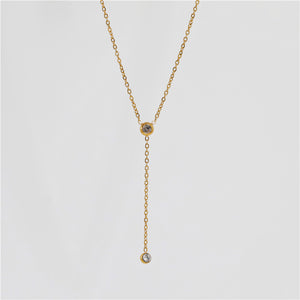
Shop AJLuxe Gemstone Necklaces
Our sterling silver and 18K gold-plated gemstone necklaces use lab-created stones built to last — no CZ fogging, no dulling over time. Brilliant on day one, brilliant in year ten.
Shop Gemstone Necklaces → What Is Moissanite? The Complete Guide
Related reading: how the two specifically hold up under daily wear, hardness numbers included.
Written by the AJLuxe team — specialists in personalized sterling silver jewelry. Last updated: June 2026.
All third-party trademarks, brand names and product names are the property of their respective owners. AJLuxe is not affiliated with, endorsed by, sponsored by, or otherwise connected to any third-party brand referenced in this article. Brand names are used solely for accurate comparative reference, and material descriptions reflect each brand's own published product specifications at the time of writing.
You Might Also Like
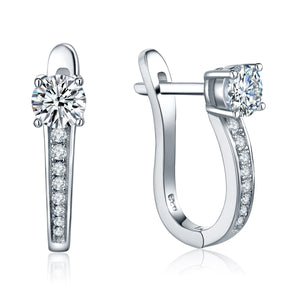
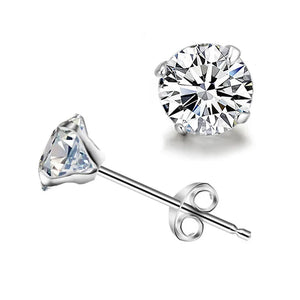
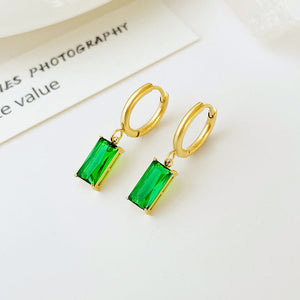
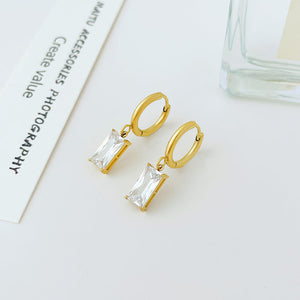
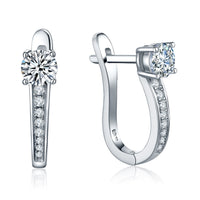
The piece they're describing → Moissanite Hoop Earrings for Women — 925 Sterling Silver, CZ, Hypoallergenic
Personalize Yours


