



TL;DR — What Is Moissanite?
- Moissanite = silicon carbide (SiC) — not carbon (diamond) and not glass (CZ). It's its own gemstone.
- Originally found in a meteorite in 1893. All commercial moissanite today is lab-grown.
- Mohs 9.25 — second only to diamond (10). Harder than sapphire, ruby, and emerald. Won't scratch with normal wear.
- More fire than diamond — its refractive index (2.65–2.69) beats diamond (2.42), giving it more rainbow light dispersion.
- Price: $300–600/carat vs $3,000–15,000/ct for natural diamond. Same visual impact at a fraction of the cost.
Most people have never heard of moissanite. Fewer still know it came from space.
In 1893, Nobel Prize-winning chemist Henri Moissan found microscopic crystals inside a meteorite crater in Diablo Canyon, Arizona. He thought they were diamonds. They weren't. They were something entirely new — silicon carbide, a gemstone that had never been seen on Earth before.
Today, that same material is lab-grown and cut into some of the most dazzling gemstones available at any price point. Here's everything you need to know about what moissanite actually is, how it's made, and whether it's right for you.
What Is Moissanite?
Moissanite is a gemstone made of silicon carbide (SiC). That puts it in a completely different chemical category from diamond (pure carbon) and cubic zirconia (zirconium oxide). It's not a simulant made to mimic another stone — it's its own mineral with its own properties.
Naturally occurring moissanite is extraordinarily rare. It exists in tiny trace amounts inside some meteorites and in certain rock formations, but not in quantities large enough to cut into jewelry. Every moissanite gemstone you'll find in a jewelry store is lab-created.
The discovery credit belongs to Henri Moissan, who found the crystals in a Canyon Diablo meteorite in Arizona in 1893. He initially misidentified them as diamonds. Later analysis revealed the silicon carbide composition, and the mineral was named moissanite in his honor. Moissan went on to win the Nobel Prize in Chemistry in 1906 — not for moissanite, but the discovery stands as one of his most famous contributions to science.
How Is Moissanite Made?
The process of growing gem-quality moissanite was perfected in the 1990s by the company Charles & Colvard, which held the original patent. Today, multiple manufacturers produce lab-grown moissanite using a thermal growing process.
Raw silicon and carbon are combined under intense heat and pressure to form silicon carbide crystals. The process takes several months to grow a crystal large enough to cut. Those crystals are then faceted using the same cutting techniques used for diamonds — brilliant cuts, cushion cuts, oval cuts, and more.
The lab-grown origin isn't a flaw. It means moissanite is consistent, conflict-free, and environmentally responsible. Unlike mined diamonds, it doesn't require excavating the earth. And unlike natural moissanite (which barely exists), lab-grown moissanite is actually available to buy.
Moissanite Properties at a Glance
| Property | Moissanite | Diamond | Cubic Zirconia |
|---|---|---|---|
| Chemical composition | Silicon carbide (SiC) | Carbon (C) | Zirconium oxide (ZrO₂) |
| Mohs hardness | 9.25 | 10 (hardest) | 8–8.5 |
| Refractive index | 2.65–2.69 | 2.42 | 2.15–2.18 |
| Fire (light dispersion) | 0.104 (highest) | 0.044 | 0.060 |
| Origin | Lab-grown (SiC crystal) | Mined or lab-grown | Lab-grown |
| Clouds or fades over time | No | No | Yes (dulls within years) |
| Price per carat | $300–600 | $3,000–15,000+ | $5–50 |
For gemological standards and grading benchmarks, see the Gemological Institute of America (GIA).

What Does Moissanite Look Like?
Moissanite is colorless to near-colorless and outsparkles diamond in most lighting conditions. Its refractive index of 2.65–2.69 is higher than diamond's 2.42, which means it bends light more aggressively — producing more "fire," the colored rainbow flashes that make a gemstone pop under light.
In direct sunlight or under a spotlight, moissanite throws vivid rainbow reflections. In softer, diffuse light, it shows brilliant white flashes. Some people love this quality. Others prefer diamond's slightly more restrained sparkle. Neither is wrong — it's a matter of personal taste.
Moissanite is also doubly refractive (birefringent). This means it bends light twice as it passes through the stone, versus diamond's single refraction. The practical effect: under 10x magnification, you can sometimes see a slight "doubling" of the facet edges inside the stone. In person and at normal viewing distance, this isn't visible.
Color grades: DEF-grade moissanite is colorless — indistinguishable from a colorless diamond to the naked eye. GH-grade moissanite has a slight warm or yellow tint, visible in certain settings and lighting. For white gold or platinum settings, DEF is recommended. For yellow gold, GH works fine and costs less.
Is Moissanite a Real Gemstone?
Yes. Moissanite is a real gemstone — it's just not a diamond. The "fake diamond" label is a misconception that frustrates gemologists.
A simulant is a stone sold as something it isn't. CZ sold in a diamond setting without disclosure is a simulant. But moissanite sold as moissanite is its own legitimate gemstone with a unique chemical composition, physical properties, and history. Calling it fake is like calling an emerald a fake ruby because they're both green and red gemstones, respectively.
Moissanite has a Mohs hardness of 9.25 — harder than sapphire (9), ruby (9), emerald (7.5), and every other natural gemstone except diamond. It's a permanent stone that won't scratch, cloud, or fade. By every measure that matters for jewelry, it behaves like a fine gemstone should.
Moissanite vs Diamond: Quick Decision Guide
| Choose Moissanite If... | Choose Diamond If... |
|---|---|
| You want maximum sparkle and fire for the price | You want a natural gemstone with resale value |
| Budget is a priority — same look at 10–20% of diamond cost | The symbolism of a natural mined stone matters to you |
| You want a conflict-free, eco-responsible stone | You plan to insure and pass the piece down as an heirloom with monetary value |
| You love colorful rainbow fire sparkle | You prefer a slightly more restrained, "icy" white sparkle |
| You want a permanently durable gemstone (not CZ) | Certification by GIA or AGS matters for the specific purchase |
How to Buy Moissanite
Here's what to look for when you're ready to buy:
Color grade: DEF (colorless) or GH (near-colorless). DEF is the premium option — completely colorless, ideal for white metals. GH shows a slight warm tint that's unnoticeable in yellow gold but can be visible in platinum or white gold settings. For most buyers, DEF is worth the modest premium.
Shape and birefringence: Round brilliant cuts minimize the visual effect of double refraction. Elongated shapes (oval, marquise, pear) can make the doubling effect slightly more visible under magnification. In person at normal distance, it's rarely noticeable regardless of shape.
Certification: Reputable moissanite comes with a certificate from the manufacturer (Charles & Colvard, Forever One, etc.). It won't be a GIA certificate — GIA grades diamonds, not moissanite — but a manufacturer's certificate confirms the stone's specifications.
Carat vs millimeter: Moissanite is sold in millimeter size, not carat weight, because its density (3.21 g/cm³) differs from diamond (3.52 g/cm³). A 6.5mm round moissanite looks the same as a 1-carat diamond but weighs slightly less. When comparing sizes, use mm dimensions, not carat weights.
Related Reading
- Moissanite vs Cubic Zirconia — Which Is Better?
- Moissanite vs Diamond — Full Comparison
- Lab Diamond vs Moissanite — Key Differences
- Moissanite Meaning and Symbolism
- Is Moissanite Worth It? Honest Review
- Shop Gemstone Necklaces →
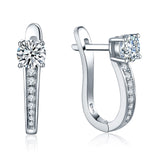
Shop AJLuxe Moissanite Hoop Earrings
925 sterling silver hoops set with lab-created CZ in a hinge-and-latch closure — nickel-free, unplated, 18.5mm.
Shop the Moissanite Hoop Earrings →Frequently Asked Questions: What Is Moissanite?
Is moissanite a fake diamond?
No. Moissanite is its own gemstone — silicon carbide (SiC) — with a different chemical composition, refractive index, and fire compared to diamond. It's not sold as a diamond. Calling moissanite a "fake diamond" is like calling an emerald a fake ruby. It's simply a different stone.
Does moissanite get cloudy over time?
No. Moissanite does not cloud, fog, or fade with wear. This is one of its key advantages over cubic zirconia, which dulls and becomes hazy within a few years of daily wear. A moissanite's brilliance is permanent — it will look the same in 20 years as it does today with normal cleaning.
Will moissanite pass a diamond tester?
Older diamond testers that measure thermal conductivity will read moissanite as diamond, because moissanite conducts heat similarly to diamond. Modern multi-tester devices that also measure electrical conductivity will correctly distinguish moissanite from diamond — moissanite is a semiconductor and conducts electricity, while diamond does not.
Does moissanite scratch?
No, not with normal daily wear. Moissanite has a Mohs hardness of 9.25 — second only to diamond (10). The only common material hard enough to scratch moissanite is diamond itself. Environmental dust (quartz, Mohs 7) and most everyday surfaces won't scratch it.
Is moissanite worth buying?
Yes — if you want a durable, brilliant gemstone without paying diamond prices. Moissanite costs 90–95% less than a comparable natural diamond, has more fire and brilliance, is conflict-free, and is permanent. The trade-off: it has no resale value, and some buyers still prefer the cultural status of a natural diamond for engagement rings.
Is moissanite better than cubic zirconia?
For any jewelry you plan to wear regularly, yes. Moissanite (Mohs 9.25) is significantly harder than CZ (Mohs 8–8.5) and doesn't cloud or dull over time. CZ loses its brilliance within 2–5 years of daily wear; moissanite does not. CZ is much cheaper for the raw stone, but for a piece you'll keep long-term, moissanite is the better investment.
What color moissanite is best?
DEF (colorless) is the premium choice and looks completely clear in any setting. GH (near-colorless) has a slight warm tint — barely noticeable in yellow gold but more visible in white gold or platinum. For most buyers, DEF moissanite in any setting gives the cleanest look.
Where does moissanite come from originally?
Moissanite was first discovered in 1893 by Nobel Prize chemist Henri Moissan inside a meteorite crater in Diablo Canyon, Arizona. Natural moissanite is almost exclusively found in meteorites and certain high-temperature rock formations, making it rarer than diamond in nature. All commercial moissanite today is lab-grown.
Can you wear moissanite every day?
Yes. Moissanite's Mohs hardness of 9.25 makes it one of the most durable gemstones available for daily wear. It won't scratch from normal activities, won't cloud, and doesn't require special maintenance beyond occasional cleaning with mild soap and water.
How big is a 1-carat moissanite?
Moissanite is lighter than diamond — its density is 3.21 g/cm³ vs diamond's 3.52 g/cm³. A 1-carat moissanite is approximately 6.5mm in diameter, which looks identical to a 1-carat diamond (also ~6.5mm). When shopping, use millimeter size rather than carat weight to get an accurate size comparison.
Does moissanite sparkle more than diamond?
Yes, moissanite has more fire (colored light dispersion) than diamond. Its fire dispersion rating is 0.104, compared to diamond's 0.044. In bright light or sunshine, moissanite throws more visible rainbow flashes. For overall white brilliance, diamond and moissanite are comparable — the difference is in the type of sparkle, not the amount.
The Bottom Line: What Is Moissanite?
Moissanite is a lab-grown silicon carbide gemstone with a meteorite origin story, a Mohs hardness of 9.25, and more fire than diamond at a fraction of the price. It's not a diamond simulant — it's its own permanent, durable gemstone with unique optical properties.
If you want brilliant sparkle that lasts a lifetime without the natural diamond price tag, moissanite delivers. If the cultural significance of a mined diamond matters to you, that's a valid reason to choose differently. Both are real answers.
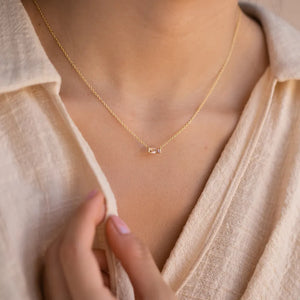
Shop AJLuxe Gemstone Necklaces
Our sterling silver and 18K gold-plated gemstone necklaces feature lab-created stones set to last. No CZ — no clouding, no fogging, just permanent brilliance.
Shop Gemstone Necklaces → Moissanite vs CZ — Which Is Better?
Written by the AJLuxe team — specialists in personalized sterling silver jewelry. Last updated: June 2026.
All third-party trademarks, brand names and product names are the property of their respective owners. AJLuxe is not affiliated with, endorsed by, sponsored by, or otherwise connected to any third-party brand referenced in this article. Brand names are used solely for accurate comparative reference, and material descriptions reflect each brand's own published product specifications at the time of writing.
You Might Also Like
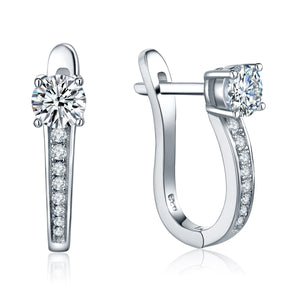

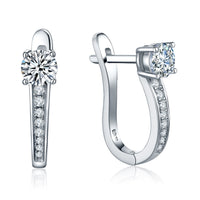
The piece they're describing → Moissanite Hoop Earrings for Women — 925 Sterling Silver, CZ, Hypoallergenic
Personalize Yours


