



The short answer
If you want maximum sparkle and the closest visual match to a diamond at the lowest price, choose moissanite — it has more fire than diamond itself and costs roughly $300–$600 per carat-equivalent. If you want a genuine natural gemstone with a softer, more "old-money" glow and don't mind less flash, choose white sapphire — natural stones run $400–$1,200 per carat, lab-created sapphire is closer to $50–$150. Both are hard enough for an engagement ring worn every day; cubic zirconia is the only one of the three that isn't.
Moissanite vs. white sapphire is the comparison people land on after they've already ruled out a mined diamond on price, and it's a genuinely close call — unlike moissanite vs. cubic zirconia, where one option is simply better. Both moissanite and white sapphire are hard enough for daily wear, both are widely available as lab-created stones, and both get pitched by different retailers as "the smart diamond alternative." The right answer depends on whether you're optimizing for sparkle or for subtlety, and almost no comparison guide is honest about that trade-off — most either sell you on one stone or bury the actual differences under affiliate links.
This guide breaks down moissanite vs. white sapphire on hardness, brilliance and fire, color, price per carat, and durability, with real numbers instead of marketing language. We'll also cover where each stone lands next to diamond and cubic zirconia, since most people shopping this comparison are really deciding among four options, not two.

Hardness and durability: Mohs scale compared
Durability is the one category where the two stones are nearly tied, and both comfortably beat cubic zirconia. The Mohs hardness scale measures scratch resistance on a 1–10 range, where diamond sits at a perfect 10.
| Stone | Mohs hardness | Everyday-wear verdict |
|---|---|---|
| Diamond | 10 | Hardest natural substance, effectively scratch-proof |
| Moissanite | 9.25 | Excellent — safe for rings worn daily, including manual work |
| White sapphire | 9 | Excellent — same family as ruby, second-hardest natural gem |
| Cubic zirconia | 8–8.5 | Fair — scratches and dulls within one to two years of daily wear |
A quarter-point difference on the Mohs scale (9.25 vs. 9) sounds significant but isn't, in practice — the scale is logarithmic, not linear, so the real-world gap between moissanite and white sapphire is small. Both will hold up to normal daily wear, gym trips, and housework for decades without needing replacement, which is more than can be said for cubic zirconia. Where the two do differ slightly: moissanite has no cleavage plane, meaning it resists chipping under a direct hard impact better than sapphire, which — like most corundum gems — can chip if struck at exactly the wrong angle on a hard edge.
Brilliance and fire: why moissanite out-sparkles sapphire
This is the category with the biggest practical difference between the two stones, and it comes down to refractive index — the physical property that determines how much a gem bends and scatters light.
| Stone | Refractive index | Visual character |
|---|---|---|
| Moissanite | 2.65–2.69 | Highest of the four — visible rainbow "fire," more flash than diamond |
| Diamond | 2.42 | Bright white sparkle, restrained "quiet luxury" flash |
| Cubic zirconia | 2.15–2.18 | Noticeably flashier than sapphire but reads as "glassy" up close |
| White sapphire | 1.76–1.77 | Softest sparkle of the four — subtle satin-like shine, not much fire |
In direct comparison, moissanite reads as noticeably sparklier than a diamond of the same size — it's actually the flashier stone of the pair, not diamond. White sapphire sits at the opposite end: its low refractive index means it doesn't throw much rainbow fire at all, which is exactly why some buyers choose it. A sapphire's shine looks closer to a soft, milky shimmer than a hard sparkle, and jewelers sometimes describe it as looking "more like a real diamond that's been worn for fifty years" — muted, not showy. If you want maximum sparkle, moissanite wins clearly. If you want something that photographs and reads as understated rather than flashy, white sapphire is the better pick — a preference this comparison covers in more depth in our full moissanite vs. diamond guide.

Color: the honesty gap most sellers skip
"White" sapphire is rarely perfectly colorless. Natural white sapphire corundum almost always carries a faint gray, yellow, or slightly green undertone unless it's been heat-treated — and even heat-treated stones can show a whisper of warmth under certain lighting that a jeweler's trained eye will catch. Lab-created white sapphire is more consistently colorless, but it's also chemically simpler (usually pure corundum with no trace elements), which some gemologists say strips away the subtle depth that makes natural sapphire attractive in the first place.
Moissanite has its own honesty gap: older or lower-grade moissanite can carry a faint yellow-green or gray tint, especially in larger stones over 1 carat-equivalent, though gem-quality D-E-F color-graded moissanite from a reputable supplier is genuinely close to colorless in normal lighting. The practical takeaway for either stone: buy from a seller who states the color grade explicitly (D-E-F for moissanite, or "colorless"/"near-colorless" for sapphire) rather than one who just says "white" — that word alone tells you nothing about how the stone will actually look on your hand.
Price per carat: moissanite vs. white sapphire vs. diamond
Price is where moissanite's advantage is clearest, and it's also where the "moissanite vs diamond price" comparison people search for separately gets most interesting — moissanite isn't just cheaper than diamond, it's cheaper than natural white sapphire too.
| Stone | Typical price per carat |
|---|---|
| Natural diamond | $4,500–$8,000+ |
| Lab-grown diamond | $800–$1,800 |
| Natural white sapphire | $400–$1,200 |
| Moissanite | $300–$600 |
| Lab-created white sapphire | $50–$150 |
| Cubic zirconia | Under $50 |
Moissanite is priced by millimeter size rather than carat weight, since it's not sold by traditional carat grading the way diamond and sapphire are — but sellers typically list a "carat equivalent" for comparison shopping. For the full breakdown of what that means and how to shop moissanite by size instead of carat, see our dedicated moissanite vs. diamond price and sizing guide. Lab-created white sapphire is the sleeper value pick in this whole comparison — it's a genuine corundum gemstone (same mineral family as ruby) at a price closer to cubic zirconia than to moissanite, though it won't have moissanite's brilliance.
Lab-created vs. natural: sourcing honesty
This is a gap almost every retailer comparison glosses over. Moissanite sold today is essentially always lab-created — natural moissanite exists only in microscopic, non-gem-quality quantities from meteorite sites, so any "natural moissanite" claim online should be treated as marketing, not fact. There's no ethical sourcing debate with moissanite because there's effectively no natural supply chain to source from.
White sapphire is different: it exists in real, mined quantities, so buyers genuinely choose between natural and lab-created stones. Natural white sapphire is mined in Sri Lanka, Madagascar, and Australia, among other locations, and pricing and sourcing transparency vary a lot by seller — ask for a country of origin and treatment disclosure (most sapphire is heat-treated to improve color and clarity, which is standard industry practice and doesn't need to be disclosed as a defect, just disclosed). Lab-created white sapphire is chemically identical corundum grown in a lab, at a fraction of the cost, with zero mining-related sourcing questions. If natural-stone provenance matters to you, sapphire is the only one of the two stones where that's even a relevant question to ask.
Which should you choose: moissanite or white sapphire?
Choose moissanite if:
- You want the closest visual match to a diamond's brilliance, or more sparkle than an actual diamond
- Budget is the primary driver and you want the best sparkle-per-dollar of any diamond alternative
- You're comfortable with a lab-created stone and don't need "natural mineral" provenance
Choose white sapphire if:
- You prefer a soft, understated shine over maximum sparkle
- You want a genuine natural gemstone (or a lab-created version of one) rather than a diamond simulant
- You like the idea of a stone from the same mineral family as sapphire and ruby, with centuries of gemological history behind it
For rings specifically, both stones perform well in a protective setting like a bezel or halo — see our white gold vs. platinum guide for how metal choice affects durability alongside stone choice, since a soft metal band can undermine even the hardest center stone. If you're set on genuine sapphire rather than choosing between it and moissanite, our full sapphire buying guide covers color grading, treatments, and origin in more depth. And if you already own sapphire jewelry, our guides to sapphire's meaning and healing properties and sapphire's zodiac associations cover the symbolic side of the stone.
Care and maintenance for both stones
Both stones are low-maintenance relative to cubic zirconia, but they aren't identical. Moissanite can be cleaned with warm water, mild dish soap, and a soft brush, and it's generally safe in an ultrasonic cleaner given its hardness and lack of cleavage plane. White sapphire tolerates the same basic cleaning method, but ultrasonic cleaners carry slightly more risk if the stone has internal fractures (common in some natural sapphire) — a soft brush and warm soapy water is the safer default for natural stones specifically.
Neither stone needs the periodic re-plating that gold-vermeil or gold-plated settings sometimes require. If your setting is white gold rather than platinum or sterling silver, keep in mind that white gold's bright white finish comes from rhodium plating, which wears down over years and can make a colorless stone look slightly warmer by contrast — see our guide on why white gold turns yellow and how to fix it if you notice your setting (not the stone) shifting color over time.
Resale value: a category neither stone wins
Neither moissanite nor white sapphire holds significant resale value, and this is worth stating plainly rather than dancing around it the way some retailers do. Both stones are typically sold at a markup similar to any manufactured jewelry item, and the secondary market for loose moissanite or lab-created sapphire is thin — you're unlikely to recoup more than a small fraction of the purchase price if you resell. Natural white sapphire fares slightly better if it's a larger, well-documented stone with a grading report, since natural gemstone material does have an independent secondary market, but a small natural sapphire in a mass-market setting won't behave meaningfully differently from moissanite here.
Practically, this means the "moissanite vs diamond price" comparison people often make isn't really about resale — diamond doesn't hold much resale value either, contrary to popular belief, typically losing thirty to fifty percent of retail value the moment it leaves the store. If your decision is being driven by investment logic, none of these three stones — moissanite, white sapphire, or diamond — is the right vehicle. Buy for how the stone looks and wears, not for future resale.
See also: Cubic Zirconia vs White Sapphire: Which Should You Buy?.
For the full worth-it verdict, see: Is Moissanite Worth It? Honest Review.
Frequently asked questions
Is moissanite better than white sapphire?
Neither is objectively "better" — moissanite has more brilliance and fire and costs less, while white sapphire is a genuine natural gemstone with a softer, more understated shine. Moissanite wins for maximum sparkle and value; white sapphire wins for natural-stone authenticity and a quieter look.
Does white sapphire look fake?
No. White sapphire's lower brilliance compared to diamond or moissanite can make it look slightly "flatter" or duller in photos, but in person it reads as a genuine, understated gemstone rather than an obvious diamond simulant — which is actually part of its appeal for buyers who don't want a stone that screams "fake diamond."
Can you tell the difference between moissanite and diamond?
A trained jeweler can, usually by testing thermal and electrical conductivity, since moissanite (unlike cubic zirconia) actually passes some diamond testers designed only to detect thermal conductivity. Visually, moissanite throws noticeably more rainbow-colored fire than diamond, especially in direct or colored light, which is the giveaway most people notice once they know to look for it.
Which is more durable, moissanite or white sapphire?
They are close. Moissanite is 9.25 on the Mohs hardness scale and white sapphire is 9 — both are excellent for daily wear. Moissanite has a slight edge against chipping since it lacks a cleavage plane, while sapphire can occasionally chip if struck at a precise angle, though this is uncommon in normal wear.
Is moissanite cheaper than white sapphire?
Usually, yes. Moissanite typically runs three hundred to six hundred dollars per carat-equivalent, while natural white sapphire runs four hundred to twelve hundred dollars per carat. Lab-created white sapphire is actually the cheapest of the two, often fifty to one hundred fifty dollars per carat, since it's simpler to grow than silicon-carbide moissanite.
Does moissanite turn yellow over time?
High-quality D-E-F color-graded moissanite does not change color with wear. Lower grades can appear to take on a faint yellow-green tint in certain lighting, but this is a property of the original color grade, not a change that develops over time the way some plated metals discolor.
Is white sapphire a real diamond alternative?
Yes, it is one of the oldest diamond alternatives in jewelry history, used for well over a century before moissanite or cubic zirconia existed as options. It's a genuine mined (or lab-created) gemstone rather than a synthetic diamond simulant, which some buyers specifically prefer.
What is the best setting for moissanite or white sapphire?
A bezel or halo setting protects the girdle (the outer edge) of either stone best, which matters slightly more for sapphire given its marginally lower hardness and possible cleavage plane. Prong settings work fine for both in day-to-day wear but expose more of the stone's edge to incidental knocks.
Does moissanite pass a diamond tester?
Some basic diamond testers that only measure thermal conductivity can be fooled by moissanite, since both diamond and moissanite conduct heat efficiently. Dual thermal-and-electrical testers, which most professional jewelers use today, correctly distinguish moissanite from diamond. Cubic zirconia fails both types of tests immediately.
Can you wear moissanite or white sapphire every day?
Yes, both are hard enough for daily wear, including an engagement ring worn continuously. Both outperform cubic zirconia significantly in scratch resistance and will not cloud or dull with years of normal use, unlike CZ, which typically needs replacing within a couple of years of daily wear.
How do I know if I'm buying real moissanite or white sapphire versus cubic zirconia?
Ask the seller directly for the stone type and, ideally, a grading or origin certificate — reputable moissanite sellers disclose color grade (D-E-F, etc.) and reputable sapphire sellers disclose natural versus lab-created and any treatment. If a listing just says "diamond alternative" or "white stone" without naming the material, treat that as a red flag.
Final thoughts
Moissanite and white sapphire both clear the bar for genuine everyday jewelry — durable, hard enough for a ring worn continuously, and priced well below diamond. The choice between them comes down to what kind of sparkle you want: moissanite is the flashier, more diamond-mimicking option and the better value per carat, while white sapphire is the quieter, more traditional natural gemstone with a softer glow. Neither is a compromise pick; they're simply optimized for different things. If you're still deciding between moissanite and an actual diamond rather than sapphire, our dedicated moissanite vs. diamond comparison covers that trade-off in full, including the price gap in detail.
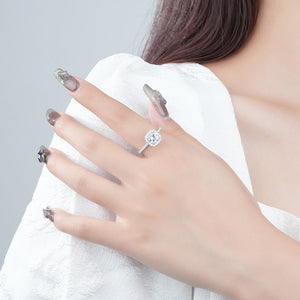
Note on material: the ring below is named “Moissanite” but is set with cubic zirconia (CZ), not genuine lab-grown moissanite — the hardness and brilliance figures in this guide describe real moissanite, not this specific piece.
Shop This Guide
See our moissanite-named halo ring — set with cubic zirconia (CZ), not genuine lab-grown moissanite (a distinct, softer material, Mohs 8–8.5 vs. moissanite’s 9.25), in sterling silver or 18K white gold.
Shop Moissanite Halo RingPrefer to browse the full selection? See all rings.
Written by the AJLuxe Team. Last updated: July 2026. Hardness and refractive index figures cross-checked against the Jewelers of America gemstone education resources.
All third-party trademarks, brand names and product names are the property of their respective owners. AJLuxe is not affiliated with, endorsed by, sponsored by, or otherwise connected to any third-party brand referenced in this article. Brand names are used solely for accurate comparative reference, and material descriptions reflect each brand's own published product specifications at the time of writing.
You Might Also Like

The piece they're describing → Moissanite Halo Ring — Sterling Silver, 18K White Gold, CZ
Personalize Yours


