

Moissanite vs Diamond: The Honest Comparison (2026)
Written by the AJLuxe team — specialists in personalized sterling silver jewelry. Last updated: June 2026.

- Hardness: Diamond wins (Mohs 10 vs moissanite 9.25) — but both are scratch-resistant enough for daily wear.
- Sparkle: Moissanite has MORE fire and rainbow dispersion (refractive index 2.65–2.69 vs diamond's 2.42).
- Price: Moissanite costs $300–600/ct; natural diamond runs $3,000–15,000/ct for comparable quality.
- Ethics: Both avoid conflict diamond supply chains. Neither is a wrong choice on that front.
Moissanite vs diamond is one of the most Googled jewelry questions right now — and for good reason. The price gap is enormous, the sparkle is real, and the "which is better" debate gets messy fast. This guide cuts through the noise and gives you a straight answer based on what actually matters to you.
Quick answer: moissanite and diamond are not the same stone. They look similar in a ring, but they're chemically different, they sparkle differently, and they cost dramatically different amounts. Which one you should buy depends entirely on your priorities.
What Is Moissanite?
Moissanite is silicon carbide (SiC) — not carbon like diamond. It was first discovered in 1893 by French chemist Henri Moissan inside a meteor crater in Arizona. He initially thought he'd found diamonds. He hadn't.
Natural moissanite is extraordinarily rare — essentially found only in meteorites and certain types of rock formations. Every moissanite sold in jewelry today is lab-created. Charles & Colvard holds the original patent for gem-quality lab moissanite, though other producers have entered the market since the patent expired.
The result: you get a gemstone with a cosmic origin story, created in a lab, with optical properties that outperform diamond in some measurable ways. That's not marketing — that's science.
The Complete Moissanite vs Diamond Comparison
| Attribute | Moissanite | Natural Diamond | Lab Diamond |
|---|---|---|---|
| Composition | Silicon carbide (SiC) | Pure carbon (C) | Pure carbon (C) — identical to natural |
| Mohs Hardness | 9.25 | 10 (hardest known mineral) | 10 |
| Refractive Index | 2.65–2.69 | 2.42 | 2.42 |
| Fire (Dispersion) | High — throws vivid rainbows | Moderate — white brilliance dominant | Moderate — same as natural |
| Price Per Carat | $300–600 | $3,000–15,000 | $800–1,500 (dropped ~70% since 2020) |
| Ethics | 100% lab-created — no mining | Conflict-free possible but requires vetting | 100% lab-created — no mining |
| Inclusions | Typically eye-clean (VS equivalent or better) | Varies — SI1 and above recommended for eye-clean | Varies — same grading as natural |
| Resale Value | Minimal — buy to wear, not invest | Loses 30–50% immediately on resale | Loses 50%+ immediately on resale |
Moissanite vs Diamond: Sparkle Side by Side
This is where moissanite surprises people. Moissanite's refractive index (2.65–2.69) is higher than diamond's (2.42). That means light bends more dramatically inside moissanite, creating more fire — the rainbow dispersion you see in sunlight or bright indoor lighting.
Diamond produces brilliant white light. Moissanite produces white light AND more rainbow flash. Which you prefer is genuinely personal. Some people find moissanite's fire breathtaking. Others find it too disco-like, preferring diamond's cooler, cleaner sparkle.

There's one technical caveat: moissanite has double refraction — it bends light twice as it travels through the stone. In some cuts and settings, this creates a faint blurriness in the facets when you look closely. Round brilliant cuts minimize this effect significantly. If you're choosing moissanite, round or cushion cuts are your best bet.
Three sparkle terms to know:
- Brilliance — white light returned from the stone (diamond has a slight edge)
- Fire — rainbow color dispersion (moissanite wins clearly)
- Scintillation — sparkle when you move the stone (both excellent — very close)
Price Comparison: What You Actually Pay
The price gap is real, and it's large. Here's what a 1-carat stone actually costs at retail:
| Stone Size | Moissanite (ring total) | Lab Diamond (ring total) | Natural Diamond (ring total) |
|---|---|---|---|
| 1 carat | $500–900 | $1,200–2,500 | $5,000–12,000 |
| 1.5 carat | $700–1,200 | $2,000–4,000 | $10,000–22,000 |
| 2 carat | $900–1,600 | $3,000–6,000 | $18,000–40,000+ |
Ring setting typically adds $500–2,000+ depending on metal and complexity. These are stone-only estimates at current market prices (2026).
Lab diamond prices have dropped dramatically — roughly 70–80% since 2020 as CVD (Chemical Vapor Deposition) technology scaled up production. If you were quoted lab diamond prices in 2021, re-check current prices. They're a much better value now than they were.
Comparing Specifically to a Lab-Grown Diamond
If the "diamond" in your comparison is lab-grown rather than mined, the math changes. A lab-grown diamond is chemically identical to a natural diamond — pure carbon, graded on the same 4Cs by GIA, IGI, or GCAL — just grown in a chamber over 6–10 weeks instead of underground over billions of years. Moissanite is a different mineral (silicon carbide) and isn't a diamond at all, lab-grown or otherwise.
Lab diamond prices have fallen 70–80% since 2020 as CVD (Chemical Vapor Deposition) production scaled up, but moissanite still costs roughly half a lab diamond at every carat size:
| Stone Size | Lab Diamond (stone only) | Moissanite (stone only) |
|---|---|---|
| 0.5 carat | $400–700 | $150–280 |
| 1 carat | $800–1,200 | $300–500 |
| 1.5 carat | $1,400–2,200 | $450–750 |
| 2 carat | $2,200–4,000 | $600–1,000 |
If budget is the only priority, moissanite wins outright. If owning a certified diamond matters — sentiment, tradition, or resale expectations (thin as they are for either) — lab diamond is now attainable at a fraction of what mined diamond costs. Look for GIA, IGI, or GCAL certification on any lab diamond purchase; Charles & Colvard is the closest equivalent for moissanite, though third-party grading of moissanite is less common.
Who Should Choose Moissanite?
Persona 1: Maximum size for your budget. If you want a 2-carat statement ring for under $2,000, moissanite is the realistic option. The sparkle is real. No one at a dinner party will know the difference.
Persona 2: Ethics are your priority. Moissanite is entirely lab-created. There's no supply chain complexity, no need to verify sourcing. If conflict-free matters deeply to you, moissanite delivers that with zero ambiguity.
Persona 3: You love colorful fire. If you've ever seen a stone throw rainbows across a room and thought "yes, that" — moissanite is for you. Diamond produces white sparkle. Moissanite produces a light show.
Who Should Choose Diamond?
Persona 1: Tradition and sentiment matter most. If the word "diamond" carries meaning for you — an engagement ring, a milestone gift, a family heirloom — that emotional weight is real and valid. Lab diamond gives you all of that at a fraction of the cost of natural diamond.
Persona 2: You prefer cooler, white brilliance. Some people genuinely prefer diamond's restrained, white-light sparkle over moissanite's colorful fire. If you've held both and diamond's look resonates more, that's your answer. There's no wrong preference.
Explore More in the Moissanite Series
- Moissanite vs Cubic Zirconia: The Real Differences
- Moissanite vs White Sapphire: Which Should You Choose?
- What Is Moissanite? The Complete Guide
- Are Lab-Grown Diamonds Real? Answered Honestly
- Moissanite Meaning and Symbolism
- Shop Gemstone Necklaces at AJLuxe
Before deciding between a diamond and moissanite, it's worth knowing what ring you're actually buying — see our breakdown of promise ring vs engagement ring if you're still deciding on the commitment level.
our guide to affordable moissanite rings covers the real GIA hardness and brilliance numbers alongside what to expect at accessible price points.
Frequently Asked Questions
Is moissanite a fake diamond?
No. Moissanite is a genuine gemstone — silicon carbide (SiC) — not a fake or imitation diamond. It's a different mineral entirely, with its own distinct properties. Calling it "fake" is like calling emerald a fake ruby because they're both green. Moissanite is sold as moissanite, not as a diamond substitute, by reputable jewelers.
Will moissanite pass a diamond tester?
Some will, some won't — it depends on the tester. Basic thermal conductivity testers sometimes read moissanite as diamond because its heat conductivity is similar. Advanced testers like the Presidium Duo use both thermal and electrical conductivity to correctly identify moissanite. If you're concerned about testing, ask the seller directly what their stones register on which tester type.
Does moissanite get cloudy over time?
No — moissanite doesn't cloud or fade. It's a durable gemstone at Mohs 9.25. What can make any stone look dull is a buildup of oils, soap, and lotion on the surface. Clean moissanite with mild dish soap and a soft brush, rinse thoroughly, and it'll sparkle like new.
Can you tell moissanite from diamond with the naked eye?
In most settings and lighting conditions, no — most people cannot tell them apart. An experienced jeweler looking closely may notice moissanite's double refraction (a faint doubling of facets) under magnification, or may notice the higher fire in certain lighting. For everyday wear, the visual difference is negligible.
Is moissanite good for engagement rings?
Yes — at Mohs 9.25, moissanite is one of the hardest gemstones available, making it excellent for daily-wear engagement rings. It won't scratch from normal contact with keys, surfaces, or other jewelry. The main reason people hesitate is sentiment, not durability.
What's the difference between moissanite and cubic zirconia (CZ)?
They're completely different stones. CZ is zirconium oxide (ZrO2), much softer (Mohs 8–8.5), and it does cloud and lose brilliance over time. Moissanite (Mohs 9.25) maintains its sparkle for decades. CZ is also significantly cheaper ($5–50 vs $300–600 per carat). If you see a stone marketed as "diamond simulant," check whether it's CZ or moissanite — the quality difference is significant.
Does diamond chip?
Yes — and this surprises most people. Diamond is the hardest mineral (Mohs 10), meaning nothing scratches it. But hardness and toughness are different properties. Diamond has perfect cleavage planes and CAN chip on a hard impact, especially at corners and girdle edges. Moissanite (9.25) is also susceptible to chipping on sharp impact but is comparable in real-world durability for everyday jewelry.
Is moissanite ethical?
Yes — moissanite is 100% lab-created. There's no mining involved, no supply chain to vet, no geographic sourcing concerns. It's one of the cleanest options available in terms of origin transparency. Lab diamond also shares this advantage over mined natural diamond.
What resale value does moissanite have?
Minimal. Moissanite has very little resale value on the secondary market. But here's the honest reality: natural diamonds also lose 30–50% of their retail value the moment you walk out of a store, and lab diamonds lose even more. If you're buying jewelry as an investment, gemstones in general are a poor choice. Buy moissanite because you want to wear it and love how it looks.
Which diamond cut works best for moissanite?
Round brilliant is the top choice. It minimizes moissanite's double refraction effect, which can create a faint blurriness in certain cuts. Cushion cut is a solid second option. Avoid step cuts (like emerald or asscher) where the long, open facets make the double refraction more visible under magnification.
Why did lab diamond prices drop so much?
CVD (Chemical Vapor Deposition) technology scaled rapidly from 2020 onward, making large-scale lab diamond production significantly cheaper. More producers entered the market, supply outpaced demand, and retail prices fell 70–80% from their 2020 peak. This trend is likely to continue as technology improves further.
Do lab diamonds hold their value better than moissanite?
Slightly, but both are poor investments. Lab diamonds lose 50–70% of retail value immediately on resale because the secondary market is thin and prices keep falling. Moissanite has almost no secondary market at meaningful prices. Both are purchases you make to wear and enjoy, not to sell later.
What certification should I look for with lab diamonds?
GIA (Gemological Institute of America), IGI (International Gemological Institute), and GCAL (Gem Certification and Assurance Lab) are the most respected certifiers for lab diamonds. All use the same 4Cs grading as natural diamonds. GIA is considered the gold standard. For moissanite, Charles & Colvard provides its own grading certificates, though third-party GIA/IGI grading of moissanite is less common.
Where can I learn more about gemstone grading standards?
The Gemological Institute of America (GIA) is the global authority on gemstone grading and the 4Cs. Their free education resources are the best starting point for understanding how diamonds and gemstones are evaluated.
Final Thoughts
Moissanite and diamond are both legitimate choices — for very different buyers. Moissanite wins on price, fire, and ethical simplicity. Diamond wins on tradition, white brilliance, and hardness (if Mohs 10 vs 9.25 matters to you).
If neither feels right for your budget — or if you want brilliant sparkle for everyday wear without the commitment of an expensive stone — our sterling silver gemstone necklaces start at $30 and feature genuine semi-precious stones that look stunning. No compromise required.
Weighing moissanite against every other option, not just diamond? See our full engagement ring alternatives comparison, covering moissanite, lab diamonds, colored gemstones, and vintage rings side by side on cost, durability, and ethics.
Note on material: AJLuxe’s own jewelry named “Moissanite” is set with cubic zirconia (CZ), not genuine lab-grown moissanite — a distinct, softer stone (Mohs 8–8.5 vs. moissanite’s 9.25). The comparison above describes real moissanite, not these specific pieces.
Shop Gemstone Necklaces — from $30
Related reading: Moissanite vs diamond necklace.
Related reading: Jewelry for 10th anniversary.
All third-party trademarks, brand names and product names are the property of their respective owners. AJLuxe is not affiliated with, endorsed by, sponsored by, or otherwise connected to any third-party brand referenced in this article. Brand names are used solely for accurate comparative reference, and material descriptions reflect each brand's own published product specifications at the time of writing.
You Might Also Like
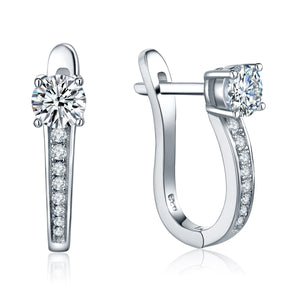
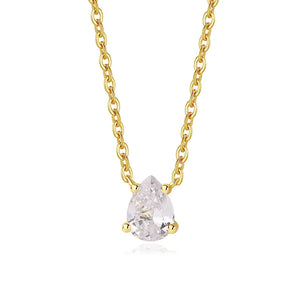
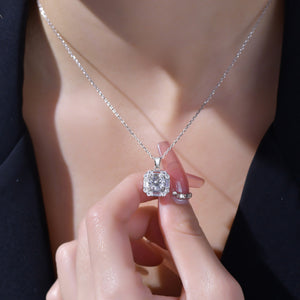
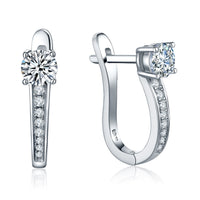
The piece they're describing → Moissanite Hoop Earrings for Women — 925 Sterling Silver, CZ, Hypoallergenic
Personalize Yours


