


Guessing a ring size is the number-one reason a ring ends up back in its box. If you have wondered whether a virtual fitting could replace this kind of manual measurement, see our explainer on how virtual jewelry try-on actually works and why it still falls short for rings specifically. This free calculator takes the guesswork out: measure the finger you are buying for — or a ring that already fits it — and get the matching US, UK, and EU size in seconds. Below the tool you will find the two easiest ways to measure at home and a full size chart in millimeters.
How to measure your ring size
You only need a ruler and one of these two methods. Whichever you choose, enter the number into the calculator above. See our full ring size conversion chart for more.
Method 1: Measure your finger
Wrap a thin strip of paper or a piece of string around the base of the finger, snug but not tight, and mark where the end overlaps. Lay it flat against a ruler and read the length in millimeters — that is your finger circumference. Make sure the loop can still slide over your knuckle, since the ring has to pass it every time you put it on.
Method 2: Measure a ring that already fits
Pick a ring that fits the intended finger well, place it flat, and measure straight across the inside from edge to edge in millimeters — that is the diameter. Switch the calculator to “Measure a ring that fits” and enter that number.
Want the full walkthrough with printable tips and common mistakes? See our complete ring size guide.
Ring size chart (US, UK, EU & mm)
The full conversion the calculator uses. Tap any row to highlight it. Sizes shown are whole US sizes; the calculator also handles half sizes.
| US size | Inside diameter | Inside circumference | UK | EU |
|---|---|---|---|---|
| 3 | 14.1 mm | 44.2 mm | F | 44 |
| 4 | 14.9 mm | 46.8 mm | H½ | 46½ |
| 5 | 15.7 mm | 49.3 mm | J½ | 49 |
| 6 | 16.5 mm | 51.9 mm | L½ | 51½ |
| 7 | 17.3 mm | 54.4 mm | N½ | 54 |
| 8 | 18.1 mm | 57.0 mm | P½ | 56½ |
| 9 | 19.0 mm | 59.5 mm | R½ | 59 |
| 10 | 19.8 mm | 62.1 mm | T½ | 61½ |
| 11 | 20.6 mm | 64.6 mm | V½ | 64 |
| 12 | 21.4 mm | 67.2 mm | X½ | 66½ |
| 13 | 22.2 mm | 69.7 mm | Z | 69 |
Tips for an accurate measurement
- Measure at the end of the day. Fingers are smallest in the morning and swell slightly as the day goes on.
- Warm hands, not cold. Cold fingers can read half a size small.
- Mind the knuckle. The band has to clear your knuckle — if your knuckle is much larger than the base of your finger, size to somewhere between the two.
- Wide bands run tight. For bands wider than about 6 mm, consider sizing up a quarter to a half size.
- Between two sizes? Size up. If your fingers change with the weather, an adjustable ring flexes with them.
Related reading: Ring engraving ideas.
Wondering about the wait? See how long ring resizing takes for timelines by ring type.
Ring size calculator FAQ
How do I measure my ring size at home without a ring sizer?
Two reliable ways. First, wrap a strip of paper or a piece of string around the base of your finger, mark where it overlaps, and measure that length in millimeters — that is your finger circumference, which the calculator converts to a size. Second, if you already own a ring that fits that finger, measure straight across the inside of it (the diameter) and enter that instead. Measure at the end of the day when your fingers are at their largest, and make sure the paper or string clears your knuckle. If you'd rather not eyeball it yourself, some rings are sold with a sizing tool built in — our guide to rings that come with a sizer breaks down how those work.
Is ring size based on the diameter or the circumference?
Both describe the same ring, just measured differently. Circumference is the distance all the way around the inside of the band; diameter is the straight-line distance across the inside. They are linked by pi (circumference = diameter × 3.14), so our calculator accepts either one. US ring sizes map to a specific inside diameter and circumference — for example, a US 7 is about 17.3 mm across and 54.4 mm around.
What is the most common ring size for women and men?
For women, the most common US sizes fall between 6 and 6.5; for men, between 10 and 10.5. These are helpful as a fallback if you are buying a surprise gift and cannot measure, but finger size varies a lot from person to person, so an actual measurement is always more reliable than an average.
What ring size is 54 mm?
A 54 mm inside circumference is a US size 7 (UK N½, EU 54), with an inside diameter of about 17.3 mm. Many countries, including much of Europe, size rings directly by the inside circumference in millimeters, which is why 54 mm is itself the EU size.
Should I size up or down if I am between ring sizes?
In most cases size up. A ring that is slightly loose is a minor fix, while one that is truly too tight can be painful to remove and may need resizing. Size up especially for wide bands, which fit tighter than thin ones, and for rings you plan to wear daily. If your finger size changes with the seasons, an adjustable ring sidesteps the problem entirely.
Does finger size change during the day?
Yes, and it is completely normal. Heat, salty food, alcohol, exercise, and air travel can swell a finger by up to a full size, while cold and early mornings shrink it. That is why jewelers recommend measuring at the end of a normal day at room temperature, and not resizing a ring based on how it felt on one unusually hot or cold day.
Ready to shop your size?
Now that you know your number, browse hypoallergenic 925 sterling silver rings — stacking bands, statement rings, and adjustable styles that fit without a measurement. Not sure how snug it should feel once it is on? Read how tight a ring should fit.
All third-party trademarks, brand names and product names are the property of their respective owners. AJLuxe is not affiliated with, endorsed by, sponsored by, or otherwise connected to any third-party brand referenced in this article. Brand names are used solely for accurate comparative reference, and material descriptions reflect each brand's own published product specifications at the time of writing.
You Might Also Like
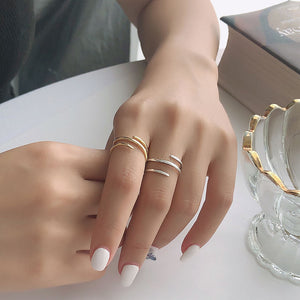
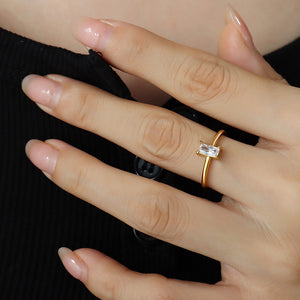

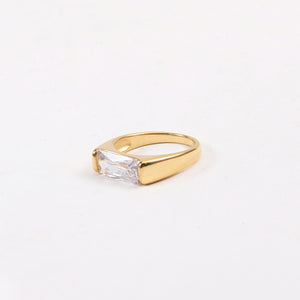
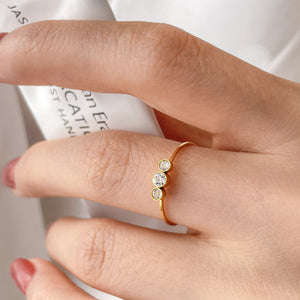
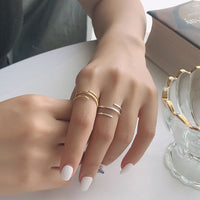
The piece they're describing → Adjustable Minimalist Ring for Women — 925 Sterling Silver, Gold or Rhodium Plated
Personalize Yours


