


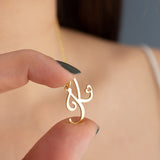
How Virtual Jewelry Try-On Works

TL;DR, How Virtual Jewelry Try-On Works
Virtual try-on apps use your phone's camera and augmented reality (AR) to place a 3D rendering of a piece onto a live video feed of your face, ears, wrist, or hand, tracking your movement in real time. It works reasonably well for necklaces and earrings, where the camera can anchor to stable facial landmarks. It's far less reliable for rings, because there's no standard reference point for finger width in a 2D camera image, so sizing is closer to a rough guess than a measurement. If a store doesn't offer try-on, you can still judge scale and fit from good product photos using a few practical checks below.
Virtual jewelry try-on lets you preview how a necklace, earring, or ring might look on you before buying, using your phone's camera and augmented reality software instead of a physical piece. It works by detecting key points on your face or hand, then rendering a 3D model of the jewelry on top of the live camera feed so it moves with you as you turn your head or hand. The technology has genuinely improved for necklaces and earrings, where the camera has stable, well-mapped reference points to anchor to. Rings remain the hardest category, because there's no reliable way for a phone camera to convert a 2D image of your finger into an exact millimeter measurement. This guide explains how the technology actually works, why it struggles specifically with rings, and how to judge scale and fit from ordinary product photos when a store, including this one, doesn't offer virtual try-on at all.
How Augmented Reality (AR) Try-On Actually Works
Virtual try-on works by using your phone's camera to detect key landmarks on your body, then rendering a 3D model of the jewelry on top of the live video in real time. For a necklace or earrings, the software identifies stable points, like the corners of your eyes, your earlobes, and the base of your neck, and uses the distance between them to scale and position the 3D model. Because those landmarks stay roughly fixed relative to each other, the overlay can track your head movement smoothly and hold a believable scale.
The underlying technology is the same face- and hand-tracking machine learning that powers social media camera filters, adapted to render a product instead of a cartoon effect. None of it requires special hardware: it runs through your phone's regular camera and processes the image on the device or through a cloud service in real time.

Why Virtual Try-On Is Especially Imprecise for Rings
Virtual try-on struggles with rings because a phone camera has no reliable way to convert a 2D image of your finger into an exact measurement, and a ring that's off by even half a size will visibly pinch or spin loosely. Necklaces and earrings tolerate some visual estimation error because they hang or clip rather than needing to fit a precise circumference. A ring doesn't have that flexibility: US ring sizes move in increments of roughly 0.4mm in diameter, and a camera-based estimate from a single hand angle simply can't resolve differences that small with any consistency.
There's also a depth-perception problem specific to hands. Fingers vary in thickness along their length, camera angle changes the apparent width of a finger significantly, and lighting or skin tone can throw off the edge-detection the software relies on to find your finger's outline in the first place. That's why even well-built try-on tools tend to present ring previews as a rough style preview only, not a sizing tool, and why a physical ring sizer or a printable sizing guide remains the more reliable option whenever a purchase is riding on an exact fit.
For an exact ring fit rather than a visual estimate, our ring size guide walks through measuring at home with a string or a printable sizer, and most of our rings ship adjustable so a close estimate still works.

How to Judge Scale and Fit From Product Photos Without a Try-On Tool
You can judge scale and fit from ordinary product photos by checking the listed measurements against something you already own, rather than relying on the photo alone. Photos get cropped, zoomed, and lit in ways that make a piece look bigger or smaller than it is, so the millimeter or inch measurements in the product description are the only number you can actually trust.
- Check the exact measurements, not just the photo. A pendant listed at 12mm reads very differently on a 5'2" frame than on a 5'9" frame, even though the photo shows just one model.
- Compare against a piece you already own. Pull out a necklace or ring with a known length or size and hold it next to a printed ruler; that gives you a real reference point for what a listed measurement will actually look like.
- Look for a scale reference in the photo itself. Product shots that include a coin, a hand, or a ruler alongside the piece are far more reliable for judging true size than a hero shot alone.
- Check the chain or band length range. A necklace's finished look depends heavily on where it falls relative to your neckline, our necklace length visualizer shows where each common length actually sits so you're not guessing from a flat product photo.
- Read the worn-on-model photos, not just the white-background hero shot. A hero photo is there for a clean product view, a worn photo on a real person is the more honest scale reference.
Should You Wait for Virtual Try-On or Buy From Photos and Measurements?
You don't need to wait for virtual try-on to buy jewelry confidently, real measurements and worn photos answer the same questions a try-on preview is trying to solve, without the accuracy problems that still affect ring sizing specifically. Virtual try-on is a genuinely useful style preview for necklaces and earrings when it's available, but it isn't the deciding factor for fit on any category, and it's not something to hold out for if a store you're buying from doesn't offer it yet.
Frequently Asked Questions
How does virtual jewelry try-on work?
Virtual jewelry try-on uses your phone's camera and augmented reality (AR) software to detect landmarks on your face or hand, then overlays a 3D rendering of the jewelry on the live video feed so it tracks your movement in real time.
Is virtual try-on accurate for rings?
No, virtual try-on is notably less accurate for rings than for necklaces or earrings, because a phone camera can't reliably convert a 2D image of your finger into an exact millimeter measurement. Most try-on tools present ring previews as a style preview rather than a sizing method.
Does AJLuxe offer virtual try-on?
Not currently. Instead, product listings include exact measurements and worn photos, and our ring size guide and necklace length visualizer help you judge fit precisely without needing an AR preview.
How can I tell how big a piece of jewelry actually is from a photo?
Check the listed measurement in millimeters or inches and compare it to a piece you already own, look for photos that include a scale reference like a coin or a hand, and prioritize worn-on-model photos over the plain white-background hero shot.
What technology powers virtual try-on apps?
Virtual try-on apps use the same face- and hand-tracking machine learning that powers common camera filters, adapted to render a 3D product model instead of a graphic effect, processed on your device or through a cloud service in real time.
All third-party trademarks, brand names and product names are the property of their respective owners. AJLuxe is not affiliated with, endorsed by, sponsored by, or otherwise connected to any third-party brand referenced in this article. Brand names are used solely for accurate comparative reference, and material descriptions reflect each brand's own published product specifications at the time of writing.
You Might Also Like
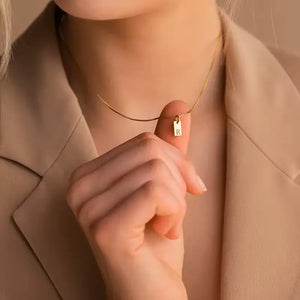
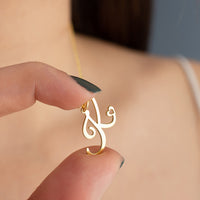
The piece they're describing → Heart Initial Necklace for Women — 18K Gold Plated, Personalized Letter + Heart Pendant
Personalize Yours


