


Related reading: how an open-band ring's hand-adjustable shank sidesteps needing an exact measured size in the first place.
Related reading: how adjustable heart rings fit differently than a numbered ring size.
Buying a ring that doesn't fit is one of the most frustrating jewelry experiences — especially for a gift. Getting the size right the first time means one thing: measuring correctly before you buy.
In a hurry? Skip the chart and use our free ring size calculator — enter your finger measurement or an existing ring's diameter to get your US, UK, and EU size instantly.
This guide covers four methods for measuring ring size at home, the complete U.S. ring size chart with millimeter equivalents, international size conversions, how to measure for someone else without them knowing, and what to do if you're between sizes.
U.S. Ring Size Chart — Circumference and Diameter
This is the reference chart. Find your ring's interior diameter in millimeters, or measure your finger circumference and match it to the chart. See our ring size conversion chart for more.
| U.S. Size | Circumference (mm) | Diameter (mm) | Notes |
|---|---|---|---|
| 3 | 44.2 mm | 14.1 mm | Child / petite pinky |
| 4 | 46.8 mm | 14.9 mm | Small women's / pinky |
| 5 | 49.3 mm | 15.7 mm | Small women's ring finger |
| 6 | 51.9 mm | 16.5 mm | Average women's ring finger |
| 6.5 | 53.1 mm | 16.9 mm | — |
| 7 | 54.4 mm | 17.3 mm | Most common women's size |
| 7.5 | 55.7 mm | 17.7 mm | — |
| 8 | 57.0 mm | 18.1 mm | Common women's / small men's |
| 8.5 | 58.3 mm | 18.5 mm | — |
| 9 | 59.5 mm | 18.9 mm | Average men's ring finger |
| 9.5 | 60.8 mm | 19.4 mm | — |
| 10 | 62.1 mm | 19.8 mm | Most common men's size |
| 11 | 64.6 mm | 20.6 mm | Larger men's |
| 12 | 67.2 mm | 21.4 mm | XL men's |
| 13 | 69.7 mm | 22.2 mm | XXL men's |
Most common sizes by gender: U.S. women average between sizes 6 and 7 (ring finger). U.S. men average between sizes 9 and 10. These are averages — individual sizing varies significantly based on height, weight, and genetics.
4 Methods to Measure Ring Size at Home
Method 1: Paper Strip Method (Most Accurate)
This is the most accurate at-home method and requires only a thin strip of paper and a ruler.
- Cut a strip of paper approximately 3/4 inch wide and 4 inches long.
- Wrap it around the base of the finger you'll wear the ring on — snugly but not tight.
- Mark where the end of the strip meets the wrapped portion with a pen.
- Lay it flat and measure the distance from the end to the mark in millimeters.
- This measurement is your finger circumference. Find it in the "Circumference" column in the chart above.
Important: Wrap around the base of the finger, not the knuckle. For fingers where the knuckle is significantly larger than the base (older adults, people with arthritis), measure the knuckle too and size up to the larger measurement — the ring needs to pass over the knuckle to fit on the finger.
Method 2: Existing Ring Method (For Gift Buying)
If you're buying a ring as a surprise gift and can access a ring the recipient already wears on that finger:
- Place the existing ring on a piece of paper and trace the inside circle.
- Measure the diameter of that circle in millimeters (across the widest point of the interior).
- Find that diameter in the "Diameter" column in the chart above.
This is the cleanest method for gift buying. Even if you can only borrow the ring briefly, a quick trace takes under 30 seconds.
Method 3: String or Floss Method
Similar to the paper strip method, but using a piece of string or dental floss:
- Wrap the string around the finger base, mark the point where it meets itself.
- Lay it flat next to a ruler and measure the marked length in millimeters.
- Match to the circumference column in the chart.
Less accurate than paper (string can stretch or compress), but works in a pinch.
Method 4: Printable Ring Sizer
Many jewelry brands offer a printable ring sizer — a paper gauge with circles of standard ring sizes printed at actual size. You place an existing ring over the circles until you find the one it sits flush in.
Critical warning: Only use a printable sizer if your printer is set to 100% scale (no "fit to page"). If the document is scaled even 5%, every size will be wrong. Always print with actual-size settings and verify with a known ruler measurement first.
If you'd rather skip the printer altogether, some rings ship with their own sizing tool included — see our guide to what "ring with sizer" means for how those work and when they're worth it.

Tips for Getting the Most Accurate Measurement
Finger size changes based on several factors. Measuring at the wrong time gives you the wrong size:
- Measure in the evening. Fingers are slightly larger at the end of the day due to fluid retention from activity. A ring that fits in the evening will always fit in the morning; not always the reverse.
- Measure at room temperature. Cold fingers shrink; warm fingers expand. Measuring outside in winter or in a hot bath gives inaccurate results.
- Measure the specific finger. Your left ring finger and right ring finger are different sizes — most people's dominant hand has slightly larger fingers. Measure the actual finger the ring will be worn on.
- Measure 2–3 times. Take 3 measurements and use the average if they differ slightly.
- Account for knuckle size. If your knuckle is notably wider than your finger base, size to the knuckle. A ring that passes over the knuckle and sits loose at the base can be adjusted with a ring adjuster insert.
What to Do If You're Between Sizes
If your measurement falls between two sizes, an adjustable ring removes the guesswork entirely (here's how adjustable rings fit different finger sizes) — its open back flexes across sizes 5–9. Otherwise, the general rule is to size up — especially for rings that will be worn daily. A slightly loose ring is more comfortable and easier to remove; a slightly tight ring is uncomfortable and can be unsafe if fingers swell further.
When sizing up makes more sense:
- Wider bands (over 6mm) — they require a larger size than narrow bands on the same finger
- Rings worn in warm climates or during summer
- Knuckle-dominant fingers (size to the knuckle)
When sizing down makes more sense:
- Narrow delicate bands (under 3mm) — they fit more loosely at the same measured size
- Rings worn primarily in cold weather
- Pinky or index finger rings where a snug fit is preferred
International Ring Size Conversion
If you're ordering from a brand that uses UK, EU, or Japanese sizing:
| U.S. Size | UK / Australia | EU (Germany/France) | Japan | Inside Diameter (mm) |
|---|---|---|---|---|
| 5 | J | 49 | 9 | 15.7 |
| 6 | L½ | 52 | 12 | 16.5 |
| 7 | N½ | 54 | 14 | 17.3 |
| 8 | P½ | 57 | 16 | 18.1 |
| 9 | R½ | 59½ | 18 | 18.9 |
| 10 | T½ | 62 | 20 | 19.8 |
| 11 | V½ | 64½ | 22 | 20.6 |

How to Find Ring Size Without Asking (For Gift Buying)
Buying a ring as a surprise gift is one of the most common reasons people need ring sizing help. Here are the most reliable approaches:
Sizing a ring for a man? The measuring methods are identical, but the size range, the average, and the wide-band adjustment all differ — those are covered in our men's ring size chart.
Method 1: Trace an existing ring
Borrow a ring they already wear on the same finger for 30 seconds — trace the inside with a pencil, measure the diameter, look up the size. This is the most reliable method for gift buying.
Method 2: Ask a family member or friend
A sibling, parent, or close friend may already know the size — or can casually find out without raising suspicion.
Method 3: The string trick
When the person is asleep, gently wrap a thin piece of string loosely around their ring finger and mark the length. This feels invasive to some — use your judgment.
Method 4: Look for size clues
Women who wear U.S. size 8 clothing typically wear ring size 7–8. Women who wear size 10–12 clothing typically wear size 8–9. This is a rough guide — body proportions vary — but it's a starting estimate if you have nothing else.
Method 5: Buy in the most common size and exchange
Women's most common size is 7. Men's most common is 10. If you truly have no information, order one of these sizes and plan to exchange. Most reputable jewelry brands (AJLuxe included) accommodate ring size exchanges for gifts.
Once you've chosen a ring style, see our complete promise ring guide for help choosing the right metal, design, and when to give one.
UK Ring Sizes: Letters vs. US Numbers
If you're shopping from the UK, you've probably noticed your ring size is a letter — not a number. The UK (and Australia) use an alphabetical sizing system, A to Z, based on the inner circumference of the ring, with half-letters (e.g., L½, N½) used for finer half-size increments. The U.S. uses whole and half numbers (5, 5.5, 6...) instead. Neither system is more accurate — they're just different scales measuring the same physical circumference, so converting between them is straightforward once you know your mm measurement.
AJLuxe ships to the UK, but our ring sizes are listed in U.S. numeric sizing at checkout (e.g., "6", "7", "8") — there is no letter-size option on the product page. Use the table below to convert your known UK letter size to the U.S. number you should select when ordering.
| UK Letter Size | US Size (select this on AJLuxe) | Diameter (mm) | Circumference (mm) |
|---|---|---|---|
| F | 3 | 14.0 mm | 44.0 mm |
| H | 4 | 14.9 mm | 46.8 mm |
| J | 5 | 15.7 mm | 49.3 mm |
| L | 6 | 16.5 mm | 51.8 mm |
| M | 6.5 | 16.9 mm | 53.1 mm |
| N | 7 (most common UK women's size) | 17.3 mm | 54.4 mm |
| O | 7.5 | 17.7 mm | 55.7 mm |
| P | 8 | 18.1–18.2 mm | 57.0 mm |
| Q | 8.5 | 18.5–18.6 mm | 58.3 mm |
| R | 9 | 18.9–19.0 mm | 59.5 mm |
| S | 9.5 | 19.4 mm | 60.8 mm |
| T | 10 (most common UK men's size) | 19.8 mm | 62.1 mm |
| V | 11 | 20.6 mm | 64.6 mm |
| X | 12 | 21.4 mm | 67.2 mm |
Note: half-letter UK sizes (e.g., L½, N½, T½) fall between the whole-letter rows above and correspond to the same half-number U.S. sizes shown in the international sizing table further up this guide. If your UK size includes a half-letter, use the closer whole-letter row here as a starting point, or check the earlier "International Ring Size Conversion" table for half-size detail.
How to convert your UK ring size for ordering from AJLuxe
- Find your UK letter size (from a UK jeweller's sizing, a ring you already own, or by measuring at home using the paper strip method above).
- Match it to the corresponding U.S. size in the table above.
- Select that U.S. number in the "Size" dropdown on the AJLuxe product page at checkout.
- If you're between two UK letters, size up to the nearest U.S. number — the same general rule from the "between sizes" section above applies.
Since ring size is a physical circumference measurement, not a regional standard, the mm columns are the most reliable cross-check regardless of which country's sizing you're used to. If you're not confident matching a UK size to a US number, measure your finger directly using the paper strip method above and match to the mm columns in either table.
What Is UK Ring Size I in US Sizing?
UK ring size I falls directly between H and J on the UK/Australia letter scale, converting to approximately U.S. size 4.5 — an interior diameter of roughly 15.3mm and circumference of roughly 48.0mm, using the same circumference-÷-3.14-for-diameter math applied throughout this guide.
Size I doesn't get its own row in most UK conversion charts, including the one above, because it sits in a petite range where jewelers commonly stock whole letters only and skip from H straight to J. If a UK jeweler measured you at I, or an existing ring is stamped with that letter, here's the closest match for ordering:
| UK Letter | Closest US Size | Diameter (mm) |
|---|---|---|
| H | 4 | 14.9 mm |
| I | ~4.5 | ~15.3 mm |
| J | 5 | 15.7 mm |
Since AJLuxe's size dropdown uses the same U.S. numbers referenced throughout this guide, choose whichever of size 4 or 5 sits closer to your measured diameter. If the ring will be worn daily, lean toward 5 so it slips comfortably over the knuckle — the same sizing-up logic covered earlier in this guide. For the most reliable result, re-measure with the paper strip method at the top of this page rather than converting from a UK letter alone; it removes any rounding introduced by the letter-to-number conversion.
Related reading: Ring engraving ideas.
Related reading: Ring Size Guide: How to Measure Your Ring Size at Home (2026).
our marquise ring guide covers why getting the size right matters even more for an elongated cut like marquise, which can rotate more easily than a round stone if the fit is loose.
If you're specifically after a narrower, more stackable width, our thin band ring guide covers how band width is measured and where durability tradeoffs actually start.
Sizing for a larger frame goes beyond just rings; our plus size jewelry guide covers bracelets and necklaces too, plus what "adjustable" actually means in practice.
Frequently Asked Questions About Ring Sizing
What is the average women's ring size?
The average U.S. women's ring size is 7 (diameter: 17.3mm, circumference: 54.4mm). Women's ring fingers most commonly fall between sizes 6 and 8. Ring size varies significantly based on genetics, height, weight, and age — these are statistical averages, not rules.
What is the average men's ring size?
The average U.S. men's ring size is 10 (diameter: 19.8mm, circumference: 62.1mm). Men's ring fingers most commonly fall between sizes 9 and 11. Taller, larger-framed men tend toward larger sizes; smaller-framed men toward smaller.
How do I measure my ring size at home without a ring sizer?
The most accurate home method: cut a thin strip of paper, wrap it around the base of your finger, mark where it overlaps, measure that length in millimeters, and look up the circumference in the ring size chart above. Do this in the evening, at room temperature, for the most accurate result.
Does ring size differ between left and right hand?
Yes, usually by about half a size. The dominant hand tends to have slightly larger fingers due to more muscle development. Always measure the specific finger on the specific hand you'll wear the ring on.
Should I size up or down if I'm between sizes?
Size up in most cases. A slightly larger ring is more comfortable, easier to remove, and safer if your fingers swell. Exceptions: cold climates (fingers smaller in winter), very narrow bands under 3mm (fit more loosely), and cases where you specifically want a snug fit for an active lifestyle.
Why does my ring feel tight when I put it on but loose when it's on?
This is the knuckle-to-finger-base size difference. Your knuckle is slightly larger than your finger base — so the ring is sized to pass over the knuckle (tight going on) but sits on the narrower base (loose when on). This is normal. If it's too loose on the base, a ring adjuster insert solves the problem without resizing.
Can I resize a ring?
Solid gold and sterling silver rings can usually be resized by a jeweler — typically 1–2 sizes in either direction without structural issues. Gold-plated rings can be resized but the resizing process may affect the plating at the resize point. Very thin bands and eternity bands (where stones go all around) are harder to resize. Check with the jeweler before purchasing if resizing may be needed. If your ring is bent rather than the wrong size, don't try to resize it yourself — see our guide on how to safely fix a bent ring and when to see a jeweler instead.
What if the ring is a gift and I get the size wrong?
Contact the retailer as soon as possible. Most jewelry brands have a ring size exchange policy specifically because gift sizes are frequently off. At AJLuxe, reach out to our customer support and we'll help you find the right size.
What is UK ring size N in US sizing?
UK size N converts to U.S. size 7 — the most common UK women's ring size (diameter: 17.3mm, circumference: 54.4mm). Select U.S. size 7 when ordering from AJLuxe. If your UK size is N½, size up to U.S. 7.5 unless you prefer a slightly snugger fit.
How do I find my UK ring size at home?
Use the same paper strip or string method described above: wrap it around your finger base, mark the overlap, and measure the length in millimeters. Then match that circumference to the UK Ring Size table on this page rather than the U.S. table — the underlying measurement is identical, only the size label differs. Many UK jewellers also offer free in-store sizing if you'd rather have it measured professionally before ordering.
Does AJLuxe use UK or US ring sizing?
AJLuxe lists ring sizes using the U.S. numeric system (e.g., 6, 7, 8) at checkout, even for orders shipping to the UK. There is no letter-size selector on the product page. UK customers should convert their known UK letter size to the equivalent U.S. number using the table above before selecting a size.
Looking for the full breakdown of every ring style? Our complete guide to types of rings for women covers all 16 ring types — from stacking and signet rings to cocktail and midi rings — with a style comparison table and occasion guide.
If you're sizing specifically for a stack of two or more rings on one finger, our how to stack rings guide covers when to size up.For the full picture on rings — types, finger meanings, stacking, metals, sizing and gifting — read The Complete Ring Guide.
Get the Size Right Before You Buy
A two-minute measurement before purchasing saves the hassle of exchanges and the disappointment of a ring that doesn't fit on the day it's given. Use the paper strip method, check the chart, and when in doubt, size up.
Browse our full ring collection — dainty bands, gemstone rings, and stacking ring sets, all in 18K gold-plated 925 sterling silver. If you're buying for someone else, see our guide to stackable ring combinations for gift inspiration. If sizing is the deciding factor, our 18K Gold Plated CZ Statement Ring ships in true US sizes 6, 7 and 8 as separate listings rather than one open band stretched to fit — so the size you measure above is the size you order.
Looking for the meaning behind different ring styles? Read our guide: What Does a Promise Ring Mean?
Written by the AJLuxe team. Last updated: May 2026.
All third-party trademarks, brand names and product names are the property of their respective owners. AJLuxe is not affiliated with, endorsed by, sponsored by, or otherwise connected to any third-party brand referenced in this article. Brand names are used solely for accurate comparative reference, and material descriptions reflect each brand's own published product specifications at the time of writing.
You Might Also Like

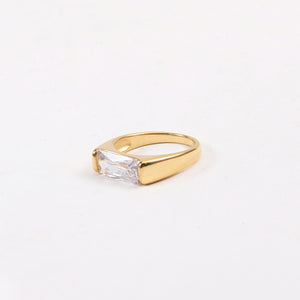
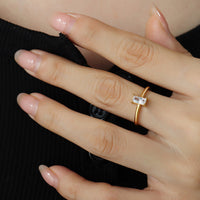
The piece they're describing → Square CZ Wedding Ring for Women — 18K Gold Plated, Princess Cut Cubic Zirconia
Personalize Yours


