

By the AJLuxe Editorial Team
"Diamonds are rare" is one of the most repeated facts in jewelry marketing — and one of the least checked. We wanted to know if it actually holds up, so instead of repeating the slogan or the internet's favorite contrarian counter-slogan, we went to the sources that are supposed to keep marketing claims like this honest: federal trade regulation, government mining data, and the diamond industry's own current financial disclosures. Here's what we found, with links so you can check every number yourself.
Where "rare" came from
The idea that diamonds are inherently rare isn't ancient — it's a 20th-century advertising campaign with a documented start date. When large diamond deposits were discovered in South Africa in the late 1800s, the companies that controlled them (later consolidated into a single dominant producer) faced the opposite problem of scarcity: a supply large enough to collapse prices if it all reached the market at once. That producer responded by controlling how many stones were released each year, and in 1947 its ad agency coined a famous tagline that did the rest of the work. The fullest account of how that campaign built the modern idea of the "rare," essential diamond is Edward Jay Epstein's 1982 magazine investigation, "Have You Ever Tried to Sell a Diamond?" — still the standard reference on how a controlled-supply cartel and a single ad campaign turned a merely uncommon mineral into a cultural symbol of scarcity and permanence.
What the law actually says about calling a diamond "rare"
The FTC's Jewelry Guides (16 CFR Part 23) are the actual rulebook U.S. jewelers are supposed to follow. There's no dedicated section that specifically addresses the word "rare" — that surprised us going in. What does apply is the general deception standard at §23.1, which makes it unfair or deceptive to misrepresent the "grade, quality... character... origin, price, value... or any other material aspect" of a jewelry product — a broad standard a specific, unsubstantiated rarity claim could run into, but not a rule that defines or polices "rare" on its own. The more concrete, checkable fact is at §23.12: since the FTC's 2018 revision, the federal definition of "diamond" no longer requires a natural, mined origin — a lab-grown stone is legally a diamond too, as long as it's clearly disclosed as "laboratory-created" or "laboratory-grown." The regulator's own definition, in other words, now assumes diamonds can be manufactured at will — not exactly consistent with "inherently rare."
What's actually coming out of the ground
So how much natural supply are we talking about? Global gem-quality diamond production for 2023 alone was roughly 76 million carats, per a country-by-country table compiled by an online geology reference, drawing on the U.S. Geological Survey's Mineral Commodity Summaries. That's tens of millions of finished, cuttable gem-quality stones entering the market in a single year — on top of whatever's already in circulation from every year before it. To put a number on just one company: the largest producer alone reported 20.9 million carats in rough diamond sales volume for 2025 in its own preliminary 2025 financial results. A genuinely rare material doesn't move at that scale, year after year, from a single seller.
For gemstones that actually meet that bar, see our guide to the world's rarest gems.
The part that surprised us most: the market is behaving like diamonds aren't scarce
If "rare" still held up as an economic fact and not just a marketing line, you'd expect diamond prices to hold firm or climb as demand grows. Instead, that producer's own numbers tell a different story. According to that same 2025 results release, its average realized rough-diamond price fell 7% year-over-year to $142 per carat, driven by a 12% drop in the rough price index — and the company explicitly names the reasons: "greater shifting of customer preference between natural diamonds and laboratory-grown diamonds" and a "surplus of available rough diamonds relative to prevailing demand." The financial toll has been steep: the producer's parent company has written down its diamond unit's enterprise value from $9.2 billion in 2023 to just $2.3 billion in 2025 — roughly $6.9 billion in cumulative impairments over three years, according to trade press coverage. A company sitting on a truly scarce, irreplaceable resource doesn't write down 75% of its own value in three years and cite "oversupply" as a reason. Those are the words of a business facing a lot more supply — natural and lab-grown combined — chasing roughly the same demand.
What sellers are actually saying, right now
Here's the part that made this genuinely a two-sided story rather than an easy takedown: not every seller is overselling the scarcity angle, and the ones that are can be checked in real time. At least one consumer diamond brand owned by a major producer currently markets itself on its homepage with a line that keeps the rarity claim front and center, even as its parent company's own financial disclosures describe an oversupplied market. Compare that to a large online diamond retailer's buying guide on this exact question, which is more careful: it states plainly that natural diamonds as a mineral are relatively common in the Earth's crust and are not inherently scarce, and that the real scarcity — such as it is — sits only in the small slice of mined stones that clear jewelry-grade standards for cut, color, clarity, and size. That's a meaningfully more accurate claim than "diamonds are rare," and it's worth noting it's coming from a company that also sells diamonds.
So — are they actually rare?
Based on what we could verify: no, not in the way the marketing implies, but the honest answer has two parts. As a raw mineral, diamonds are not scarce — tens of millions of gem-quality carats are mined every year, and that has been true for decades, which is precisely why the industry historically had to manage supply rather than simply let a "naturally rare" market set its own price. But "some grades of a common material are less common than other grades" is a very different, much smaller claim than "diamonds are rare" — and it's not the claim most diamond marketing actually makes. And today, the industry's own financial disclosures — a company writing down its own value by billions and blaming "oversupply" — are hard to square with rarity being the operative economic fact people are being sold.
Where this leaves shoppers who love the sparkle without the mythology
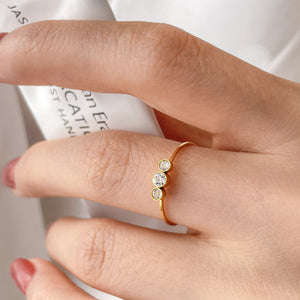
AJLuxe doesn't sell mined diamonds, so we don't have a rarity story to defend or a stake in which way this cuts — our pieces are 925 sterling silver and 18K gold-plated designs set with cubic zirconia and moissanite, priced at $24.99–$79.99, and we're upfront that a CZ stone is a diamond simulant, not a diamond. What we can offer honestly is the alternative for shoppers who want the look without paying for a decades-old scarcity narrative that, by the diamond industry's own 2025 numbers, is under real pressure: browse our engagement rings or wedding bands collections if that's what you're after. If you do want a natural or lab-grown diamond, this at least gives you a clearer starting point for what "rare" should and shouldn't mean when you're paying for it.
Sources
- FTC, Guides for the Jewelry, Precious Metals, and Pewter Industries, 16 CFR Part 23 (current text via the eCFR)
- FTC, 16 CFR §23.1 — Deception (general)
- FTC, 16 CFR §23.12 — Definition and misuse of "diamond"
- An online geology reference's country-by-country diamond production table (compiling USGS Mineral Commodity Summaries 2024 gem-diamond production data)
- The largest diamond producer's preliminary financial results for 2025 (Feb 2026), published on its corporate website
- Trade press coverage of the parent company's write-down of its diamond unit's value
- An online diamond retailer's buying guide on whether natural diamonds are rare
- Edward Jay Epstein, "Have You Ever Tried to Sell a Diamond?", magazine investigation, February 1982
All third-party trademarks, brand names and product names are the property of their respective owners. AJLuxe is not affiliated with, endorsed by, sponsored by, or otherwise connected to any third-party brand referenced in this article. Brand names are used solely for accurate comparative reference, and material descriptions reflect each brand's own published product specifications at the time of writing.
You Might Also Like
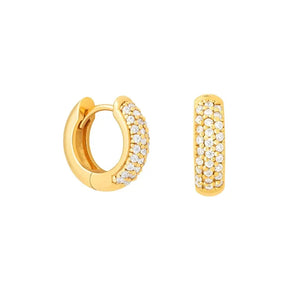
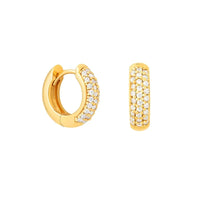
The piece they're describing → Diamond-Cut Huggie Hoop Earrings for Women — 925 Sterling Silver, 18K Gold Plated
Personalize Yours


