


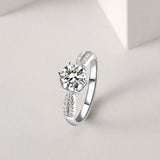
- Four prongs show more of the stone; six prongs hold a bit more securely and look a little busier.
- Prong shapes include round, claw, pointed, flat, double, tab and V (used on points and corners).
- Loose prong signs: the stone rattles or shifts, a prong catches a fingernail or thread, or a prong looks short, bent or thin.
- If you suspect a loose prong, stop wearing the ring and take it to a jeweler. Do not bend it back yourself.
- Our stones are cubic zirconia, and we only call a ring prong set when its page says so.
Prongs hold most of the rings you see, from the classic solitaire ring to many halo designs. This guide explains how they work, how to spot trouble, and how they compare with the other options in our full ring settings guide.
What are prongs on a ring?
Prongs are thin metal arms that rise from the base of the head and fold over the top edge of the stone to hold it down. Many jewelers call them claws. Because the arms cover only small points on the stone's edge, most of the stone stays open to light from the top and sides, which is the main reason people choose them.
The tips of the prongs grip the stone at its girdle, the thin outer edge. A well-made head has prongs of matching height and spacing, each one touching the stone with no gap.
Should I choose four prongs or six?
Choose four prongs if you want to show more of the stone and six if you want a slightly more secure hold. Trade sources broadly agree on this trade-off, though a well-made four-prong head can be very secure. With four prongs, a round stone is often set in a square or "compass" pattern; with six, the prongs form a hexagon and one failing prong leaves the stone held by five.
| Feature | Four prong | Six prong |
|---|---|---|
| Stone visible | More | Slightly less |
| Hold if one prong fails | Three prongs left, stone may tilt | Five prongs left, more margin |
| Look | Modern, open | Classic, round-looking stone |
| Best shapes | Round, oval, square | Round, larger stones |
| Snag exposure | Fewer points to catch | More points to catch |
What are the types of prongs?
The types are named for the shape of the prong tip, and the shape changes both the look and the snag risk. Terms vary a little by jeweler, so use these as general guides.
- Round (ball) prongs: Rounded tips that are smooth, comfortable and low on snags. A common everyday choice.
- Claw prongs: Slim, curved arms that hook over the stone. The word "claw" is often used for any prong, but it also describes a more tapered, pointed style that keeps metal light.
- Pointed prongs: Tapered to a fine point, which shows more stone and looks sharp, but the tip can catch fabric.
- Flat prongs: Wider, flatter tops with a modern look and a larger grip surface. They sit low and cover a bit more of the stone's edge.
- Double prongs: Two prongs side by side in place of one, often used to add security or extra detail at corners.
- Tab prongs: A short, flat metal tab that lies over the stone, a lower-profile alternative that bridges toward a bezel.
- V prongs (marquise prongs): A V-shaped prong that wraps the point or corner of a marquise, pear, princess or emerald stone. This protects the most fragile spot. See our marquise ring guide and princess cut ring guide.
What are the pros and cons of prong settings?
The main advantage is light and the main drawback is exposure. Here is the balance in one view.
| Pros | Cons |
|---|---|
| Shows the most of the stone and lets in the most light | Prongs can catch on sweaters, hair and gloves |
| Easy to clean from underneath | Tips can wear thin over time and need retipping |
| Usually costs less than bezel or pave work | A bent prong can let the stone shift or fall out |
| Widely available in every stone shape | Exposes stone edges and corners to knocks |
How can I tell if a prong is loose?
The fastest signs are movement, a rattle, a catch or a visible gap. None of these tests replaces a jeweler's inspection, so treat them as a first screen.
- Rattle test: Hold the ring near your ear and tap the side of the head gently. A faint tick or rattle can mean the stone is moving.
- Snag test: Run a fingernail or a thread over each prong tip. A prong that catches, or feels sharp or raised, may be bent or worn.
- Look test: In bright light, check that every prong touches the stone and that they all look the same height. A missing, shortened or thin prong is a warning.
- Gentle movement test: Rest a fingertip on the stone and press lightly. It should not rock or spin. Do not push or twist hard, since that can make a loose prong worse.
Also notice if the ring starts catching hair or fabric more than before, or if the stone looks tilted.
What should I do about loose or worn prongs?
Stop wearing the ring and take it to a jeweler. Do not try to bend a prong back with pliers or a pin, because metal that is bent repeatedly work-hardens and can crack, and you can scratch or chip the stone.
Jewelers generally use two repairs, described here in general terms:
- Retipping: Adding fresh metal to the worn tip of a prong that is otherwise sound, then reshaping it to grip the stone again.
- Rebuilding: Replacing a prong that is badly worn, cracked at the base or missing, by attaching new metal to the head.
Heat is often involved, so ask a jeweler whether a repair suits your ring's metal, plating and stone before agreeing to it. Plated pieces and softer stones may not tolerate heat or aggressive polishing, and repair cost can approach the price of a lower-cost ring, so a repair quote may be worth weighing against replacement. Jewelry trade sources often suggest having prongs checked about once or twice a year, though intervals vary.
Prong vs bezel: which is better?
Prong shows more of the stone and bezel holds it more securely. Neither is better for everyone, so match the choice to your day.
| Factor | Prong | Bezel |
|---|---|---|
| Light and sparkle | Highest | Lower, since metal covers the edge |
| Security | Good, needs checks | Highest |
| Snag risk | Higher | Low |
| Cleaning | Easy, open underneath | Harder to reach under the rim |
| Corner protection | Needs V or corner prongs | Built in |
See the bezel setting guide for the full picture, and cathedral settings if you want prongs on raised arches.
How do I protect the stone in a prong setting?
The best protection is to take the ring off before heavy work and to keep the prongs from taking knocks. Remove it for the gym, gardening, cleaning and anything that uses grip. Store it in a pouch so the prongs do not catch on other jewelry, and avoid wearing high prong heads under tight gloves. For corner stones, choose V or double prongs, and consider a lower head if you stack rings.
How do I care for and clean prong-set rings?
Wipe the ring with a soft cloth and use a soft brush gently around the prongs to lift dirt from underneath the stone. Dirt under the stone dulls cubic zirconia faster than anything else, and the open underside of a prong head makes it easy to reach. Our step by step guide to cleaning cubic zirconia jewelry covers products to avoid. For plated rings, product pages generally advise avoiding ultrasonic and steam cleaners, because they can wear plating and loosen small stones. If a ring has any sign of loose prongs, skip cleaning machines and see a jeweler.
An honest note on our range
We sell cubic zirconia jewelry, not diamonds, and we only describe a setting when the product page does. Two pieces say prong set outright:
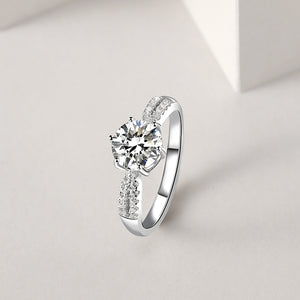
- The sterling silver CZ solitaire ($47.99) is described as a round CZ solitaire, prong set, with pave CZ accents on the shoulders, on an unplated 925 sterling silver band.
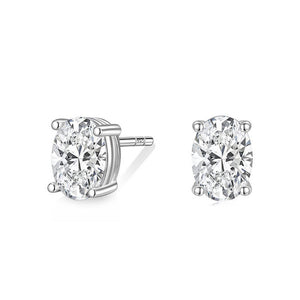
- The CZ stud earrings ($26.99) are described as an oval CZ solitaire per earring in a four-prong setting, on unplated 925 sterling silver. Stock is low, so check availability.
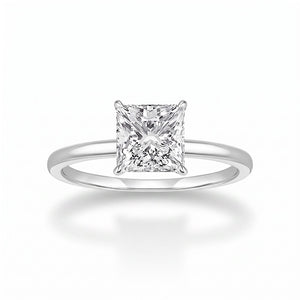
Our princess cut CZ ring ($44.99) is described as a square CZ solitaire, but its page does not say how the stone is held. We do not claim V prongs or any other style for it. For help choosing among our pieces, see affordable engagement rings.
More in this guide
Related reading: ring settings guide, bezel setting guide, cathedral setting guide, solitaire ring guide and best cz engagement rings.
Frequently Asked Questions
What is the difference between claw and round prongs?
Claw prongs are slim, tapered arms that hook over the stone, while round prongs end in a smooth, rounded tip. Round tips tend to feel smoother and snag less. Many people use "claw" to mean any prong, so ask which tip shape a listing means.
Are 4 prongs or 6 prongs better?
Four prongs show more of the stone and six hold slightly more securely, so six suits a very active lifestyle. A well-made four-prong ring can still be dependable.
How do I know if my ring prong is loose?
Signs include a stone that rattles or shifts, a prong that catches a fingernail or thread, a visible gap between the prong and the stone, or a prong that looks bent or short. Stop wearing the ring and have a jeweler inspect it.
Can I fix a bent prong myself?
No, take it to a jeweler. Bending a prong back can crack the metal or scratch or chip the stone.
What is prong retipping?
Retipping is when a jeweler adds fresh metal to the worn tip of a prong and reshapes it. It is used when the prong is still sound at its base, while a prong that is missing or cracked usually needs rebuilding.
Do prongs snag on clothing?
They can, especially pointed or raised ones. Round prongs and lower heads catch less. Bezel and flush settings snag least.
Why do some rings have double prongs?
Double prongs add a second arm at a corner or on each side, which can give more coverage and a distinct look, often on square or rectangular stones.
Is a prong setting good for cubic zirconia?
Yes, prongs are common for cubic zirconia and let light through for sparkle. Cubic zirconia is generally rated about 8 to 8.5 on the Mohs scale, below diamond, so protect corners and keep prongs checked.
Written by AJLuxe Team. Last updated: October 2026
All third-party trademarks, brand names and product names are the property of their respective owners. AJLuxe is not affiliated with, endorsed by, sponsored by, or otherwise connected to any third-party brand referenced in this article. Brand names are used solely for accurate comparative reference, and material descriptions reflect each brand's own published product specifications at the time of writing.
You Might Also Like
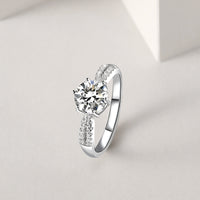
The piece they're describing → Sterling Silver Engagement Ring for Women — 925 Sterling Silver, CZ Solitaire, Hypoallergenic
Personalize Yours


