


What Counts as an "Affordable" Engagement Ring in 2026?
"Affordable" is a moving target because the engagement-ring market itself is expensive by default. Natural-diamond engagement rings commonly cost several thousand dollars -- but spending varies widely, and many couples spend well under $3,000. So when a retailer advertises "affordable engagement rings," they usually mean rings priced in the hundreds to low thousands, still well within traditional diamond-ring territory.
That's a different "affordable" than a $40 sterling silver ring. Neither is wrong -- they're answering different questions. If you want a real diamond at a lower price than a jewelry-store average, the affordable tier of the diamond market (smaller stones, lab-grown, simpler settings) is what you're shopping. If you want the lowest realistic price for a ring that reads as an engagement ring at all, that's the cubic zirconia and sterling silver tier this guide focuses on.
How Cheap Can an Engagement Ring Actually Get?
The cheapest engagement-style rings that still look and wear like the real thing are 925 sterling silver set with cubic zirconia, running roughly $25-$80 -- our own three run $39.99, $47.99, and $49.99. Below that price band, quality typically drops to plated base metal (brass or zinc alloy under a thin gold or rhodium coating) or glass stones instead of cut cubic zirconia, which is where "cheap" starts meaning cheap materials rather than just a lower price.
- $25-$80: 925 sterling silver with cubic zirconia -- the floor for a ring that's genuinely precious-metal, not costume jewelry.
- $200-$800: A small lab-grown diamond or a moissanite center stone in a simple sterling silver or 10K gold setting.
- $800-$3,000: A larger lab-grown diamond, or a small natural diamond, in a solid gold setting -- a common range for real couples.
- $3,000-$6,000+: Natural diamonds in solid gold or platinum settings -- the typical natural-diamond tier.
Where you land on this ladder depends on one decision more than any other: whether the stone has to be a mined diamond. Everything below that line -- lab-grown, moissanite, cubic zirconia -- exists specifically because it looks similar at a fraction of the cost. See our best gemstones for engagement rings guide for how each of those stones actually compares on hardness and daily-wear durability.

Real Ways to Get an Affordable Engagement Ring
There are a handful of genuine ways to lower the price without simply buying a worse-made ring (see also our best sites for engagement rings roundup for where to actually shop for each option):
- Choose a diamond alternative. Lab-grown diamonds run 60-85% less than natural diamonds of the same size and grade; moissanite runs even lower while still being a real, durable gemstone -- not a simulant like cubic zirconia.
- Go smaller on the center stone. Carat weight drives cost more than almost any other factor; a well-cut smaller stone often reads better in person than a larger, poorly cut one.
- Simplify the setting. A solitaire or three-prong setting costs less in labor and metal than a halo or pavé band, and shows off the center stone just as clearly.
- Shop sales, outlets, or secondhand. Major retailers' outlet arms and resale marketplaces sell real diamond rings below original retail; the trade-off is a narrower selection and, for resale, no manufacturer warranty.
- Skip the diamond entirely. A cubic zirconia ring in genuine sterling silver isn't a "worse diamond ring" -- it's a different, much cheaper category that some couples choose deliberately, not just as a compromise.
When a Sterling Silver CZ Ring Makes Sense
A cubic zirconia engagement ring makes the most sense as a placeholder while you save or shop for something else, a promise ring ahead of a later proposal, a low-risk everyday ring for someone who travels or works with their hands, or simply the choice for a couple who never wanted a diamond in the first place. It's an honest, common purchase in all of those cases -- not a smaller version of a diamond ring, a different one.
| Ring | Metal | Stone | Price |
|---|---|---|---|
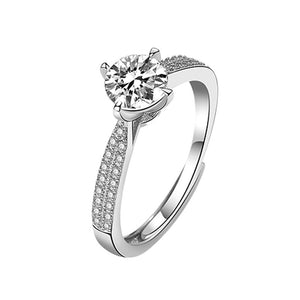
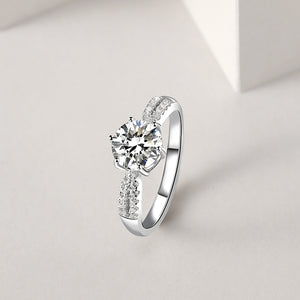
| Micro Pave Zircon Ring | 925 sterling silver, 18K gold finish | AAA cubic zirconia pavé | $39.99 |
| Sterling Silver Solitaire Ring | 925 sterling silver, polished white finish | Round CZ solitaire, prong-set | $47.99 |
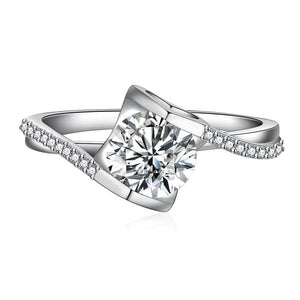
| Round CZ Ring | 925 sterling silver, 18K gold-plated finish | Brilliant-cut cubic zirconia | $49.99 |
All three are genuine 925 sterling silver (not plated brass), which is what makes them hypoallergenic and durable enough for daily wear -- the trade-off is the stone, not the metal.
Not shopping for a diamond right now?
Our Micro Pave Zircon Ring is $39.99 -- genuine 925 sterling silver with cubic zirconia, adjustable, and hypoallergenic.
Shop the Micro Pave Zircon RingWhat to Check Before Buying a Cheap Engagement Ring
Check the base metal first -- "sterling silver" or "925" stamped on the ring means genuine, hypoallergenic precious metal; a ring only described as "silver-tone" or "silver-plated" is likely a cheaper alloy that can tarnish faster and irritate sensitive skin. Next, check how the stone is set: prong-set stones (individual metal claws holding the stone) are generally more secure over years of wear than glued or bezel-pressed stones on the lowest-cost pieces. Finally, check the return policy and sizing options -- an adjustable band avoids a resizing trip, and a real return window matters more at every price point than most buyers think to ask about.
An engagement ring and a wedding band are also easy to conflate when you're shopping on a budget for both. They're different pieces bought for different moments -- see our engagement ring vs. wedding band guide if you're not sure which one you actually need right now, or our affordable marriage rings guide if it's the wedding band itself you're pricing out.
If you ever add a piece worth documenting more formally, whether it's a diamond upgrade or an heirloom stone, see our guide on how to get jewelry appraised for what a credentialed appraisal actually involves.
For a closer look at what a specific budget actually buys, our guide to engagement rings under $200 breaks down the real metal and stone tradeoffs.
Want the geometric Art Deco look without an antique price tag? Our Art Deco jewelry guide covers what actually defines the style versus just being old.
Frequently Asked Questions
What is the most affordable engagement ring?
The most affordable engagement-style rings are 925 sterling silver bands set with cubic zirconia instead of a mined diamond, typically $25-$80 -- ours run $39.99-$49.99. Among real diamond options, a small lab-grown stone in a simple setting is the cheapest way in, usually starting a few hundred dollars, well below a natural diamond of the same size.
What is a reasonable engagement ring budget?
There's no fixed number that applies to everyone. A natural-diamond ring commonly runs several thousand dollars, but many couples spend under $3,000, and financial guidance has moved away from old salary-based rules (like "two months' pay") toward spending what you're actually comfortable with. A reasonable budget is one that doesn't create debt, whatever number that is for your situation. For where the salary rule came from and how to set a number, see how much to spend on an engagement ring.
Is a $1000 dollar engagement ring cheap?
No -- $1,000 is below what many natural-diamond rings cost, but it's not "cheap" by market standards; it's a real, common budget that buys a modest natural diamond or a larger lab-grown or moissanite stone in a simple setting. "Cheap" in the ring industry usually refers to sub-$100 pieces, like sterling silver and cubic zirconia rings, which sit in a different material category entirely rather than being a smaller version of a $1,000 diamond ring.
Can I get an engagement ring for $500?
Yes -- $500 typically buys a small lab-grown diamond or moissanite stone in a simple sterling silver or 10K gold setting from a direct-to-consumer jeweler, or a larger, more elaborate cubic zirconia design if you're not set on a genuine stone. It's below typical natural-diamond prices but a realistic, commonly spent amount, not an outlier.
How much is the cheapest engagement ring?
A sterling silver ring set with cubic zirconia can cost as little as $25-$50, which is close to the true floor for a ring that still looks like a conventional engagement ring. Below that price point, quality typically drops to plated base metal or glass "diamonds," which is where a cheap price starts meaning cheap materials rather than just a lower stone cost.
Is $200 too cheap for an engagement ring?
No -- $200 is enough for a well-made sterling silver ring with a quality cubic zirconia stone, or a very small lab-grown diamond in a simple setting. It's far below typical natural-diamond prices, but "too cheap" is a judgment about what you and your partner value, not a fixed line; plenty of couples deliberately choose this range for a placeholder ring, a promise ring, or because a diamond ring simply isn't a priority for them.
Can I get an engagement ring for $1000?
Yes -- $1,000 is a realistic budget for a modest natural diamond in a simple setting, a larger lab-grown diamond, or a moissanite center stone with money left over for the band. It's below typical natural-diamond prices, but it's a common, non-extreme budget, not a compromise choice.
What's a good cheap engagement ring?
A good cheap engagement ring is genuine 925 sterling silver (not plated brass or zinc alloy) set with a well-cut cubic zirconia stone in a secure prong setting -- the metal and setting quality matter more to how it holds up than the stone itself at this price point. Our Micro Pave Zircon Ring ($39.99) and Round CZ Ring ($49.99) are both built this way rather than cutting corners on the base metal to hit a lower price.
Looking for the honest budget option, not a diamond alternative?
All three are genuine 925 sterling silver with cubic zirconia, hypoallergenic, and under $50: the Micro Pave Zircon Ring ($39.99), the Sterling Silver Solitaire Ring ($47.99), or the Round CZ Ring ($49.99).
Shop Affordable Engagement RingsRelated reading: how a halo setting works and why it makes a center stone look bigger for less.
Related reading: a full buying guide to princess cut rings specifically -- how the shape compares to round and cushion, and why the corners need a protective setting.
Related reading: what actually makes a setting a "solitaire" and how that setting style compares to halo, pave, and three-stone rings.
Related reading: our dedicated guide to square-cut and princess-cut rings, including what “18K gold plated” legally means before you buy.
Written by the AJLuxe Team. Last updated: August 2026.
Related reading: see our full promise ring guide.
Related reading: once you've picked a ring, see how to actually insure your jewelry for how scheduling a piece on a policy actually works.
All third-party trademarks, brand names and product names are the property of their respective owners. AJLuxe is not affiliated with, endorsed by, sponsored by, or otherwise connected to any third-party brand referenced in this article. Brand names are used solely for accurate comparative reference, and material descriptions reflect each brand's own published product specifications at the time of writing.
You Might Also Like

The piece they're describing → Micro Pave Zircon Engagement Ring for Women — 925 Sterling Silver, 18K White Gold, AAA CZ
Personalize Yours


