


Last updated: October 2026
What Chain Thickness Is Typical for a Necklace?
The most common necklace chain thickness is roughly 1 mm to 3 mm, with 1 to 1.5 mm the usual choice for a pendant necklace and 2 to 3 mm for a chain worn on its own. Below 1 mm a chain is very delicate, and above 4 mm it reads as bold or chunky. There is no official standard, so a seller's "thin" or "medium" can mean different things, and the millimeter figure is the only reliable number to compare.
The table below is a practical guide to what each width looks like and what it suits. Inch values are converted from millimeters at 25.4 mm per inch (1 inch is exactly 2.54 cm, per the NIST Guide to the SI, Special Publication 811, Appendix B). The "suits" column is styling guidance, not a measured rule.
| Width | Inches | How it reads | Suits |
|---|---|---|---|
| 0.5 to 0.8 mm | 0.02 to 0.03 | Hair fine, nearly invisible | A tiny charm or a single small stone. Fragile, so best for light wear. |
| 1 mm | 0.04 | Delicate, visible up close | Small initials and small pendants, and a base layer in a stack. |
| 1.5 mm | 0.06 | Fine but clearly there | Most small to medium pendants. The safe default. |
| 2 mm | 0.08 | Noticeable but still dainty | Medium pendants, or worn alone as a quiet everyday chain. |
| 2.5 to 3 mm | 0.10 to 0.12 | Clearly a chain, not a thread | Worn alone, or with a larger flat or bar pendant. |
| 4 mm | 0.16 | Bold | A statement chain on its own. A small pendant will be overpowered. |
| 5 to 6 mm | 0.20 to 0.24 | Chunky | Worn alone, or as the heavy anchor of a layered look. |
How Thick Should a Chain Be for a Pendant?
A chain for a pendant should be thin enough that the pendant is the first thing you see, which for most small pendants means 1 to 1.5 mm. As a simple rule of thumb, the chain should look clearly narrower than the pendant it carries, so a pendant roughly ten times wider than the chain tends to look balanced and one only three or four times wider starts to look crowded.
A worked example: the Heart Initial Necklace has a heart pendant that its product page lists at approximately 12 mm x 10 mm, on a 16 inch chain with a 2 inch extender. That pendant is about 12 mm across, so a chain in the 1 to 1.5 mm range leaves it as the focal point, and even a 2 mm chain would keep it in charge. A 4 mm chain, by the same rule, would start to compete with it. Its product page does not list a chain width in millimeters, so we are not quoting one here; when a listing leaves it out, measure or ask before you buy.
Weight matters as well as looks. A heavier or larger pendant puts more load on every link and on the jump ring holding it, so it suits a sturdier chain. Our guide to necklace chain types covers which constructions hold heavier pendants best.
Is a 2 mm Chain Too Thin?
No, a 2 mm chain is not too thin for most people: it is a visible, everyday width that works alone or with a medium pendant. It would only be too thin for a very large or heavy pendant, or if you want the chain itself to make a statement. For a small initial or birthstone charm, 2 mm is already on the sturdy side.
Is a 4 mm Chain Too Thick?
A 4 mm chain is too thick for a small or delicate pendant, but it is not too thick as a statement piece on its own. At 4 mm the chain becomes the main feature, so it is best worn without a pendant, or with only a plain one. On a slim neck or under a high neckline it can look heavy, and a longer length (18 to 20 inches) usually softens it.
Is a 3 mm or a 5 mm Chain Better?
A 3 mm chain is the more versatile of the two: it is bold enough to wear alone and still sits comfortably under a collar. A 5 mm chain is a deliberate statement, better for people who want a chunky look and are happy to wear it as the only necklace. If you are unsure, start at 3 mm and size up only if you find yourself wishing it were more noticeable.
How Do Chain Thickness and Length Work Together?
Thickness and length change how heavy a chain looks: the same width looks bolder at 16 inches than at 20, because a shorter chain sits higher and takes up less of the neckline. As a rough guide, delicate chains of 1 to 1.5 mm look good at 16 to 18 inches, while chains of 3 mm and up often look better at 18 to 22 inches so they do not feel like a collar. See our chain necklace length guide for where each length sits, and the 16 inch versus 18 inch comparison if you are choosing between those two.
Why Does the Same Width Look Different on Different Chain Types?
The same millimeter figure looks different across chain types because width is measured at the widest point of the link, and link shapes fill that space differently. A flat link lying flat looks broader than a round one of the same stated width, a twisted or woven chain looks fuller because there is little open space, and a ball chain's width is the diameter of its beads. Compare chains by millimeters first, then by type.
For what each chain type looks like and how it behaves, read the chain types guide and the gold chain guide. If you are looking at bead chains specifically, the ball chain guide explains how bead size is stated.
Is a Thicker Chain Stronger?
Not necessarily: a thicker chain has more metal in each link, but how the links are built and joined, and how strong the clasp and jump rings are, usually decide whether a chain survives daily wear. A well made 1.5 mm chain can outlast a poorly joined 3 mm one. The weak points on most chains are not the width of the links but the small joins: a jump ring, a clasp, or an open link that was never fully closed.
Thickness also does not change what a chain is made of. A plated chain is still a metal base with a thin plated surface at any width, and plating wears where it rubs, not where it is widest. Check the listing for the base metal and finish before you assume anything about durability. If a chain does break, our guide on how to fix a broken necklace chain explains which breaks you can handle at home and which need a jeweler.
How Do You Measure Chain Thickness at Home?
To measure a chain you own, lay it flat on a table and measure across the widest part of the chain, from one outer edge to the other, using a ruler with millimeter markings or a digital caliper. A ruler is less precise than a caliper, but it is enough to place a chain in the table above. If your ruler is in inches, multiply by 25.4 to get millimeters.
Two tips make the number reliable. First, measure the width of the whole chain, not the thickness of the wire in a single link, because listings and the table above use overall width. Second, measure in two or three spots and average them, since some chain types are slightly wider where links overlap. Seller listings usually state width in millimeters, so you can match a chain you already like.
How Does Thickness Affect Layering?
For layering, vary the thickness: pair a fine chain of 1 mm with a slightly thicker one of 2 mm or 3 mm, and place them at different lengths, so the stack has contrast instead of looking like one blurred line. Two chains of the same width at lengths a few inches apart can look repetitive, while a fine and a medium chain together look intentional.
Keep the heaviest or most statement chain as the anchor, and let delicate chains sit shorter or longer around it. Our guides to layering gold necklaces and layering without tangling show lengths and combinations.
Shop a pendant that sits well on a fine chain: Heart Initial Necklace →
If you want a small pendant on a delicate chain, the Heart Initial Necklace is a good example of the balance described above. Its product page lists a 316L stainless steel base with 18K gold plating and an adjustable 16 to 18 inch length. It is personalized with the letter you choose, so it is final sale; standard returns are 30 days for unworn items in original packaging, and the customer pays return shipping.
Frequently Asked Questions
What is the typical thickness of a gold chain?
The typical gold chain for a necklace is about 1 mm to 3 mm wide, with 1 to 1.5 mm common for pendant chains and 2 to 3 mm for chains worn alone. Men's and statement chains often run wider, and there is no official standard, so always compare the millimeter figure.
Is a 4mm chain too thick?
A 4 mm chain is too thick for a small pendant but works well as a bold chain on its own. It reads as a statement piece, so wear it without a delicate pendant and consider an 18 to 20 inch length to soften it.
Is a 3mm or 5mm chain better?
A 3 mm chain is better for most people because it is versatile and comfortable under a collar, while a 5 mm chain is a deliberate chunky statement. Choose 5 mm only if you want the chain to be the focus of the outfit.
Is a 2mm chain too thin?
A 2 mm chain is not too thin for everyday wear. It is a visible, dainty width that suits a medium pendant or works alone, and it is only too thin for a very heavy or very large pendant.
What is a good thickness for a chain?
A good thickness is one that keeps the pendant, or the chain if you wear it alone, as the focus: about 1 to 1.5 mm for small pendants, 2 mm for everyday wear, and 3 mm or more for a chain worn on its own. Match it to the pendant size and how you plan to wear it.
Is an 18 or 20 inch necklace better?
An 18 inch necklace is the usual default and sits just below the collarbone, while a 20 inch chain hangs lower and suits V-necks and layering. Thicker chains often look better at 20 inches. Our length guide shows where each sits.
Written by the AJLuxe team. Last updated: October 2026.
Source: NIST, Guide for the Use of the International System of Units (SI), Special Publication 811, Appendix B (conversion factors: 1 inch = 2.54 centimeters), nist.gov.
All third-party trademarks, brand names and product names are the property of their respective owners. AJLuxe is not affiliated with, endorsed by, sponsored by, or otherwise connected to any third-party brand referenced in this article. Brand names are used solely for accurate comparative reference, and material descriptions reflect each brand's own published product specifications at the time of writing.
You Might Also Like
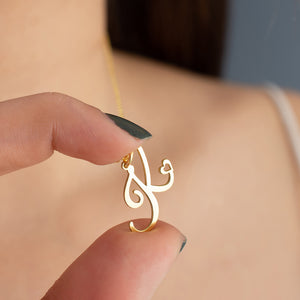
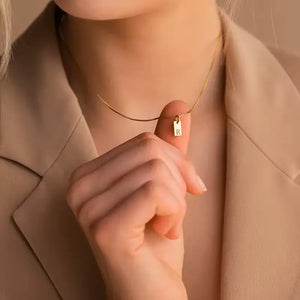
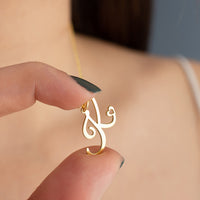
The piece they're describing → Heart Initial Necklace for Women — 18K Gold Plated, Personalized Letter + Heart Pendant
Personalize Yours


