


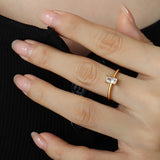
Rings are the one piece of jewelry that does the most work. They signal relationship status, personal identity, cultural affiliation, and aesthetic sensibility — often all at once. A woman wearing rings has made more deliberate choices than anyone looking realizes: which finger, which metal, which width, how many, and whether they stack or stand alone.
This is the complete ring guide for anyone who wants to understand the category thoroughly — whether you're buying your first ring, building a stack, choosing a meaningful gift, or trying to decode what different rings signal. Every section links to our full in-depth guide on that topic for when you want to go deeper.
Every Ring Type Explained
There are more ring types than most buyers realize — and each one has a distinct purpose, style logic, and price tier. Our complete types of rings guide covers every style with visual descriptions, occasion guidance, and buying recommendations. Here's the overview:
Band rings are the foundation of any ring wardrobe — a continuous loop of metal with no stone. Simple bands are the most versatile ring you can own: they work with everything, stack easily, and age beautifully. Width matters: thin bands (1–2mm) are delicate and feminine; medium bands (3–5mm) are substantial but still stackable; wide bands (6mm+) make a statement alone.
Cocktail rings / statement rings are designed to be noticed — oversized stones, dramatic settings, bold silhouettes. They're worn one per hand, never stacked. Index or middle finger, center stage.
Signet rings have a flat top — historically used to press a wax seal with a family crest or initial. Now worn as personal statement pieces, often engraved or monogrammed. Strong historical association with heritage, identity, and authority. See our best signet rings for women guide for specific picks.
Stacking rings are designed to be worn in multiples — thin, delicate bands meant to be combined. The concept is an anchor ring (usually more substantial) with thinner bands layered beside and below it. See our stackable ring combinations guide for specific pairings, or our best stacking rings for women guide for curated sets.
Promise rings signal romantic commitment without formal engagement — a statement of intention between two people. They're worn on any finger, by any gender, at any price point. Our promise ring meaning guide covers what they mean, how they differ from engagement rings, and which finger to wear them on — or see our best promise rings guide for real picks by budget.
Eternity rings feature stones set all the way around the band — symbolizing unending love or commitment. They're given at milestones: marriage, anniversary, birth of a child. The eternity ring meaning guide explains every variation (full vs. half eternity, different stone settings) and their significance.
Thumb rings are worn on the thumb — historically a sign of wealth (a wide, expensive ring on a non-grip finger) or archery skill. Today they signal independence, personal style, and intentional choice. Read the full thumb ring meaning guide for the complete history and modern signaling breakdown.
Pinky rings have the richest symbolic history of any finger — mob associations, signet rings of powerful families, Engineer's Ring tradition in North America, and the LGBTQ+ community's historical use. The pinky ring meaning guide covers every tradition, left vs. right hand differences, and what wearing one signals today.
What Wearing a Ring on Each Finger Means
Every finger carries cultural associations built over centuries. You're not obligated to follow any of them — but knowing them helps you wear rings with intention rather than by accident. Our ring on each finger meaning guide covers all five fingers in depth. The summary:
| Finger | Primary Association | Best Ring Type | Notes |
|---|---|---|---|
| Thumb | Independence, wealth | Wide band, statement ring | No cultural ownership — fully personal |
| Index (pointer) | Authority, confidence | Signet, cocktail, bold band | Visible in gestures; makes a statement |
| Middle | Balance, neutral | Anchor ring for stacks | No specific cultural meaning; central visual position |
| Ring finger | Commitment (West: left hand) | Eternity ring, stacking bands | Right ring finger is free for fashion in most traditions |
| Pinky | Status, affiliation, personal identity | Signet, thin band, statement | Richest symbolic history of any finger |
For the complete breakdown — including left vs. right hand differences, cultural variations by country, and which fingers to use for fashion vs. meaning — read the ring on each finger meaning guide.
Rings for Every Occasion
The right ring for a specific moment isn't just about aesthetics — it's about what you want the ring to communicate and how long it will be worn.
Daily wear. Durability and comfort first. Smooth settings (bezel or flush-set stones) rather than prong-set stones that snag. Simple bands, low-profile stacking rings, and smooth signets all work. Avoid very wide rings on dominant-hand fingers you use for gripping. Mohs 7+ stones (amethyst, topaz, sapphire) or no stone at all for daily wear.
Special occasions and events. Statement rings, cocktail rings, and rings with larger stones earn their moment here. Put them on index or middle finger, alone — they don't need company.
Gifting — commitment. Promise rings and eternity rings are the standard choices. Promise rings sit at a wider price range; eternity rings typically carry more weight and are given at established milestones.
Gifting — birthdays and celebrations. Birthstone rings are the most personal option — the stone carries both color significance and personal meaning. See our full birthstone collection for current options.
Building a long-term ring wardrobe. Start with one thin band in your primary metal. Add a second, slightly different band. Then a third with a small stone or different texture. Stack them before buying more. Three rings is when stacking becomes visible as a style choice. For specific combination recommendations, read the stackable ring combinations guide.
How to Find Your Ring Size — and Why It Changes
Ring sizing is not fixed. Your finger size changes throughout the day (fingers swell in heat, after exercise, and in the evening), across seasons (fingers are measurably larger in warm months), and over years. A ring sized accurately in winter may fit differently in summer.
The standard sizing guidance: measure at the end of the day, at room temperature, when your fingers are at their most typical size. Don't measure when you're cold, just exercised, or first thing in the morning.
Our complete ring size guide covers every measurement method (string method, printable sizer, jeweler measurement), how to convert between US, UK, EU, and Asian sizing systems, how to size knuckle rings, and what to do when your dominant and non-dominant hands are different sizes. It also includes the US-UK-EU size conversion table and a guide to resizing existing rings.

Ring Stacking — The Principles That Make It Work
Ring stacking looks effortless when it's done well and cluttered when it's not. The difference is almost always the anchor principle and a few proportion rules. Our how to stack rings guide and how to wear rings guide cover this in depth. The core rules:
The anchor principle. Every successful stack has one ring that anchors it — typically the widest, most substantial, or most meaningful ring. It goes in the middle of the stack. Thinner bands go above and below it. Without an anchor, stacks look random.
Odd numbers. Three rings or five rings reads as intentional. Two or four reads as incomplete or symmetrical. Three on one finger, or three distributed across fingers of one hand, is the starting point for every stack.
Vary width and texture. All thin bands = monotonous. All wide bands = heavy. Alternating one wider band with two thin bands creates visual rhythm. Mixing a plain band with a textured or stone-set band adds depth.
Balance across hands. If you're wearing three rings on your right hand, one or two on your left keeps the overall look balanced rather than lopsided. You don't need symmetry — you need balance.
For specific ring combination recommendations — what styles, metals, and textures to combine — read the stackable ring combinations guide.
Ring Style Guide — Finding Your Aesthetic
Ring aesthetics fall into four broad categories. Knowing your aesthetic simplifies every buying decision.
Minimalist. Thin bands, 1–2mm width, simple metals, no stone or very small flush-set stone. The goal is a barely-there look that reads as effortless. Yellow gold or sterling silver thin bands stack well for this aesthetic. Two to three bands on the ring finger with nothing else on the hand.
Curated/editorial. The mix-and-match aesthetic — different metals, different textures, different widths, intentionally combined. Rose gold + yellow gold + sterling silver, each band distinct. This is the most common contemporary styling approach and the one that photographs best.
Statement/maximalist. Oversized stones, wide bands, cocktail rings, bold silhouettes. Fewer rings but bigger impact. One statement ring per hand, worn alone on the index or middle finger.
Meaningful/symbolic. Every ring has a reason — a birthstone, a promise, a graduation milestone, a travel memory. The aesthetic is secondary to the meaning. These collections tend to grow gradually over years and tell a personal story.
For full styling guidance — how many rings, which combinations, how to dress rings up or down — read the complete ring styling guide.

Ring Metals — What Each One Means for Durability, Color and Care
Metal choice determines how a ring looks, how long it lasts, and how much care it needs. The four primary options for most jewelry buyers:
Sterling silver (925) is the most accessible fine jewelry metal — real silver content (92.5%), bright white-grey color, works with every stone. It tarnishes over time (oxidizes to grey-black) and requires occasional polishing. For everyday wear, sterling silver rings hold up well. They can be rhodium-plated to resist tarnish.
Gold-plated sterling silver gives you gold color at silver prices — a base of sterling silver (925) with a layer of gold over the surface. The gold layer wears over time; how quickly depends on the micron thickness of the plating and how hard the piece is worn. Replating costs roughly $15–30 and restores it to new.
Solid gold (10K, 14K, 18K) doesn't tarnish, doesn't need replating, and holds its color and value indefinitely. 14K is the standard for everyday jewelry — high enough gold content for warmth and durability, low enough for affordability compared to 18K.
Rose gold gets its warm pink color from copper alloyed with gold. It's not a separate metal — it's a color variation of gold. The copper content makes it slightly more durable than yellow gold at the same karat. Rose gold plating over sterling silver follows the same rules as yellow gold plating.
For metal durability comparisons, tarnish behavior, and care instructions by metal type, see our guides on what jewelry doesn't tarnish and how to clean jewelry at home.
For a look at one specific elongated cut, our marquise ring guide covers how marquise compares to oval and round, plus what to check on CZ vs. diamond claims.
our cross rings for women guide covers a specific motif style, including honest sterling silver and stone-disclosure standards to look for.
For a bold, single-focal-point option, a statement ring covers how it compares to a cocktail ring and how to size one correctly.
our two-tone ring guide covers a specific mixed-finish construction, including what separates an honest plated build from a genuinely dual-metal one.
Not sure a ring will suit you before buying? See how virtual jewelry try-on actually works.
One ring style with a history that predates fashion entirely: read the history of the signet ring.
Even the finger a ring goes on has a backstory: see why it's called the ring finger.
Buying across US, UK or EU sizing? Use our ring size conversion chart to convert accurately.
Frequently Asked Questions About Rings
What finger should I wear a ring on?
There are no rules — only conventions you can follow or ignore. Left ring finger is reserved for commitment jewelry in Western tradition. The middle finger is the best anchor for stacking. The index finger signals confidence. The pinky has the richest symbolic history. The thumb is the most unconventional and personal choice.
How do I find my ring size at home?
Wrap a thin strip of paper around your finger, mark the overlap, measure the length in millimeters, and divide by 3.14 to get the diameter. Match to a ring size chart. Measure at the end of the day. For detailed instructions and a US-UK-EU conversion table, read the ring size guide.
How many rings should I wear at once?
One ring makes the strongest single statement. Three rings is the stacking threshold — where it reads as a deliberate style choice. Four to six rings requires a visual anchor. There's no upper limit, but the question is always whether the combination looks curated or accidental.
Can you mix gold and silver rings?
Yes — mixed metals work when you have a dominant metal. Three gold rings and one silver reads as curated; two gold and two silver often clashes. Rose gold bridges yellow and silver well.
What's the difference between a promise ring and an engagement ring?
A promise ring signals romantic commitment and intention without implying engagement. An engagement ring specifically signals an accepted proposal. Promise rings are simpler, less expensive, and worn on any finger. Read the full promise ring meaning guide for everything you need to know.
How do I keep rings from tarnishing?
For sterling silver: store in airtight bags, keep dry, polish regularly. For gold-plated: avoid water, sweat, and lotions directly on the ring. For all metals: remove before swimming, showering, and exercising. See the full guide to cleaning jewelry at home.
What ring should I buy as a gift?
Birthstone ring or initial ring for a meaningful personal gift. Promise ring or eternity ring for a romantic gift. A thin stackable band in the recipient's preferred metal is the safest universal option — it works with any existing collection.
What does a ring on the right hand mean?
In Western culture, the right hand is free for fashion — no reserved meaning the way the left ring finger has. In Eastern European and South Asian traditions, commitment rings are worn on the right ring finger. Read the full ring on each finger meaning guide.
Final Thoughts
Rings are personal in a way that most jewelry isn't. They're on your hands — the most visible and active part of your body. Every ring you choose, and every finger you wear it on, communicates something. Knowing the conventions lets you use them intentionally: following them when the meaning resonates, ignoring them when your own meaning is more important.
The complete ring wardrobe isn't built in a day. Start with one ring that genuinely means something. Add a thin band that complements it. Build slowly, with intention. The best ring collections always tell a story.
Explore our full ring collection: all rings | stacking rings.
Written by the AJLuxe team. Last updated: May 2026.
All third-party trademarks, brand names and product names are the property of their respective owners. AJLuxe is not affiliated with, endorsed by, sponsored by, or otherwise connected to any third-party brand referenced in this article. Brand names are used solely for accurate comparative reference, and material descriptions reflect each brand's own published product specifications at the time of writing.
You Might Also Like
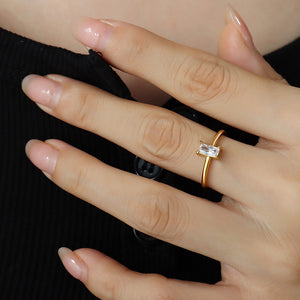

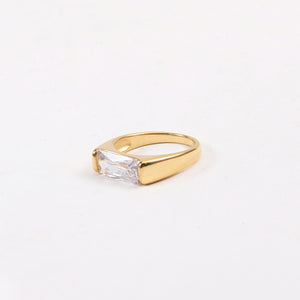
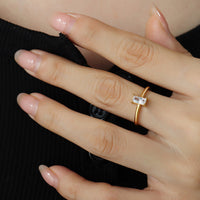
The piece they're describing → Square CZ Wedding Ring for Women — 18K Gold Plated, Princess Cut Cubic Zirconia
Personalize Yours


