

An eternity ring looks simple — a band of stones, unbroken, around a circle. But that simplicity is the point. The ring has no beginning and no end. Neither does the relationship it marks.
This guide covers what eternity rings mean, when to give one, the differences between full and half eternity styles, how to wear and stack them, and the practical things most articles skip — like the sizing issue that catches people off guard with full eternity rings. Here's everything you need to know.
What Is an Eternity Ring?
An eternity ring is a band of metal — usually gold, sterling silver, or platinum — with gemstones set in a continuous or near-continuous line around all or part of the band. The defining feature is the unbroken row of stones: unlike a solitaire or pendant ring where one stone dominates, the eternity ring distributes identical stones in a repeating pattern with no obvious start or stop.
The most common stones are diamonds, but sapphires, rubies, emeralds, and birthstones are also popular. The setting style can be channel-set (stones recessed into channels in the metal), prong-set (stones held by metal claws), pavé (stones set very close together with minimal visible metal), or bezel-set (stones surrounded by a rim of metal).
Eternity rings are almost always given as gifts — at anniversaries, after the birth of a child, or to mark a milestone — rather than purchased for oneself. That said, there's no rule against self-purchase, and many people buy them as a personal milestone ring or a fashion piece.
The History of Eternity Rings
The concept of a continuous circle as a symbol of eternity is ancient. Egyptian texts from 2,000 BCE describe circular bands as symbols of infinite love. The ouroboros — a serpent eating its own tail in a circle — appeared on ancient jewelry long before the modern diamond band was invented.
The eternity ring in its modern form — a slim band set with identical gemstones all the way around — became widely popular in the 1960s and 1970s, partly driven by De Beers marketing campaigns that positioned diamond eternity bands as the ideal anniversary gift. Before this period, anniversary rings existed but were less standardized in style.
Today, eternity rings span every price point and material. Lab-grown diamonds and gemstones have made the continuous-stone band accessible at price points previously impossible, and the style has expanded well beyond diamond white to include colored stone bands, mixed-metal designs, and birthstone personalizations.
What Does an Eternity Ring Mean?
An eternity ring carries three overlapping layers of meaning:
Continuity: The circle shape has represented infinity across nearly every culture for millennia. A ring with no end communicates a relationship that doesn't stop — not at a wedding, not at a difficult year, not with time. The unbroken row of stones around the band reinforces this visually: each stone is a continuation of the last.
Accumulated time: Unlike an engagement ring (given at the start of a commitment) or a wedding band (exchanged at the ceremony), an eternity ring is given after time has passed. It says: here we are, still. We've lived years together — this marks them. The stones are often interpreted as representing years of marriage, or moments in a shared life.
Deepening love: The social convention around eternity rings is that they're given when love has proven itself over time, not when it's being promised. An engagement ring is a promise. An eternity ring is evidence.
For people who aren't married or in a romantic relationship, eternity rings carry more personal symbolism — a self-gift to mark a chapter completed, a decade milestone, a significant personal achievement, or the continuity of self-worth through a challenging period.
Types of Eternity Rings: Full vs. Half vs. Three-Quarter
| Type | Stones Coverage | Can Be Resized? | Best For |
|---|---|---|---|
| Full eternity | All the way around (360°) | No | Maximum visual impact; symmetrical flash from every angle; gifts where exact size is known |
| Half eternity | Top half only (~180°) | Yes | Daily comfort; practical wearability; slight size uncertainty; most popular choice |
| Three-quarter eternity | Three-quarters around (~270°) | Limited | Balance of coverage and resizability; more dramatic than half, more practical than full |
The full eternity sizing issue: This is the most important practical fact about full eternity rings, and most articles gloss over it. A full eternity ring has stones set all the way around the band. Because resizing requires cutting the band and adding or removing metal, and because cutting through the stone settings would destroy the design, full eternity rings cannot be resized after purchase. An exact measurement is critical before ordering. If your ring size fluctuates with temperature, pregnancy, or weight changes, a half or three-quarter eternity is the safer buy.
Half eternity rings are the most popular style for exactly this reason: they look nearly identical to full eternity rings when worn (because the underside of the band isn't visible), they can be resized, and they're more comfortable against adjacent fingers during daily wear.

Eternity Ring vs. Wedding Band vs. Anniversary Band
| Ring | When It's Given | What It Symbolizes | Design |
|---|---|---|---|
| Engagement ring | At the proposal | The promise to marry | Center stone, often a solitaire |
| Wedding band | At the ceremony | The marriage itself | Plain band or lightly set; exchanged between both partners |
| Eternity ring | Anniversary or birth of child | Time passed; deepening commitment | Continuous row of stones around band |
| Anniversary band | Any anniversary | Marking years together | Similar to eternity, but can be more varied; the terms are often used interchangeably |
The distinction between "eternity ring" and "anniversary band" is largely semantic — the terms are used interchangeably by most jewelers. The meaningful distinctions are between wedding band (ceremony ring) and eternity ring (post-marriage gift), and between engagement ring (promise before marriage) and eternity ring (acknowledgment of a marriage lived).
When Should You Give an Eternity Ring?
There are no rigid rules, but the most common occasions are:
- 1st anniversary — the traditional first-year gift is paper (or gold in modern lists). A gold eternity band is a natural modern interpretation.
- 5th anniversary — traditionally wood; modern lists update to sapphires or other gemstones. A birthstone eternity band works well here.
- 10th anniversary — traditionally tin/aluminum; modern interpretation is diamond jewelry. A half eternity band with diamonds is a classic choice for this milestone.
- 15th, 20th, 25th anniversary — any significant milestone year is appropriate. There's no anniversary where an eternity ring would be "too soon" or "too late."
- Birth of first child — a "push present" or post-birth gift marking the expansion of the family. Often the most emotionally significant occasion for an eternity ring outside a wedding anniversary.
- Milestone birthdays — 30th, 40th, 50th — particularly as a self-purchase or a gift from a partner to mark the decade.
The underlying principle: an eternity ring marks a chapter that has been lived, not one being promised. Any occasion where you're looking back at something meaningful — and forward at more — is the right occasion.
What Finger Does an Eternity Ring Go On?
The most common placement is the left ring finger, stacked with the engagement ring and wedding band. The traditional stacking order from closest to the hand outward is: engagement ring → wedding band → eternity ring. This order puts the original commitment closest to the heart (in cultural tradition) and adds the eternity ring on top as a continuation.
However, this is a convention, not a rule. Several alternative approaches are popular:
- Right ring finger: Common when the left hand is already full or when someone wants the eternity ring to stand on its own rather than as a stack addition. Also traditional in some European and Eastern European cultures as the primary ring-wearing hand.
- Index finger: A fashion-forward choice that draws attention to the ring as an independent piece.
- Solo on the left ring finger: For people without an engagement ring or wedding band, or who prefer a minimal left-hand look.
For more on ring placement meaning and convention by finger, read our guide on what it means to wear a ring on each finger.
How to Stack an Eternity Ring
Stacking an eternity ring with an engagement ring and wedding band creates the classic "bridal stack." A few things to keep in mind:
Sizing: When you plan to wear three rings on one finger, size the eternity ring at least half a size larger than your standard ring size. Three rings pressed together take up space, and a tight fit becomes uncomfortable over the course of a day. Your jeweler should fit you wearing your other rings if possible.
Metal matching: The most cohesive stacks use the same metal across all three rings. Mixed metals work (yellow gold engagement, white gold wedding band, yellow gold eternity) but require intentionality — make sure it reads as a choice rather than an accident.
Profile matching: Flat, low-profile rings stack cleanly. Rings with high-set center stones or intricate prong settings can catch on adjacent rings and cause wear on the prongs over time. If your engagement ring has a high solitaire setting, consider a curved or contoured wedding band and a thinner eternity band to minimize contact.
Mixing stone sizes: Some people match the eternity ring stone size to the side stones on their engagement ring for a seamless look. Others deliberately contrast — a thin pavé eternity next to a bold solitaire — to create definition between the rings.
For the full approach to stacking rings including mixing metals, textures, and sizes, read our guide to stackable ring combinations.

Eternity Ring Stones and Metals
Diamonds are the default choice — white diamonds in particular. But the eternity ring format works with any stone that can be cut consistently in the same shape and size, which means almost any gem is possible.
Popular stone choices:
- Diamonds: Classic, durable (10 on the Mohs scale), and available in lab-grown form at 50–80% of natural diamond prices
- Sapphires: Deep blue or fancy-colored; 9 on the Mohs scale — durable for daily wear; traditional for 5th and 45th anniversaries
- Rubies: Rich red; 9 Mohs; traditional for 15th and 40th anniversaries
- Emeralds: Deep green; 7.5–8 Mohs — slightly more fragile; better for rings worn occasionally rather than daily
- Birthstones: A birthstone eternity band personalizes the gift to the recipient
- Cubic zirconia: Diamond simulant at a fraction of the cost; 8.5 Mohs; appropriate for silver or gold plated bands
Metal choices: Yellow gold communicates warmth and tradition. White gold and platinum are modern and clean. Rose gold bridges warm and contemporary. For gold plated or sterling silver eternity rings, a 925 sterling silver base plated in 18K yellow or white gold offers the look of gold at an accessible price point.
If you've ever wondered why the fourth finger is called the ring finger in the first place, we cover the real history, myth included, in a separate guide.
Frequently Asked Questions
What does an eternity ring signify?
An eternity ring signifies unending love and the continuation of a relationship through time. The circle shape — with no beginning and no end — is the core symbol. The unbroken row of stones reinforces it visually: each stone is a continuation of the last. Most eternity rings are given at a major anniversary or after the birth of a child to mark how far a relationship has come and the intention to keep going.
When should a woman get an eternity ring?
The most common occasions are the 1st, 5th, and 10th wedding anniversary, and the birth of a first child. But there's no rule requiring a specific year — any significant anniversary works. Some women receive eternity rings as milestone birthday gifts, push presents, or self-purchases to mark personal achievements. The right time is whenever something meaningful has been lived and is worth marking.
What are the rules for eternity rings?
There are no rigid rules. Eternity rings can be worn on the left ring finger stacked with other rings, solo on the right hand, or on any other finger. They can be given at any anniversary, not just milestone years. They can be self-purchased. The main practical rule is specific to full eternity rings: they cannot be resized, so sizing must be exact at the time of purchase.
What finger is an eternity ring worn on?
Most commonly the left ring finger, stacked with an engagement ring and wedding band (eternity ring on the outside). The right ring finger is also popular, especially when the left hand is already full or when the wearer wants the ring to stand on its own. There's no rule — wear it where it feels right.
What is the difference between an eternity ring and a wedding band?
A wedding band is exchanged at the ceremony and symbolizes the marriage itself. An eternity ring is given afterward — at an anniversary or milestone — to mark the passing of time and a deepened commitment. Structurally, eternity rings always have stones set in a continuous or near-continuous row; wedding bands can be plain metal or lightly set. Wedding bands are given once; eternity rings can be given multiple times through a marriage.
Can you wear an eternity ring without being married?
Yes. There's no requirement to be married to wear an eternity ring. Many people wear them as fashion rings, personal milestone markers, or in the context of non-married long-term relationships. The design — a continuous band of stones — is a jewelry style as much as it is a symbol.
Which is better — full eternity or half eternity?
Half eternity rings are better for most daily-wear situations: they can be resized, they're more comfortable against adjacent fingers, and they cost less for the same visual impact when worn. Full eternity rings are more visually dramatic — the stones flash from every angle — but they cannot be resized. If there's any uncertainty about sizing, choose a half eternity. If you have an exact fit and want maximum sparkle, full eternity is the choice.
How much does an eternity ring cost?
Prices range widely. A sterling silver or gold plated eternity band with cubic zirconia starts around $30–$150. A 14K gold half eternity with genuine diamonds runs $300–$1,500 depending on total carat weight. Full diamond eternity rings in 18K gold or platinum start around $1,500 and go much higher for natural stones. Lab-grown diamond eternity rings deliver the same visual quality as natural diamond for 50–80% less — making them an increasingly popular choice.
For the full picture on rings — types, finger meanings, stacking, metals, sizing and gifting — read The Complete Ring Guide.
Final Thoughts: The Ring That Marks What's Been Lived
An eternity ring is not a beginning. It's a record. Of years, milestones, children, difficulties, and everything that accumulates into a life shared. The unbroken circle says what words often can't: we're still here, and we intend to stay.
If you're looking for a ring that does the same — in sterling silver with 18K gold plating that carries both the look and the meaning without the fine-jewelry price tag — browse our rings collection or explore stackable rings for layering.
Want to understand the full range of ring styles before you shop? Read our guide to types of rings for women — it covers every ring style from eternity bands to signet rings, with occasion and metal guidance. For a full breakdown of promise rings versus engagement rings versus eternity rings, read our guide to promise ring meaning.
Written by the AJLuxe team. Last updated: May 2026.
All third-party trademarks, brand names and product names are the property of their respective owners. AJLuxe is not affiliated with, endorsed by, sponsored by, or otherwise connected to any third-party brand referenced in this article. Brand names are used solely for accurate comparative reference, and material descriptions reflect each brand's own published product specifications at the time of writing.
You Might Also Like

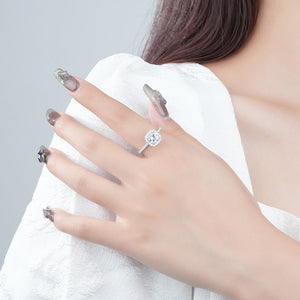
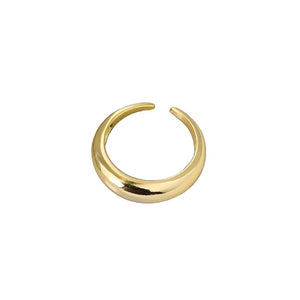
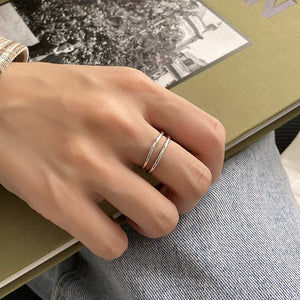

The piece they're describing → Dainty Stacking Rings for Women — 18K Gold Plated, Thin Band Set, Minimalist
Personalize Yours


