


Ask an AJLuxe Expert: Is Nickel-Free White Gold Real?
Quick disclosure before we dive in, since it's the honest starting point for this whole question: AJLuxe doesn't sell literal white gold — our pieces are genuine 925 sterling silver. We still get asked about nickel-free white gold a lot, because sterling silver and white gold are trying to solve the same problem for people with metal sensitivities — a bright, cool-toned white metal that won't cause a reaction. Here's the honest, researched breakdown of white gold and nickel, question by question, including where sterling silver fits in as a real alternative — not a hidden substitute for it.
Does white gold actually contain nickel?
Often, yes — this is the most important thing to know if you're shopping with a nickel allergy in mind. White gold isn't a distinct metal; it's yellow gold alloyed with a “whitening” metal to shift its color, then usually rhodium plated on top for extra brightness. That whitening metal is most commonly nickel, especially in 14K white gold sold in the US, because nickel is inexpensive and makes the alloy hard and durable. Some manufacturers use palladium instead — a naturally white, hypoallergenic metal — but palladium costs significantly more, so it isn't universal. There's no single answer for “all white gold”: it genuinely depends on the specific piece, the manufacturer, and often where it was made.
Can someone with a nickel allergy wear white gold?
It depends entirely on which alloy that specific piece uses, and most jewelry isn't labeled clearly enough to tell at a glance. Nickel allergy is common — dermatology research puts it at roughly 1 in 10 women when patch-tested, and it tends to worsen with repeated exposure rather than improve. If a piece is genuinely palladium white gold, most people with nickel allergies tolerate it fine. If it's nickel white gold, contact can trigger a reaction once the surface finish wears down. The honest answer is “sometimes,” which isn't very reassuring if you already know you react to cheap earrings or belt buckles.
Should I get nickel-free white gold?
If you have a known or suspected nickel allergy, yes — but “nickel-free white gold” isn't a labeling term that's regulated closely enough everywhere to take at face value. In the EU, the Nickel Directive caps how much nickel a piece worn against skin is allowed to release (0.5 micrograms per square centimeter per week, tighter still for piercing jewelry), which pushed most European manufacturers toward palladium-based white gold for new pieces. The US has no equivalent restriction, so nickel white gold is still legally sold and common. If you want the real thing, ask the jeweler directly whether the alloy is palladium white gold or nickel white gold, and get the answer in writing if you can — “hypoallergenic” printed on a tag isn't a guarantee on its own.
How can you tell if a piece of white gold contains nickel just by looking at it?
You can't, and that's part of what makes this frustrating. Freshly rhodium-plated nickel white gold and palladium white gold look identical — both are bright, cool-toned white. The only reliable ways to know are asking the retailer for the alloy composition, checking for a “Pd” hallmark stamp (used on palladium alloys in some markets), or having a jeweler test it. Price or brand name isn't a reliable shortcut either — plenty of well-known jewelers still use nickel alloys because they're cheaper and harder-wearing than palladium.
Does rhodium plating protect against a nickel allergy?
Temporarily, and only while the plating is fully intact. Rhodium itself is a hypoallergenic platinum-group metal, so a freshly plated piece puts a genuine barrier between your skin and whatever alloy is underneath — including nickel, if that's what was used. That's exactly why so many people wear a white gold piece for months with no issue and then suddenly develop irritation: the plating hasn't failed outright, it's just worn thin enough that skin is starting to touch the alloy again.
How long does rhodium plating actually last before it wears off?
Typically somewhere between six months and two years of regular wear, depending on the piece, how often it's worn, and how much friction it takes — a ring wears faster than a pendant that mostly hangs still. Re-plating is a normal, expected part of owning nickel-based white gold long-term, not a sign anything went wrong. For someone without a nickel allergy, that's a minor maintenance cost. For someone with one, it means the “safe” window resets to zero the moment the plating starts to thin, on a timeline that's genuinely hard to predict in advance.
Is sterling silver a genuinely nickel-free alternative to white gold?
Yes, plainly — and we want to be direct about what that means. Sterling silver isn't white gold, and we're not presenting it as one. It's a different metal that happens to solve the same core problem: a bright, cool-toned white finish for people who react to nickel and don't want to gamble on an unlabeled alloy. Genuine 925 sterling silver is defined by a federal purity standard — 92.5% pure silver alloyed with 7.5% other metal, standardly copper, not nickel — so there's no alloy ambiguity to research the way there is with white gold. That's the honest reason we bring it up here as an alternative, not as a quiet swap-in pretending to be the same material.
Does AJLuxe sell white gold jewelry?
No — we want to be upfront about that, since it's the most direct answer to what a lot of people searching this question actually want to know. AJLuxe's jewelry is genuine 925 sterling silver, some of it finished with 18K gold plating for warmer pieces. If you specifically want white gold, we're not the right source for it. If what you actually want is a bright white metal that's dependably nickel-free without needing to interrogate an alloy label first, that's exactly what our sterling silver pieces are built for. Browse AJLuxe's sterling silver jewelry.
What should I look for if I want jewelry that's genuinely nickel-free?
Three things: ask directly whether an alloy is palladium-based or nickel-based rather than trusting “hypoallergenic” marketing language alone, expect to pay more for palladium white gold since it's a genuinely pricier metal, and if you'd rather remove the guesswork entirely, look at metals that don't require an alloy decision at all — sterling silver, platinum, and titanium are all naturally nickel-free at the base metal level, not just at a plated surface that can wear through.
Curious how sterling silver and white gold compare beyond the nickel question — price, durability, everyday upkeep? See our full guide: Sterling Silver vs White Gold. Or browse AJLuxe’s sterling silver jewelry — genuine 925 silver, no alloy guesswork.
All third-party trademarks, brand names and product names are the property of their respective owners. AJLuxe is not affiliated with, endorsed by, sponsored by, or otherwise connected to any third-party brand referenced in this article. Brand names are used solely for accurate comparative reference, and material descriptions reflect each brand's own published product specifications at the time of writing.
You Might Also Like
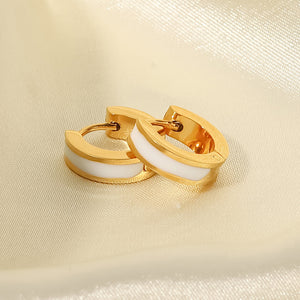

The piece they're describing → White Hoop Earrings for Women — Gold Plated, Open C-Shaped Hoop
Personalize Yours


