


Ask an AJLuxe Expert: Should I Get My Ears Pierced?
Here's what we'd tell you if you asked us directly: “should I get my ears pierced” is really two different questions bundled into one. The medical side — pain, safety, infection risk, healing — belongs to a licensed piercer or doctor, and we're not going to pretend a jewelry brand has any business answering that for you. But the other side — whether it fits your style, what jewelry actually makes sense before and after, and how to think about the decision without overcomplicating it — is territory we do know well. So that's what we're covering here, question by question, and we'll point you to the right expert whenever a question crosses into their territory instead of ours.
Should I get my ears pierced?
That's genuinely a personal call, and we're not going to pretend there's one right answer. What pierced ears give you is options: a much wider range of earring styles than clip-ons or magnetic earrings allow, the ability to build up an ear stack over time — a stud here, a huggie there — and a low-cost way to change your look for years. It's also genuinely optional. If you're not sure yet, non-permanent alternatives like ear cuffs and clip-ons exist for exactly this reason, and they're a real way to test whether you like the look before committing to anything. What we can't tell you is whether it's medically right for you — that depends on your skin, any metal sensitivities, and your own health history, which is a conversation for a piercer or doctor, not a jewelry blog.
Does it hurt, and is it safe?
This is exactly the kind of question we won't guess at. Pain, healing, and infection risk are a licensed piercer's or doctor's territory, not ours, and you deserve a real answer from someone qualified to give one — not a jewelry brand's best guess dressed up as expertise. Ask your piercer directly before you sit down; a good one will walk you through what to expect for your specific ear and piercing type, and a doctor can speak to anything related to your personal health history.
How do I find a piercer I can trust?
We're a jewelry brand, not a piercing authority, so we're not going to rate specific studios or techniques for you — but there are some non-medical, consumer-facing things worth checking before you book anywhere: a properly licensed studio, a piercer who's happy to answer questions about their process and the jewelry they use, a portfolio of healed (not just fresh) piercings, and real reviews from past clients. The Association of Professional Piercers (safepiercing.org) publishes consumer guidance on exactly this, and it's worth a read before you choose a studio — that's the real authority here, not us.
What earrings should I start with, and what should I wear once it's healed?
The very first piece is your piercer's call, not ours — most professional studios pierce with implant-grade jewelry chosen specifically to support healing, and you shouldn't swap it out until your piercer tells you it's ready. Once you get that green light, that's where material starts to matter for everyday comfort: nickel is one of the most common causes of ordinary earring irritation, so hypoallergenic options like 925 sterling silver or 18K gold-plated pieces are worth looking for as your first “real” earrings. Browse AJLuxe’s hypoallergenic earrings if you want options that are gentle on sensitive ears once your piercer has cleared you to change your jewelry.
Will pierced ears actually fit my style?
For most people, yes — lobe piercings are one of the most versatile accessory decisions there is. Simple studs work for everyday and office wear, hoops and huggies dress a look up, and you can add a second or third piercing later to build out a stack, all without changing anything else about how you dress. If you're still on the fence, you don't have to decide permanently right away — our ear cuff guide for non-pierced ears covers a genuinely good way to test the layered-ear look before committing to a needle at all.
How much does it typically cost?
Prices vary a lot by location and studio, and a dedicated piercing studio is usually more expensive than a mall kiosk or jewelry counter. As a general piece of consumer advice: that price gap often reflects real differences in training, equipment, and jewelry quality, so the cheapest option isn't necessarily the best value for something that stays on your body while it heals. It's worth asking upfront for the full price, since most studios charge separately for the piercing service and the actual starter earring.
How long until I can change my earrings?
Healing time isn't something we're going to put a number on for you. It depends on the piercing type, your own healing, and your piercer's specific aftercare plan, and it genuinely varies from person to person. Your piercer will give you a realistic timeline for your ear specifically, and that's the timeline to trust over anything you read online, including this article.
What if I get it done and decide I don't like it?
That's a completely reasonable thing to think about beforehand, and it's worth asking your piercer about your options if it happens. If the idea of a longer-term decision makes you hesitant in the first place, that's a good reason to start with a non-permanent option instead — a well-made ear cuff can give you a very similar layered look with zero commitment, and it's honestly a great way to “try on” whether you'd want a second or third piercing before you actually go get one.
What should my starter earrings be made of?
This one is squarely in our lane. Most licensed studios pierce with implant-grade steel or titanium specifically because it's inert and low-reaction during the healing window, and that's the right call for the piercing itself — don't swap it out early just to switch to a "nicer" metal. Once you're cleared to change jewelry, nickel is the most common cause of ongoing irritation in everyday earrings, so hypoallergenic 925 sterling silver or genuinely plated 18K gold is worth prioritizing over cheap costume-grade alloys, which often contain nickel even when they're marketed as "gold-tone" or "silver-tone." If your ears still feel irritated weeks after healing with a metal you switched to, that's a signal to go back to a hypoallergenic material, not a sign something's wrong with piercing itself.
Should my first earrings be flat-back or butterfly-back?
Flat-back studs are the more comfortable choice for a fresh piercing, since the flat disc sits close to the ear and doesn't catch on pillows or hoodies the way a standard butterfly-back post can during the first few weeks. Once healed, that stops mattering much and it becomes purely a style preference — both back types work fine for daily wear afterward. If you sleep on your side, a flat-back starter earring is the small, practical detail most first-timers don't think to ask their piercer about.
How do I know my piercing is actually ready for a jewelry change?
Again, the piercer's timeline is the one to trust, not a generic number — but the practical signal most people look for is that the piercing no longer feels tender to the touch and there's no visible discharge, crusting, or redness for at least a few days straight. Even once it looks healed on the surface, a piercing channel keeps maturing internally, which is part of why some piercers recommend waiting past the point it stops hurting before the first swap. When in doubt, ask at your follow-up rather than guessing from what you've read.
For more on choosing your first earrings, see our guides to best hypoallergenic earrings and types of ear piercings. And if you'd rather test the look before committing to anything, our ear cuff guide for non-pierced ears is a great place to start.
All third-party trademarks, brand names and product names are the property of their respective owners. AJLuxe is not affiliated with, endorsed by, sponsored by, or otherwise connected to any third-party brand referenced in this article. Brand names are used solely for accurate comparative reference, and material descriptions reflect each brand's own published product specifications at the time of writing.
You Might Also Like
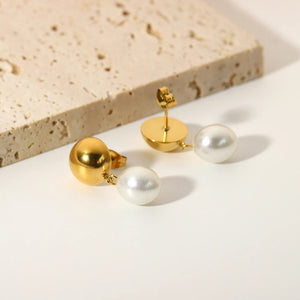
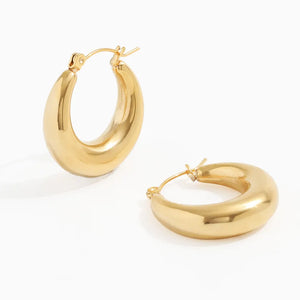


The piece they're describing → Heart Initial Necklace for Women — 18K Gold Plated, Personalized Letter + Heart Pendant
Personalize Yours


