


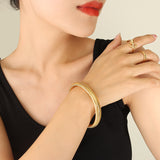
Ask an AJLuxe Expert: Will Gold Plated Jewelry Fade?
Here's what we'd tell you if you asked us directly: “will it fade” is one of the most common and most misunderstood questions about gold plated jewelry, because “fade” isn't really what happens. Whether you already own a gold plated piece or you're deciding whether to buy one, the honest answer depends more on the metal hiding under the gold than on the gold itself. Here's the real breakdown, question by question.
Will gold plated jewelry actually fade?
Yes, but “fade” is slightly the wrong word for what actually happens. The thin layer of gold on the surface doesn't lose its color the way fabric fades in sunlight. Instead, the layer physically thins from everyday friction — against skin, clothing, other jewelry — until the base metal underneath starts to show through in high-contact spots like a clasp or the back of a pendant. How fast that happens, or whether it happens at all within a normal wearer's lifetime, depends almost entirely on the metal underneath the gold, not the gold itself.
How long will gold-plated jewelry last?
With normal daily wear and basic care — taking it off before showering, swimming, or sleeping when you can — most quality gold plated pieces hold their color well for 1 to 3 years before any noticeable change. Plenty of people wear the same piece for 4 to 5 years with no visible issues at all. The range is wide because it depends on the plating thickness (typically 0.5 to 2.5 microns on well-made pieces), how often the piece is worn, and what it rubs against — a ring takes more friction than a pendant that mostly hangs still.
How long does it take for gold plating to fade?
There's no fixed clock — plating doesn't fail on a schedule. A piece worn daily and never removed for showering, workouts, or sleep can show wear in a matter of months; the same piece worn occasionally and cared for properly can look essentially new for years. “How long” is really a question about how a piece is worn and stored, not a fixed property of gold plating itself.
Can I shower with gold-plated jewelry?
You can, but we wouldn't make it a habit. Soap, shampoo, and hot water don't damage the gold layer directly, but they add to the everyday friction and chemical exposure that eventually wears any plating thin — and chlorinated or heavily softened water can be harder on it than plain tap water. If you want a piece to last as long as possible, the simplest rule is: last thing off before you shower, first thing back on once you're dressed.
How do you keep gold-plated jewelry from fading?
Three things matter most: keep it dry (off for showering, swimming, and sweaty workouts), keep it away from concentrated chemicals (perfume, lotion, and hairspray applied directly onto the piece rather than before it goes on), and store it properly — flat or hanging, away from other jewelry that can scratch the surface, ideally in a soft pouch or lined box rather than loose in a drawer. None of this is complicated, and it can meaningfully stretch how long a piece looks new.
Does gold-plated jewelry fade faster in water, or is it really just about everyday wear?
Both play a role, but everyday wear is the bigger factor. A splash of water or being caught in the rain isn't going to visibly damage plating on its own. What actually accelerates wear is the combination — water plus friction, like toweling off while still wearing a ring, or water plus chemicals, like chlorine, salt water, or minerals in hard tap water sitting on the surface as it dries. Treat water less as an outright enemy and more as a reason to be a little more careful in the moment.
Does 14K gold plating fade faster than 18K?
The karat number describes the purity of the gold alloy in the plating layer, not directly its thickness, but in practice 18K plating tends to hold its warmer, richer color slightly longer than 14K, since it contains a higher percentage of pure gold and is a little less prone to the subtle color shift that lower-karat alloys can show with prolonged exposure to air and skin oils. It's a secondary factor, though — plating thickness and the base metal underneath still matter more than the karat number alone.
What's the difference between “gold plated” and “gold vermeil” — does it change how fast it fades?
Yes, meaningfully. “Gold plated” can legally mean gold over almost any base metal, including inexpensive brass or copper alloys. “Gold vermeil” is a regulated term under FTC jewelry guidelines that specifically means gold plated over sterling silver, with a minimum gold thickness. Because sterling silver doesn't corrode the way brass or copper can, vermeil pieces tend to age more gracefully — even once the gold layer eventually thins in a high-contact spot, what's underneath still looks like a precious metal instead of the dull, yellow-green tinge that can show through on a brass or copper base.
If my gold-plated jewelry does fade, can anything be done, or is it ruined?
It's not ruined. A piece with a good base metal, like sterling silver, can usually be professionally re-plated and come back looking essentially new, since the underlying structure hasn't actually changed — only the surface layer thinned. That's one more reason the base metal matters more than most people expect when deciding what to buy in the first place: a vermeil piece is worth re-plating because there's real sterling silver underneath, in a way a bargain piece over an unknown base metal usually isn't. Browse AJLuxe's gold vermeil jewelry — 18K gold over 925 sterling silver — if that kind of longevity matters to you.
For the full chemistry, timeline, and prevention breakdown, see our complete guide: Does Gold Plated Jewelry Tarnish?
All third-party trademarks, brand names and product names are the property of their respective owners. AJLuxe is not affiliated with, endorsed by, sponsored by, or otherwise connected to any third-party brand referenced in this article. Brand names are used solely for accurate comparative reference, and material descriptions reflect each brand's own published product specifications at the time of writing.
You Might Also Like

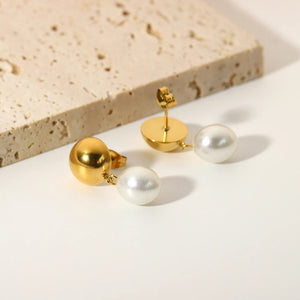
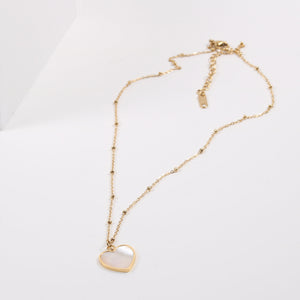
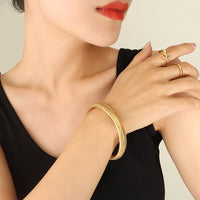
The piece they're describing → Gold Elastic Bangle Bracelet for Women — 18K Gold Plated, Stretch Fit, Stackable
Personalize Yours


