



Last updated: September 2026
Why Is It Called the "Ring Finger"?
The fourth finger on the left hand carries a wedding ring in most Western countries today, and the belief that gave it its name is a genuine, well-documented piece of history: a supposed vein running straight from that finger to the heart. It's a myth in the technical sense, a widely held belief that isn't scientifically accurate, but it's also a real historical artifact you can trace through Roman writers, medieval physicians, and church wedding rites. Here's what people actually believed, what anatomy actually shows, and how the finger kept its name even after the vein theory fell apart.
The Vena Amoris: Where the Belief Came From
The belief traces back to ancient Egypt and was carried forward by the Romans, who gave it its Latin name: vena amoris, the "vein of love." The idea was specific: a single vein was thought to run directly from the fourth finger of the left hand straight to the heart, making that finger the natural place to wear a ring symbolizing romantic commitment.
The clearest early written record comes from the 7th century, when the Christian scholar Isidore of Seville recorded the Roman belief in his writings. The Latin phrase "vena amoris" itself is documented later still: the earliest known use traces to the English ecclesiastical lawyer Henry Swinburne, whose treatise on marriage law was published in 1686, well into the medieval-to-early-modern period rather than antiquity itself. In other words, the underlying belief is ancient, but the exact phrase that's often quoted today is centuries newer than the Romans who supposedly coined it.
Whichever version you trace, the belief did real cultural work: it gave people a tidy, romantic explanation for a custom (wearing a ring on that specific finger) that needed an origin story, and "a vein tied straight to your heart" is a far more compelling reason than "because that's just where we've always put it."
What Real Anatomy Actually Shows
There is no special vein connecting the fourth finger to the heart. Every finger on the hand returns blood to the heart through essentially the same venous network: blood from all five fingers drains into the same system of veins in the hand and forearm before eventually reaching the heart, with no finger enjoying a private, direct line that the others lack.
The science that put this to rest arrived well after the belief had already taken hold. The physician William Harvey didn't correctly describe how blood actually circulates, leaving the heart and returning to it through a closed network shared by the whole body, until the 17th century. Before that, understanding of circulation was incomplete enough that a "special vein of love" wasn't an obviously wrong claim to make. Once circulation was properly mapped, the idea that one specific finger had privileged plumbing to the heart didn't hold up, but by then the custom of wearing the ring there was already well established and didn't need the anatomy to survive.
So Why the Fourth Finger, Really?
The real reason the ring stayed on that finger has more to do with tradition and religious ritual than biology, and it varies by culture. In medieval Western Europe, Christian wedding ceremonies built the placement directly into the liturgy: the officiant (or groom) would touch the ring to the bride's thumb, index finger, and middle finger in turn, invoking "the Father," "the Son," and "the Holy Spirit," before finally sliding the ring onto the fourth finger on the word "Amen." That ritual sequence, documented in English, Norwegian, and Spanish wedding customs, reinforced the fourth-finger placement generation after generation, independent of whether anyone still believed the vein story.
The custom isn't universal, either, which is itself evidence that it was never really about anatomy. Which hand the ring goes on varies by country and religion: many Eastern Orthodox and Catholic-majority countries in Eastern Europe (including Russia) place the wedding ring on the right hand rather than the left. Traditional Indian custom also favors the right hand, since the left hand is considered ritually unclean in many Hindu communities, and in some Hindu traditions a toe ring, not a finger ring, is the primary marriage symbol for women. If a single vein really ran from one specific finger to the heart, the custom wouldn't be able to flip hands, or skip the hand entirely, from one culture to the next.
Myth vs. Fact: Quick Comparison
| Belief | What was claimed | What's actually true |
|---|---|---|
| Vena amoris (vein of love) | A vein runs directly from the fourth finger to the heart | No such direct vein exists; venous return from all fingers is essentially the same |
| Origin | Widely attributed to the ancient Egyptians and Romans | The belief is genuinely ancient, but the Latin phrase "vena amoris" is first documented in a 1686 English legal text, not a Roman one |
| Why the custom persisted | Assumed to be rooted in anatomy | Reinforced by medieval Christian wedding liturgy (the "Father, Son, Holy Spirit, Amen" ring sequence), independent of anatomy |
| Which hand | Assumed to be universal | Varies by country: left hand in the US and much of Western Europe, right hand in Russia, Germany after marriage, and much of Eastern Orthodox and Hindu tradition |
Shop Rings at AJLuxe: 18K Gold Plated Statement Ring →
For more on the symbolism behind this finger across cultures, see our full ring finger meaning guide.
Related reading: The real history of mourning jewelry.
Frequently Asked Questions
Is the vena amoris real?
No. The vena amoris, or "vein of love," was a belief held by ancient Egyptians and Romans that a vein ran directly from the fourth finger to the heart. Modern anatomy has confirmed there is no such direct vein: venous return from every finger runs through the same shared network in the hand and forearm, not a private line from one finger.
Why do we wear wedding rings on the ring finger?
Mostly tradition, not anatomy. The vena amoris myth is the romantic origin story most people know, but the custom was reinforced for centuries by Christian wedding liturgy, in which the ring was symbolically touched to the thumb, index, and middle fingers before being placed on the fourth finger for the final "Amen." The vein belief and the ritual placement reinforced each other long after physicians understood the vein claim wasn't accurate.
Did the Egyptians or the Romans start the vena amoris belief?
Both are credited, depending on the source. The underlying idea is generally traced to ancient Egypt and then carried forward by the Romans, who are usually credited with the Latin name. The specific Latin phrase "vena amoris" itself doesn't appear in the written record until much later, in a 1686 English legal text on marriage, so the exact wording is newer than the ancient belief it describes.
Does every finger really have the same vein connection to the heart?
Yes. All the fingers drain blood into the same shared venous system in the hand, which then returns to the heart through the larger veins of the arm and torso, the same path used by blood from every other finger. There's no anatomical basis for treating one finger differently from the rest.
Do all cultures wear the wedding ring on the same finger and hand?
No. While the fourth finger of the left hand is standard in the US, UK, and much of Western Europe, many countries place it on the right hand instead, including Russia and other Eastern Orthodox and Catholic countries in Eastern Europe, as well as traditional Indian custom. Germany traditionally moves the ring from the left hand (engagement) to the right hand (marriage). That variation is one of the clearest signs the fourth-finger custom was never really about a unique vein.
Final Thoughts
The "ring finger" got its name from a belief people sincerely held for centuries, not from an anatomical fact. That's part of what makes it worth knowing: the vena amoris story is a real piece of documented history, tracing from ancient Egypt through Roman writers through medieval church ritual, even though the vein itself was never there. The custom of wearing a ring on that finger long outlived the belief that explained it, which says more about the staying power of tradition and ceremony than it does about human anatomy.
At AJLuxe, we make rings people actually wear every day, on whichever finger and hand feels right to them, not because of a myth about veins, but because a ring is a small, wearable way to mark something that matters.
Written by the AJLuxe team. Last updated: September 2026.
Sources: Vena amoris (Wikipedia, citing historical and anatomical sources), Ring finger (Wikipedia), Wedding ring customs by country (Wikipedia).
Shop Rings at AJLuxe: 18K Gold Plated Statement Ring →
All third-party trademarks, brand names and product names are the property of their respective owners. AJLuxe is not affiliated with, endorsed by, sponsored by, or otherwise connected to any third-party brand referenced in this article. Brand names are used solely for accurate comparative reference, and material descriptions reflect each brand's own published product specifications at the time of writing.
You Might Also Like
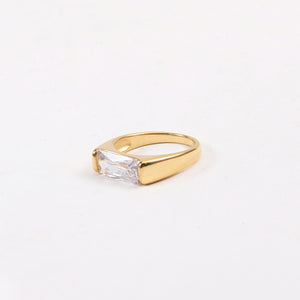


The piece they're describing → 18K Gold Plated Statement Ring — Tarnish-Resistant CZ
Personalize Yours


