


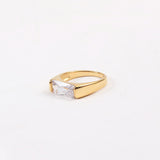
TL;DR: "Why is gold soft" and "what does karat mean" are really the same question. Karat measures the proportion of pure gold in a piece, and pure gold's own atomic structure is what makes it soft in the first place. Alloying gold with harder metals is the standard way to make it durable enough for daily-wear jewelry, and the karat number tells you exactly how much of that trade-off was made. This guide explains the actual metallurgy, not just the price difference, behind 24K, 18K, and 14K gold.
Why Pure Gold Is Soft, at the Atomic Level
Pure gold is soft because its atoms are arranged in a simple, highly regular crystal structure called a face-centered cubic lattice, and that structure allows layers of atoms to slide across one another with relatively little resistance.
Metals deform (bend, dent, scratch) when planes of atoms shift position relative to each other, a process materials scientists call slip. In a pure metal made of only one kind of atom, all packed in a uniform, repeating pattern, those planes are free to glide past each other fairly easily, because every atom is the same size and every gap is the same shape. Gold's face-centered cubic structure is especially prone to this kind of easy slip, which is a major reason pure gold ranks so low on hardness scales, typically cited around 2.5 to 3 on the 10-point Mohs scale, softer than a fingernail can sometimes scratch.
This isn't a flaw in gold, it's simply what an extremely pure, single-element metal does. The same softness is also part of why gold is so workable, it's one of the most malleable and ductile metals known, which is exactly why goldsmiths have been able to hammer, stretch, and shape it for thousands of years.
What "Karat" Actually Measures
Karat measures the proportion of pure gold in an alloy, out of 24 parts total, not a grade of quality or a brand tier.
24 karat (24K) gold is defined as pure gold, essentially as close to 100% gold as commercially achievable. Every karat number below that represents a fraction of 24: 18K gold is 18 parts gold to 6 parts other metal, or 75% pure gold. 14K gold is 14 parts gold to 10 parts other metal, about 58.3% pure gold. 10K, the lowest karat commonly sold as "gold" in the US, is about 41.7% pure gold, which is also the minimum purity the FTC's Jewelry Guides allow to be marketed as gold in the United States.
| Karat | Approx. % Pure Gold | Common Use |
|---|---|---|
| 24K | ~99.9% | Bullion, investment bars, rarely worn jewelry |
| 22K | ~91.7% | Traditional/ceremonial jewelry in some regions |
| 18K | 75% | Fine jewelry, gold plating layers |
| 14K | 58.3% | Everyday-wear fine jewelry (common in the US) |
| 10K | 41.7% | Budget fine jewelry, lowest US legal minimum |
For more on how 18K and 14K specifically compare on price and everyday performance, see our 18K vs 14K gold plating guide.
Why Alloying Makes Gold Harder
Alloying makes gold harder because mixing in atoms of a different size than gold's own disrupts the regular, easy-sliding crystal lattice that makes pure gold soft.
When metals like copper, silver, or zinc are melted together with gold, their atoms distribute through gold's crystal structure. Because those atoms are a different size than gold atoms, they distort the once-uniform lattice, creating irregularities that make it physically harder for atomic planes to slip past each other. Metallurgists call this solid-solution strengthening, and it's the same basic mechanism used to harden many other metal alloys, not something unique to gold. The more alloy metal is added (the lower the karat), the more disrupted the lattice becomes, and generally, the harder and more scratch-resistant the resulting metal is.
This is also why the specific alloy matters, not just the karat number. 14K yellow gold, 14K white gold, and 14K rose gold all contain the same proportion of pure gold, but different alloy metals (nickel or palladium for white gold, more copper for rose gold), which is part of why different gold colors can feel slightly different in hardness and why white gold is often extra strengthened with rhodium plating on top.
18K vs 14K: Which Is Actually Harder?
14K gold is generally harder and more scratch-resistant than 18K gold, because it contains a higher proportion of alloy metal and less pure gold.
This runs counter to a common assumption that higher karat automatically means a "better" or more durable piece. In terms of pure metallurgical hardness, the opposite is true: 18K's higher gold content (75%) makes it noticeably softer than 14K's (58.3%), which is why 18K pieces are somewhat more prone to fine scratches over years of daily wear, while still being valued for their richer, warmer color and higher precious-metal content. Neither is objectively "better," they're a genuine trade-off between color and gold content on one side and hardness on the other, which is why the right choice depends on how a piece will actually be worn, not on karat alone.
Does Harder Always Mean Better for Jewelry?
No, more hardness isn't automatically the right choice, because hardness is only one of several properties that matter for how jewelry looks and wears over time.
A ring worn daily benefits more from scratch resistance than a pendant that mostly just hangs still, which is part of why rings are more often made in lower, harder karats while richly colored high-karat gold is more common in less friction-prone pieces. Gold plating adds another layer to this trade-off entirely, since the plating layer's own karat affects its color and how it develops a patina, separate from the hardness of whatever base metal sits underneath it. For the mechanics of how that plating layer is actually applied, see our guide on how gold plating actually works.
Shopping With Karat Hardness in Mind
If you're weighing 18K's richer color against everyday scratch resistance, 18K gold-plated pieces over a 925 sterling silver base offer that warmer tone without the cost of solid gold. See our 18K gold plated statement ring as an example of that combination.
Frequently Asked Questions
Why is gold so soft but heavy?
Softness and weight (density) are separate atomic properties. Gold is soft because its crystal lattice allows atomic planes to slide easily, but it's dense because gold atoms themselves are heavy and pack tightly together, and neither property determines the other.
Is 14K or 24K gold softer?
24K gold is softer. It's pure gold with no alloy metals disrupting its crystal structure, while 14K gold's alloy content (about 41.7% non-gold metal) makes it meaningfully harder and more scratch-resistant.
Why is gold so soft?
In its pure (24K) form, gold's atoms sit in a simple, regular crystal lattice that lets layers of atoms slide past each other with relatively little resistance, which is what makes pure gold one of the softer, most malleable common metals.
Is 100% pure gold soft?
Yes. Pure (24K) gold is soft enough that it can be dented or scratched by everyday objects, which is exactly why almost all gold jewelry, apart from bullion, is made from a harder, alloyed karat like 18K, 14K, or 10K rather than 24K.
All third-party trademarks, brand names and product names are the property of their respective owners. AJLuxe is not affiliated with, endorsed by, sponsored by, or otherwise connected to any third-party brand referenced in this article. Brand names are used solely for accurate comparative reference, and material descriptions reflect each brand's own published product specifications at the time of writing.
You Might Also Like
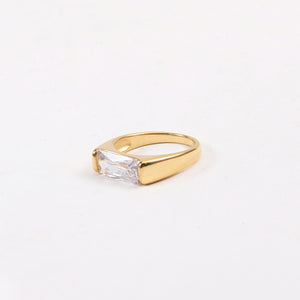

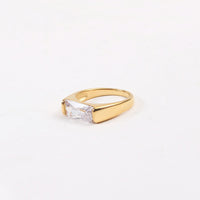
The piece they're describing → 18K Gold Plated Statement Ring — Tarnish-Resistant CZ
Personalize Yours


