


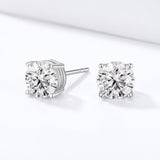
Stud earrings are the foundation of every jewelry collection. Simple, elegant, and endlessly versatile — they work with everything from casual jeans to a formal gown. But "stud earring" covers a surprisingly wide range of styles, materials, and closures. Here's the complete guide.
What Are Stud Earrings?
Stud earrings are earrings that sit flush against the earlobe, with no chain, hoop, or hanging piece — just a decorative top and a post that passes through the piercing. The post locks in place from behind with a clasp, most often a butterfly back, screw back, or flat back.
That no-dangle design is what separates a "stud" from every other earring category — drops, hoops, huggies, threaders. It's also why studs read as understated rather than statement: nothing moves or catches the light except the front-facing piece itself. That's why studs are the most universally worn earring type: comfortable, low-profile, and appropriate in virtually every setting, from a new piercing to the office to a formal event.
Types of Stud Earrings by Style
There are eight main types of stud earrings, each suited to different piercings, budgets, and occasions:
1. Classic Solitaire Studs
The original stud — a single stone (or metal ball) in a prong or bezel setting, centered on the earlobe. Round brilliant is the most popular cut, but oval, square, and cushion cuts are also common. Solitaire studs in CZ or clear stones are the closest affordable alternative to diamond studs — same visual effect at a fraction of the price.
2. Shaped Studs
Heart, star, moon, flower, leaf, butterfly — shaped studs add personality while keeping the low-profile silhouette of a classic stud. These work especially well as stacking pairs in cartilage piercings (helix, tragus, conch) where the small size reads as jewelry rather than hardware. For a closer look at the leaf category specifically, our leaf earrings buying guide covers real prices across the market and what to check before buying a pair.
3. Birthstone Studs
Studs featuring each month's birthstone — amethyst (February), aquamarine (March), emerald (May), ruby (July), sapphire (September), etc. Birthstone studs are one of the most popular gift categories because they're personal without requiring engraving. For everyday wear, CZ birthstone alternatives in the correct color are more durable than natural stones in small stud settings. See our birthstone stud earrings guide for the full month-by-month breakdown, real prices, and styling tips.
4. CZ Studs
Cubic zirconia studs deliver diamond-like sparkle at accessible prices. In sizes 4mm–8mm, a well-cut CZ in a sterling silver setting is visually indistinguishable from a diamond at conversational distance. CZ studs in 18K gold-plated 925 sterling silver are the best combination of sparkle, durability, and value.
5. Crown-Set Studs
Crown setting (also called claw or prong setting) holds the stone in a raised basket of metal prongs. This maximizes light entry to the stone and creates more sparkle. The tradeoff: prongs catch on hair and fabric more easily. Crown-set studs work best for occasional or formal wear rather than everyday use.
AJLuxe makes a 1-carat crown-set CZ stud in 18K gold plated 925 sterling silver if you want the sparkle without the prong-snag risk on a thin band.
6. Bezel-Set Studs
Bezel setting encircles the stone completely in a band of metal, flush with the surface. More secure than prong settings, less likely to catch on clothing. Bezel studs have a sleeker, more modern profile and are ideal for active wear or sensitive ear piercing spots (cartilage) where prong snags are more disruptive.
7. Cluster Studs
Multiple smaller stones arranged in a cluster pattern — typically a center stone surrounded by smaller stones — to create the impression of a larger, more complex piece. Cluster studs are visually striking without the weight or cost of a large single stone.
8. Flat-Back Studs (Threadless Studs)
Flat-back studs are specifically designed for sensitive ears and new piercings. The post ends in a flat disc (rather than a butterfly or screw mechanism) that sits flush against the back of the ear — eliminating the sharp post tip and the butterfly that can irritate healing piercings. These are the recommended standard for cartilage piercings and for anyone with chronic ear sensitivity.
Stud Earring Closure Types
| Closure Type | How It Works | Best For | Watch Out For |
|---|---|---|---|
| Butterfly / push-back | Butterfly-shaped clasp squeezes onto post | Standard everyday wear | Can irritate new piercings; post tip can scratch |
| Screw-back | Butterfly screws onto threaded post | Fine jewelry, active wear; most secure | Slower to put on/take off |
| Flat-back / labret | Flat disc backs; front piece pins into hollow post | Sensitive ears, new piercings, cartilage | Requires a tool to change tops; less common |
| Friction / post-and-nut | Tension holds butterfly on smooth post | Everyday, affordable range | Less secure than screw-back; can fall off |
Stud Earring Metals — What to Look For
The metal matters more for earrings than almost any other jewelry type because posts sit inside your piercing — direct contact with skin and tissue.
| Metal | Safe for Sensitive Ears? | Notes |
|---|---|---|
| 925 sterling silver | ✅ Yes | Hypoallergenic, durable, the safest everyday metal |
| 18K gold plated over 925 | ✅ Yes | Safe: silver core, gold surface. Plating wears over 1–2 years |
| Surgical steel | ✅ Usually | Good for new piercings; contains trace nickel (rarely causes issues) |
| Titanium | ✅ Best for allergies | Nickel-free, gold-colored options available |
| Gold-plated over brass | ⚠️ Maybe | Brass contains zinc + copper; can cause reactions as plating wears |
| Mystery alloy / "alloy" | ❌ No | Often contains nickel; responsible for most earring reactions |
Stud Earring Size Guide
Size matters more for studs than most people realize. The "right" size depends on your lobe size, personal style, and occasion.
- 3–4mm: Very small — looks subtle, childlike, or minimalist. Best for upper cartilage piercings or as one element in a stacked lobe look. Barely visible from distance.
- 5–6mm: The most versatile everyday size. Visible and elegant without being large. The "default" stud size for most people.
- 7–8mm: Statement-forward for a stud. Clearly visible, works for professional settings. Good for heavier occasions.
- 9–10mm+: Bold statement stud. Best reserved for formal occasions or a curated fashion look. Can look heavy on smaller lobes.
As a general rule: the larger your earlobe, the larger the stud can be before looking disproportionate. A 5mm stud on a small lobe reads like a statement; the same stud on a larger lobe reads as subtle.
How to Choose the Right Stud Earrings
- Start with your lifestyle: Do you wear earrings every day? Go for bezel-set or flat-back in sterling silver — durable, comfortable, hypoallergenic. Occasional wear only? Crown-set studs with more sparkle make sense.
- Consider your piercing health: New or irritated piercings → flat-back studs in sterling silver or titanium only. Fully healed piercings → any high-quality metal.
- Match to your wardrobe: Silver metals complement cooler skin tones and blues/greens/grays. Gold metals complement warmer skin tones and earth tones/warm colors.
- Choose a size for your lobe: When in doubt, 5–6mm is universally flattering and versatile.
- Think about stacking: If you have multiple piercings, plan your stud collection as a set — a 3mm at the top, 5mm in the middle, and 7mm at the lobe creates a beautiful graduated stack.
Browse all stud earrings →
Related Guides
- Best stud earrings for sensitive ears — what metals are actually safe
- How to wear stud earrings — putting them in, stacking, and care
- Stud vs hoop earrings — which is better for you?
- Gold stud earrings guide — what "gold" actually means
- Flat-back earrings guide — what they are and why they're better
- Best hypoallergenic earrings — nickel-free picks by material and price
How to Find a Safe Place to Get Your Ears Pierced
The safest way to find an earring piercing location is to search for a licensed professional piercer at a dedicated piercing studio or tattoo shop — not a mall kiosk or jewelry-counter piercing gun — since studios use single-use, individually sealed sterile needles and follow bloodborne-pathogen sterilization protocols that piercing guns can't meet (guns can't be fully sterilized between customers and crush tissue rather than cleanly puncturing it). The Association of Professional Piercers (APP) publishes safety standards for the industry and runs a member piercer locator, which is a more reliable starting point than a generic "earring piercing near me" search.
What to check before you sit down in the chair:
- Ask what jewelry they insert first. A reputable piercer uses implant-grade titanium, niobium, or solid 14k+ gold for the initial piercing — never nickel-alloy or gold-plated starter studs. A fresh piercing is an open wound, and it reacts to a low-quality metal faster and more severely than healed skin does.
- Confirm they use a single-use needle, not a piercing gun. Needle piercing is more precise, causes less tissue trauma, and the needle is disposed of immediately after use — ask to see it opened from sealed sterile packaging in front of you.
- Look for visible sterilization equipment (an autoclave, not just alcohol wipes) and a piercer who changes gloves between clients.
- Read reviews for healing outcomes, not just the piercing appointment itself. Infection, migration, and keloiding show up weeks later — that's the feedback that actually tells you if a studio is careful.
Once the initial piercing has fully healed — several weeks for lobes, considerably longer for cartilage, and your piercer will confirm you're ready — that's the point to move out of starter jewelry and into your own stud collection, where the metal and closure guidance above applies.
Shop AJLuxe Oval CZ Stud Earrings
925 sterling silver, left unplated -- the "925" hallmark is stamped right on the post. Oval-cut CZ, 4-prong set, $26.99.
Shop the Oval CZ Studs →Related reading: how heart-cut studs compare to huggie, hoop, and drop earrings.
For a setting with more visual presence than a plain solitaire, a crown-set stud raises the metal into small points around the stone for extra sparkle.
Frequently Asked Questions
- What are stud earrings?
- Stud earrings sit directly against the earlobe with no dangling element. The post goes through the piercing and is secured by a clasp on the back. The most universally worn earring type — comfortable, low-profile, appropriate everywhere.
- What size stud earrings should I get?
- 5–6mm is the most versatile everyday size. 3–4mm for cartilage or minimalist. 7–10mm for statement occasions. Larger earlobes suit larger studs; smaller lobes look best with 4–6mm.
- What's the difference between butterfly back and flat-back stud earrings?
- Butterfly backs use a pinch-clasp that squeezes onto the post. Flat-backs have a smooth disc — no sharp post tip, no butterfly to embed into healing tissue. Flat-backs are more hygienic and better for sensitive ears and new piercings.
- Are stud earrings good for new piercings?
- Yes — studs are the standard for new piercings. For healing piercings specifically, use flat-back studs in sterling silver or titanium. Avoid butterfly backs for healing piercings.
- What metal stud earrings are best for sensitive ears?
- 925 sterling silver and 18K gold-plated over 925 sterling silver are both hypoallergenic. Titanium is best for severe nickel allergies. Avoid mystery alloys and gold-plated brass.
- Can you sleep in stud earrings?
- Yes — studs are the most sleep-friendly earring type. Flat-back studs are more comfortable for sleeping than butterfly backs.
- How do you stack stud earrings?
- Graduate sizes from helix to lobe: 3mm at top, 5mm in second lobe, 7mm in first lobe. Match metals for cohesion. Vary stone types for visual interest.
Related reading: how to measure and choose the right post size.
The Foundation of Every Earring Collection
Every jewelry collection starts with a great pair of studs. Once you understand the types, closures, metals, and sizing, choosing becomes simple: match the style to your lifestyle, the metal to your ear sensitivity, and the size to your lobe. Start with a 5–6mm CZ or birthstone stud in 925 sterling silver — it goes with everything and works for everyone.
Written by the AJLuxe team — specialists in 925 sterling silver and 18K gold-plated jewelry. Last updated: June 2026.
All third-party trademarks, brand names and product names are the property of their respective owners. AJLuxe is not affiliated with, endorsed by, sponsored by, or otherwise connected to any third-party brand referenced in this article. Brand names are used solely for accurate comparative reference, and material descriptions reflect each brand's own published product specifications at the time of writing.
You Might Also Like

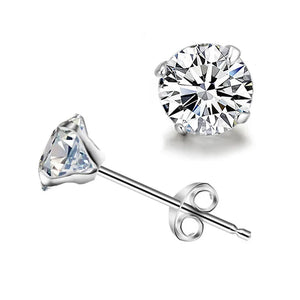
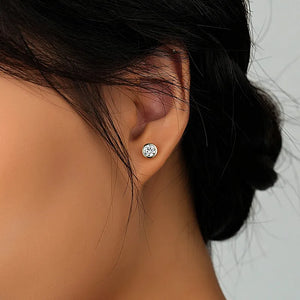
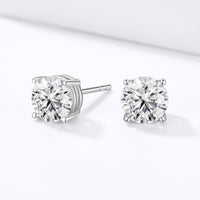
The piece they're describing → Round CZ Stud Earrings for Women — 925 Sterling Silver, Hypoallergenic, Gift-Ready
Personalize Yours


