


If you've ever searched "types of ear piercings" at midnight while planning your next one, you already know how confusing it gets. Helix or forward helix? Daith or rook? Tragus or anti-tragus? The terminology alone is a full language.
This guide breaks down every major ear piercing type in plain English — what it is, where it sits, how much it hurts, how long it heals, and what jewelry works best. By the end, you'll know exactly which piercing fits your anatomy, your pain tolerance, and your style. For a zone-by-zone map that also covers spacing and which placements combine well together, see our companion ear piercing chart.
The Two Main Zones: Lobe vs. Cartilage
Every ear piercing falls into one of two anatomical zones: the soft lobe at the bottom, or the firm cartilage that makes up most of your outer ear.
The difference matters for three reasons:
- Healing time — Lobes heal in 6–8 weeks. Cartilage takes 6–12 months.
- Pain level — Cartilage piercings generally hurt more and bruise more.
- Infection risk — Cartilage has less blood flow, so infections can become serious faster.
All 15 Types of Ear Piercings: Quick Reference Table

| Piercing Type | Location | Pain (1–10) | Healing Time | Best Jewelry |
|---|---|---|---|---|
| Standard Lobe | Lower lobe | 2–3 | 6–8 weeks | Studs, hoops, huggies |
| Upper Lobe (2nd/3rd) | Middle lobe | 2–4 | 6–8 weeks | Small studs, huggies |
| Helix | Upper outer cartilage | 5–6 | 6–9 months | Flat-back labret, small hoops |
| Forward Helix | Front upper cartilage | 5–7 | 6–12 months | Flat-back labret, tiny stud |
| Tragus | Small flap near ear canal | 5–7 | 6–12 months | Flat-back labret, tiny hoop |
| Anti-Tragus | Ridge above lobe, facing tragus | 6–8 | 9–12 months | Curved barbell, captive ring |
| Daith | Innermost cartilage fold | 5–7 | 6–12 months | Captive hoop, horseshoe |
| Rook | Anti-helix fold, upper inner | 6–8 | 9–12 months | Curved barbell |
| Conch (Inner) | Cup-shaped center cartilage | 5–7 | 6–12 months | Flat-back labret, stud |
| Conch (Outer) | Flat outer cartilage panel | 5–6 | 6–12 months | Hoop, orbital |
| Flat / Scapha | Flat cartilage, between helix & antihelix | 5–6 | 6–12 months | Flat-back labret |
| Industrial | Two points across upper cartilage | 7–8 | 6–12 months | Straight barbell |
| Orbital | Two holes, one ring through both | 5–7 | 6–12 months | Captive ring |
| Snug | Anti-helix, inner rim | 7–9 | 9–18 months | Curved barbell |
| Ear Lobe Stretching (Gauging) | Standard lobe, stretched | 3–5 | Ongoing (weeks per size) | Tunnels, plugs, tapers |
Lobe Piercings: The Foundation of Any Curated Ear
The standard lobe piercing is what most people get first — it's the one at the very bottom of your ear. Pain is minimal (most people rate it a 2 out of 10) and healing is fast at 6–8 weeks with proper aftercare.
The second and third lobe piercings sit progressively higher on the lobe. These let you stack multiple studs or hoops for a layered look. Because they're still in soft tissue, healing is similar to the first — around 6–8 weeks.
What earrings work for lobes? Nearly anything: traditional butterfly-back studs, push-back studs, huggies, small hoops, drop earrings. The lobe can handle heavier jewelry than cartilage. At AJLuxe, our hypoallergenic earring collection is designed specifically for sensitive lobes — 18K gold-plated sterling silver with no nickel.
Helix Piercings: The Most Popular Cartilage Option
The helix sits along the upper outer rim of your ear. It's the most common cartilage piercing because it's versatile and relatively forgiving. Pain is usually a 5–6 — a sharp pressure during the piercing, followed by soreness for a few days.
Healing takes 6–9 months. The most common mistake people make is switching jewelry too early — wait for your piercer to confirm full healing before changing.
The forward helix is the same rim but at the front, closest to your face. It's smaller and trickier to pierce, with a longer healing window of up to 12 months.
Jewelry tip: Flat-back labret studs are ideal for new helix piercings because they don't rotate and have less surface contact. Once healed, small hoops work beautifully.
Tragus and Anti-Tragus: The Statement Cartilage Piercings
The tragus is the small, thick flap of cartilage that partially covers your ear canal. Getting it pierced requires a needle (never a gun) and a skilled piercer. Pain tends to be a 5–7 — most people report hearing a "crunch" sound during the procedure.
The anti-tragus sits directly across from the tragus, on the curved ridge above your lobe. It's less common and takes longer to heal (9–12 months) because the tissue is particularly dense.
Anatomy note: Not everyone can get a tragus or anti-tragus piercing. Some people's anatomy simply doesn't have enough tissue. A reputable piercer will tell you honestly whether yours is viable before you commit.
Daith, Rook, and Conch: The Inner Ear Piercings
These three sit deeper in the ear structure:
The daith goes through the innermost fold of cartilage, right where your ear canal begins (full guide: daith piercing jewelry). It's become famous for the unverified claim that it can relieve migraines (similar to acupuncture). There's no scientific evidence for this, but it remains one of the most requested piercings. Captive hoops are the standard jewelry choice.
The rook is the ridge that runs across the inner upper ear (full guide: rook piercing jewelry). It's one of the more painful cartilage piercings (6–8 range) because the tissue is particularly thick. Curved barbells are the go-to jewelry here.
The inner conch sits in the cup-shaped center of your ear (full breakdown: conch piercing jewelry guide). The outer conch is on the flat panel beside it. Both heal in 6–12 months. Inner conch is often done with flat-back labrets; outer conch looks stunning with a large captive hoop.
Industrial and Snug: Advanced Piercings
The industrial piercing is two helix piercings connected by a single straight barbell. It's one of the most dramatic ear piercings you can get, and it requires both holes to heal in perfect alignment. Pain is 7–8, and healing can be frustrating because any pressure on either hole extends the timeline.
The snug sits on the inner rim of the anti-helix. It's one of the hardest ear piercings to heal (some piercers won't do them at all) and can take 9–18 months. Anatomy plays a huge role — many people simply don't have the right ridge structure. Pain is typically 7–9.
Curated Ear: How to Combine Multiple Piercings
A "curated ear" is a deliberately styled arrangement of multiple piercings across your ear. The goal is balance — mixing sizes, metals, and positions to create a cohesive look.
Three popular starting combinations:
- Classic triple lobe: Three lobe piercings at different heights, sized small to large from top down
- Lobe + helix: Two lobe piercings plus one helix — the most common combination
- Full stack: Triple lobe + helix + tragus + conch — takes 12+ months to complete due to staggered healing
The key rule: never get more than 2–3 new piercings at once. Your immune system can only heal so much simultaneously, and crowding new piercings increases infection risk.
Earring Gauge Size: What the Numbers Mean
Gauge refers to the thickness of the jewelry post. Confusingly, higher gauge numbers = thinner jewelry.
| Gauge | Diameter (mm) | Common Use |
|---|---|---|
| 20G | 0.8mm | Most cartilage piercings (helix, tragus, daith) |
| 18G | 1.0mm | Standard ear piercings in US; most lobe jewelry |
| 16G | 1.2mm | Industrial, rook, conch, some lobes |
| 14G | 1.6mm | Stretched lobes, body piercing |
Most earrings sold at jewelry stores are 18G or 20G. If you've had your piercings for a while and aren't sure of your gauge, an 18G earring fits the majority of standard lobe piercings done in the US.
According to GIA's jewelry care guidelines, using proper gauge jewelry reduces tissue irritation and extends the life of your piercing.
Aftercare: How to Keep Any Piercing Healthy
The rules are the same regardless of piercing type:
- Saline spray twice daily — sterile saline (0.9% sodium chloride) only. No hydrogen peroxide, no rubbing alcohol, no antibiotic ointment.
- Don't touch it with unwashed hands — most infections come from fingers, not the jewelry itself
- Sleep on a travel pillow or silk pillowcase — pressure on a healing cartilage piercing extends healing by weeks
- Don't rotate or twist the jewelry — this is outdated advice. Movement breaks the healing tissue
- Wait for full healing before changing jewelry — "surface healed" (no crust, no redness) is not fully healed
For lobe piercings, our 18K gold-plated sterling silver studs and huggie earrings are safe for healing piercings — nickel-free, hypoallergenic, and won't cause reactions in freshly pierced lobes.
Once a piercing is fully healed and you're ready to switch out starter jewelry for flat backs, knowing the right removal technique matters — see our guide on how to remove flat back earrings for screw-back and push-back styles.
If you're switching to huggie hoops once healed, they close a different way than flat backs -- see our guide on how to open huggie earrings for the hinge-lift motion and what to do if one feels stiff at first.
Which Ear Piercing Should You Get First?
If you already have a standard lobe piercing, the best next steps depend on your goals:
- Want a curated ear stack? → Add a second or third lobe piercing first. They heal fastest and give you the most jewelry flexibility.
- Want one statement piercing? → Helix is the safest bet. Versatile, widely practiced, and beautiful when healed.
- Want something unique? → Tragus or daith. Both are conversation pieces and less common than helix.
- Pain-sensitive? → Stick with lobes. Cartilage piercings hurt more and take significantly longer to heal.
Whatever you choose, go to a professional piercer who uses implant-grade titanium or solid gold for initial jewelry. Never use a piercing gun on cartilage — the blunt force trauma causes damage that a needle doesn't.
Frequently Asked Questions About Ear Piercings
What is the most painful ear piercing?
The snug and industrial piercings are generally considered the most painful, rating 7–9 on a 10-point scale. Both involve thick cartilage and awkward anatomy. The rook and anti-tragus also rank high. Lobe piercings are the least painful, typically rating 2–3.
How long does a helix piercing take to heal?
A helix piercing takes 6–9 months to fully heal, though it may look healed on the surface after 3–4 months. Do not change jewelry until your piercer confirms complete healing. Changing too early is the single most common cause of prolonged healing and infections.
Can I get multiple ear piercings at once?
Yes, but limit yourself to 2–3 new piercings per session. Your immune system can only heal so much at once. Getting 4 or more piercings simultaneously significantly increases your risk of infection and complications. Wait at least 3 months between piercing sessions.
What gauge is a standard ear piercing?
Most standard ear piercings in the US are done at 18G (1.0mm). However, some piercers use 20G (0.8mm) for cartilage piercings. If you're unsure what gauge your piercings are, an 18G earring will fit most standard lobe piercings without causing stretching.
Does a daith piercing help with migraines?
There is no peer-reviewed scientific evidence that daith piercings relieve migraines. The claim is based on the supposed similarity to acupuncture points. Many people report improvement, but this is considered anecdotal. If migraines are severe, consult a neurologist rather than relying on a piercing for treatment.
What is the fastest healing ear piercing?
Standard lobe piercings heal fastest — typically 6–8 weeks with proper aftercare. Second and third lobe piercings also heal quickly. Cartilage piercings are the slowest, with some like the snug taking up to 18 months.
What earrings are best for newly pierced ears?
Implant-grade titanium, solid 14K–18K gold, or implant-grade surgical steel are the best choices for new piercings. Nickel-free 18K gold-plated sterling silver (like AJLuxe's earrings) is safe for healed lobes but may cause irritation in very fresh piercings. Avoid fashion earrings with unknown metals for at least 8 weeks.
Can I get a tragus piercing if I have small ears?
Tragus piercings require sufficient tissue on the tragus flap. Some people with very small ears or very thin tragus tissue may not be good candidates. An experienced piercer will assess your anatomy during a consultation before proceeding. Never let a piercer pressure you into a piercing your anatomy isn't suited for.
What is the difference between a conch and a flat piercing?
The inner conch sits in the cup-shaped bowl of the ear, while the flat piercing (also called scapha) sits on the flat cartilage panel between the helix rim and the antihelix ridge. The inner conch requires a flat-back labret or stud; the flat piercing also uses flat-back labrets but sits in a more visible position on the outer ear.
How do I build a curated ear?
Start with your lobe piercings and heal them fully before adding cartilage piercings. Map out a balanced arrangement — typically mixing one statement piece (helix, tragus, or daith) with 2–3 lobe piercings at different heights. Space new piercings at least 3 months apart to allow proper healing. Work with your piercer to place each new piercing in the right spot for your specific ear anatomy.
Is it normal for a new piercing to be sore for weeks?
Yes. Lobe piercings are typically sore for 1–2 weeks. Cartilage piercings can be tender and sensitive for months — especially if bumped or slept on. Consistent soreness without swelling, discharge, or fever is normal. See a piercer or doctor if you notice increasing redness, warmth, swelling, or pus, which signal infection.
Looking for hypoallergenic earrings safe for healing piercings or sensitive lobes? Browse AJLuxe's earring collection — 18K gold-plated 925 sterling silver, nickel-free, and designed for sensitive ears.
Thinking about a nose piercing too? Our nose ring with studs guide covers the stud-vs-ring style difference, standard gauge sizing, and which nickel-free metals are safest.
Written by the AJLuxe team — specialists in personalized sterling silver jewelry. Last updated: June 2026.

All third-party trademarks, brand names and product names are the property of their respective owners. AJLuxe is not affiliated with, endorsed by, sponsored by, or otherwise connected to any third-party brand referenced in this article. Brand names are used solely for accurate comparative reference, and material descriptions reflect each brand's own published product specifications at the time of writing.
You Might Also Like
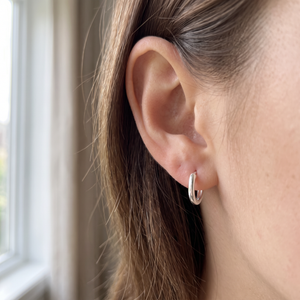
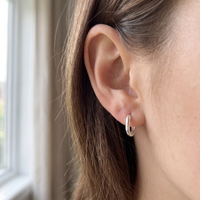
The piece they're describing → Silver Huggie Earrings for Women — 925 Sterling Silver, Hypoallergenic, Minimalist
Personalize Yours


