


The short answer
Art Deco jewelry is defined by strict geometric symmetry, straight lines and stepped shapes (rather than the flowing curves of the earlier Art Nouveau style), and precision stone cuts like baguette, emerald, and square/princess cuts -- it emerged in the 1920s and peaked through the early 1930s, and you can spot the style in a modern piece by its geometry even when it isn't a genuine antique.
"Art Deco" gets used loosely to describe almost any geometric jewelry, but the actual style has specific, identifiable features that trace back to a particular decade. Knowing what those features are makes it easier to find pieces -- vintage or new -- that genuinely fit the look instead of just being marketed with the label.

What is considered Art Deco jewelry?
Art Deco jewelry is defined by strict geometric symmetry -- straight lines, stepped or fan-shaped patterns, and clean, architectural forms -- as a deliberate contrast to the flowing, nature-inspired curves of the earlier Art Nouveau period. The style emerged alongside the broader Art Deco movement in architecture and design in the 1920s, and its jewelry favored precision-cut stones set in symmetrical, often geometric arrangements rather than the organic settings that came before it.
What stone cuts and shapes define the look?
Baguette (narrow rectangular), emerald (rectangular with cut corners), and square or princess cuts are the signature stone shapes of Art Deco jewelry, chosen specifically because their straight edges reinforce the style's geometric symmetry. Round brilliant cuts appear too, but usually arranged in symmetrical clusters or stepped patterns rather than as a single solitaire, which reads as a later or different-era style.
How can I tell if a ring is genuinely Art Deco?
Look for symmetry first: a true Deco piece is typically symmetrical along at least one axis, with geometric (not floral or curved) linework. On an actual antique, platinum was the dominant metal of the era because it could hold fine, detailed metalwork better than gold or silver -- a piece described as "Art Deco" in yellow gold with rounded, organic detailing is more likely Deco-inspired or a different era than a genuine 1920s original.
Can you get the Art Deco look without buying an antique?
Yes -- "Deco-inspired" pieces borrow the style's geometric shapes and stone cuts without claiming period-authentic construction or materials, and they cost a fraction of a verified antique. A square or princess-cut centerpiece in a clean, symmetrical setting captures the look; it's worth checking that a listing is honest about which one you're buying; a real 1920s piece and a new piece made in the Deco style are very different purchases at very different price points.
At a Glance
| Style era | Defining shapes | Typical stone cuts | Vibe |
|---|---|---|---|
| Art Nouveau (1890s-1910s) | Flowing curves, floral/insect motifs | Cabochon, freeform | Organic, whimsical |
| Art Deco (1920s-early 1930s) | Straight lines, symmetry, stepped/fan shapes | Baguette, emerald, square/princess | Geometric, precise, bold |
| Retro (1930s-1940s) | Chunky, sculptural, mixed metals | Large center stones, cocktail-ring scale | Glamorous, sculptural |
| Modern Deco-inspired | References Deco geometry without antique construction | Faceted CZ or lab-created stones | Vintage look, new-piece price |
Shop This Guide
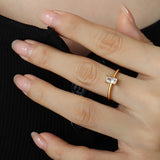
18K gold-plated band with a princess/square-cut cubic zirconia centerpiece -- $28.99. Deco-inspired geometric faceting, not a vintage or antique piece.
Shop the Square CZ Wedding RingFrequently Asked Questions
What is considered Art Deco jewelry?
Jewelry defined by geometric symmetry, straight lines, and stepped or fan-shaped patterns, made from the 1920s through the early 1930s -- a deliberate contrast to the flowing curves of the earlier Art Nouveau style.
What is some of the most famous Art Deco jewelry?
Pieces by houses like Cartier and Van Cleef & Arpels from the 1920s-30s are the best-known examples, typically featuring platinum settings, baguette and emerald-cut stones, and strict geometric symmetry.
What types of jewelry were popular in the 1920s?
Long strands of beads, geometric brooches, cocktail rings, and bold bracelets were popular in the 1920s, largely in the Art Deco style's signature geometric, symmetrical designs.
How to tell if a ring is Art Deco?
Check for geometric symmetry, straight-line or stepped patterns, and precision stone cuts (baguette, emerald, square). Platinum settings and fine detailed metalwork are common on genuine period pieces; a ring described as Deco with rounded or floral detailing is more likely a different era or a modern Deco-inspired design.
All third-party trademarks, brand names and product names are the property of their respective owners. AJLuxe is not affiliated with, endorsed by, sponsored by, or otherwise connected to any third-party brand referenced in this article. Brand names are used solely for accurate comparative reference, and material descriptions reflect each brand's own published product specifications at the time of writing.
You Might Also Like
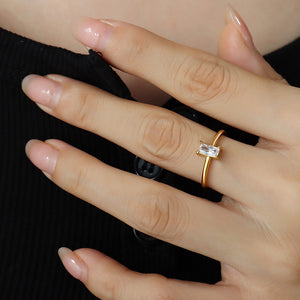

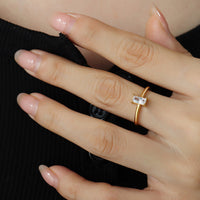
The piece they're describing → Square CZ Wedding Ring for Women — 18K Gold Plated, Princess Cut Cubic Zirconia
Personalize Yours


