


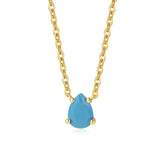
When you set a turquoise vs larimar stone side by side, the difference is immediate — turquoise carries earthy matrix veins and a saturated blue-green, while larimar glows like sunlight on a shallow Caribbean bay. Both stones share a blue family of colors, yet they come from opposite ends of the planet, carry different price tags, and suit different wearers. Here's everything you need to choose between them.
What Is Turquoise?
Turquoise is a hydrated copper aluminum phosphate mineral with the chemical formula CuAl₆(PO₄)₄(OH)₈·4H₂O. It forms in arid regions where copper-rich groundwater reacts with aluminum-bearing rock, producing the opaque blue-green stone that humans have prized for more than 7,000 years. The finest specimens come from Iran (Nishapur), the American Southwest (Arizona, Nevada, New Mexico), and Egypt's Sinai Peninsula.
Turquoise lands at 5–6 on the Mohs hardness scale — softer than quartz, which means it can scratch with everyday wear. Its characteristic webbing of brown or black veins is called matrix, formed by the host rock. Color ranges from pale sky-blue to deep green-blue depending on the ratio of copper (more blue) to iron (more green). Spiritually, it's tied to protection, wisdom, and communication across Native American, Persian, and Tibetan traditions. Learn more at GIA's turquoise resource.
What Is Larimar?
Larimar is a rare blue variety of the silicate mineral pectolite (NaCa₂Si₃O₈(OH)), found in only one location on Earth — a single volcanic mountain in the Barahona province of the Dominican Republic. It was officially discovered in 1974 by Miguel Méndez, who named it by combining his daughter's name "Larissa" with the Spanish word for sea, "mar." Its rarity is part of its allure: the mine is estimated to have a finite lifespan of decades, not centuries.
Larimar rates 4.5–5 on the Mohs hardness scale — slightly softer than turquoise. Its color palette runs from pale white-blue to deep volcanic blue, with white cloud-like patterns caused by radiating pectolite crystals. The deepest blue specimens are the most valuable. Metaphysically, larimar is called the "Atlantis Stone" and is associated with calm, emotional healing, and connection to water energy. See detailed mineralogy at Mindat.org, or our own larimar meaning guide for the full symbolism and healing properties.
Turquoise vs Larimar: Key Differences
| Property | Turquoise | Larimar |
|---|---|---|
| Color | Medium to deep blue-green, often with brown/black matrix veins | Pale to medium sky-blue with white cloud patterns |
| Mohs Hardness | 5–6 | 4.5–5 |
| Transparency | Opaque | Opaque to slightly translucent |
| Origin | Iran, USA (Arizona/Nevada), Egypt, China, Mexico | Dominican Republic only |
| Rarity | Moderately available; heavily mined for centuries | Extremely rare; single-source finite deposit |
| Price per carat (cabochon) | $1–$10 (commercial); $50–$300+ (Sleeping Beauty, gem-grade) | $5–$30 (lower grade); $50–$150+ (deep blue, high grade) |
| Common Treatments | Stabilization with resin (very common), dyeing, wax coating | Generally untreated; occasionally waxed |
| Luster | Waxy to dull | Waxy to silky |
| Composition | Copper aluminum phosphate | Sodium calcium silicate (pectolite variety) |
| Spiritual Meaning | Protection, wisdom, communication, luck | Calm, emotional healing, oceanic energy, compassion |
| Sensitivity | Sensitive to oils, perfume, acids; porous untreated | Sensitive to acids, household chemicals; moderately porous |
| Best Use Case | Statement pieces, Southwest-style jewelry, men's rings | Delicate pendants, earrings, spiritual jewelry |
The biggest practical difference between turquoise and larimar is hardness and origin. Turquoise at 5–6 Mohs is slightly more durable for rings and bracelets subject to abrasion. Larimar at 4.5–5 is best reserved for pendants and earrings that won't knock against hard surfaces daily.
Color-wise, you're choosing between two different moods. Turquoise is bold and earthy — its matrix veins and saturated blue-green read as confident, bohemian, or Southwestern. Larimar is softer and more ethereal — its pale blue-white patterns evoke calm water and open sky.
On price, the two stones can overlap significantly, but for different reasons. Gem-grade Persian turquoise commands premium prices because of historical prestige. High-grade deep-blue larimar is expensive because of genuine geological scarcity — there's only one mine on the planet producing it.
When to Choose Turquoise
- If you want a stone with cultural heritage. Turquoise has been sacred to Navajo, Zuni, and Pueblo peoples for centuries, and to Persian royalty even longer. Wearing it connects you to one of humanity's oldest gemstone traditions.
- If you're buying a ring or bracelet. At Mohs 5–6, turquoise handles daily abrasion better than larimar. It's still softer than quartz (7), so avoid hard knocks — but it's the more practical choice for pieces that contact surfaces.
- If you prefer a bold, high-contrast look. The blue-green body color with dark matrix veins creates a graphic, eye-catching pattern that stands out against silver or gold settings. It reads as confident and earthy.
- If you're working with a tighter budget. Commercial stabilized turquoise is widely available and affordable. You can find genuine turquoise cabochons set in sterling silver for under $50, making it accessible for everyday jewelry.
When to Choose Larimar
- If you want something genuinely rare. Only one mine in the world produces larimar. Owning a piece means wearing a stone that can't be replicated elsewhere on Earth — that scarcity has real value beyond aesthetics.
- If you're drawn to ocean or water energy. Larimar's association with Caribbean sea color isn't incidental — the stone literally formed in a volcanic island. Its metaphysical connection to water, calm, and emotional balance resonates with many crystal practitioners and spiritual jewelry wearers.
- If your style is soft and ethereal rather than bold. Larimar's pale blue-white palette pairs beautifully with minimalist silver settings. It reads as serene and feminine rather than graphic and earthy.
- If you want a collector's piece. Deep volcanic blue larimar is increasing in value as the mine's reserves deplete. High-grade specimens are already sought by collectors. It's a stone whose market position may strengthen over time.
Price Comparison: Turquoise vs Larimar
Both stones span a wide price range depending on grade, origin, and treatment status. Here's what to expect:
| Grade | Turquoise | Larimar |
|---|---|---|
| Entry / commercial | $1–$5 per carat (stabilized) | $5–$15 per carat (pale, lower saturation) |
| Mid-grade | $10–$50 per carat (natural, good color) | $20–$50 per carat (medium blue) |
| High grade / gem | $50–$300+ per carat (Sleeping Beauty, Persian, natural) | $80–$200+ per carat (deep volcanic blue, minimal white) |
Turquoise pricing is heavily influenced by treatment status. Stabilized turquoise (injected with resin to harden and intensify color) is the most affordable and most common. Natural, untreated turquoise — especially from renowned mines like Sleeping Beauty in Arizona (now closed) or Nishapur in Iran — commands multiples more. Always ask for treatment disclosure when buying.
Larimar pricing is driven by color depth and pattern. The deepest sky-blue specimens with minimal white clouding are the rarest and most valuable. "Volcanic blue" larimar — the richest blue grade — can rival or exceed high-quality turquoise in price per carat. However, mid-grade larimar remains accessible and is often more affordable than equivalent-quality natural turquoise.
Care and Durability
Turquoise care: Keep turquoise away from perfumes, body lotions, oils, and cleaning chemicals. Untreated turquoise is porous and will absorb these substances, permanently changing its color. Clean with a soft damp cloth — no ultrasonic cleaners, no steam. Store in a pouch or soft cloth to prevent scratching from harder stones. It's rated 5–6 Mohs, so quartz dust (found in everyday air and fabrics) can slowly scratch its surface over years.
Larimar care: Larimar sits at 4.5–5 Mohs — softer than turquoise. It's vulnerable to household acids (vinegar, citrus), chlorine (swimming pools), and harsh chemical cleaners. Clean with plain warm water and a soft brush. Avoid ultrasonic cleaners, which can cause internal fractures. Because larimar is usually untreated, it doesn't share turquoise's absorption problem with oils, but it should still be kept away from prolonged moisture. Store separately from harder gemstones.
Long-term durability: For rings and bracelets worn daily, turquoise holds up better than larimar. Both stones benefit from being set in protective bezels rather than prong settings, which expose the stone to impact. For pendants and earrings — the categories where most blue gemstone jewelry is sold — both perform comparably with proper care.
Turquoise and larimar are both blue gemstones, but turquoise (Mohs 5–6) is slightly harder and more durable than larimar (Mohs 4.5–5). Turquoise is found worldwide with centuries of cultural history, while larimar comes exclusively from one mine in the Dominican Republic, making it rarer. Commercially stabilized turquoise starts at $1–$5 per carat, while larimar starts around $5–$15 per carat, with high-grade specimens of both stones reaching $200+ per carat. The key deciding factor is aesthetic: turquoise offers bold blue-green with earthy matrix patterns, while larimar delivers a softer, paler sky-blue reminiscent of Caribbean waters.
Best Types of Turquoise Jewelry and How to Style Them
Turquoise works best in four jewelry forms — pendant necklaces, stud or drop earrings, cuffs and bangles, and rings — and the right pick depends on how often you want to wear it and how bold you want the look (2026). Pendants and earrings are the most forgiving starting point: they keep the stone away from countertops, keyboards, and other daily knocks, so you get turquoise's color without worrying about its Mohs 5–6 softness. Cuffs and rings are the statement pieces — better suited to occasional wear or a protective bezel setting than to a piece you'll bang around all day.
| Jewelry Type | Best For | Styling Tip |
|---|---|---|
| Pendant necklace | Everyday wear, layering | Layer a single turquoise pendant with two finer chains for depth, or wear it solo on a shorter chain so the stone sits at the collarbone as the focal point. |
| Stud or drop earrings | Daily rotation, office-safe styling | Small cabochon studs read as polished and everyday; drop styles add movement without the durability risk of a ring or bracelet. |
| Cuff or bangle | Statement, boho-inspired looks | Stack a turquoise cuff with plain metal bangles rather than other gemstones — it lets the matrix veining stay the visual anchor. |
| Ring | Occasional wear, Southwest-style statement pieces | Choose a bezel setting (not prongs) to protect the stone's edges, and treat it as a special-occasion piece rather than a daily-wear band. |
On metal pairing, turquoise's blue-green tone reads coolest against silver settings and warmest against gold-toned settings — neither is "more correct," it's a matter of undertone. A stone with more green in it tends to pop against warm gold tones, while a bluer stone leans crisper against silver. AJLuxe sets its turquoise pieces in 925 sterling silver, including options finished with 18K gold plating over that silver base for a warmer look — worth knowing since a piece marketed simply as "gold" online may not specify what's underneath the plating.
For gifting, turquoise's affordability at the commercial-grade end makes it an easy entry point: a single pendant or stud pair reads as a complete, considered gift without the cost of a full jewelry set.
Related reading: Boho Jewelry Style.
Related reading: Turquoise and Gold Jewelry: Why It Works and How to Style It.
Related reading: Malachite vs Jade: How to Tell Them Apart.
Frequently Asked Questions
Is larimar rarer than turquoise?
Yes, larimar is significantly rarer than turquoise. Larimar comes from a single volcanic deposit in the Dominican Republic — it's the only place on Earth where this stone forms. Turquoise, by contrast, is mined across multiple continents including North America, Iran, Egypt, China, and Australia. The single-source nature of larimar means its supply is finite and may be exhausted within decades.
Which is more expensive, turquoise or larimar?
It depends on grade, but mid-range specimens are often similarly priced. Commercial stabilized turquoise can be cheaper than larimar at the entry level, starting around $1–$5 per carat versus $5–$15 for larimar. At the high end, gem-grade Persian or Sleeping Beauty turquoise can exceed $300 per carat, outpacing most larimar. Deep volcanic blue larimar can reach $150–$200+ per carat, making high-grade larimar roughly comparable to high-grade natural turquoise in price.
Can you wear turquoise and larimar together?
Yes, turquoise and larimar pair beautifully. Their complementary blue tones create a layered ocean palette — turquoise adding warmth and earthiness, larimar adding softness and calm. Just store them separately to prevent the harder turquoise (5–6 Mohs) from scratching larimar (4.5–5 Mohs). Many crystal practitioners intentionally combine them for a blend of protective turquoise energy and healing larimar energy.
Is turquoise or larimar better for a ring?
Turquoise is the better choice for a ring worn daily. At Mohs 5–6, it handles abrasion from daily wear more reliably than larimar at 4.5–5. Neither stone is ideal for an engagement ring or everyday-wear ring without a protective bezel setting, but if you're choosing between the two for a ring, turquoise has the durability edge. Larimar is best reserved for pendants, earrings, and occasional-wear statement rings.
Where does larimar come from?
Larimar comes exclusively from the Los Chupaderos mine in the Barahona province of the Dominican Republic, in the Caribbean. It was officially named and recognized in 1974. The stone forms in volcanic chimneys within the mountain — a unique geological process that hasn't been replicated anywhere else on Earth. This single-source origin is the primary driver of larimar's rarity and increasing collector value.
Is larimar a form of turquoise?
No, larimar and turquoise are entirely different minerals. Turquoise is a copper aluminum phosphate, while larimar is a blue variety of pectolite — a sodium calcium silicate. They share a blue color family but have different chemical compositions, crystal structures, origins, and gemological properties. Calling larimar a form of turquoise is like calling sapphire a form of aquamarine because both are blue.
Does turquoise change color over time?
Untreated natural turquoise can change color over time due to its porous nature. Oils from skin, perfume, lotion, and environmental pollutants absorb into the stone, gradually shifting it from blue toward green. This was once considered a sign of the stone "absorbing negativity" in many traditions. Stabilized turquoise resists this color shift because the resin treatment fills the pores. Larimar does not share this characteristic and holds its color more stably.
What does larimar symbolize?
Larimar symbolizes calm, emotional healing, clear communication, and connection to water and sky energy. It's sometimes called the "Dolphin Stone" or "Atlantis Stone" in metaphysical traditions. Many practitioners use it for stress reduction, cooling hot emotions, and enhancing nurturing energy. It's associated with the throat chakra in crystal healing frameworks, which connects to authentic communication and self-expression.
Is turquoise a lucky stone?
Turquoise has been considered a protective and lucky stone across many cultures for thousands of years. In Persian tradition, turquoise on your body means your gaze is protected from evil. In Native American traditions, it's a stone of protection and connection to the sky spirit. Tibetan Buddhists have used it in prayer beads and amulets for centuries. While "luck" is a matter of personal belief, the cross-cultural consensus on turquoise as a protective stone is remarkably consistent across history.
What chakra is turquoise associated with?
Turquoise is primarily associated with the throat chakra (Vishuddha), which governs communication, authentic expression, and speaking your truth. Some practitioners also link it to the third-eye chakra for its connection to wisdom and spiritual insight. Larimar shares the throat chakra association but is additionally tied to the heart chakra for its calming, emotional-healing properties. If throat chakra work is your goal, both stones are appropriate — turquoise for clarity and strength of voice, larimar for compassionate and calm communication.
How do you tell real turquoise from fake?
Real turquoise is almost always cool to the touch (genuine stones absorb heat slowly), has a waxy luster, and shows natural variations in color and matrix. Plastic and dyed howlite imitations feel lighter, warm up faster against skin, and often show unnaturally uniform color. The scratch test helps too: turquoise (Mohs 5–6) won't scratch with a fingernail (Mohs ~2.5) but will scratch with a steel knife. A UV light test can reveal resin stabilization. When in doubt, buy from reputable dealers who provide treatment disclosure and ideally a gemological certificate.
Which stone is better for meditation?
Both stones support meditation, but for different intentions. Turquoise is better suited for meditation focused on protection, clarity, communication, and spiritual connection to ancestral or Earth energies. Larimar is better for meditation focused on calm, releasing emotional tension, deepening self-compassion, and connecting with water or oceanic energy. If you're new to crystal meditation, larimar's gentle, soothing energy is often described as easier to work with for beginners. Turquoise tends to feel more activating and directional in its energy.
Shop at AJLuxe
Looking for quality gemstone jewelry in 925 sterling silver? Browse our featured piece — hypoallergenic, gift-ready, 30-day returns. Explore our full gemstone necklace collection.
For more on healing crystals and gemstone meanings, see our guides on amethyst meaning and healing properties and our gemstone buying guide.
Final Thoughts
Turquoise and larimar are two of the most evocative blue gemstones in jewelry — but they serve different wearers. Turquoise is the choice for someone who wants cultural weight, a bold graphic pattern, slightly better durability, and accessibility at multiple price points. Larimar is the choice for someone drawn to genuine rarity, a softer oceanic aesthetic, and a stone whose value is anchored in geological scarcity rather than historical prestige.
If you're still undecided, think about where you'll wear the piece. For rings and bracelets that contact hard surfaces daily, turquoise's extra half-point of hardness gives it the practical edge. For a pendant or earrings — where beauty is the primary criterion — larimar's ethereal pale-blue glow is hard to match. Either way, you're choosing a stone with a real story behind it.
All third-party trademarks, brand names and product names are the property of their respective owners. AJLuxe is not affiliated with, endorsed by, sponsored by, or otherwise connected to any third-party brand referenced in this article. Brand names are used solely for accurate comparative reference, and material descriptions reflect each brand's own published product specifications at the time of writing.
You Might Also Like
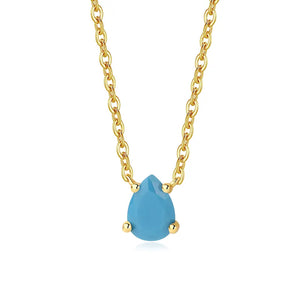
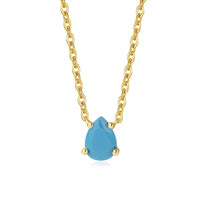
The piece they're describing → Teal Crystal Pendant Necklace for Women — Teardrop Stone, 925 Sterling Silver
Personalize Yours


