


The short answer
A three-stone mother's ring works when three things line up: the stone order (birth order is traditional, but center-stone-for-mom and color-balance layouts are both accepted), the stone type (genuine birthstones need a hardness check before they go into a daily-wear ring — opal and pearl are not ring-safe the way sapphire or CZ is), and the metal (gold warms up cooler stones like blue topaz or aquamarine; white gold or silver-tone metal makes warmer stones like garnet or ruby pop). This guide covers where the three-stone format actually comes from, how to pick and order the stones, a durability chart for choosing real birthstones versus simulated ones, and an affordable stacking-ring alternative if you want the symbolism without a fine-jewelry price tag.
"Three stone mothers ring" and "three stone mothers rings" both point to the same idea — a mother's ring is built for the whole family, but the three-stone version specifically fits parents with three kids (or three of anything worth marking: grandchildren, a blended family, a set of siblings). It's one of the most searched mother's-ring configurations for exactly that reason: three is common enough to have its own name, but the layout questions — order, spacing, symmetry — come up more with three stones than with one or two.
This guide covers what the format actually symbolizes, how real jewelers say to order and arrange the stones, which birthstones hold up to daily ring wear and which don't, and a hypoallergenic stacking-ring alternative if genuine gemstones aren't the priority.

What a Three-Stone Mother's Ring Symbolizes
A three-stone mother's ring symbolizes three people — most often three children — through their birth-month gemstones set together in one piece, worn as a daily reminder of family rather than put away for special occasions. There's no single agreed-on origin story for the mother's ring format. Mothersfamilyrings.com, a specialty mother's-ring retailer, lays out three competing accounts: one traces it to a jeweler's early system of small screw-set mounts that let a stone be added per child; another to two wedding bands fused together with a couple's sons' birthstones; a third ties its popularity to Mother's Day itself, which Anna Jarvis established in the United States roughly 90 years ago (the second Sunday in May) — after which, per that history, jewelry gifted for the new holiday increasingly featured children's birthstones, and the mother's ring format grew out of that gift-giving pattern.
Whichever account is closest to the truth, the symbolism today is consistent across jewelers: each stone stands for a specific person, and wearing them together is a visible, everyday way to carry the family with you — no inscription or explanation needed.
How to Choose and Arrange the Stones
Most families order the three stones by birth order, oldest child on one side to youngest on the other, reading left to right — it's the most common convention across mother's-ring sellers, but it isn't a rule. A center-stone layout, where the parent's own birthstone sits in the middle flanked by two children's stones, is a common alternative when someone wants their own birth month represented too. Because three is an odd number, it's also the easiest count to arrange symmetrically — a center stone with one matching stone on each side reads as balanced in a way that two or four stones don't automatically achieve, which is part of why three-stone layouts are a popular starting point even for parents who plan to add more stones later.
A few practical choices matter as much as the order:
- Same size or graduated? Three same-size stones read as more modern and minimal; a slightly larger center stone with two smaller flanking stones reads more traditional.
- Same cut or mixed? Matching round or oval cuts keep the row looking intentional; mixing cuts (to accommodate different birthstone shapes) can still work but benefits from a consistent setting style across all three.
- Color balance. Three very different-colored birthstones (say, deep red garnet, pale blue aquamarine, and green peridot) will read as more colorful and eclectic than three stones in a similar tone family — neither is wrong, but it's worth previewing before committing to a custom order.
Metal, Stone Type, and Durability
The metal you choose changes how the birthstone colors read, and the stone type you choose determines whether the ring can be worn every day without babying it. Cooler-toned stones like blue topaz, aquamarine, or amethyst warm up next to yellow gold; warmer stones like garnet, ruby, or citrine tend to pop more against white gold, rhodium-plated silver, or platinum. Sterling silver with a rhodium or 18K gold finish gives you that same color-pairing flexibility at a lower price point than solid gold.
Stone durability matters more in a ring than in any other jewelry category, because a ring takes more daily impact — against countertops, door handles, gym equipment — than a necklace or pair of earrings ever will. On the Mohs hardness scale that gemologists use to rank scratch resistance, sapphire and ruby sit at 9 (just below diamond's 10), making them genuinely safe for daily-wear rings. Topaz and cubic zirconia (CZ) are also solid ring choices in the 8–8.5 range. Opal (around 5.5–6.5) and pearl (2.5–4.5) are both popular birthstones but are considerably softer — jewelers typically recommend protective bezel settings for either one in a ring, and even then, a mother's ring worn daily isn't the ideal place for a soft, natural pearl or opal if it can be avoided.
| Birthstone | Mohs hardness | Good for daily-wear ring? |
|---|---|---|
| Sapphire / Ruby | 9 | Yes — among the most durable ring stones after diamond |
| Topaz | 8 | Yes, with normal care |
| Cubic Zirconia (simulated) | 8–8.5 | Yes — a durable, affordable stand-in for any birth month's color |
| Amethyst / Citrine / Garnet | 7–7.5 | Yes, generally durable for everyday settings |
| Opal | 5.5–6.5 | With caution — protective bezel setting recommended |
| Pearl | 2.5–4.5 | Not ideal for daily rings — better suited to necklaces or earrings |
If a family includes a June, opal (October), or pearl-birthstone member, a simulated stone in that color is often the more practical choice for a ring specifically — it keeps the durability consistent across all three stones without asking anyone to swap their "real" birthstone for a substitute in someone else's eyes. The visual symbolism is unchanged either way; the stone represents the person regardless of whether it's mined or lab-made.
Styling a Three-Stone Mother's Ring
A three-stone ring can be worn as a solo statement piece or as the anchor of a stack, layered with plain bands on either side to add width without competing for attention. Because the three-stone format is inherently symmetrical, it pairs cleanly with a matching pendant or bracelet in the same stone lineup for anyone who wants the birthstones to show up in more than one piece. For everyday wear, an adjustable open-shank band (rather than a fixed size) is worth prioritizing — hands change size slightly with weather and time of day, and an adjustable band means the ring keeps fitting without a resize.
If you like the three-stones-together symbolism but want to build it gradually — or want the flexibility to represent more than three people without commissioning a custom ring — AJLuxe's Dainty Stacking Ring Set ($37.99) takes a different but related approach: ultra-thin 18K gold plated bands over 925 sterling silver, designed to be worn three, four, or five at a time on the same finger, with each band standing in for a different person. It's not a substitute for a genuine three-stone birthstone ring if that's specifically what you're after, but it's a hypoallergenic, adjustable, budget-friendly way to get a "one ring per person" look without the fine-jewelry price tag or a custom order.
Frequently Asked Questions
What does a three-stone mother's ring symbolize?
Each of the three stones represents a specific person — most commonly three children, but sometimes grandchildren or another meaningful trio — chosen by birth month and set together in one band as an everyday reminder of family.
How do you arrange the stones on a three-stone mother's ring?
The most common convention is birth order, oldest to youngest, read left to right. A center-stone layout — the parent's own birthstone in the middle, flanked by two children's stones — is a common alternative, and because three is an odd number it's naturally easy to arrange symmetrically either way.
What is the best metal for a three-stone mothers ring, gold or silver?
It depends on the stone colors more than a fixed rule: yellow gold tends to warm up cooler-toned stones like blue topaz or aquamarine, while white gold, rhodium-plated silver, or platinum tends to make warmer stones like garnet or ruby stand out more. 18K gold plating over 925 sterling silver gives the same color-pairing choice at a lower price than solid gold.
Can you get a three-stone mothers ring with names instead of birthstones?
Yes — many jewelers offer engraved-name versions alongside or instead of birthstones, and some rings combine both, with names engraved on the band's interior or shoulders and birthstones set on top. It's a common customization request, not a separate product category.
What's the difference between a two-stone and a three-stone mother's ring?
The stone count is chosen to match the number of children (or family members) being represented — a two-stone ring for two kids, a three-stone ring for three, and so on up through rings with five, six, or more stones for larger families. The design principles (ordering, symmetry, metal pairing) apply the same way regardless of stone count.
Are the stones in a three-stone mothers ring real gemstones?
It depends on the piece — fine-jewelry mother's rings typically use genuine birthstones set in solid gold, while more affordable versions use simulated stones (like cubic zirconia cut and colored to match a birth month) in gold-plated sterling silver. Both represent the same people the same way; the difference is price, durability consistency across softer and harder birthstones, and whether the setting is fine jewelry or fashion jewelry.
Is a three-stone mothers ring durable enough for everyday wear?
It depends on which birthstones are included. Sapphire, ruby, topaz, and cubic zirconia are all hard enough (Mohs 8+) for daily-wear rings. Softer birthstones like opal and pearl are more prone to scratching or chipping in a ring setting and are generally better suited to less-exposed jewelry like necklaces or earrings, or set in a protective bezel if they're going in a ring.
Can a three-stone mothers ring be resized or adjusted later?
Fine-jewelry rings with fixed sizing typically need a jeweler to resize them, which is worth confirming before ordering a personalized piece. Adjustable open-shank rings, common in gold-plated sterling silver versions, flex to fit a small range of sizes without a resize, though they're less precise than a fixed, professionally sized band.
All third-party trademarks, brand names and product names are the property of their respective owners. AJLuxe is not affiliated with, endorsed by, sponsored by, or otherwise connected to any third-party brand referenced in this article. Brand names are used solely for accurate comparative reference, and material descriptions reflect each brand's own published product specifications at the time of writing.
You Might Also Like
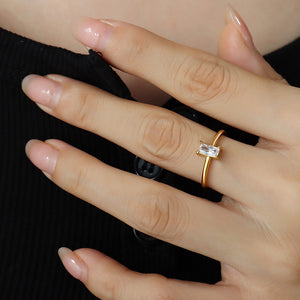

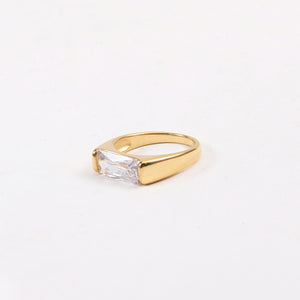
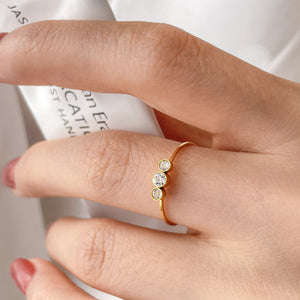

The piece they're describing → Dainty Stacking Rings for Women — 18K Gold Plated, Thin Band Set, Minimalist
Personalize Yours


