


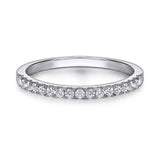
- Shank (band): the circle around the finger. This is what people mean by ring shank.
- Head (setting): holds the stone with prongs or a bezel.
- Shoulders: where the shank rises toward the head.
- Gallery: the open area under the stone, seen from the side.
- Sizing area: the bottom of the shank, where a jeweler adds or removes metal.
- Comfort fit: a slightly rounded inside to the band.
Most ring questions come down to a few words: shank, head, prongs and gallery. Once you know them, a listing, a repair quote or a conversation with a jeweler gets much easier. This guide names every part of a ring, explains the main shank types, and shows why the shank matters for ring size and resizing. We drew on retailer and jeweler guides and a public online encyclopedia, and we note where they use different words. It is about ring anatomy, so for how to measure your finger, use our ring size guide.
What Are the Parts of a Ring Called?
| Part | What it is | Also called |
|---|---|---|
| Shank | The band that encircles the finger, not including the setting | Band, hoop (one encyclopedia entry) |
| Head | The structure that holds the center stone, with its prongs or bezel | Setting, crown |
| Center stone | The main, usually largest, stone | Main stone |
| Prongs | Small metal tips or claws that grip the stone | Claws |
| Bezel | A metal rim that wraps the edge of the stone | Collar or collet setting |
| Shoulders | The upper sides of the shank that rise to meet the head | Often thickened or decorated for support |
| Gallery | The open area under the stone, visible from the side | |
| Side stones | Stones on either side of the center stone | Accent stones (a source warns not to confuse them with stones along the band) |
| Sizing area | The bottom of the shank, where a jeweler resizes | Sizing bar |
| Hallmark | A stamp inside the band showing the metal, such as 925 | Maker marks may sit beside it |
Sources agree on the basics and differ in details. One calls the part under the stone the gallery and notes its exact position is described loosely, and another encyclopedia entry describes a gallery as a decorative band with a row of perforations. We use the common jeweler meaning: the open area beneath the stone.
How Does the Head of a Ring Hold a Stone?
The head holds the stone in one of two main ways: prongs or a bezel. Prongs are metal tips that fold over the edge of the stone. A common rule from the sources is that four prongs expose more of the stone and are easy to repair, while six prongs are suggested for larger stones. A bezel is a metal rim around the whole edge of the stone, which one retailer describes as more secure and better for active wearers. Other head styles you will see named include the basket, which is an open frame under the stone, and the halo, which is a ring of small stones around the center stone.
This matters in daily wear. Prongs leave more of a stone open to light, while a bezel covers its edge. For the right snugness once you have chosen a style, read our guide to how tight a ring should fit.
What Is the Shank of a Ring?
The shank is the part of a ring that encircles the finger, not including the setting. Jewelers use shank and band to mean nearly the same thing: if you are looking at a plain gold or silver band with no stone, the whole ring is the shank. On a ring with a stone, the shank is everything except the head. It carries the hallmark inside, takes most of the wear against the skin, and holds the sizing area at the bottom.
What Are the Types of Ring Shank?
| Shank type | How it looks | Good to know |
|---|---|---|
| Traditional (round) | A perfectly round band | The default shape |
| Straight | No tapers or splits | No tapers or splits |
| Tapered | Thins as it moves away from the stone | Thins away from the center stone |
| Cathedral | Arches that rise on each side toward the stone | Arches protect the stone and show it from the side |
| Split | The band divides into two strands near the stone | Divides, then rejoins at the stone |
| Bypass | The two ends overlap rather than meeting | Ends overlap and wrap the stone |
| Euro style | A flattened bottom with squared outer edges | Described as helping to keep a ring from spinning |
| Knife edge | Two slanted sides form a sharp outer edge | Sharp outer edge |
A shank style can also affect resizing, since ornate or stone-set shanks give a jeweler less plain metal to work with. Ask a jeweler before you buy a style you may need to resize.
What Is Comfort Fit?
Comfort fit is a ring design with a slightly rounded inside to the band. Two jeweler glossaries define it this way: the inner surface curves gently instead of being flat, which can feel smoother when sliding the ring on and off. Many glossaries do not define it at all, so it is a term worth checking in a listing. Note that comfort fit changes how a band feels, not its size, so you may still need to size up or down depending on the width of the band.
Why Do Ring Parts Matter for Sizing and Resizing?
Sizing is done at the shank. Jewelers describe a sizing area at the bottom of the shank where metal is added or removed to change the size, which is why stones set around the band can limit what a jeweler can do. If you are unsure whether a ring will work, see what to do when a ring is too big and ring size adjusters. For current costs and which metals are easier to work with, read how much ring resizing costs. Open-shank designs that press gently to fit are an alternative to resizing, though they work only across a limited range of sizes.
For size conversions between countries, use the ring size conversion chart. One encyclopedia entry notes that an international standard defines size by inner circumference in millimetres, while many countries still use their own systems, so a US 7 is not a 7 everywhere.
What Does AJLuxe Offer?
We are honest about what we sell. Our CZ ring in 925 sterling silver has a cubic zirconia center stone in a prong setting on a sterling silver band with gold or rhodium plating, and it comes in whole sizes (check the listing for what is in stock). Cubic zirconia is a simulated stone, not diamond. We do not offer a resizing service, so measure before you order, and our adjustable sterling silver ring uses an open shank that you press to fit. For more shapes, browse the rings collection, and see stackable ring combinations for how plain shanks work together.
More in this guide
This page is part of our jewelry parts glossary. Related reading: the parts of a necklace, the parts of an earring, and the average ring size for women.
Frequently Asked Questions
What are the parts of a ring called?
The main parts are the shank (the band), the head (which holds the stone), the shoulders, the gallery, the prongs or bezel, and the center stone. Rings may also have side stones and a hallmark.
What is the bottom part of a ring called?
It is the bottom of the shank. Jewelers call this the sizing area or sizing bar because it is where metal is added or removed to change the ring size.
What is the part of a ring that holds the stone called?
The head, also called the setting. It holds the stone using prongs or a bezel.
What is a ring shank?
The shank is the band that goes around the finger, not including the setting. It is often just called the band.
What is the gallery of a ring?
The gallery is the open area under the center stone, which you can see from the side of the ring.
What is the difference between a shank and a band?
In practice they mean nearly the same thing. Jewelers tend to say shank when talking about a ring with a stone, and band for a plain ring.
What is a comfort fit ring?
A ring with a slightly rounded inside surface, designed to feel smoother on the finger. It does not change the size.
What are the types of ring shanks?
Common types include traditional, straight, tapered, cathedral, split, bypass, Euro style and knife edge. Each changes the look and sometimes how easily the ring can be resized.
Sources
A bridal jewelry education page on ring anatomy, a diamond retailer guide to ring terms, two jeweler glossaries (including comfort fit), and a public online encyclopedia entry on rings, all read on 2026-10-09. Where they use different terms we say so. Our product details come from our own listings.
Written by AJLuxe Team. Last updated: October 2026
All third-party trademarks, brand names and product names are the property of their respective owners. AJLuxe is not affiliated with, endorsed by, sponsored by, or otherwise connected to any third-party brand referenced in this article. Brand names are used solely for accurate comparative reference, and material descriptions reflect each brand's own published product specifications at the time of writing.
You Might Also Like
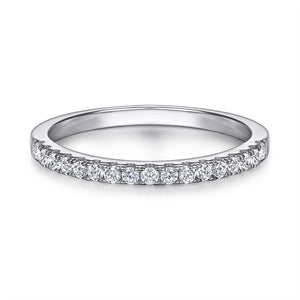
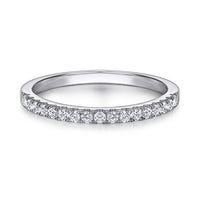
The piece they're describing → CZ Wedding Ring for Women — 925 Sterling Silver, Brilliant Cut Cubic Zirconia, Luxury Band
Personalize Yours


