


• Birthstone: Garnet — a family of 6 species (not one single mineral)
• Hardness: Mohs 6.5–7.5 depending on species
• Colors: Red (most common), green (tsavorite, demantoid), orange (spessartite), yellow-orange (hessonite), purple (rhodolite), color-change; virtually every color except blue
• Finest varieties: Demantoid (highest dispersion of any non-diamond); Tsavorite (rivals emerald); Paraíba-like color-change garnet
• Key meaning: Protection, vitality, love, loyalty
• History: Worn by travelers and warriors for protection since ancient Egypt; Noah's ark "lantern" in legend
• Internal link: See our full garnet meaning guide
• Shop: January birthstone necklaces in sterling silver
Garnet is January's birthstone — and it's far more interesting than most people realize. Most people think of garnet as a dark red stone, slightly less prestigious than ruby. But garnet is actually a family of six distinct gemstone species, and some of its rarer members — demantoid garnet with its extraordinary fire, tsavorite with its emerald-rivaling green, Mandarin garnet with its neon orange glow — are among the most collectable gems in the world. This guide covers all six garnet species, what makes each special, how to choose January birthstone jewelry, and the history of one of humanity's oldest protective gems.
At AJLuxe, our birthstone necklaces use genuine semi-precious stones set in 925 sterling silver — not glass or synthetic substitutes.
What Is the January Birthstone?
Garnet is the birthstone for January. Unlike most birthstones that are a single mineral species, "garnet" is an umbrella term for a group of silicate minerals that share the same crystal structure (isometric) but differ in chemical composition. The six main gem garnet species are: pyrope, almandine, spessartite, grossular, andradite, and uvarovite. Most commercial garnet jewelry uses pyrope-almandine mixtures, but each species has distinct properties, colors, and in some cases — dramatically different price points.
The name garnet comes from the Latin granatum, meaning "pomegranate" — a reference to the red seeds of the fruit, which closely resemble red garnet crystals in a matrix. Garnet crystals naturally grow in a dodecahedral (12-faced) shape, and ancient miners found them already partially rounded by nature — ready to use as beads with minimal shaping.

The Six Garnet Species — A Complete Family Tree
| Species | Trade Names | Colors | Key Source | Price Range |
|---|---|---|---|---|
| Pyrope | Bohemian garnet, rhodolite (with almandine) | Deep red to purple-red | Bohemia (Czech Republic), South Africa | $5–$100/ct |
| Almandine | Common red garnet, star garnet | Dark red to reddish-brown | India, Brazil, Sri Lanka, USA (Idaho star garnet) | $5–$50/ct |
| Spessartite | Mandarin garnet, spessartine | Orange to orange-red (vivid neon orange at best) | Namibia (Mandarin), Nigeria, Brazil | $50–$1,500/ct (Mandarin) |
| Grossular | Tsavorite (green), hessonite (orange-yellow), leuco garnet (colorless) | Green, yellow-green, orange, colorless | Kenya/Tanzania (tsavorite), Sri Lanka (hessonite) | $50–$3,000+/ct (tsavorite) |
| Andradite | Demantoid (green), melanite (black), topazolite (yellow) | Green, black, yellow | Russia (Ural demantoid), Namibia, Italy | $500–$5,000+/ct (demantoid) |
| Uvarovite | Uvarovite druzy | Bright emerald green (only comes in tiny crystals) | Russia, Finland, Canada | Sold by piece, not carat (too small to facet) |

Demantoid Garnet — The Garnet with More Fire Than Diamond
Demantoid garnet (green andradite) is one of the most extraordinary gemstones in the world — and one of the least known outside serious gem collectors. It comes from Russia's Ural Mountains, and its key property is extraordinary dispersion: the ability to split white light into spectral colors (fire). Demantoid's dispersion coefficient is 0.057 — higher than diamond (0.044) and higher than any other commonly encountered faceted gemstone.
What this means in practice: a well-cut demantoid in strong light shows more "fire" — more rainbow flashes of spectral color — than a diamond of equivalent size. It's one of those gems that gemologists say you need to see in person to fully appreciate.
Fine Russian demantoid is extremely rare and expensive: $2,000–$5,000+ per carat for top quality. Its characteristic inclusion is the famous "horsetail" inclusion — a radiating spray of golden-yellow chrysotile asbestos fibers, named for its resemblance to a horse's tail. This inclusion is the authentication mark: genuine Russian demantoid almost always has horsetails. A demantoid without horsetails may be from Namibia or another source (also valid), but horsetails confirm Russian origin and often carry a premium.
Tsavorite Garnet — The Emerald Rival
Tsavorite is vivid green grossular garnet. It was discovered in 1967 by Scottish geologist Campbell Bridges in the Tsavo region of Kenya (hence the name) and later commercially developed in the Merelani Hills of Tanzania near the tanzanite mining area. Bridges brought the stone to Tiffany & Co., who launched it to the gem market — the same Tiffany connection as tanzanite.
Tsavorite's color comes from chromium and vanadium — the same elements that color emerald green. The result is a vivid, pure green that rivals fine Colombian emerald in color saturation. But tsavorite has significant advantages over emerald:
- Hardness: Mohs 7–7.5 vs emerald's 7.5–8 (similar, but tsavorite typically has fewer fractures)
- Clarity: Tsavorite is typically much cleaner than emerald — inclusions are the norm in emerald, the exception in tsavorite
- Treatment: Tsavorite is never treated — it reaches the market in its natural state. Virtually all commercial emerald is oiled/resin-filled
- Price: Fine tsavorite is less expensive than comparable emerald, though the gap is narrowing
Fine tsavorite (1ct+ with vivid green color) sells for $500–$3,000+ per carat. Above 2 carats, top-grade tsavorite becomes very rare and commands significant premiums.
Mandarin Garnet — Namibia's Neon Orange
Mandarin garnet is spessartite garnet from Namibia with an exceptionally vivid, saturated orange color — sometimes described as "orange juice" or "neon orange." It was discovered in the Kunene region of Namibia in the 1990s and immediately caused a sensation in the colored stone market because nothing else produces that specific orange saturation at that clarity level.
Regular spessartite garnet from Nigeria or Brazil can be a fine orange stone, but Namibian Mandarin garnet stands out for its intensity. The color is caused by manganese and iron in specific proportions. At its best, Mandarin garnet has a saturation level comparable to fine Paraíba tourmaline or vivid yellow sapphire — an "electric" quality that makes it visible from across a room.
Color-Change Garnet — Like Alexandrite, but Garnet
Some garnets (typically pyrope-spessartite blends) exhibit alexandrite-like color change: they appear one color in daylight and a completely different color in incandescent light. The most dramatic color-change garnets shift from vivid green in daylight to vivid red or reddish-purple under incandescent. This phenomenon occurs because these garnets have a transmission window in both the blue-green and red portions of the spectrum — daylight activates the green, incandescent light activates the red.
Color-change garnets come from Madagascar, Tanzania, and Sri Lanka. They are genuinely rare and not widely known, making them exceptional conversation pieces and collector items. Fine color-change garnets can sell for $300–$2,000+ per carat.
Garnet History — Warrior Protection and Noah's Lantern
Garnet is among the oldest gemstones in human use. Garnet beads found in graves in Egypt have been dated to 3800 BCE — nearly 6,000 years of continuous use as ornament and amulet. Ancient Egyptians called garnet the "carbuncle" and used it in rings, necklaces, and chest ornaments. Red garnet was associated with the heart, blood, and life force across Mediterranean cultures.
In the ancient Near East and medieval Europe, garnet was the warrior's stone. Crusaders set garnets in their weapons and armor for protection in battle. The Koran (Quran) described the fourth heaven as built of carbuncle (interpreted as garnet). A widespread legend says Noah used a glowing garnet lantern to navigate the Ark at night — a story likely derived from garnet's vivid red appearance when held up to light.
Medieval travelers carried garnet as protection against accidents, injury, and evil on the road. This tradition persists: garnet is still considered a "protection for travelers" stone in modern crystal traditions.
In North America, garnet has been prized by Native American peoples for centuries. The Navajo and other Southwest peoples used garnets (often red almandine) in jewelry and traded them across long distances. Idaho produces a unique star garnet variety (almandine with asterism) found in few other places in the world.
Garnet in Industry — The Stone That Sands Your Wood
One of garnet's most unusual facts: it's the abrasive in most garnet sandpaper. Almandine garnet's hardness (Mohs 7–7.5) and natural crystal fracture pattern make it ideal for sanding wood, finishing metal, and waterjet cutting. The garnet abrasive industry uses approximately 300,000 metric tons of garnet per year — far more than goes into jewelry. The next time you sand a piece of furniture, you may literally be handling the January birthstone.
January Birthstone Meaning and Symbolism
Garnet's consistent historical meaning across cultures is protection, vitality, and loyalty. Red garnet was worn by warriors going into battle and travelers setting out on long journeys. It was associated with the heart, blood, and courage. In Hindu tradition, red garnet was linked to the base chakra — the foundation of physical energy and survival instinct.
Different garnet colors carry additional meanings:
- Red garnet: Love, passion, protection, vitality
- Green garnet (tsavorite): Growth, abundance, new beginnings
- Orange garnet (spessartite): Creativity, confidence, enthusiasm
- Color-change garnet: Adaptability, transformation, dual nature
For the full history of garnet's meaning and healing properties, see our complete garnet meaning guide.
What Color Is the January Birthstone?
The traditional January birthstone color is deep red — the dark red of pyrope-almandine garnet, often described as "wine red" or "blood red." This is the color most people associate with garnet and the classic choice for January birthstone jewelry.
But January's birthstone actually spans an extraordinary color range:
- Deep wine red (pyrope/almandine) — the classic
- Purple-red to violet (rhodolite — pyrope-almandine mix)
- Vivid orange-red to orange (spessartite/Mandarin)
- Vivid green (tsavorite, demantoid)
- Golden yellow (hessonite, topazolite)
- Color-change (green to red in different light)
How to Choose January Birthstone Jewelry
| If You Want | Choose | Budget |
|---|---|---|
| Classic deep red birthstone | Pyrope or rhodolite garnet | Affordable — $20–$150 in silver |
| Most unique/unusual gift | Color-change garnet or demantoid | $200–$1,000+ depending on size |
| Investment / collector piece | Russian demantoid or fine tsavorite | $500–$5,000+/ct |
| Vivid, eye-catching color | Mandarin garnet or tsavorite | $100–$2,000 depending on quality |
| Best everyday durability | Any garnet — Mohs 6.5–7.5 is fine for necklaces, earrings, and pendants | All price ranges |
Buying tips:
- For standard red garnet: look for vivid, eye-catching color with no visibly "inky" or black areas
- Rhodolite (purple-red garnet) is excellent value and more distinctive than standard dark red garnet
- For demantoid: ask for Russian origin and look for the horsetail inclusion (positive identifier)
- For tsavorite: no treatment means what you see is purely natural — unlike emerald, no oiling
- Garnet is suitable for most jewelry types; avoid rings set in silver if you want the stone to last decades (bezel settings protect better than prongs)
How to Care for Garnet Jewelry
- Clean with: Warm soapy water and a soft brush; ultrasonic is generally safe for most garnets (avoid for heavily fractured stones)
- Avoid: Steam cleaners for demantoid (andradite garnets have lower thermal resistance); ultrasonic for demantoid and hessonite
- Store: In a cloth bag or box; garnet (Mohs 6.5–7.5) can be scratched by topaz, sapphire, and diamond
- Daily wear: Garnet is suitable for pendants, earrings, and bracelets every day; rings with garnet are fine but the lower hardness means the surface can eventually acquire a scratched patina
Gifting January Birthstone Jewelry
| Occasion | Best Choice | Why |
|---|---|---|
| January Birthday | Red garnet or rhodolite necklace | Classic birthstone gift, personal, affordable |
| For a gem lover | Tsavorite, demantoid, or color-change garnet | Unusual, collector-worthy — tells a story |
| Valentine's Day | Deep red pyrope or rhodolite ring/pendant | Red = love; garnet = protection and loyalty |
| New Year gift | Spessartite or tsavorite (green = new beginnings) | January timing + growth symbolism of green garnet |
| Budget-conscious | Red almandine or pyrope garnet silver necklace | Beautiful, personal, genuine — excellent value |
Browse our January birthstone garnet collection:
• Garnet birthstone necklaces in sterling silver
• Gemstone necklaces — full collection
• January birthday gifts — curated gift ideas
Frequently Asked Questions About the January Birthstone
What is the January birthstone?
January's birthstone is garnet — a family of six gemstone species (pyrope, almandine, spessartite, grossular, andradite, uvarovite) that comes in nearly every color. The most common is deep red, but garnet also comes in vivid green (tsavorite), orange (Mandarin garnet), and even color-change varieties.
What color is the January birthstone?
The classic January birthstone color is deep red — the dark wine-red of pyrope or almandine garnet. But garnet spans a remarkable color range: purple-red (rhodolite), neon orange (Mandarin garnet), vivid green (tsavorite, demantoid), golden yellow (hessonite), and color-change. It covers virtually every color except blue.
Is garnet only red?
No — garnet comes in almost every color except blue. The six garnet species produce red, orange, yellow, green, purple, pink, colorless, and color-change stones. Many people are surprised to learn that some of the finest green gemstones in existence — tsavorite and demantoid — are both garnet varieties.
What is tsavorite garnet?
Tsavorite is vivid green grossular garnet from Kenya and Tanzania, discovered in 1967. Its color rivals fine Colombian emerald but tsavorite is typically cleaner, never treated, and often less expensive than comparable emerald. It's named after Tsavo National Park in Kenya, near where it was first found.
What is demantoid garnet?
Demantoid is green andradite garnet, found primarily in Russia's Ural Mountains. It has the highest dispersion (fire) of any non-diamond gemstone — higher than diamond itself — and shows brilliant rainbow flashes of color under light. Authentic Russian demantoid typically contains "horsetail" inclusions — radiating sprays of golden chrysotile fibers that are a positive identification marker and sometimes add to value.
What is Mandarin garnet?
Mandarin garnet is a variety of spessartite garnet from Namibia with a vivid, saturated neon-orange color. Discovered in the 1990s in the Kunene region, its intense orange color is unlike any other garnet and rivals fine orange sapphire or spessartite from other sources in its vividness.
What is color-change garnet?
Some garnets (typically pyrope-spessartite blends from Madagascar or Tanzania) display alexandrite-like color change — appearing vivid green in daylight and red or reddish-purple under incandescent light. They are genuinely rare and not widely known, making them among the most unusual January birthstone choices.
Is garnet a good everyday gemstone?
Garnet (Mohs 6.5–7.5) is well-suited for pendants, earrings, and bracelets for daily wear. For rings, it's adequate but softer stones will eventually show surface abrasion. Protective settings (bezel, halo) extend longevity for garnet rings.
What does garnet symbolize?
Garnet has been associated with protection, vitality, love, and loyalty across cultures for over 5,000 years. It was worn by warriors for protection and travelers for safe journeys. Red garnet symbolizes the heart, passion, and life force. The name itself refers to pomegranate seeds — a symbol of abundance in many traditions.
Is garnet rarer than ruby?
Common red garnet (almandine/pyrope) is much more abundant and less expensive than ruby. However, specific garnet varieties — demantoid, tsavorite, color-change garnet, fine Mandarin — are genuinely rare and may be more expensive than commercial-grade ruby. Garnet's wide species range means it occupies every level of the market from very affordable to collector-exclusive.
Shop at AJLuxe: Garnet Pendant Necklace — genuine garnet teardrop, 925 sterling silver ($42.99) · January Birthstone Necklace — garnet red infinity pendant ($42.99) · Birthstone Stud Earrings — garnet CZ, 925 sterling silver ($26.99)
Aquarius spans both January and February, so its birthstones connect directly to two months. Explore the full zodiac guide: Aquarius Birthstone: Amethyst, Garnet & The Complete Zodiac Guide.
January 1–19 falls under Capricorn — if you or your recipient is a Capricorn, explore our Capricorn birthstone guide for garnet's deeper zodiac significance.
Final Thoughts — Choosing Your January Birthstone
Garnet rewards those who look beyond the obvious. The classic deep red garnet is beautiful, affordable, and rich in 6,000 years of human history. But if you want to give or wear something extraordinary, garnet's full family offers some of the rarest and most visually stunning gems available: demantoid with more fire than diamond, tsavorite rivaling the finest emerald, Mandarin garnet in neon orange, color-change stones shifting green to red like alexandrite.
January birthstone jewelry doesn't have to be predictable. Whatever your budget and taste, the garnet family offers something genuinely special.
Browse our January birthstone garnet necklaces in sterling silver — and explore our complete garnet meaning guide for the full history and symbolism of this remarkable gemstone family.
Written by Vaishakhi Ajmera — founder of AJLuxe, specialists in personalized sterling silver jewelry. Last updated: June 2026. | Sources: GIA Garnet · American Gem Society · Jewelers of America
Explore more: Birthstone Jewelry by Month
You Might Also Like
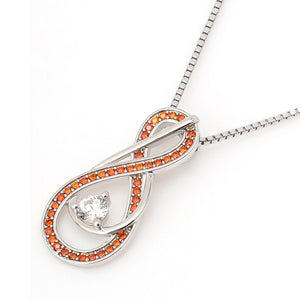
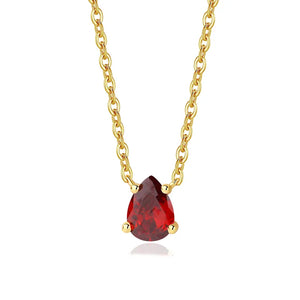
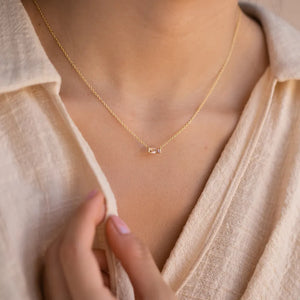
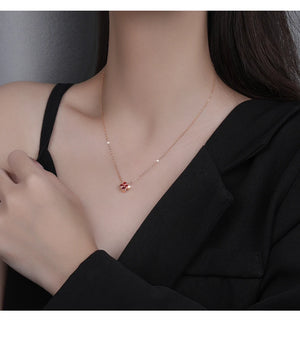
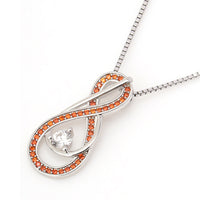
The piece they're describing → January Birthstone Necklace for Women — Garnet Red Infinity Pendant, 925 Sterling Silver
Personalize Yours

