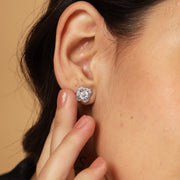
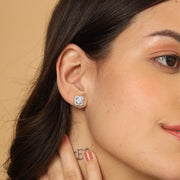
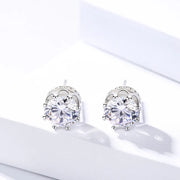
Stud Earrings: The Foundation of Every Earring Collection If you could own only one style of earring for the rest of your life, the stud would be the right choice. No other style covers as much groun…
If you could own only one style of earring for the rest of your life, the stud would be the right choice. No other style covers as much ground: you can wear studs to a job interview, to the gym, to a black-tie event, and to bed. They work in every piercing location from a simple lobe piercing to a helix or tragus. They never get caught in hair or fabric. They don't swing into your face when you lean over a desk. Studs are the rare piece of jewelry that genuinely disappears into your daily routine while still doing its job of adding polish and intention to every look.
Every earring collection starts here. Before you invest in hoops, drops, or chandeliers, the stud is the piece you reach for on the mornings you don't think about jewelry. It's the piece you forget you're wearing and then find a compliment waiting for you at the end of the day. The best stud earrings are versatile enough to work on their own but also sophisticated enough to pair with more dramatic earrings in a curated ear stack. They are the foundation everything else gets built on, and getting that foundation right matters enormously.
When most people buy stud earrings, they focus entirely on what's visible: the face of the earring, its size, its sparkle. What they completely overlook is the post — the thin metal rod that actually passes through the piercing and sits inside the piercing channel for hours at a time. This is a critical oversight. The post is the part of the earring that contacts the interior of your piercing, and the material that post is made from is the single biggest factor determining whether your ears will react or stay comfortable.
Nickel is the most common contact allergen in the world, and it is present in enormous quantities in most brass jewelry alloys. Brass itself is a copper-zinc alloy, but many brass formulations include nickel to improve their workability. When you wear earrings with brass posts, even brass posts that have been plated in gold or silver, that nickel is in direct contact with piercing tissue. Ear piercings are healed wounds. The interior of the piercing channel is skin, and nickel passes through skin into the bloodstream at the site of a piercing. What often happens is not an immediate reaction but a developing sensitivity: you wear nickel-containing jewelry for months or years without obvious problems, and then one day your ears start to itch, swell slightly, or weep a small amount of fluid. The nickel sensitivity has developed, and once it exists, it tends to worsen with repeated exposure rather than improve.
Sterling silver offers a completely different picture. The designation 925 sterling means the alloy is 92.5% pure silver and 7.5% copper. That copper component is rarely allergenic — copper sensitivity exists but is far less common than nickel sensitivity — and the resulting alloy is genuinely safe for the vast majority of people who have sensitive ears. When you buy stud earrings with 925 sterling silver posts, you're getting real silver where it matters most: at the point of contact with your skin.
One important warning: some stud earrings on the market describe themselves as "sterling silver" in reference to the decorative face of the earring — the part you can see — while the post itself is made from a base metal alloy. This is not deceptive marketing on purpose, but it can lead to real confusion. When you're shopping for stud earrings and have sensitive ears, look specifically for descriptions that confirm sterling silver posts, not just sterling silver earrings. For brand-new piercings that are fewer than eight weeks old, titanium posts are actually the gold standard because titanium is completely inert, but for fully healed piercings — the kind most adults have — 925 sterling silver is an excellent and more affordable choice.
Stud earring size is measured in millimeters and refers to the diameter of the decorative face, not the post. This measurement has a significant impact on how the earring reads on different face shapes and in different contexts. A 3mm stud is subtle enough to disappear into a professional setting while still being visible and intentional. An 8mm stud is unmistakably present and works as a focal point even without additional jewelry. Understanding where different sizes fall on that spectrum helps you choose with intention.
| Size | Look | Best Occasion | Best Face Shape |
|---|---|---|---|
| 3mm | Barely-there, ultra-delicate | Professional, formal, new piercings | All face shapes; especially small faces |
| 4mm | Classic small stud, visible without dominance | Everyday, office, most occasions | All face shapes; universal |
| 5mm | Balanced, noticeable but never loud | Casual, daytime social, weekend | Medium to larger face shapes |
| 6mm | Confident, catches light well | Evening, date night, celebrations | Oval, round, heart-shaped faces |
| 7mm | Statement stud, clearly decorative | Special occasions, going out | Oval and longer face shapes work best |
| 8mm+ | Bold, makes earrings the focal accessory | Statement dressing, celebrations | Oval, square, long face shapes |
Cubic zirconia, known as CZ, is a lab-created crystalline material specifically engineered to refract light in a way that closely mimics diamond. The key properties of CZ are its hardness (about 8–8.5 on the Mohs scale), its optical clarity, and its consistency: every CZ stone in a production run is visually identical, which means you can buy CZ studs and expect them to sparkle in exactly the same way across both earrings and across years of wear. CZ studs are the right choice when what you're after is sparkle — clean, bright, confident light-catching ability — without the cost of diamonds and without the variability of natural stones. It's worth noting that a high-quality CZ in a well-made setting outperforms a low-grade natural diamond in terms of visual impact. CZ has no inclusions, no color tint, and no irregularity in cut that budget diamonds often have. For everyday studs that you reach for by habit, CZ is an excellent choice.
Gemstone studs offer something entirely different: color, identity, and meaning. Birthstone studs feel personal in a way that CZ doesn't — they carry an association with a specific month, a person, a milestone. A pair of amethyst studs in February purple communicates something about who you are; a pair of garnet studs in deep red carries a warmth and richness that no amount of sparkle quite replicates. Gemstone studs also suit different styling moods: a pair of turquoise studs in 5mm belongs to a completely different aesthetic universe than a pair of white CZ in the same size. The decision between CZ and gemstone comes down to whether sparkle or meaning matters more to you in the moment — and the right answer is to own at least one pair of each.
A complete stud earring collection doesn't require dozens of pairs. It requires five well-chosen pairs that each serve a distinct purpose. With these five, you have a stud for every mood, occasion, and outfit combination you're likely to encounter.
Stud earrings accumulate product buildup in the crevices around the stone setting and at the base of the post over time. A simple monthly cleaning routine keeps them looking like new. Use a soft toothbrush (a children's toothbrush works well for its small size) with a tiny drop of mild soap and warm water. Work the bristles gently around the stone setting and along the post, rinse under clean water, and pat dry with a soft cloth. Never use abrasive cleaners or rough cloths, which scratch the metal surface. A silver polishing cloth used once a month keeps sterling silver bright and reduces the need for deeper cleaning. For storage, individual slots or small compartments — whether in a ring tray or a compartmented jewelry box — prevent studs from scratching against each other and make it easy to find matching pairs without searching.
The stud is the only earring style that works genuinely well in every piercing location, which makes it the most important piece to understand if you're building an ear stack. Lobe piercings are the obvious starting point, but studs are equally appropriate and comfortable in helix piercings (the cartilage ridge around the outer ear), tragus piercings (the small cartilage nub in front of the ear canal), conch piercings (the large flat area of cartilage inside the ear), daith piercings (the innermost fold of cartilage), and flat piercings (the flat upper cartilage surface). The flat profile of a stud means it doesn't catch on hair, helmets, headphones, or fabric in the way that hoops and drops can. This makes studs the practical choice for cartilage piercings where comfort and security matter most.
When building an ear stack — multiple piercings styled together across one or both ears — studs are typically the building blocks that other pieces complement. A classic lobe stud at 5–6mm, a smaller 3–4mm stud in the second lobe piercing, and an even smaller 2–3mm stud in the helix creates visual layering that reads intentional and curated. One detail that many people overlook when selecting studs for cartilage piercings is gauge. Standard lobe piercings are almost universally done at 20 gauge. Many cartilage piercings are also done at 20 gauge, but some piercers use 16 gauge for helix, tragus, or conch piercings. If you wear a 20-gauge post in a 16-gauge piercing, the post will be loose and the earring may shift or sit off-center. Ask your piercer what gauge your cartilage piercings were done at before buying studs intended for those locations — it's a small detail that makes a significant difference in comfort and fit.
A well-chosen pair of stud earrings outlasts trends, works across every dress code, and serves as the quiet foundation of a jewelry collection that tells the story of who you are. Start with a quality 4mm CZ in 925 sterling silver, and build from there.
An earring that sits flat against the earlobe on a single post pushed through the piercing, secured by a back — no hoop, no chain, no drop or movement. It's the simplest, most everyday earring shape, which is why it's usually the safest first pick for sensitive ears or all-day wear.
The post matters more than the visible stone or finish — 925 sterling silver, like every piece here, is nickel-free and is what actually determines comfort for sensitive ears. See the best materials for earrings for how sterling silver compares to titanium, surgical steel and gold.
Yes, generally — studs sit flat with no hoop or drop to catch on a pillow, which makes them one of the safer shapes to leave in overnight. See the best earrings to sleep in for more.
Cubic zirconia is a real, manufactured stone — not glass, and not a claim to be a diamond. It's cut and set the same way a diamond would be, at a fraction of the cost, and is the honest, disclosed material used across this collection rather than an undisclosed substitute.
Yes. We hold our own inventory rather than dropshipping, so anything listed as available is on our shelves and ready to ship.
Orders placed before 12pm EST ship the same day; everything else ships the next business day. Delivery inside the USA takes 3–5 days from dispatch, and shipping is free with no minimum order.
Look for studs with 925 sterling silver posts. The post is what contacts the inside of your piercing, so the face material matters less than the post material. Avoid brass or base metal posts even if they're plated. For very reactive ears or new piercings, titanium posts are the most inert option available.
Start with a larger stud (5–6mm) in your primary lobe piercing, then step down in size as you move up the ear. A 3–4mm stud in the second lobe and a 2–3mm stud in the helix creates natural visual hierarchy. Vary the stone types — CZ, pearl, colored gemstone — so each stud has its own identity rather than just being a smaller version of the one below.
CZ stands for cubic zirconia. It's a lab-created crystalline material that mimics the light refraction of diamonds. CZ is not a fake diamond — it's a distinct material engineered specifically for its optical properties. High-quality CZ has no inclusions, consistent clarity, and brilliant sparkle that outperforms many budget natural diamonds.
Use a soft toothbrush with mild soap and warm water. Gently scrub around the stone setting and along the post, rinse thoroughly, and pat dry with a soft cloth. Do this once a month. Use a silver polishing cloth to maintain the metal surface between cleanings. Avoid harsh chemical cleaners or ultrasonic cleaners for CZ stones, as they can loosen settings.
Butterfly backs can loosen over time and may allow the earring to slip out, especially during sleep or if you move your hair frequently. Screw backs are the most secure closure for studs because the back threads onto the post and cannot accidentally slide off. If you've lost studs before, switching to screw backs solves the problem.
Butterfly backs (also called push backs) slide onto the post and hold through tension — quick to put on but can loosen over time. Screw backs thread onto the post like a tiny bolt, creating a secure connection that won't accidentally release. Screw backs are more secure for active lifestyles, travel, or sleep. Butterfly backs are faster for everyday wear when security isn't a concern.
For a helix piercing, 3–4mm is the standard comfortable range. The cartilage area around the helix is smaller than a lobe, so oversized studs can look disproportionate and may apply pressure to surrounding tissue. During healing, a slightly longer post is often used to accommodate swelling; once healed, a shorter post with a flat disc in 3mm is ideal.
A stud sits flat against the lobe on a single post, with no hoop, chain or drop to move or catch. That simplicity is what makes it the usual safe default for sensitive ears and all-day wear — see every earring type explained for how it compares to hoops, huggies and drops.
The post is what decides comfort here, not the visible stone or finish. Every piece in this collection is 925 sterling silver, nickel-free, whether the setting is cubic zirconia, a birthstone color, or a plain metal shape. See the best materials for earrings for how sterling silver compares to titanium and surgical steel.
Most studs in this collection are set with cubic zirconia — a real, manufactured stone cut and set like a diamond, disclosed as CZ rather than passed off as anything else. One style, the Birthstone Stud, is set by month color instead of CZ.
Across 580 reviews in this collection the average is 4.43. The Crown Shaped Zircon Stud and White Gold Pink Heart Earrings lead at 107 reviews each.
Wipe with a dry cloth after wearing, and take earrings off before showering or swimming. Anything unworn can be returned within 30 days, and shipping is free in the USA both ways with no minimum order.
The guides shoppers open most before choosing this piece.