

- Mineral: Gypsum (CaSO₄·2H₂O) — transparent crystalline form
- Hardness: 2 on the Mohs scale — scratches with a fingernail, dissolves in water
- Chakras: Crown, Third Eye, Soul Star (etheric)
- Meaning: Clarity, cleansing, light, higher consciousness
- Key use: Clears and charges other crystals; energy clearing for spaces and people
- Biggest buyer confusion: Most "selenite wands" in stores are actually satin spar — a related but different variety of gypsum
- Jewelry note: At Mohs 2, best suited for pendants and earrings, not rings or bracelets
Selenite is one of the most recognized crystals in any collection — yet most people don't own true selenite at all. The glowing white wands and towers sold in nearly every crystal shop are technically satin spar, a fibrous cousin of selenite that shares the same mineral family but has a completely different structure. Understanding the difference matters, especially if you're buying selenite jewelry or investing in high-quality pieces.
Here's what this guide covers: the real etymology behind the name, what selenite actually means energetically, the geological wonder that put this mineral on the map, how it differs from satin spar, which chakras it activates, how to care for it (water is the enemy), and how to use it effectively for energy clearing.
Where the Name "Selenite" Comes From
The name selenite traces directly to the Greek goddess of the moon, Selene — daughter of the Titans Hyperion and Theia, who drove her silver chariot across the night sky. The Greek word selēnitēs lithos literally means "moon stone," describing the way transparent selenite crystals catch and diffuse light with a soft luminous glow that ancient observers compared to moonlight.
The formal mineral name was coined in 1747 by J.G. Wallerius, who classified the transparent crystalline variety of gypsum as selenite to distinguish it from the fibrous satin spar form. So the name isn't metaphorical — it's the original scientific classification, rooted in a 2,700-year-old association between this glowing stone and the moon.
That lunar connection runs through virtually every meaning selenite carries: cycles, clarity, feminine energy, light in darkness, and the illumination of what's hidden. It's one of the more linguistically honest names in the crystal world — the moon metaphor earned its way in through direct observation, not marketing.
What Is Selenite, Scientifically?
Selenite is the transparent, well-crystallized variety of gypsum — a hydrous calcium sulfate mineral with the chemical formula CaSO₄·2H₂O. Gypsum is one of the most common minerals on Earth, found in sedimentary rock formations on every continent. It forms when sulfate-rich water evaporates in marine or lake environments, depositing calcium sulfate crystals over thousands to millions of years.
What makes selenite distinct from other gypsum varieties is its crystal structure: large, flat, translucent monoclinic crystals that cleave in perfect sheets. This is why selenite is used in laboratories and optics — sliced thin enough, it becomes a polarizing filter for light.
Two physical properties matter most for anyone buying or wearing selenite:
- Hardness of 2 on the Mohs scale — softer than a copper penny (3.5), easily scratched by a fingernail. This makes selenite fragile in everyday wear.
- Water solubility — selenite dissolves slowly in water. Running it under a tap repeatedly, leaving it in a humid bathroom, or doing a water cleanse will cause the surface to pit and eventually crumble. Never cleanse selenite in water.
These aren't warnings to scare you off selenite — they're practical facts that determine how you store it, wear it, and care for it. More on that in the care section below. For a complete guide on why water is so dangerous for selenite and what to use instead, see: Can Selenite Go in Water?
The Naica Mine: Where Selenite Reached Its Limit
In 2000, miners drilling in the Naica silver mine in Chihuahua, Mexico, broke through a wall into a chamber that stopped them cold. Inside was the Cave of Crystals (Cueva de los Cristales) — a void roughly the size of a basketball court, nearly 1,000 feet underground, filled floor to ceiling with selenite crystals up to 36 feet long and 3 feet wide, some estimated to weigh 55 tons.
Scientists determined the crystals grew over approximately 500,000 years in conditions of 136°F (58°C) with 99% humidity — just above the temperature at which gypsum converts to anhydrite. That narrow temperature window allowed incredibly slow crystal growth: at estimated rates of less than 1mm per century, each giant crystal represents geological patience on a scale that's genuinely hard to comprehend.
The cave is uninhabitable by humans without a special ice suit — even with one, explorers can only stay about 10 minutes before heat and humidity incapacitate them. When the mine's dewatering pumps were shut down in 2015, the cave reflooded and the crystals were once again submerged. They may continue growing for another half million years.
The Naica discovery confirmed what mineralogists suspected: given the right conditions, selenite crystals grow to a scale that seems impossible. The crystals you hold in your hand formed the same way — just in a smaller chamber, over a shorter time.

Selenite vs. Satin Spar: The Confusion the Crystal Industry Ignores
Here's something almost no crystal retailer will tell you: the vast majority of products sold as "selenite" — the polished wands, towers, bowls, lamps, and palm stones — are technically satin spar, not selenite.
Both are varieties of gypsum, but they have very different structures:
| Property | True Selenite | Satin Spar |
|---|---|---|
| Crystal structure | Flat, tabular, transparent monoclinic crystals | Fibrous, silky parallel fibers running lengthwise |
| Appearance | Clear, glassy, often transparent like ice | White, opaque, silky sheen with chatoyancy (cat's-eye) |
| Mohs hardness | 2.0 | ~2.5 (slightly harder) |
| Workability | Breaks and splinters easily — hard to cut and ship | Takes a better polish, survives cutting and shipping |
| What's sold as "selenite" | Rare in shops — mostly raw/rough pieces | Virtually every polished wand, tower, bowl, and lamp |
| Energy properties | Same mineral, same metaphysical tradition | Same mineral, same metaphysical tradition |
Why does this happen? When the crystal retail market grew rapidly, the name "selenite" became attached to all white gypsum products — even the fibrous satin spar variety — because satin spar was far easier to cut, polish, and ship without breaking. The name stuck. Most crystal shops now use "selenite" and "satin spar" interchangeably, which is technically imprecise but practically widespread.
Does it matter energetically? Both are the same mineral with the same calcium sulfate composition. The metaphysical tradition doesn't distinguish between them — the cleansing, clarifying properties apply to both. If you're buying for energy work, your satin spar wand isn't less effective because it was mislabeled. If you're a mineral collector or buying selenite jewelry, knowing the difference helps you ask the right questions.
Selenite Meaning: Clarity, Light, and the Self-Cleansing Stone
Selenite's core metaphysical meaning revolves around three themes: clarity, energy cleansing, and connection to higher consciousness. These aren't arbitrary — they trace back to observable physical properties that ancient practitioners noticed and interpreted.
The transparency of true selenite — the way light passes through it and diffuses softly — gave rise to its association with illumination and mental clarity. Cloudy thinking, emotional fog, confusion: selenite is said to cut through all of them the way light cuts through a thin crystal pane.
Its most distinctive claimed property is the ability to cleanse and recharge other crystals simply by placing them near or on it. Unlike most crystals in this tradition — which are said to absorb energy and need periodic cleansing themselves — selenite is believed to be a self-cleansing stone, maintaining its own clarity without external help. (It does still benefit from an occasional moonlight or sound-bath cleanse, but it doesn't accumulate heavy energy the way denser stones like black tourmaline do.)
In summary, selenite's meaning clusters around:
- Mental clarity — clearing confusion, indecision, mental fog
- Energy cleansing — removing stagnant or heavy energy from people, spaces, and other crystals
- Higher consciousness — facilitating meditation, spiritual work, connection to intuition
- Peace and calm — selenite's energy is consistently described as gentle, not forceful; it clears rather than protects
- Truth and honesty — bringing hidden things into light, both in self-reflection and in communication with others
Selenite and the Chakras: Crown, Third Eye, and Beyond
Selenite is primarily associated with the Crown Chakra (Sahasrara) — the energy center at the top of the head that governs connection to higher states of consciousness, spiritual awareness, and the experience of unity beyond the individual self. A blocked or underactive Crown Chakra shows up as feelings of disconnection, cynicism, meaninglessness, or an inability to access meditative states. Selenite is used to open and clear this center.
It also works with the Third Eye Chakra (Ajna) — the center between the brows associated with intuition, inner vision, and mental clarity. When these two chakras work together — Crown and Third Eye in alignment — the combination supports both high-frequency spiritual access and grounded, clear-minded insight.
Some practitioners also associate selenite with the Soul Star Chakra — an etheric chakra believed to sit above the physical body, linked to the soul's higher purpose and akashic records. Selenite wands are commonly used to sweep this energy field before meditation work.
A simple chakra practice with selenite: lie flat, place a piece of selenite at the top of your head (Crown), and a second piece on your forehead (Third Eye). Hold this position for 10–15 minutes while focusing on breath. Many practitioners find this helps quiet the mental chatter that makes meditation difficult.

Selenite Varieties: More Than White
Most people picture selenite as white or clear, but gypsum crystallizes in a wider color range than the typical shop inventory suggests:
- White/clear selenite — the classic form; transparent to translucent, vitreous luster
- Peach selenite (also called orange selenite) — iron oxide inclusions give a warm golden-orange tone; associated with the Sacral Chakra; found primarily in Morocco
- Desert rose selenite — plate-like crystals that form in rose-shaped clusters in desert sands; each "petal" is a gypsum crystal. Technically satin spar structure, sold as both "selenite" and "desert rose"
- Fishtail selenite (butterfly selenite) — twin crystals that form in a V-shape resembling a fish's tail or butterfly wings; considered particularly potent for duality and balance work
- Green selenite — rare; chlorite or other mineral inclusions add a pale green cast; found in parts of Australia and the US Southwest
- Blue/grey selenite — atmospheric impurities during formation; less common commercially
- Golden selenite — warm amber to gold tones from sulfur inclusions; found in Utah and parts of New Mexico
Energetically, the white and clear forms are considered the highest-vibration and most versatile. The peach/orange form adds a warmer, more emotionally grounding energy to selenite's typically ethereal quality. Fishtail selenite is often chosen specifically for twin-flame or relationship work because of its paired crystal structure.
Selenite Healing Properties
In crystal healing traditions, selenite is used for both emotional and physical support — though as with all crystal practices, these are complementary to medical care, not a replacement for it.
Emotional and mental support:
- Reducing anxiety and mental noise — selenite's gentle high-frequency energy is considered calming rather than stimulating
- Supporting decision-making by clearing confusion — practitioners often hold or wear selenite when they feel overwhelmed by competing thoughts
- Releasing stored emotional patterns — the Crown Chakra connection helps process experiences that have become stuck at the mental level
- Promoting honesty and self-awareness — selenite is associated with truth-telling, particularly to oneself
Physical and environmental:
- Placed in corners of a room, selenite is traditionally used to clear the energetic atmosphere — particularly useful after conflict, illness, or stressful periods in a space
- Some practitioners use selenite wands in body scanning — sweeping the stone a few inches above the body from head to feet, aiming to clear the aura
- Selenite lamps, when used as a light source, are believed to continue emitting clearing energy passively throughout a space
At AJLuxe, we've seen customers choose selenite pendants specifically for its calm energy during high-stress periods — it's one of the few crystals where the visual effect (that soft white glow) genuinely mirrors the energy people describe wearing it. A delicate selenite pendant in 925 sterling silver sits closest to the Throat and Heart Chakra area when worn as a necklace, making it particularly effective for communication clarity and emotional balance.
How to Use Selenite
Charging other crystals: Place stones you want to recharge on a selenite charging plate or flat piece overnight. Selenite doesn't absorb energy from other stones — it's believed to transmute and clear it, restoring other crystals to a clean energetic state. This makes a selenite charging plate one of the more practical tools in a crystal collection.
Space clearing: Walk through a room with a selenite wand, moving slowly and intentionally. You can set a specific intention — "clear heavy energy from this space" — while doing so. Pay attention to doorways, corners, and areas where energy tends to feel stagnant. Many people do this after guests leave, after difficult conversations, or when moving into a new space.
Meditation: Hold a piece of selenite in your non-dominant hand (or both hands) during seated meditation. The Crown Chakra connection makes it particularly useful for practices aimed at quieting mental noise or accessing intuitive states. Some practitioners place selenite at their Crown while lying in Savasana at the end of a yoga practice.
Desk or workspace: A selenite tower or wand on your desk is one of the more functional uses — its energy-clearing properties work passively, and the visual reminder of clarity is genuinely useful during concentrated work.
Wearing selenite: A pendant or earrings keep selenite in your field throughout the day. Given its hardness of 2, stick to styles where the stone won't contact hard surfaces — pendants and drop earrings are ideal. Avoid selenite rings or bracelets for everyday wear, as the stone will scratch quickly against clothing, countertops, and bags.
Selenite Care: What You Must Know Before Cleansing It
Selenite requires specific care that differs from most other crystals in one critical way: keep it away from water.
Because selenite is a form of gypsum — a water-soluble mineral — prolonged contact with water causes the surface to cloud, pit, and eventually dissolve. A single brief rinse probably won't destroy it, but a water cleanse, leaving it near a sink, or storing it in a humid bathroom will cause visible damage over time. This is a hard limit, not a gentle suggestion.
How to cleanse selenite safely:
- Moonlight — place it on a windowsill or outside on a full moon night. No moisture risk if the weather is dry.
- Sunlight — a few hours in morning sunlight works well. Avoid prolonged exposure as very intense heat can cause some crystals to fade, though selenite's white color is structural, not a dye.
- Sound — singing bowls, tuning forks, or bells work beautifully for selenite. The vibration clears the crystal without any contact risk.
- Smudging — passing selenite through sage or palo santo smoke is a traditional method that leaves no moisture.
- Dry salt — bury in dry sea salt for a few hours (NOT saltwater). Remove and brush off salt completely afterward.
Storage: Wrap selenite pieces individually in a soft cloth when not in use. Because it cleaves in flat sheets and scratches easily, even contact with other stones in the same pouch will damage the surface. Store separately from harder crystals.
For jewelry: Remove selenite pieces before washing hands, showering, swimming, or exercising. Wipe with a dry soft cloth after wearing. The body's natural oils won't harm it, but water will.
Zodiac and Planetary Associations
Selenite's primary zodiac associations are Cancer and Gemini. The Cancer connection is straightforward — Cancer is ruled by the moon, and selenite is literally named after the moon goddess. The lunar symbolism (cycles, emotion, intuition, the home) aligns directly with Cancer's core themes.
The Gemini association connects to the communication and mental clarity aspects of selenite — Gemini's realm of quick thought, adaptability, and information flow resonates with selenite's role in clearing mental fog and facilitating honest communication.
Planetarily, selenite is associated with the Moon and, in some traditions, Mercury — again, the Moon for the obvious naming connection, Mercury for the communication and clarity dimensions.
Selenite also appears in some traditions as a stone for Taurus, as gypsum is an earth mineral that forms in evaporite sequences — the Taurus connection to material earth, stability, and sensory experience grounds selenite's otherwise ethereal energy.
Selenite in Jewelry: What to Know Before You Buy
Selenite's Mohs hardness of 2 makes it one of the softer stones used in jewelry — softer than amber (2–2.5), softer than pearl (2.5–4.5), and significantly softer than quartz (7) or topaz (8). This doesn't make it unwearable, but it does determine which jewelry styles are practical.
Best suited for:
- Pendants — worn close to the body but not exposed to constant friction; ideal for selenite's hardness level
- Drop earrings and studs — minimal contact with hard surfaces
- Occasional-wear pieces — selenite makes beautiful statement jewelry for mindful occasions
Not ideal for:
- Rings — hands contact hard surfaces constantly; even normal daily use will scratch and chip a Mohs-2 stone within weeks
- Bracelets — the same friction issue, plus selenite is at risk of being scratched by other bracelet stones in a stack
- High-activity wear — gym, garden work, cooking — any activity where the stone contacts hard surfaces repeatedly
At AJLuxe, our selenite pieces use 925 sterling silver settings that protect the stone's edges, which is the most vulnerable part of a low-hardness crystal. The silver base is hypoallergenic and safe for sensitive skin — important since selenite jewelry sits directly against skin during wear.
Frequently Asked Questions About Selenite
What does selenite do energetically?
Selenite is primarily used for energy clearing — of spaces, people, and other crystals. It's associated with the Crown and Third Eye Chakras and is believed to promote mental clarity, calm emotional turbulence, and facilitate connection to higher states of awareness during meditation. Unlike many crystals, it's considered self-cleansing, meaning it doesn't accumulate the energy it clears.
Can selenite go in water?
No. Selenite is a form of gypsum (calcium sulfate), which is water-soluble. Prolonged exposure to water — water cleansing, humid environments, leaving it near a sink — causes the surface to dissolve, pit, and cloud over time. Use moonlight, sound, dry salt, or smoke to cleanse selenite instead. This is one of the most important care rules for selenite owners.
Is selenite the same as satin spar?
No, though the names are used interchangeably in most shops. Both are varieties of gypsum, but true selenite has a transparent, flat, tabular crystal structure, while satin spar has a fibrous, silky structure with a chatoyant sheen. The vast majority of polished "selenite" wands, towers, and bowls sold commercially are satin spar — it's more durable and workable than true selenite. Energetically, both share the same properties since they're the same mineral.
What chakra is selenite associated with?
Selenite's primary chakra is the Crown Chakra (Sahasrara), located at the top of the head, which governs spiritual connection and higher consciousness. It also works with the Third Eye Chakra (Ajna) for clarity and intuition, and some practitioners associate it with the etheric Soul Star Chakra above the physical body. Selenite is one of the most commonly used Crown Chakra stones alongside clear quartz and amethyst.
How do you cleanse selenite?
The safest methods are moonlight (place outside or on a windowsill overnight), sound (singing bowls, tuning forks, or bells), smudging (pass through sage or palo santo smoke), or dry salt (bury briefly, then brush off completely). Never use water — selenite is water-soluble and water cleansing will damage the surface over time. Selenite is also considered a largely self-cleansing stone, so it needs less frequent cleansing than denser crystals like obsidian or black tourmaline.
What crystals pair well with selenite?
Selenite works well with most other crystals because of its clearing properties — it can help reset the energy of neighboring stones. For meditation, selenite pairs especially well with amethyst (both are Crown Chakra stones), clear quartz (amplifies selenite's clarifying energy), and labradorite (adds intuitive protection to the clarity selenite provides). For grounding, pair selenite with black tourmaline — the two balance each other, with tourmaline grounding what selenite elevates.
Can selenite charge other crystals?
Yes — placing crystals on a flat piece of selenite overnight is one of the most widely used crystal-charging methods. Selenite is believed to clear accumulated energy from other stones without needing to be emptied itself first. A selenite charging plate is particularly useful for smaller tumbled stones and crystal jewelry that's worn regularly and picks up energy throughout the day.
What does selenite look like?
True selenite is transparent to translucent with a glassy, vitreous luster — it looks like a thick, milky glass or ice. Satin spar (sold as selenite) appears white and opaque with a silky, fibrous sheen and a cat's-eye effect under direct light. Selenite varieties range from clear to white, peach, orange, pale green, and golden, depending on mineral inclusions during formation. Size ranges from small tumbled pieces to the 36-foot giants in Mexico's Naica Mine.
Is selenite toxic or safe to handle?
Selenite (gypsum) is non-toxic and safe to handle. It contains no heavy metals or toxic compounds. The only precautions are around its softness — it creates fine dust when scratched or broken, so avoid inhaling dust from grinding or breaking selenite pieces. As with all mineral specimens, wash hands after handling, particularly before eating. Selenite is not considered a hazardous mineral by occupational health standards.
How do you tell real selenite from fake?
Genuine selenite (and satin spar) can be identified by: (1) the fingernail scratch test — your nail should scratch it at Mohs 2; if it doesn't, it's not selenite; (2) temperature — selenite feels slightly warm to the touch due to its thermal insulating properties, unlike glass or plastic which feel cool; (3) weight — selenite is relatively light for its size; (4) the optical test — true selenite shows perfect cleavage in flat sheets. Most concerns about "fake" selenite in the market are actually mislabeled satin spar, not completely fake material.
Where is selenite found in the world?
Major deposits exist in Mexico (the Naica Mine, Chihuahua state), Morocco (the largest global supplier of satin spar products), the United States (Oklahoma, Utah, New Mexico), Australia, Poland, Spain, and parts of Canada. Each source produces slightly different crystals — Mexican selenite tends toward large, clear tabular pieces; Moroccan satin spar is the fibrous white variety that dominates the market. NASA confirmed gypsum deposits on Mars in 2004, making it one of the few Earth minerals with confirmed extraterrestrial presence.
What's the difference between selenite and white quartz?
The simplest test: hardness. Selenite/satin spar rates 2 on the Mohs scale — it scratches with a fingernail and is easily marked by a copper coin or key. Quartz rates 7 — it won't scratch at all with those tools, and in fact quartz will scratch glass. Visually, satin spar has a silky fibrous sheen that white quartz doesn't. True selenite is transparent-to-translucent; most white quartz is opaque (milky quartz) or has a cloudier appearance without the fibrous cat's-eye effect of satin spar.
Final Thoughts: Why Selenite Belongs in Your Collection
Selenite is one of the most versatile crystals to own — and one of the most commonly misunderstood. Whether you call what you have selenite or satin spar, the mineral family is the same, the properties are the same, and the 2,700-year association with the moon goddess Selene has made it a symbol of clarity and light across multiple cultures and centuries.
What makes selenite practically useful beyond the metaphysical tradition is its structural uniqueness: transparent crystals that formed over half a million years in the dark heat of the Naica mountain, a Mohs-2 softness that means it needs thoughtful care, and a water solubility that makes it fundamentally different from every other crystal in your collection.
If you're choosing a selenite piece for jewelry, opt for a pendant or earrings where the stone won't contact hard surfaces daily. If you're using it for energy work, a flat charging plate and a selenite tower are the most functional forms. Either way, keep it dry, store it separately from harder stones, and let it do what it's been doing since Theophrastus first described gypsum in the 4th century BCE — catch the light and return it.
Explore our selenite and gemstone crystal jewelry in 925 sterling silver with 18K gold plating — hypoallergenic, gift-ready, free US shipping.
Written by the AJLuxe team. Last updated: July 2026. | Sources: GIA — Gypsum and Selenite · USGS — Gypsum
All third-party trademarks, brand names and product names are the property of their respective owners. AJLuxe is not affiliated with, endorsed by, sponsored by, or otherwise connected to any third-party brand referenced in this article. Brand names are used solely for accurate comparative reference, and material descriptions reflect each brand's own published product specifications at the time of writing.
You Might Also Like
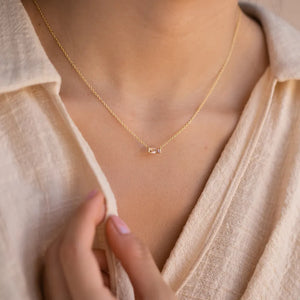
The piece they're describing → Heart Initial Necklace for Women — 18K Gold Plated, Personalized Letter + Heart Pendant
Personalize Yours


