


The short answer
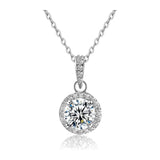
A halo necklace surrounds a pendant's center stone with a ring of smaller accent stones, which reflects extra light back toward the center and reads visually larger than the same stone in a plain solitaire pendant. It works with any center stone -- mined diamond, lab-grown diamond, moissanite, or cubic zirconia -- and typically costs less than buying a bigger single stone to get a comparable amount of visible sparkle.
One quick note before you keep reading: if you searched "halo necklace" hoping for video-game merchandise, that's a different product with the same name -- this guide is about the jewelry setting.

What Is a Halo Necklace?
A halo necklace is a pendant where a ring of smaller accent stones surrounds a center stone, following its outline. The style is borrowed directly from halo engagement rings, adapted to a pendant setting. The "halo" refers only to how the accent stones are arranged -- the center stone itself can be a mined diamond, a lab-grown diamond, moissanite, cubic zirconia, or a colored gemstone, since nothing about the setting requires a specific material.
Halo vs. Solitaire vs. Cluster vs. Bezel Pendant
A halo setting adds a ring of accent stones around the center stone; a solitaire skips accents entirely, a cluster setting groups several small stones with no single dominant center, and a bezel setting wraps the center stone in a metal rim instead of prongs. Each trades sparkle and visual size against how much upkeep (prong checks, plating wear) the piece needs.
| Setting | How it's built | Maintenance |
|---|---|---|
| Halo | Ring of small accent stones surrounds a separate center stone, extending sparkle and reading visually larger than the center stone alone | Most crevices to clean; more prongs to check over time |
| Solitaire | Single center stone, no accents, on a plain setting | Fewest crevices/prongs; simplest to keep clean and inspect |
| Cluster | Several small stones grouped together with no single dominant center stone | Many small prongs across the whole cluster; a loosened stone anywhere in the group is harder to spot than one center stone |
| Bezel | Center stone fully wrapped in a metal rim instead of prongs | No prongs to snag or loosen -- most secure daily-wear setting, though the rim covers more of the stone's edge so it can read slightly dimmer than a halo of the same size |
Does a Halo Setting Really Make the Pendant Look Bigger?
Yes -- the halo's ring of smaller stones extends the area of visible sparkle and bounces extra light back toward the center stone, so the eye reads the whole cluster as one larger area of brilliance instead of measuring the center stone in isolation. That's an optical effect from the design, not a change to the actual stone -- the center stone's size and weight don't change, the setting just changes how much of the piece catches light.
What's Actually in AJLuxe's Halo Necklace
AJLuxe's halo necklace uses a 1-carat round cubic zirconia (CZ) center stone (6.5mm diameter) in a pave CZ halo, on a 316L stainless steel chain with rhodium plating. It is not sterling silver and not gold plated -- unlike most of the AJLuxe catalog, this piece is built on a stainless steel base with a rhodium finish, and we're naming that plainly rather than letting the "gold-tone" look imply gold plating. Under the FTC's Jewelry Guides (16 CFR Part 23), plated jewelry has to be sold and labeled as plated, not as the base precious metal -- AJLuxe lists this piece as rhodium-plated stainless steel, not solid or plated gold.
Material breakdown
- Base metal: 316L stainless steel -- hypoallergenic and safe for most sensitive skin, but NOT nickel-free; nickel is alloyed into 316L steel itself, so this is not the right piece for a diagnosed nickel allergy.
- Plating: Rhodium plating over the stainless steel, for a bright white-gold-tone finish that resists tarnish better than a plain polished finish.
- Chain: Adjustable cable chain, 16in + 2in extender to 18in, lobster clasp.
- Center and accent stones: round cubic zirconia, 1 carat / 6.5mm diameter, in a pave CZ halo -- not a mined or lab-grown diamond, not moissanite.
- What's included: the necklace, gift-boxed with a free printed message card (16 designs, or leave it blank to write your own) -- not a matching earring set.
- Price: $44.99. The product listing notes this is a first-run piece with very limited stock.
For scale on the center stone: cubic zirconia rates around 8-8.5 on the Mohs hardness scale versus a mined diamond's 10, which is part of why CZ costs a fraction of a comparable-looking diamond pendant and why gentle care (below) matters more than it would for a diamond.
Halo Necklace Care and Maintenance
Wipe a rhodium-plated halo necklace with a soft, dry cloth after wearing it and store it separately in a pouch to keep the accent stones from scratching against other jewelry. Remove it before showering, applying lotion or perfume, swimming, or exercising -- rhodium is a surface treatment, not a solid metal, and repeated contact with moisture and chemicals is the fastest way to wear through the plating and expose the stainless steel underneath. Once the plating visibly thins, it needs re-plating rather than polishing back to new.
Shop This Guide
AJLuxe's halo necklace pairs a 1-carat cubic zirconia center stone in a pave CZ halo with a rhodium-plated 316L stainless steel chain -- $44.99, gift-boxed with a printed message card. Honestly: not sterling silver, not gold plated -- a stainless-steel piece that says so.
Shop the CZ Halo Pendant NecklaceFrequently Asked Questions
What does a halo necklace mean?
A halo necklace refers to the setting, not a symbol -- a pendant's center stone is surrounded by a ring of smaller accent stones (the "halo") that follows its outline, a style borrowed from halo engagement rings. It doesn't carry religious or symbolic meaning on its own the way a cross or evil-eye pendant does; "halo" here describes the ring of stones, not a message.
What does a circle pendant necklace mean?
A plain circle pendant is most often read as a symbol of eternity or unity, since a circle has no beginning or end -- but a halo pendant is a different thing. The "circle" in a halo setting is a ring of small accent stones surrounding a separate center stone, not a solid circle shape, so it doesn't carry the same eternity symbolism unless the pendant is also shaped like a closed circle.
What is a CZ necklace?
A CZ necklace uses cubic zirconia, a lab-created stone, as its center or accent stone instead of a mined or lab-grown diamond. Cubic zirconia is cut and faceted to mimic diamond's brilliance at a fraction of the cost, and it's the stone in AJLuxe's own halo necklace -- a 1-carat round CZ center stone framed by a pave CZ halo.
Is a halo necklace or a solitaire necklace better?
Neither is objectively better -- a halo pendant gives more visible sparkle and reads larger for the price because the accent stones add surface area, while a solitaire is simpler to keep clean with fewer contact points to check over years of wear. Halo wins on sparkle per dollar; solitaire wins on lowest maintenance.
What are the downsides of rhodium plating?
Rhodium plating wears down with friction and exposure to lotion, soap, and sweat, eventually revealing the base metal underneath -- how fast depends on how often the piece is worn and washed against. It's a surface treatment, not a solid metal, so once the finish thins it needs re-plating rather than polishing back to new.
Is a stainless steel necklace worth it?
Yes, for everyday wear specifically -- 316L stainless steel resists tarnish, scratching, and daily knocks better than plated sterling silver, and it doesn't need re-plating the way vermeil or gold-plated pieces eventually do. The trade-off is that stainless steel itself can't be resized, so anything sizing-dependent (like chain length) has to be right at purchase.
What is the most hypoallergenic jewelry metal?
Titanium and niobium are considered the most hypoallergenic metals because they contain no nickel at all. 316L surgical-grade stainless steel -- what AJLuxe's halo necklace is made of -- is the next most common hypoallergenic option and is safe for most sensitive skin, but it is NOT nickel-free; nickel is alloyed into 316L steel itself, so anyone with a diagnosed nickel allergy should still be cautious.
Does a halo setting actually make a pendant look bigger?
Yes, by design -- the ring of smaller stones extends the sparkle across a wider surface area and reflects extra light back toward the center stone, so the eye reads the whole cluster as one larger area of brilliance rather than measuring the center stone alone. The center stone's actual size and weight don't change; only how much of the piece catches light does.
All third-party trademarks, brand names and product names are the property of their respective owners. AJLuxe is not affiliated with, endorsed by, sponsored by, or otherwise connected to any third-party brand referenced in this article. Brand names are used solely for accurate comparative reference, and material descriptions reflect each brand's own published product specifications at the time of writing.
You Might Also Like
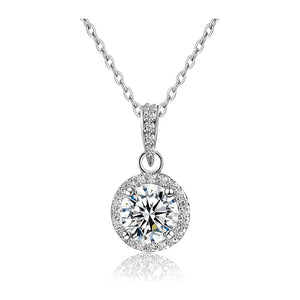
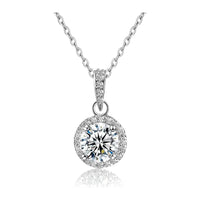
The piece they're describing → Round Halo Pendant Necklace — 1 Carat CZ, Gift Boxed with Message Card
Personalize Yours


