


• Birthstone: Amethyst — purple variety of quartz (SiO₂ + iron + irradiation)
• Hardness: Mohs 7 — suitable for all jewelry types
• Best color grade: "Deep Siberian" — 75–80% purple + 15–20% blue secondary hue
• Special varieties: Ametrine (half amethyst/half citrine, Bolivia only); Rose de France (pale lavender-pink); Vera Cruz (Mexico, very pale/clear)
• Heat treatment: Amethyst turns citrine yellow at 470°C+; prasiolite (green amethyst) at lower temperatures
• Key meaning: Sobriety, clarity, spiritual protection, peace of mind
• History: Once ranked with ruby and sapphire; value dropped after 1800s Brazilian discovery
• Internal link: See our full amethyst meaning guide
• Shop: February birthstone necklaces in sterling silver
Amethyst is February's birthstone and one of the most beloved purple gemstones in the world. What most people don't know is that amethyst was once one of the rarest and most expensive gemstones — historically ranking alongside ruby, emerald, sapphire, and diamond as the five "cardinal" precious gems. A single event changed everything: the discovery of massive amethyst deposits in Brazil in the early 1800s flooded the market and transformed amethyst from a royal treasure into an accessible stone for everyone. Today amethyst offers exceptional color and quality at prices that make purple gemstone jewelry accessible to any budget — and it's still remarkable.
At AJLuxe, our birthstone necklaces use genuine semi-precious stones set in 925 sterling silver — not glass or synthetic substitutes.
What Is the February Birthstone?
Amethyst is the purple variety of quartz (silicon dioxide, SiO₂). In its pure form, quartz is colorless. The purple color develops when iron (Fe⁴⁺) impurities substitute for silicon atoms in the crystal structure, and natural gamma radiation from surrounding rocks alters the iron's oxidation state over geological time. The specific combination of iron content and radiation exposure determines the intensity and hue of the purple color.
Amethyst forms in geodes, alluvial deposits, and pegmatite veins worldwide. The largest amethyst-producing countries today are Brazil (by far the largest, primarily Rio Grande do Sul state), Uruguay (produces darker, more saturated stones), Zambia, Bolivia, and Russia (the historical "Siberian" source that set the color standard).

Amethyst Colors and Varieties
Amethyst's color ranges from barely-there pale lavender to an almost inky dark purple. The trade uses several informal color grade names:
| Color Grade | Description | Source | Value |
|---|---|---|---|
| Deep Siberian | ~75–80% purple + 15–20% blue secondary hue; no brown or gray modifier | Russia (historic), Zambia, Uruguay | Highest — $15–$50+/ct |
| Uruguayan | Very dark, saturated purple — can approach "inky" if too dark | Uruguay | High — especially at medium-dark tones |
| Brazilian Medium | Medium purple, good saturation — the commercial standard | Brazil (Rio Grande do Sul) | Moderate — excellent value |
| Rose de France | Pale lavender-pink — translucent, soft, romantic | Brazil and elsewhere | Low–moderate; popular in large-stone fashion jewelry |
| Vera Cruz | Very pale, transparent lilac — almost colorless | Vera Cruz, Mexico | Low; valued for clarity and crystal form |
Ametrine — When Both Meet in One Crystal
Ametrine is a naturally bicolored quartz that is half amethyst (purple) and half citrine (yellow-orange) in the same crystal. It comes exclusively from the Anahi Mine in the Santa Cruz department of Bolivia — the only location in the world where this specific natural bicolor forms reliably enough to produce commercial quantities.
The phenomenon occurs because the Anahi deposit has unusual temperature gradients within the crystal growth chamber. Amethyst forms when iron is in one oxidation state at lower temperatures; citrine's yellow color forms when iron is in a different state at higher temperatures. A crystal that grew through both temperature zones captures both colors in different zones of the same stone.
Ametrine is typically cut in rectangular or emerald-cut shapes to show both color zones. It's a genuinely unusual natural gemstone — one stone, two colors, one mineral species.
Heat Treatment — The Transformation Chemistry
Amethyst's relationship with heat is one of gemology's most interesting transformation stories:
- At ~470°C+: Amethyst turns yellow to golden-brown, becoming citrine. Most commercial citrine on the market today is heat-treated amethyst — not natural citrine (which is rarer and typically paler). If you see a vivid orange-red "Madeira citrine" or "golden citrine" at a low price, it's almost certainly started life as amethyst.
- At lower temperatures (~250–350°C): Some amethyst from specific deposits turns green, producing prasiolite (sometimes marketed as "green amethyst"). This is a trade name that isn't strictly accurate mineralogically, but it describes the material. Most prasiolite on the market is irradiated+heated Brazilian amethyst.
- Natural amethyst-to-citrine transformation: This also happens in nature — geological heat events can turn amethyst patches within a crystal to citrine, creating natural ametrine.
Amethyst History — From Royal Treasure to Accessible Gem
The story of amethyst in human culture spans over 4,000 years, but the most important inflection point came in the early 19th century.
For most of Western history, amethyst was one of the five "cardinal" precious gemstones — alongside diamond, ruby, emerald, and sapphire. It was the gemstone of royalty: the British Crown Jewels include multiple amethysts; Catherine the Great of Russia collected amethysts obsessively; the papal ring (the "Ring of the Fisherman") traditionally features an amethyst. The ancient Greeks carved amethyst drinking cups, believing the stone kept the drinker sober. Roman matrons wore amethyst to ensure their husbands remained faithful.
Then, in the early 1800s, enormous amethyst geode deposits were discovered in Brazil — particularly in Rio Grande do Sul. The supply increased so dramatically that the price of amethyst collapsed. What had been a royal luxury became commercially available. The GIA today classifies amethyst as a "precious" gemstone but one of the most affordable, precisely because of this geological windfall.
The "not drunk" etymology (Greek amethystos) reflects the ancient Greek belief that wearing amethyst or drinking from amethyst vessels would prevent drunkenness. Some historians believe this association may have originated from the stone's color resemblance to diluted wine (ancient Greek wine was often watered down to a pale purple). Whatever the origin, the sobriety association became one of amethyst's most persistent traditional meanings.
February Birthstone Meaning and Symbolism
Amethyst's meanings across traditions converge on clarity, protection, and spiritual awareness:
- Greek tradition: Sobriety and clear thinking; protection from intoxication and excess
- Christian tradition: Purple = royalty and spiritual authority; amethyst was worn by Catholic bishops and still appears in ecclesiastical jewelry
- Tibetan Buddhism: Considered sacred to the Buddha; used to make prayer beads
- Crystal healing tradition: Third eye and crown chakra stone; promotes spiritual awareness, meditation, inner peace, and protection from negative energy
- Modern symbolism: Wisdom, calm, clarity of mind, peaceful sleep (historically placed under pillows for this purpose)
For the complete history and healing properties of amethyst, see our full amethyst meaning guide.
What Color Is the February Birthstone?
Amethyst is purple — but the specific shade varies considerably. The traditional, most recognized February birthstone color is a medium to deep purple, ideally with a slight blue secondary hue that adds depth and richness. This is the "Deep Siberian" grade, named for the Russian Ural Mountains mines that produced the color standard before Brazil became dominant.
Paler amethysts (Rose de France, Vera Cruz) are legitimate amethyst but considered lower quality in the trade. Very dark amethysts from Uruguay can be beautiful but sometimes appear "inky" in low light. The ideal for most jewelry buyers is a vivid medium purple — not too pale, not too dark, with the blue secondary hue that makes it look distinctly purple rather than violet.
How to Choose February Birthstone Jewelry
| Priority | What to Look For | What to Avoid |
|---|---|---|
| Color first | Vivid, saturated purple with slight blue secondary hue | Grayish, brownish, or "inky" very dark stones that look black in low light |
| Clarity | Eye-clean — amethyst typically has very few inclusions | Visible cracks or internal fractures (common in low-grade material) |
| Color zoning | Minimal — look for even color distribution across the stone | Strong color zoning (pale patches + dark patches) visible face-up |
| Unique choice | Ametrine (purple-yellow bicolor from Bolivia) for something truly different | N/A — ametrine is naturally unusual |
| Light sensitivity | Store away from prolonged direct sunlight — some amethysts can fade slightly | Extended display in sunlit windows |
For a complete guide on amethyst water safety and sunlight care, see: Can Amethyst Go in Water?.
How to Care for Amethyst Jewelry
- Clean with: Warm soapy water and soft brush; ultrasonic cleaner is generally safe
- Avoid: Prolonged direct sunlight (can cause slight fading over years); steam cleaners; sudden temperature changes
- Store: In a cloth bag or box; amethyst (Mohs 7) can be scratched by sapphire, topaz, and diamond
- Daily wear: Well-suited for pendants, earrings, and bracelets; rings are fine but the surface can eventually acquire fine surface scratches from everyday contact
Gifting February Birthstone Jewelry
| Occasion | Best Choice | Why |
|---|---|---|
| February Birthday | Deep purple amethyst necklace or earrings | Classic birthstone gift — personal and beautiful |
| Valentine's Day | Purple amethyst pendant in silver | Purple = romance; silver setting complements the color beautifully |
| Unique/unusual gift | Ametrine pendant (purple-yellow bicolor) | Only from one mine in Bolivia — genuinely one-of-a-kind natural bicolor |
| Someone who loves soft colors | Rose de France amethyst necklace (pale lavender-pink) | Romantic, soft pastel — different from typical amethyst |
| Budget-conscious | Brazilian amethyst silver necklace | Excellent quality at very accessible prices; genuine and beautiful |
Browse our February birthstone collection in sterling silver:
• Amethyst birthstone necklaces in sterling silver
• Gemstone necklaces — full collection
• February birthday gifts — curated gift ideas
Frequently Asked Questions About the February Birthstone
What is the February birthstone?
February's birthstone is amethyst — the purple variety of quartz (SiO₂). Its color comes from iron impurities and natural radiation exposure during crystal formation. Amethyst ranges from pale lavender to deep purple, with the finest grade called "Deep Siberian" — a vivid purple with blue secondary hue.
What color is the February birthstone?
Amethyst is purple. The ideal February birthstone color is a medium to deep purple with a slight blue secondary hue — called "Deep Siberian" in the trade, named for the Russian Ural Mountains mines that set the color standard. Paler varieties (Rose de France, Vera Cruz) are also genuine amethyst but considered lower quality.
Why does "amethyst" mean "not drunk"?
The name comes from the Greek amethystos — "not intoxicated." Ancient Greeks believed wearing amethyst or drinking from amethyst cups would prevent drunkenness. The connection may have originated from the stone's resemblance to diluted wine (ancient Greek wine was often mixed with water to a pale purple), or it may reflect a broader association of the purple stone with clarity and sobriety. The belief persisted through the medieval period.
Why did amethyst stop being as valuable as ruby and sapphire?
Until the early 1800s, amethyst was extremely rare and ranked as one of the five cardinal precious gemstones. Then huge amethyst geode deposits were discovered in Brazil, particularly in Rio Grande do Sul. The massive increase in supply drove the price down dramatically. Today amethyst is classified as a semi-precious stone — still beautiful, but available at a fraction of its historical price. The same mechanism explains why some rubies and sapphires remain expensive: they haven't had their "Brazilian moment."
What is ametrine?
Ametrine is a naturally bicolored quartz crystal that is half amethyst (purple) and half citrine (yellow-orange) in the same stone. It forms only in the Anahi Mine in Bolivia, where specific temperature gradients in the crystal growth zone allowed different iron oxidation states to crystallize in different parts of the same crystal. Ametrine is a genuinely unusual natural gemstone — one mineral, two natural colors, one source.
Can amethyst be turned into citrine?
Yes — heating amethyst to approximately 470°C converts it from purple to yellow, producing what the trade calls "citrine." Most commercial citrine on the market is heat-treated amethyst. Natural citrine (from geological processes rather than treatment) is rarer and typically paler. The vivid orange-red "Madeira citrine" commonly sold is almost entirely heat-treated amethyst from Brazil.
What is "green amethyst"?
"Green amethyst" is a trade name for prasiolite — a pale green quartz produced by heating certain amethyst deposits at lower temperatures (~250–350°C). The GIA notes that "green amethyst" is a misnomer because green is not a natural color for amethyst. Prasiolite is real and is a genuine gemstone, but the "green amethyst" name is technically inaccurate.
Does amethyst fade in sunlight?
Some amethyst can fade slightly with prolonged exposure to direct sunlight over time. This is because UV light can affect the iron-based color centers in the crystal. For most jewelry purposes and normal wear, fading is not a concern. Storing amethyst jewelry away from direct sunlight (in a box or drawer) when not worn prevents any long-term color change.
What metal works best with amethyst?
Sterling silver is the classic and most natural-looking pairing with amethyst — silver's cool white tone complements the purple beautifully. White gold achieves a similar effect at higher price. Yellow gold creates a complementary warm contrast and gives an antique or vintage look. Rose gold with amethyst is a popular contemporary combination.
Is amethyst good for everyday wear?
Yes — amethyst's Mohs 7 hardness makes it durable enough for daily wear in pendants, earrings, and bracelets. For rings worn daily, it's adequate but will gradually show fine surface scratches from dust and everyday contact over years of heavy use. A protective setting helps extend the surface quality.
Shop at AJLuxe: Amethyst Pendant Necklace — genuine amethyst teardrop, 925 sterling silver ($39.99) · February Birthstone Necklace — amethyst infinity pendant ($42.99) · Birthstone Stud Earrings — amethyst CZ, 925 sterling silver ($26.99)
Aquarius spans both January and February, so its birthstones connect directly to two months. Explore the full zodiac guide: Aquarius Birthstone: Amethyst, Garnet & The Complete Zodiac Guide.
If you're a Pisces (February 19 – March 20), see our dedicated Pisces birthstone guide for the full aquamarine, bloodstone, and jade stone profile for this water sign.
Final Thoughts — Choosing Your February Birthstone
Amethyst's journey from royal treasure to accessible gemstone is one of geology's great market stories. But what hasn't changed is the color: a fine deep purple amethyst with the blue secondary hue that defines "Deep Siberian" quality is genuinely beautiful at any price point. And for buyers looking for something beyond the standard, ametrine from Bolivia's Anahi Mine remains one of the most unusual natural bicolor gemstones available — two colors in one crystal, from one mine in the world.
February birthstone jewelry is among the most affordable and beautiful birthstone options of any month. Purple is universally flattering, silver is the perfect metal pairing, and the variety of shades means there's an amethyst for every taste from soft lavender to deep purple.
Browse our February birthstone amethyst necklaces in sterling silver — or read our complete guide to amethyst meaning, history, and healing properties.
Written by Vaishakhi Ajmera — founder of AJLuxe, specialists in personalized sterling silver jewelry. Last updated: May 2026. | Sources: GIA Amethyst · American Gem Society · Jewelers of America
Explore more: Birthstone Jewelry by Month
You Might Also Like
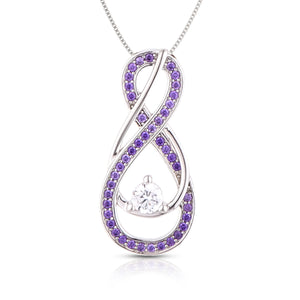
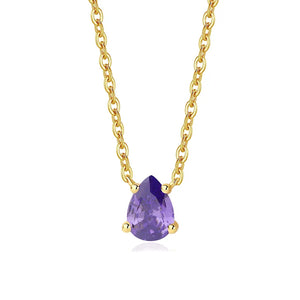

The piece they're describing → February Birthstone Necklace for Women — Amethyst Purple Infinity Pendant, 925 Sterling Silver
Personalize Yours

