


- Meaning: Communication, teaching, calm strength, emotional healing
- Chakras: Throat (primary) + Heart
- Zodiac: Taurus, Gemini, Virgo
- Element: Water, Earth
- Hardness: 2.5–7 on Mohs scale (varies by silica content)
- Color: Blue-green to turquoise, often with brown/black matrix
- Best for: Difficult conversations, public speaking, emotional transitions, anxiety
- Rarest form: Gem silica — chrysocolla locked inside chalcedony
Chrysocolla is one of the most visually striking stones in the mineral world — a swirling palette of turquoise blues, seafoam greens, and earthy browns that has fascinated jewelers, healers, and mineral collectors for over 4,000 years. If you've ever mistaken it for turquoise, you're not alone. The two stones look remarkably similar, but chrysocolla has a chemistry, a history, and a meaning that's entirely its own.
At AJLuxe, we set genuine gemstones in 925 sterling silver — every stone is inspected for consistent colour and natural character before it goes into a piece.
Ancient Egyptian diplomats carried it into negotiations. Cleopatra reportedly wore chrysocolla jewelry during every meeting with foreign rulers. And the Greek philosopher Theophrastus gave it its name in 315 BCE — a name that literally means "gold glue," because goldsmiths used it to solder gold pieces together. This is a stone with a long paper trail.
In this guide you'll find everything you need to know: what chrysocolla actually is (the geology is fascinating), what it means in crystal traditions, its healing properties, the difference between chrysocolla and turquoise, how to spot a fake, and how to use it day-to-day. Let's start with the stone itself.
What Is Chrysocolla?
Chrysocolla is a hydrous copper silicate mineral — essentially, copper, silicon, and water locked together in a soft, waxy matrix. It forms in the oxidation zones of copper ore deposits, which is why it's found wherever major copper mining happens: the American Southwest (Arizona, New Mexico), Chile, Peru, Israel, the Democratic Republic of Congo, and Australia.
Its color comes entirely from copper. The higher the copper concentration, the richer the blue-green. When chrysocolla forms alongside other copper minerals — malachite (green), azurite (deep blue), cuprite (red), or dioptase (emerald green) — you get the swirling multi-color patterns that make it so visually distinctive. That matrix of black or brown you often see? That's limonite or iron oxide from the surrounding host rock.
One thing that surprises people: chrysocolla's hardness varies enormously. Pure chrysocolla sits at just 2.5–3.5 on the Mohs scale — soft enough to scratch with a copper coin. But when silica soaks into the structure during formation (a process called silicification), hardness climbs to 6 or 7. This silica-rich form is far more durable and produces the gem-quality material you'll find in fine jewelry.
The rarest and most valuable version is called gem silica — chrysocolla so thoroughly intergrown with chalcedony (microcrystalline quartz) that it becomes transparent to translucent, with a vivid aqua color that rivals fine aquamarine. Gem silica is mined primarily in Arizona and the Philippines and commands prices of $20–$100+ per carat in top quality.
Chrysocolla Meaning
Chrysocolla's core meaning is communication — specifically, the kind that's honest, calm, and grounded in wisdom rather than ego. It's often called the "teaching stone" or the "wise stone," a name that traces directly to ancient Egypt, where scribes and diplomats carried it when entering negotiations.
The deeper meaning goes beyond just talking. Chrysocolla is associated with the kind of communication that comes after emotional healing — when you've processed what you feel and can now speak from a place of clarity rather than reactivity. It pairs Throat Chakra energy (expression) with Heart Chakra energy (compassion), which is why crystal practitioners reach for it during difficult conversations, conflict resolution, and creative work that requires authentic self-expression.
Three layers of meaning show up consistently across traditions:
- Calm strength: The ability to hold your ground without aggression. Chrysocolla is associated with the quiet authority of a teacher or elder — firm but never harsh.
- Emotional transformation: Moving through change without being overwhelmed by it. Ancient miners in copper regions wore chrysocolla as a protective talisman during the transformation of raw ore into refined metal — symbolically appropriate for any personal transformation.
- Empowered teaching: The confidence to share what you know. Whether you're a writer, a teacher, a leader, or a parent trying to have a hard conversation with your child — chrysocolla is the stone that tradition associates with speaking truth with grace.
The name itself reinforces this layered meaning. Chrysos (gold) + kola (glue) — the stone that joins and bonds. Not with force, but with the gentle adhesion of honest connection.
Chrysocolla History and Origins
Chrysocolla has one of the longest and most specific historical records of any crystal — not because people wrote about its spiritual properties, but because they used it practically for thousands of years before it became a meaning stone.
4000 BCE — Egyptian eye paint. The earliest documented use of chrysocolla is as a cosmetic pigment. Ground chrysocolla and malachite were mixed into green eye paint used in ancient Egypt from the Badarian Period onward. This wasn't just vanity — green eye paint had religious significance, associated with Hathor and Re. Chrysocolla was part of the daily ritual life of the Nile Valley for millennia.
315 BCE — Theophrastus names it. The Greek philosopher and botanist Theophrastus, a student of Aristotle, wrote the first systematic mineralogy text: Peri Lithon ("On Stones"). In it, he named chrysocolla and described its primary use: goldsmiths ground it into a powder and used it as a flux and solder ingredient to join gold pieces without visible seams. The name chrysocolla — gold glue — was literal. This is one of the oldest recorded mineral names still in active use.
Ancient Egypt and Cleopatra. Egyptian records and later accounts describe chrysocolla as the "wise stone" — specifically prized by those whose job was to negotiate, mediate, and resolve conflict. Pharaoh-Queen Cleopatra VII (69–30 BCE) is said to have worn chrysocolla jewelry at every meeting with foreign rulers and ambassadors. Whether this is documented history or folk tradition passed down through the crystal-healing lineage is debated, but the association is consistent across multiple ancient sources: chrysocolla was the diplomat's stone.
The copper connection. Chrysocolla's entire history is tied to copper mining. Every ancient copper-producing civilization — Egyptians at Sinai and the Eastern Desert, Romans in Cyprus (the word "copper" itself comes from the Greek Kypros, Cyprus), Peruvians in the Andes — worked with chrysocolla as a byproduct of copper extraction. Ancient miners at the Timna Valley in Israel, one of the world's oldest copper mines (active since 6000 BCE), would have encountered chrysocolla daily. It was industrial before it was spiritual.
Eilat Stone. In Israel, chrysocolla found near the ancient port city of Eilat combines with malachite, azurite, and turquoise to form a striking multi-colored stone called Eilat Stone — Israel's national stone and a gemstone with its own distinct cultural identity going back to the time of King Solomon.
Chrysocolla Healing Properties
In crystal healing traditions, chrysocolla is one of the most versatile stones — it works on emotional, mental, and communicative levels simultaneously. Here are the properties practitioners use it for most:
Emotional healing
Chrysocolla is a go-to stone for releasing old emotional patterns — particularly grief, guilt, and the kind of chronic anxiety that lives in the chest and throat. Its copper-blue energy is described as cooling and soothing, calming emotional intensity without suppressing it. It's often used during and after breakups, career transitions, or any period of major life change where emotions need to be processed, not bypressed.
Communication and self-expression
The connection between chrysocolla and the Throat Chakra makes it a practical tool for anyone who struggles with self-expression. Public speakers, writers, therapists, and teachers use it to ease performance anxiety and encourage clear, authentic communication. The specific quality chrysocolla brings is not louder speech, but more honest speech — the ability to say the hard thing with kindness rather than aggression.
Calming anxiety and stress
Chrysocolla's energy is consistently described as tranquilizing — it reduces mental chatter, slows reactive thinking, and promotes the kind of stillness needed for good decision-making. Crystal practitioners often recommend it for people who tend to speak (or type) in anger and regret it afterward. Hold it, breathe, then respond.
Empowerment and confidence
Despite its calming reputation, chrysocolla is not a passive stone. The "wise stone" association is about quiet confidence — the kind that doesn't need to shout. It's associated with the inner authority of someone who knows their own mind. For people who tend to shrink or stay silent when they should speak up, chrysocolla is used as an empowerment tool.
Creativity and teaching
Chrysocolla supports creative work — especially work that involves communication: writing, music, art, performance. Its "teaching stone" aspect extends to any creative act that shares something true about your inner world with the outer one.
Chrysocolla Chakra and Zodiac
Chrysocolla works primarily on two chakras, and the combination is what makes it distinct from other blue-green stones:
Throat Chakra (Vishuddha): Located at the base of the throat, this is the energy center for communication, self-expression, and speaking truth. A blocked Throat Chakra shows up as fear of speaking, difficulty articulating feelings, or a tendency to lie (to others or yourself). Chrysocolla's blue energy is said to open and activate this chakra — not forcing you to speak, but removing the energetic obstruction that makes honest communication feel impossible.
Heart Chakra (Anahata): The Heart Chakra governs love, compassion, and emotional intelligence. Chrysocolla's green tones connect to this center, ensuring that what comes out of your throat is filtered through the heart — spoken with empathy rather than judgment. This heart-to-throat connection is what practitioners describe as chrysocolla's most unique quality: it doesn't just open your voice, it grounds it in love.
Zodiac associations:
- Taurus (April 20–May 20): Chrysocolla supports Taurus's need for emotional stability and helps them express the deep feelings they tend to hold in.
- Gemini (May 21–June 20): Natural communicators, Geminis use chrysocolla to slow down and ensure their rapid-fire communication comes from genuine understanding rather than surface-level cleverness.
- Virgo (August 23–September 22): For Virgo's tendency toward perfectionism and self-criticism, chrysocolla brings compassion and gentler self-expression.

Chrysocolla Varieties and Forms
Chrysocolla rarely occurs alone. It almost always forms in combination with other copper minerals, producing natural varieties that each carry their own visual character and, in metaphysical traditions, their own energetic blend:
Gem Silica
The rarest and most valuable form of chrysocolla. When chrysocolla forms so intergrown with chalcedony (microcrystalline quartz) that the structure becomes transparent or translucent, the result is gem silica — a vivid aqua gemstone that looks like fine aquamarine but with a richer, more complex color. Hardness reaches 6.5–7. Fine gem silica from Arizona's Inspiration Mine and from the Luzon Island mines in the Philippines commands $20–$100+ per carat. If you see "blue chalcedony" priced this high, it's almost certainly gem silica.
Malachite-Chrysocolla
Green malachite swirled with blue-green chrysocolla produces one of the most visually dramatic natural combinations in the mineral world. The two copper minerals form together in oxidation zones, their banding creating abstract landscape patterns. Energetically, this combination is considered doubly transformative — malachite's heart-opening properties amplified by chrysocolla's communication energy.
Azurite-Chrysocolla
Deep royal blue azurite with turquoise chrysocolla. Azurite brings a Third Eye energy (intuition, inner vision) that complements chrysocolla's Throat Chakra focus. Together they're used for communicating insight — putting what you intuitively know into clear words.
Eilat Stone
Found only in the Timna Valley and Eilat region of Israel, Eilat Stone combines chrysocolla with malachite, azurite, turquoise, and sometimes cuprite and pseudomalachite. The result is a vivid blue-green-and-teal mosaic unlike any other copper mineral combination. It's Israel's national stone and has been traded since the time of King Solomon. Eilat Stone is considered especially powerful for matters of the heart and for reconciliation.
Quantum Quattro
A trademarked blend from Namibia combining chrysocolla, malachite, shattuckite, dioptase, and smoky quartz. The name refers to the four copper silicate minerals working together. It's considered one of the most energetically complex of the copper mineral combinations, used specifically for deep emotional release and past-trauma healing.

Chrysocolla vs. Similar Stones
Chrysocolla is frequently confused with or compared to other blue-green stones. Here's how they differ — practically and metaphysically:
| Stone | Color | Hardness | Key Meaning | Best For |
|---|---|---|---|---|
| Chrysocolla | Blue-green, often multi-toned with matrix | 2.5–7 | Communication, teaching, calm strength | Difficult conversations, emotional healing, anxiety |
| Turquoise | Sky blue to blue-green, uniform color | 5–6 | Protection, wisdom, friendship | Protection, Sagittarius, December birthstone |
| Larimar | Sky blue with white cloud patterns | 4.5–5 | Serenity, feminine power, healing | Deep emotional trauma, Caribbean energy, Leo |
| Amazonite | Mint green to blue-green, wavy white veins | 6–6.5 | Truth, hope, harmony | Setting boundaries, Virgo, everyday wear |
| Blue Lace Agate | Pale blue with white lace banding | 6.5–7 | Gentle communication, patience, calming | Children, highly sensitive people, social anxiety |
| Aquamarine | Pale to medium blue, transparent | 7.5–8 | Courage, clarity, safe passage | Travel, March birthstone, Pisces/Aries |
The key distinction: Chrysocolla and turquoise look the most similar but are mineralogically different. Turquoise is a phosphate mineral; chrysocolla is a silicate. Turquoise is harder, denser, and has a more uniform color. Chrysocolla shows more color variation within a single stone and almost always has some black or brown matrix. The scratch test is the simplest field check: if a copper coin scratches it, it's likely chrysocolla (hardness ~3). Turquoise resists a copper coin.
How to Tell If Chrysocolla Is Real
Chrysocolla is sometimes imitated with dyed glass, dyed howlite, or synthetic blue-green resins. Here are four quick checks:
- Streak test: Drag the stone across unglazed porcelain (the back of a tile). Real chrysocolla leaves a pale blue to blue-green streak. Dyed glass leaves no streak or a white streak.
- Hardness test: Try to scratch it with a copper coin. Soft chrysocolla (2.5–3.5) will scratch easily. If it's rock-hard, it's either silicified chrysocolla (gem silica) or not chrysocolla at all — check the price and source.
- Weight test: Chrysocolla is denser than glass. A glass imitation feels lighter than a genuine specimen of the same size. Not a definitive test on its own, but a useful clue.
- Transparency test: Standard chrysocolla is opaque to sub-translucent. If you hold a stone up to light and it's fully transparent with no visible crystal structure, it's likely glass or dyed quartz, not chrysocolla. The exception is gem silica, which is intentionally translucent — but gem silica is rare, expensive, and sold with documentation.
The best protection is buying from a reputable seller who provides the source mine and material description. For jewelry specifically, look for "chrysocolla in chalcedony" or "gem silica" for high-quality translucent pieces, and "natural chrysocolla" with a stabilized or cabochon note for standard opaque specimens.
How to Use Chrysocolla
The most effective uses for chrysocolla track directly from its meaning. Here are the scenarios where practitioners reach for it most:
Before difficult conversations: Hold chrysocolla for a few minutes before a conversation you're dreading — a confrontation, a negotiation, a hard truth you need to share. The intention is to shift from reactive to responsive mode: calm, clear, and grounded before you speak.
Public speaking and performance: Wear chrysocolla at the throat — a pendant is traditional — on days when you're presenting, performing, teaching, or leading a meeting. The throat placement is intentional: it sits directly at the Throat Chakra.
Journaling and creative writing: Place chrysocolla on your desk or hold it when you're stuck. Its connection to authentic expression helps bypass the inner critic and access what you actually want to say.
Meditation for emotional release: Hold chrysocolla over the heart or throat during meditation focused on releasing old emotional patterns. Pair it with slow, deliberate breathing. Chrysocolla is particularly used for grief work and for healing communication wounds — conversations you wish you'd had, or words you regret saying.
In the home: Chrysocolla placed in a living room or kitchen — shared spaces where family communication happens — is used to promote calmer, more honest conversations in the household environment.
How to Care for Chrysocolla
Chrysocolla needs careful handling because of its variable hardness and porous structure:
- Keep it dry: Chrysocolla is a hydrous mineral — it contains structural water. Prolonged soaking can damage it, and water can cause color changes in lower-quality specimens. Don't clean it in water baths or ultrasonic cleaners. Wipe with a dry or barely damp soft cloth only.
- Store separately: Hardness 2.5–3.5 means almost any other stone in your collection can scratch it. Store chrysocolla in its own soft pouch or section.
- No steam cleaning: Heat and steam can cause chrysocolla to crack or lose color, especially in pieces that haven't been fully stabilized.
- Mild cleaning only: If jewelry needs cleaning, use a dry soft brush (a clean makeup brush works well) to remove dust. Avoid chemical cleaners entirely — copper minerals react unpredictably with acids and solvents.
- Energetic cleansing: Crystal practitioners cleanse chrysocolla with sound (singing bowl, chime), moonlight, or by placing it on a selenite charging plate. Because of the water sensitivity, avoid saltwater cleansing. Brown rice cleansing (burying in a bowl of dry rice for 24 hours) is a popular alternative.
Chrysocolla Meaning: Frequently Asked Questions
How do you pronounce chrysocolla?
It's pronounced kris-uh-KOL-uh. Four syllables, with the stress on the third: kris-uh-KOL-uh. The "ch" is a hard K sound, not a "ch" as in "cheese." It comes from ancient Greek, where the kh sound was always a guttural K.
What is chrysocolla good for?
Chrysocolla is primarily used for communication, emotional healing, and calming anxiety. It's the stone practitioners reach for before difficult conversations, during periods of emotional transition, and for creative work that requires authentic self-expression. Its Throat Chakra connection makes it particularly useful for anyone who struggles to speak their truth with clarity and kindness.
Is chrysocolla a birthstone?
Chrysocolla is not a traditional birthstone on the standard Gregorian calendar. However, it is sometimes listed as an alternate or modern birthstone for May (associated with Taurus/Gemini) and as a zodiac stone for Taurus, Gemini, and Virgo. In some traditions it's also connected to the planet Venus.
What is the difference between chrysocolla and turquoise?
Chrysocolla is a hydrous copper silicate; turquoise is a hydrous copper aluminum phosphate — different chemistries entirely. Turquoise is harder (5–6 vs. 2.5–3.5), denser, and tends to have more uniform color. Chrysocolla shows more color variation within a single stone and almost always has a dark matrix. The simple field test: try to scratch with a copper coin. Chrysocolla scratches easily; turquoise resists it.
What chakra is chrysocolla associated with?
Chrysocolla works primarily on the Throat Chakra (Vishuddha) — the energy center governing communication and self-expression. Its green tones also connect it to the Heart Chakra (Anahata), which is why practitioners describe its communication energy as compassionate rather than aggressive: it speaks from the heart, not the ego.
Can chrysocolla get wet?
Brief contact with water won't damage chrysocolla, but you should avoid soaking it or submerging it for extended periods. Chrysocolla is a hydrous mineral — it contains structural water — and prolonged exposure to water can cause color changes or surface damage, especially in lower-quality specimens. Wipe clean with a dry cloth rather than washing. Never put it in an ultrasonic cleaner or steam clean it.
What is gem silica chrysocolla?
Gem silica is the rarest and most valuable form of chrysocolla — a translucent to transparent variety in which chrysocolla has formed so thoroughly intergrown with chalcedony (microcrystalline quartz) that it takes on a gem-quality clarity. Its vivid aqua color rivals fine aquamarine. Gem silica is mined primarily in Arizona (USA) and the Philippines and can reach $20–$100+ per carat at the top end. Standard chrysocolla is opaque; gem silica is not.
Who should wear chrysocolla?
Chrysocolla is especially useful for people who struggle to express themselves clearly, tend to suppress difficult emotions, work in communication-heavy roles (teachers, therapists, public speakers, writers), or are going through a period of emotional transition. It's also traditionally associated with negotiators and mediators — people who need to hold space for conflict without being consumed by it.
Is chrysocolla toxic?
In its polished, finished form as jewelry or a tumbled stone, chrysocolla is safe to handle. However, chrysocolla contains copper, and you should not ingest it, breathe its dust, or prepare crystal-infused water (gemstone elixirs) directly with raw chrysocolla. If you work with rough chrysocolla (cutting, grinding, or polishing), wear a dust mask — copper silicate dust is an irritant. Polished pieces worn as jewelry present no toxicity risk for normal wear.
What crystals work well with chrysocolla?
Chrysocolla pairs naturally with other copper minerals: malachite (for deeper emotional transformation), azurite (for intuition alongside communication), and turquoise (for protection alongside expression). For amplifying its calming energy, practitioners pair it with blue lace agate or celestite. For grounding its water energy, black tourmaline or smoky quartz balances it well.
How much is chrysocolla worth?
Standard chrysocolla cabochons and tumbled stones are relatively affordable — $5–$30 for jewelry-grade pieces. Stabilized chrysocolla (hardened with resin for durability) is common in the market. Natural, unstabilized chrysocolla with high color saturation and tight patterning commands a premium. Gem silica — the translucent chalcedony-chrysocolla — is priced like a fine gemstone: $20–$100+ per carat depending on color intensity and clarity.
What is the Eilat Stone?
Eilat Stone is Israel's national stone — a natural combination of chrysocolla, malachite, azurite, turquoise, and sometimes cuprite found only in the Timna Valley and Eilat region of southern Israel. It has been mined and traded since the time of King Solomon (approximately 970–931 BCE). It's named after the ancient port city of Eilat and considered one of the most historically significant copper mineral combinations in the world.
Final Thoughts: Is Chrysocolla Right for You?
Chrysocolla is the stone for anyone who needs to find their voice — not the loudest voice in the room, but the most honest one. It's been a diplomat's tool, an artist's companion, and a healer's first choice for over 4,000 years, from Egyptian eye paint to Cleopatra's jewelry box to the mineral collections of Greek philosophers.
What makes it distinct from other blue-green stones is that combination of Throat and Heart Chakra energy: it's not just about saying things, but about saying them with compassion. That's rare. It's the difference between speaking your truth and weaponizing it — and chrysocolla, at its core, is always the former.
If you're drawn to chrysocolla, there's usually a reason. Something needs to be expressed, healed, or released. Trust that impulse.
Explore our full collection of sterling silver and 18K gold-plated birthstone and gemstone jewelry — hypoallergenic, gift-ready, and free US shipping.
- Birthstone necklaces — personalized gemstone pendants
- Full jewelry collection — rings, earrings, necklaces, bracelets
- Gemstone meanings guide — all 17 stones explained
Written by the AJLuxe editorial team — specialists in personalized sterling silver and gemstone jewelry. Last updated: May 2026. Sources: GIA.edu (gem standards), Mindat.org (chrysocolla mineralogy), Fire Mountain Gems (chrysocolla properties).
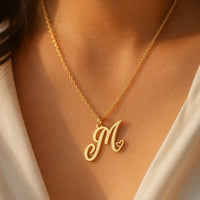
The piece they're describing → Heart Initial Necklace for Women — 18K Gold Plated, Personalized Letter + Heart Pendant
Personalize Yours
