


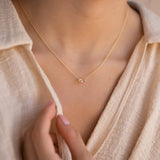
- Pendants are single statement pieces meant to anchor a necklace; charms are smaller, swappable, and often layered or collected.
- Charms almost always have an open jump ring so they move between chains, bracelets, or charm holders — most pendants don't.
- 925 sterling silver with 18K gold plating works for both, and either can be made hypoallergenic and nickel-free.
- Layering more than 2-3 pieces on one chain is the most common cause of tangling — length staggering fixes it, not more jump rings.
- A pendant on an 18-inch chain sits at the collarbone; on 20-22 inches it drops to the sternum, which matters more for pendants than for charms.
- AJLuxe's Birthstone Charm Necklace ($27.99) is a true charm-style piece — a baguette CZ birthstone on a fine chain, in 925 sterling silver.
"Charm" and "pendant" get used interchangeably in product listings, but they're not the same category of jewelry, and mixing them up is the reason so many necklace layers end up tangled in a drawer. The distinction comes down to how the piece attaches to its chain and what job it's designed to do — one is built to be the whole outfit's focal point, the other is built to be added to, changed, and collected over time. Here's how to tell them apart, and which one actually fits what you're shopping for in 2026.
What Is the Difference Between a Charm and a Pendant?
A charm is a small decorative piece with its own jump ring or clasp, meant to be attached and removed from a chain, bracelet, or charm holder — a pendant is a larger, usually singular piece designed to hang as the visual centerpiece of a necklace and is often fixed to its chain rather than swapped. The practical difference shows up at the point of attachment: pick up a charm and you'll usually find an open (or openable) jump ring, because it's built to move. Pick up a pendant and the bail is often closed or soldered, because it's built to stay put. Charms also tend to be sold in sets or as single add-ons around $15-$40; pendants are more often sold as a complete necklace, chain included.
Charm vs. Pendant: Side-by-Side Comparison
The table below breaks down the practical differences that actually affect how you shop and wear each one.
| Feature | Charm | Pendant |
|---|---|---|
| Attachment | Open jump ring — swappable | Fixed or closed bail — usually permanent |
| Typical size | Small, often under 1 inch | Larger — the visual focal point |
| How it's sold | Often individually or in sets, chain separate | Usually as a complete necklace |
| Best for | Layering, collecting, personalizing over time | A single statement piece worn daily |
| Gifting angle | Add-on gift, birthstone or initial | Standalone gift, often the main event |
What Metal Should You Choose for Charms and Pendants?
925 sterling silver is the safest all-around base metal for both charms and pendants, and an 18K gold plating over that same base gives you the warmer tone without switching materials entirely. Because a charm sits closer to skin folds (especially when layered) and a pendant is often worn for hours at a time, the base metal matters more than the finish — sterling silver is naturally more tarnish-resistant than plated-only base metals, and a nickel-free, hypoallergenic build avoids the itching or discoloration that cheaper alloys cause. If you're deciding between the two finishes for the same design, gold plating shows fingerprints and daily wear slightly faster than solid silver, so it's worth wiping both down after wear regardless of which you pick.
How Do You Layer Charms and Pendants Without Them Tangling?
The fix for tangled layers is staggering chain lengths by at least 2 inches per piece, not adding more jump rings or clasps. A common setup is a shorter chain around 16-18 inches carrying a small charm or initial, with a pendant necklace at 20-22 inches worn underneath as the anchor piece — the length gap keeps the pieces from crossing when you move. Charms with smaller, tighter jump rings also snag less against a pendant's chain links than charms with large open loops, so if you're building a layered look, check that the jump rings are fully closed before wearing.
What Occasions Are Charms and Pendants Best For?
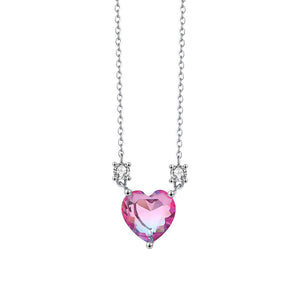
Pendants work best as the primary gift or the everyday piece someone wears alone, while charms work best as an add-on gift, a birthday or birthstone touch, or a way to personalize a necklace someone already owns. A heart pendant, for example, reads as a complete gift on its own — something like AJLuxe's Heart Pendant Necklace ($34.99, 18K gold plated, hypoallergenic) is designed to be the whole necklace, not one piece of a set. A birthstone charm, by contrast, is often chosen specifically because it can be layered onto a chain the recipient already wears, which is why charm-style birthstone pieces get bought as smaller, additive gifts rather than the main present.

How Do You Care for Silver and Gold-Plated Charms and Pendants?
Store charms and pendants flat or hanging separately, keep them away from perfume and lotion until they've dried, and wipe both down with a soft cloth after wear to remove oils before they build up. Because charms have more surface area exposed at the jump ring and pendants often have a stone setting or bail seam, moisture tends to collect at those attachment points first — that's usually where tarnish or plating wear shows up earliest, so it's the spot to focus a quick wipe-down on. Sterling silver can be cleaned with a dedicated silver polishing cloth; gold-plated pieces should be wiped with a dry or barely damp cloth only, since abrasive polish can wear through the plating over time. For general guidance on metal allergies and jewelry-related skin sensitivity, the American Academy of Dermatology's patient resources are a reliable reference (https://www.aad.org).
Which Should You Choose: Charm or Pendant?
Choose a pendant if you want one necklace that does all the work, and choose a charm if you want a piece that can grow, layer, or move between chains over time. If the gift (or the outfit) needs a single clear centerpiece — a first big necklace, an anniversary gift, something worn alone — a pendant like the Heart Pendant Necklace is the more complete choice. If you're personalizing an existing chain, marking a birth month, or building a layered look piece by piece, a true charm-style design is the better fit: AJLuxe's Birthstone Charm Necklace ($27.99, 925 sterling silver, baguette CZ) is built exactly for that — a small, swappable birthstone charm on a fine chain rather than a fixed statement piece. Both are 925 sterling silver with an 18K gold plating option, hypoallergenic, and arrive gift-boxed at no extra charge, so the decision comes down to whether you want one piece to say everything, or several pieces that can change with you.

Frequently Asked Questions
Is a charm the same as a pendant?
No — a charm has its own jump ring so it can be swapped between chains or bracelets, while a pendant is typically a larger, fixed centerpiece designed to be the main visual element of one necklace.
Can you wear a charm as a pendant?
Yes, as long as the charm's jump ring fits over your chain's clasp or the chain can be opened to add it, a charm can be worn as the main piece on a necklace, though it will usually sit smaller and less centered than a purpose-built pendant.
What is the difference between a pendant and a locket?
A locket is a specific type of pendant that opens to hold a photo, note, or keepsake inside, while a pendant is the broader category that includes any fixed centerpiece, whether it opens or not.
Do charms fit any necklace chain?
Most charms fit any chain as long as the charm's jump ring is large enough to slide over the chain's links or clasp, but very fine chains (under 1mm) may need a charm with a correspondingly small jump ring to sit correctly.
Are gold-plated charms and pendants hypoallergenic?
They can be, but the hypoallergenic property comes from the base metal underneath the plating, not the gold layer itself — a nickel-free 925 sterling silver base with 18K gold plating, like AJLuxe uses, stays hypoallergenic even as the plating wears.
How long should a pendant necklace be?
18 inches sits a pendant at the collarbone for most people, while 20-22 inches drops it to the sternum — shorter lengths suit smaller pendants and higher necklines, longer lengths suit larger statement pendants.
All third-party trademarks, brand names and product names are the property of their respective owners. AJLuxe is not affiliated with, endorsed by, sponsored by, or otherwise connected to any third-party brand referenced in this article. Brand names are used solely for accurate comparative reference, and material descriptions reflect each brand's own published product specifications at the time of writing.
You Might Also Like
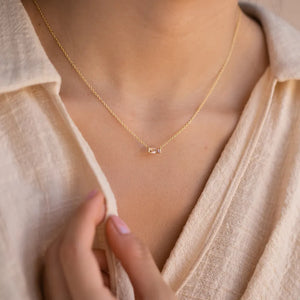
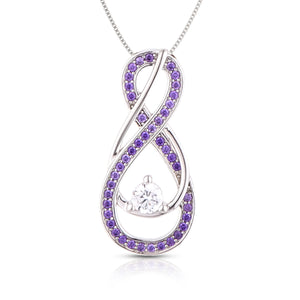

The piece they're describing → Birthstone Charm Necklace for Women — Baguette CZ Pendant, 18K Gold Plated
Personalize Yours


