


The short answer
A birthstone ring is only as good as the match between three things: the stone's hardness (some birthstones like opal and pearl are too soft for daily-wear rings), the metal (14K gold or 18K gold plated over 925 sterling silver for skin-safe, long-lasting wear), and the setting style (solitaire for a single stone, stackable bands for a personalized or mother's ring). For everyday rings, prioritize a hard stone or a lab-created stone over a soft natural one, and decide up front whether you want one meaningful stone or a stackable set you can build on. This guide gives you a month-by-month durability chart, a metal-to-stone color pairing table, and how to plan a mother's or stackable birthstone ring the right way.
"Best birthstone rings" is a search that hides at least four different shoppers behind one phrase: someone buying their own birth-month ring, someone shopping a personalized birthstone ring as a gift, a parent or child building a mother's birthstone ring with one stone per family member, and someone after a stackable birthstone ring set to mix and layer. This guide is built for all four. Instead of just listing which stone belongs to which month, we'll cover the part most birthstone guides skip entirely — which birthstones are actually durable enough for a ring you wear every day, how to pair the stone's color with the right metal, and how to plan a mother's or stackable ring so it still looks intentional after you've added the third or fourth stone.
We'll also be honest about one thing up front: the softest birthstones (opal, pearl, and to a lesser extent emerald) are beautiful but genuinely risky as everyday rings, and knowing that before you buy saves you a cracked stone and a disappointing gift.

Birthstone by month: the full chart
Before choosing a ring, confirm the birthstone. Several months have more than one official stone, which gives you options on color and price — June, October, November, and December all have alternatives worth knowing about.
| Month | Birthstone(s) | Color |
|---|---|---|
| January | Garnet | Deep red |
| February | Amethyst | Purple |
| March | Aquamarine | Pale blue |
| April | Diamond (or white CZ / white sapphire) | Colorless |
| May | Emerald | Green |
| June | Pearl, Alexandrite, or Moonstone | White / color-change |
| July | Ruby | Red |
| August | Peridot | Lime green |
| September | Sapphire | Blue |
| October | Opal or Tourmaline | Iridescent / pink |
| November | Topaz or Citrine | Yellow / amber |
| December | Turquoise, Tanzanite, or Blue Zircon | Blue / blue-violet |
If you'd rather choose by astrology than by calendar month, the two systems don't always line up — our birthstone by zodiac sign guide maps each stone to its sign so you can pick whichever association means more to you. According to the GIA (Gemological Institute of America), the modern birthstone list was standardized in 1912 and updated since, which is why several months now carry more than one recognized stone.
Which birthstones are durable enough for a ring you wear daily
This is the single biggest gap in most "best birthstone rings" content: a ring takes far more abuse than a necklace or a pair of earrings, because your hands knock into everything. A stone that's perfect in a pendant can chip within weeks in a ring. Hardness is measured on the Mohs scale (1 to 10), and for an everyday ring you generally want 7 or higher.
| Birthstone | Mohs hardness | Everyday ring? |
|---|---|---|
| Diamond / white CZ | 10 / 8.5 | Excellent |
| Sapphire (Sept), Ruby (July) | 9 | Excellent |
| Topaz (Nov), Alexandrite (June) | 8 – 8.5 | Very good |
| Emerald (May), Aquamarine (Mar) | 7.5 – 8 | Good — but emerald is brittle, handle with care |
| Amethyst (Feb), Citrine (Nov), Garnet (Jan) | 7 – 7.5 | Good for regular wear |
| Peridot (Aug), Tanzanite (Dec) | 6.5 – 7 | OK — protective setting recommended |
| Opal (Oct), Moonstone (June), Turquoise (Dec) | 5 – 6.5 | Occasional wear only |
| Pearl (June) | 2.5 – 4.5 | Not recommended for daily rings |
The practical takeaway: if you're a July or September baby, your natural birthstone (ruby, sapphire) is already ring-ready. If your birthstone is opal, pearl, or turquoise and you want a ring you'll actually wear every day, either choose a protective bezel setting, reserve it for occasional wear, or use a lab-created harder stone in the same color family. That last option is why so many everyday birthstone-style rings use durable cubic zirconia — it survives daily contact far better than a soft natural stone.
Natural vs. lab-created birthstones: which to buy
The second gap most guides gloss over: whether to pay for a natural stone or choose a lab-created one. This isn't a quality trade-off so much as a values-and-budget decision, and the right answer changes depending on whether the ring is a heirloom or an everyday piece.
| Factor | Natural birthstone | Lab-created / simulated |
|---|---|---|
| Price | Higher, varies with quality | Much lower for the same look |
| Appearance | Natural inclusions, unique | Often cleaner and more uniform |
| Durability | Depends on the stone | Consistent, often harder than soft naturals |
| Best for | Heirlooms, investment pieces | Everyday and stackable rings, gifts on a budget |
For a keepsake ring meant to be passed down, a certified natural stone (look for GIA or AGS certification) holds sentimental and resale value. For a ring you'll wear to work, the gym, and everywhere in between, a lab-created or simulated stone gives you the same color and sparkle without the anxiety of chipping an expensive natural gem. Both are legitimate choices — the mistake is paying heirloom prices for a stone you'll treat as everyday wear, or vice versa.

Matching metal to birthstone color
The metal frames the stone, and the wrong pairing can wash out an otherwise beautiful color. As a rule, warm-toned stones glow against yellow gold, cool-toned stones pop against white metals, and versatile stones work with either.
| Metal | Best with | Notes |
|---|---|---|
| Yellow gold / 18K gold plated | Ruby, garnet, citrine, peridot, emerald | Warms up red, green and amber tones |
| 925 sterling silver / white gold | Sapphire, aquamarine, amethyst, topaz, diamond/CZ | Enhances cool blue and purple tones |
| Rose gold | Morganite, pink tourmaline, moonstone, opal | Flatters soft pinks and iridescent stones |
For skin comfort and longevity, the metal underneath matters as much as the color on top. A 14K gold or 18K gold plated over 925 sterling silver ring is hypoallergenic because the base metal is sterling silver, not brass — the same principle that makes gold plated over sterling a safe, durable choice for anyone with sensitive skin. Avoid gold plating over brass or zinc for a ring you'll wear constantly; once the plating wears at the band's contact points, the base metal can irritate skin and discolor.
Personalized and mother's birthstone rings
A third gap in most guides: how to actually plan a multi-stone ring so it still looks intentional. Personalized and mother's birthstone rings hold one stone per person — a mother's own stone plus one for each child, or a couple's two stones. The temptation is to keep adding stones, but the rings that age well follow a couple of rules:
- Decide the maximum up front. A band comfortably holds 2–4 stones before it starts to look crowded. If you expect more, a stackable design (one thin band per stone) scales better than a single band. Three is the most common count for this format -- see our three-stone mother's ring guide for how to order and arrange them.
- Order stones by birth order or by color balance. Chronological (oldest to youngest) is the sentimental default; alternating warm and cool stones is the more visually balanced option.
- Keep stone sizes equal. Uniform stones read as a considered set; mismatched sizes read as an afterthought unless you're deliberately featuring one central stone.
- Match the metal to the family's everyday jewelry. If everyone wears gold, a gold-toned band ties the ring to the rest of their collection.
For a gift that grows over time, a stackable birthstone ring set is the most flexible format — you add a band (and a stone) as the family grows, rather than resizing or remaking a single ring. If you're building a personalized gift beyond rings, our birthstone charm guide covers coordinating charm pieces that use the same birth-month stones.
Stackable birthstone rings: how to build a set
Stackable birthstone rings are having a moment because they solve two problems at once — they let you wear more than one meaningful stone, and they let you restyle the look daily by adding, removing, or reordering bands. The best stackable sets share a consistent band width and metal so the individual rings read as one intentional stack rather than a random pile.
- Anchor with one solid band. A plain band between two stone bands gives the eye a rest and keeps the stack from looking busy.
- Use adjustable or true-to-size bands. An adjustable stacking ring forgives the small size differences between fingers and knuckles, which matters when you're wearing several at once.
- Mix a stone band with a midi ring. A birthstone band on the lower finger paired with a plain midi ring above the knuckle adds height to the stack without adding more stones.
Stacking rings also pair naturally with other minimalist pieces — many people who wear stacked bands also layer delicate toe rings in summer, keeping the same thin-band, adjustable aesthetic across the whole look.
Best birthstone rings: AJLuxe picks
AJLuxe's ring range is built around durable, everyday-friendly stones set in 18K gold plated over 925 sterling silver — the hypoallergenic base that survives daily wear. Because a clear cubic zirconia stone is one of the hardest and most versatile everyday options (and stands in beautifully for an April diamond birthstone), it's the ideal core for a stackable birthstone-style ring you can build on.
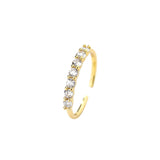
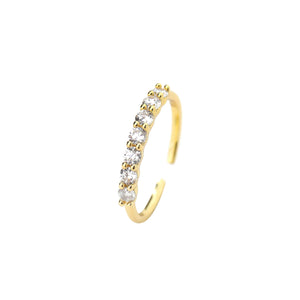
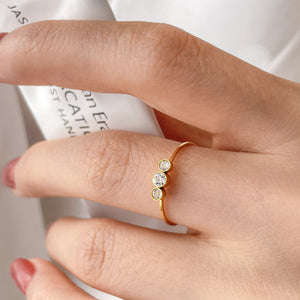
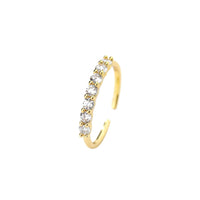
- Everyday stackable base: our Round CZ Stacking Ring — 925 sterling silver, 18K gold plated, adjustable, with a durable round CZ that reads as a classic solitaire birthstone ring and layers cleanly into a stack.
- Marquise variation: the Marquise CZ Stacking Ring adds an elongated stone shape for contrast within the same stack.
- Build your own set: browse the full rings collection to mix stone shapes and plain bands into a personalized stack.
Shop This Guide
Our Round CZ Stacking Ring — 925 sterling silver, 18K gold plated, adjustable, with a durable round stone that works as a standalone birthstone-style ring or the foundation of a stackable set you build over time.
Shop Stackable RingsBirthstone rings as gifts and milestone pieces
Birthstone rings are one of the most personal gifts you can give because the stone is chosen for a specific person. They work as birthday gifts, Mother's Day gifts, push presents, and milestone markers. If you're weighing a birthstone ring against another sentimental ring style for a partner, our best promise rings guide compares the two and helps you decide which symbolism fits the relationship. For a mother or grandmother, a stackable set that adds a stone per grandchild becomes a living keepsake that grows with the family.
How to choose: a quick decision path
- Confirm the stone. Check the birth month (some months have options) or choose by zodiac sign if that means more.
- Match durability to wear. Everyday ring → a Mohs 7+ stone or a lab-created stone. Occasional/keepsake → soft naturals like opal or pearl are fine with care.
- Pick a metal for the stone's color and your skin. Warm stones with gold, cool stones with silver/white gold — and 14K gold or 18K gold plated over sterling silver for hypoallergenic daily wear.
- Choose single vs. multi-stone. One meaningful stone → solitaire. A family or evolving gift → stackable bands, one stone at a time.
- Decide natural vs. lab-created based on whether it's a heirloom (natural, certified) or an everyday piece (lab-created for durability and value).
Citrine’s specific ring styles, settings, and quality factors get a full breakdown in our citrine jewelry rings guide, which goes deeper than this month-by-month overview.
Written by the AJLuxe Team. Last updated: July 2026. According to the GIA (Gemological Institute of America), birthstones trace back centuries and were formally standardized in 1912, with several months now carrying multiple recognized stones — which is why confirming the exact stone (and its durability) before buying a ring matters more than most shoppers expect.
Frequently Asked Questions
Which birthstone corresponds to my birth month?
Birthstones by month are: January garnet, February amethyst, March aquamarine, April diamond, May emerald, June pearl or alexandrite, July ruby, August peridot, September sapphire, October opal or tourmaline, November topaz or citrine, and December turquoise, tanzanite, or blue zircon. Several months have more than one official stone, so you can choose based on color, budget, or durability.
Are real birthstones better than lab-created ones for rings?
Not necessarily — it depends on the purpose. Natural stones are unique and hold heirloom and resale value, while lab-created or simulated stones offer the same color and sparkle at a lower price and are often more durable than soft natural stones. For an everyday ring, a lab-created stone is often the more practical choice; for a keepsake, a certified natural stone makes more sense.
What metal is best for a birthstone ring?
For durability and skin comfort, 14K gold or 18K gold plated over 925 sterling silver are the best everyday choices because the base metal is hypoallergenic. Match the metal to the stone's color as well: yellow gold flatters warm stones like ruby and citrine, while sterling silver or white gold enhances cool stones like sapphire and aquamarine.
Which birthstones are durable enough for everyday ring wear?
Diamond, sapphire, ruby, topaz, and cubic zirconia are all Mohs 8 or higher and excellent for daily wear. Amethyst, citrine, garnet, aquamarine, and emerald (Mohs 7 to 8) are good with normal care. Opal, moonstone, turquoise, and especially pearl are soft (Mohs 2.5 to 6.5) and better suited to occasional wear or protective settings.
What makes a personalized or mother's birthstone ring special?
A mother's or personalized birthstone ring holds one stone per family member — often the mother's stone plus one for each child — and can be engraved with names or dates. It combines individual birth-month symbolism with family meaning, which is why it's such a popular sentimental gift. A stackable format lets you add a stone as the family grows.
Can I stack multiple birthstone rings together?
Yes. Stackable birthstone rings are designed to be worn together, usually with a consistent band width and metal so the set looks intentional. You can mix stone bands with a plain anchor band or a midi ring, reorder them daily, and add new bands over time to represent more family members or occasions.
How do I determine the right ring size for a birthstone ring?
Measure your finger with a ring sizer or wrap a strip of paper around the base of the finger and compare it to a standard size chart. For multi-stone or mother's rings, make sure the band is wide enough to hold all the stones comfortably. An adjustable stacking ring avoids sizing guesswork, which is helpful for gifts.
Can I choose a birthstone by zodiac sign instead of birth month?
Yes. Zodiac birthstones follow astrological signs rather than calendar months, so they can differ from the traditional month-based stone. Many people choose the zodiac stone when it feels more personal or when they prefer its color. The two systems overlap in places but aren't identical.
Which birthstone is the most valuable?
Diamond (April) is generally the most valuable birthstone, followed by high-quality sapphire (September), ruby (July), emerald (May), and rare alexandrite (June). Value within any stone varies enormously with color, clarity, cut, and carat, so a top-grade sapphire can outprice a low-grade diamond.
What is the best setting style for a birthstone ring?
A solitaire setting highlights a single birthstone and is the most classic choice. A halo setting surrounds the stone with smaller accent stones for extra sparkle, while a bezel setting wraps the stone in metal for maximum protection — ideal for softer birthstones like opal or peridot that need shielding in a ring.
How do I care for a birthstone ring to keep it looking new?
Clean it gently with a soft cloth and mild soapy water, avoiding harsh chemicals and ultrasonic cleaners on softer stones like opal, pearl, and turquoise. Store it separately so harder stones don't scratch softer ones, and take the ring off during heavy cleaning, gardening, or workouts to protect both the stone and the setting.
Related reading: see what a promise ring means and how to choose one.
All third-party trademarks, brand names and product names are the property of their respective owners. AJLuxe is not affiliated with, endorsed by, sponsored by, or otherwise connected to any third-party brand referenced in this article. Brand names are used solely for accurate comparative reference, and material descriptions reflect each brand's own published product specifications at the time of writing.
You Might Also Like

The piece they're describing → Round CZ Stacking Ring for Women — 925 Sterling Silver, 18K Gold Plated, Adjustable
Personalize Yours


