


Huggie earrings are small hoop earrings designed to sit flush against the earlobe — they "hug" the ear rather than hanging away from it. They're typically 8–14mm inner diameter, have a hinged snap clasp, and come standard in 16G (1.2mm) or 18G (1.0mm) post gauge.
All huggies are hoops, but not all hoops are huggies. The right size for most standard lobe piercings is 10–12mm. For helix or cartilage, 6–10mm. Wait at least 6 weeks after a lobe piercing (12 weeks for cartilage) before switching to huggies.
Huggie earrings have gone from niche to mainstream over the past decade for a simple reason: they're the most practical earring you can own. They stay put during workouts, don't snag on hair or headphone cables, stack beautifully with other ear jewelry, and work equally well in a boardroom or on a beach. This guide covers everything — sizes, gauges, styles, which piercings they fit, how to put them on and take them off, and how to care for them.
Huggie Earrings vs. Regular Hoop Earrings
All huggie earrings are hoops, but not all hoops are huggies. The distinction comes down to size, fit, and clasp mechanism:
| Feature | Huggie Earrings | Regular Hoop Earrings |
|---|---|---|
| Inner diameter | 8–14mm | 20–60mm+ |
| Tube / band width | 2–4mm (noticeably thick) | 0.5–1.5mm wire typically |
| Fit | Sits flush against earlobe | Hangs away from ear |
| Clasp | Hinged snap-shut | Wire click-in or latch |
| Movement | Minimal — stays in place | Swings and moves freely |
| Best for | Everyday, active wear, stacking | Statement, dressy occasions |
The thicker tube cross-section (2–4mm wide band) is what gives huggies their characteristic look — they're substantial enough to see from across the room, but small enough to sit flat. That visual weight is the primary reason they look different from thin-wire mini hoops even when both are technically the same inner diameter.
Types of Huggie Earrings
Plain Gold or Silver Huggies
The most versatile style — a smooth oval or round hoop in yellow gold, white gold, rose gold, or silver. Plain huggies in 18K gold-plated 925 sterling silver are the everyday gold standard: hypoallergenic, durable, and visually identical to solid gold at a fraction of the cost. These are the "set it and forget it" earrings — they go on Monday morning and come off Friday night.
Pavé and CZ Huggie Earrings
Huggies set with cubic zirconia (CZ) or lab diamonds in a pavé arrangement — tiny stones set closely together across the surface of the hoop. The effect is a continuous ring of sparkle that catches light in all directions. Micro pavé (very small stones in a very tight setting) gives the most refined look; channel-set CZ (stones in a groove) is more durable for active wearers.
Pearl Huggie Earrings
One of the strongest jewelry trends of 2024–2026: a small freshwater or shell pearl attached to or set within a huggie hoop. The combination of the clean metal ring and the soft organic pearl creates a contrast that feels both modern and timeless. Pearl huggies work equally well for casual and formal occasions.
Enamel Huggie Earrings
Huggies with colored enamel coating — available in a full color spectrum. Enamel huggies are popular as a low-key way to add color to an ear stack without wearing beaded or gemstone earrings. They're also a favorite gifting choice because the colors can be personalized to match a recipient's style or a birthstone color.
Textured Huggies
Hammered, twisted, beaded, or brushed-finish huggies. Texture adds visual interest without the addition of stones — popular for a more artisan or organic aesthetic. Hammered gold huggies in particular have become a staple of the minimalist fine jewelry market.
Charm Huggies
A small charm (star, moon, heart, evil eye, initial) attached at the bottom of the hoop with a jump ring. The charm hangs just below the earlobe, adding movement while the hoop stays snug. This style bridges the gap between classic huggies and drop earrings.
Open / Split Huggies
A C-shaped huggie that doesn't fully close — the open ends of the hoop are worn through the piercing but the hoop doesn't snap shut. This style has a more architectural look and is popular in fashion-forward ear curation. Note that open huggies are less secure than snapped varieties and are better for occasional wear than daily activity.
Huggie Earring Sizes and Gauges Explained
Inner Diameter — Which Size Fits Where
| Inner Diameter | Fit Description | Best Piercing Location |
|---|---|---|
| 6–8mm | Very snug — close cartilage fit | Tragus, helix, rook, daith |
| 8–10mm | Snug — fits most cartilage | Helix, forward helix, small lobes |
| 10–12mm | Standard — most popular size | Standard lobe piercing |
| 12–14mm | Slightly open — small gap visible | Larger earlobes, lower lobe piercings |
| 14mm+ | Mini hoop territory | Transitional between huggie and mini hoop |
How to Measure for the Right Size
Use a ruler or soft measuring tape. Place it against your earlobe with one end at your piercing hole and measure to the bottom edge of your lobe. Most people measure 5–8mm. Add 2–4mm to that number to get your ideal huggie inner diameter — this gives the hoop just enough room to close without pressing into the lobe. If you measure 6mm of lobe below your piercing, a 10mm huggie will fit with a small amount of visible gap; a 8mm huggie will hug more tightly.
Post Gauge — What 16G and 18G Mean
Gauge refers to the thickness of the post that passes through your piercing. Standard huggie earrings come in two gauges:
- 16G (1.2mm diameter): The standard gauge for most huggie earrings and most lobe piercings done at a professional piercing studio. 16G posts fit comfortably in piercings that were pierced at 16G or larger.
- 18G (1.0mm diameter): Slightly thinner — the standard gauge for most piercing guns used at mall jewelry stores. If your piercings were done with a gun, they're likely 18G. An 18G post fits any hole that was pierced at 18G or larger.
If a 16G post feels tight or won't pass through, your piercing is 18G — choose earrings labeled 18G. Never force a larger post through a piercing.
Band Width / Tube Thickness
Beyond inner diameter and gauge, the band width (how thick the hoop ring itself is) changes the overall look significantly:
- 1–2mm band: Dainty huggie — close to a thin wire hoop but with the snap clasp. Delicate, minimal.
- 2–3mm band: Classic huggie — substantial enough to be clearly "chunky" but not overwhelming.
- 3–4mm band: Bold huggie — a visible statement piece. Pavé stones set in this width look particularly dramatic.
Which Piercings Can Wear Huggie Earrings?
Huggies aren't just for standard lobe piercings. With the right size, they work across multiple ear piercing locations:
- Standard lobe (first hole): 10–12mm inner diameter. The most common use case.
- Second and third lobe piercings: 8–10mm inner diameter — the higher up the ear, the smaller the lobe, so a smaller hoop is typically needed.
- Helix (outer cartilage rim): 8–10mm. A popular choice for a curated ear look — one huggie in the lobe, one in the helix creates a clean "climbing" effect.
- Forward helix: 6–8mm — this is a tight spot; a smaller, thinner huggie is needed.
- Tragus (small cartilage nub above the earlobe): 6–8mm inner diameter. A well-fitted 6mm huggie in the tragus is a subtle, refined look.
- Conch, rook, daith: Possible but sizing is highly individual — these piercings vary significantly in anatomy. Consult a professional piercer for sizing.
When Can You Switch to Huggies After Getting Pierced?
Timing matters — switching to huggies too soon can disturb healing and cause complications:
- Lobe piercings: Minimum 6 weeks before switching jewelry. 8–12 weeks is safer. The piercing should be fully healed externally and pain-free before swapping.
- Cartilage piercings (helix, tragus, conch): Minimum 12 weeks, often longer — cartilage heals more slowly than lobe tissue. Many piercers recommend waiting 6 months for a full interior heal before switching to huggies in cartilage locations.
Are huggies safe as initial/healing jewelry? Generally not. Most professional piercers recommend flat-back labret studs for initial piercings — they minimize movement during healing. Once healed, huggies are an excellent choice.
How to Put On and Remove Huggie Earrings
Putting Them On
- Hold the huggie with the hinge at the top and the post pointing toward you.
- Find the small notch or release point on the side — gently press or pinch to open the clasp.
- Swing the post end away from the hoop until the hoop is open.
- Thread the post through your piercing from front to back.
- Swing the post end back toward the hoop until it clicks securely. You should feel and hear the snap.
- Tug gently to confirm it's locked — if it pulls open easily, reseat the clasp.
Taking Them Off
- Hold the hoop with the hinge at the top, clasp facing you.
- Locate the release point — typically a small notch on the side of the clasp, or a slight depression you can press with a fingernail.
- Press the release with one fingernail while gently pulling the post end away from the hoop.
- Once the post end has swung free, slide the post back through your piercing from back to front.
Troubleshooting: Clasp Won't Close or Won't Open
- Won't close (post end won't snap in): Check that the post is fully seated in the socket — it should drop in straight, not at an angle. If the clasp is loose from wear, a jeweler can reshape the post end to create a tighter fit in minutes.
- Won't open (clasp is stuck): Accumulated skin oil and product can gum up the hinge. Soak in warm water with a drop of dish soap for 2–3 minutes, then try again. If the clasp is genuinely seized, take it to a jeweler rather than forcing it.
- Post won't go through the piercing: Never force it — the gauge may be larger than your piercing. Try an 18G post instead of 16G, or see a piercer if the hole has tightened.
How to Style Huggie Earrings
By Face Shape
- Oval: The most versatile face shape — any huggie style, size, and metal works.
- Square / Angular: Rounded huggie shapes (standard circular hoops) soften strong angles at the jaw. Avoid overly geometric or angular styles.
- Long / Rectangular: Wider huggies (12–14mm) add horizontal width to balance a longer face. Avoid very small huggies, which elongate the face further.
- Round: Use sparingly or pair with a drop element below the huggie to create vertical length. Very small huggies (8–10mm) work best.
- Heart-shaped: Small to medium huggies (10–12mm) balance a narrower chin nicely.
Building an Ear Stack
- Two piercings: Larger huggie (12mm) in the first hole, smaller huggie (8–10mm) or stud in the second — creates a natural graduated look.
- Three piercings: Huggie in the lobe, small stud in the second hole, tiny flat-back stud or helix huggie in the third. This is the most popular "curated ear" formula.
- Asymmetric stack: Two or three huggies climbing one ear, single statement earring on the other. High-fashion, intentionally unbalanced.
By Occasion
- Everyday / office: Plain gold or silver huggie (10–12mm, 2mm band). Clean, professional, never overdressed.
- Evening / events: Pavé or diamond-cut huggie. The sparkle reads well under artificial light.
- Active / gym: Small plain huggies (8–10mm) — they stay flat, don't snag, and survive workouts without dangling into equipment.
- Beach / casual: Charm huggie or textured huggie — a personality piece that works barefoot or in sandals.
Men's Huggie Earrings
Huggie earrings are increasingly worn by men — particularly in streetwear, high fashion, and beach casual contexts. Men's huggies tend to run smaller (8–10mm), in plain gold or silver, with a thicker band (3–4mm) for a more substantial look. Plain yellow gold or oxidized silver are the most popular choices. Any huggie style works regardless of gender — the categories aren't different, just the typical size and styling preference.
Metal Options for Huggie Earrings
Because huggies sit flush against skin and are often worn for extended periods, metal choice matters more than for earrings worn occasionally:
- 18K gold-plated 925 sterling silver: The best value for everyday huggies — hypoallergenic, no nickel in the base, durable gold appearance, accessible price.
- Solid 14K or 18K gold: The safest and most durable choice; the right option if you want to wear huggies 24/7 for years without maintenance. Significantly higher price point.
- 925 sterling silver: Excellent hypoallergenic option for the silver look. Requires occasional polishing but holds up well for daily wear.
- Titanium: The most hypoallergenic metal available — fewer than 0.6% of people react to titanium, compared to 20%+ for nickel-containing alloys. The best choice for anyone with confirmed metal allergies who can't wear gold or silver without reaction.
- Stainless steel: Durable and affordable but often contains nickel — not suitable for sensitive skin. Common in fashion jewelry tier huggies.
Browse gold huggie earrings in 18K gold-plated 925 sterling silver, or the full hypoallergenic jewelry collection for sensitive-ear options. For a metal-by-metal buying checklist, read our dedicated guide to hypoallergenic huggie earrings.
Gold Plated vs. Solid Gold Huggie Earrings: What You're Actually Paying For
Most huggie earring guides skip this comparison entirely. Here's the honest breakdown across every tier:
| Type | Price range | Base metal | How long it lasts | Safe for sensitive ears? |
|---|---|---|---|---|
| Gold-plated (brass base) | $5–$25 | Brass or copper | 3–6 months daily wear | No — brass turns skin green |
| 18K gold plated over 925 sterling | $20–$80 | 925 sterling silver | 1–3 years daily wear | Yes — nickel-free base |
| Gold vermeil | $40–$150 | 925 sterling silver | 1–3 years daily wear | Yes — regulated standard |
| Solid 14K gold | $150–$500 | 14K gold alloy | Decades | Yes |
| Solid 18K gold | $250–$800 | 18K gold alloy | Decades | Yes |
The key difference between the two gold-plated tiers is the base metal. A brass-based huggie will turn your skin green when the plating wears off — because the brass underneath oxidizes on contact with moisture and sweat. An 18K gold plated huggie on a 925 sterling silver base won't — the sterling underneath is tarnish-resistant and skin-safe even when the plating thins.
For most people who want everyday huggie earrings they can wear and swap without worry, 18K plated over 925 sterling silver is the sweet spot: the look of gold without the brass risk, at a price point that makes owning multiple styles practical. Browse AJLuxe gold huggie earrings — 18K gold plated 925 sterling silver, from $25.
Are Huggie Earrings Good for Sensitive Ears?
Yes — with the right metal. Because huggies sit in constant contact with skin and the post is in the piercing channel all day, the metal choice is more consequential for huggies than for earrings you wear only occasionally.
Approximately 20% of people have some degree of nickel sensitivity. Nickel is found in many base metals, some stainless steel formulations, and low-karat gold alloys (10K–14K gold can contain more nickel than 18K). For sensitive ears: choose 925 sterling silver, 18K gold-plated 925 sterling silver, solid 14K or 18K gold, or titanium. Avoid anything labeled only "gold tone," "alloy," or "stainless steel" without further specification.
How to Care for Huggie Earrings
Because huggies sit flush against skin, they accumulate oils, makeup, and product residue in the hinge and inner surface more than other earring types. Regular cleaning keeps them looking sharp and extends lifespan:
- Weekly clean: Dip in warm water with one drop of mild dish soap. Use a soft-bristled toothbrush to gently scrub the hinge area and inner surface. Rinse, then dry completely — pay attention to the hinge cavity where moisture can sit.
- Polish the outer surface with a microfiber or silver polishing cloth after wearing to remove fingerprints and skin oils.
- Store clasps closed — closing the hoop before putting huggies away protects the clasp mechanism and keeps the hoop's shape. Store pairs separately in soft pouches to prevent scratching.
- Remove before swimming, showering, and applying product — the same rules as any gold-plated jewelry apply. Chlorine and daily shampoo are the main causes of premature gold layer wear.
For deeper cleaning and tarnish removal, our sterling silver cleaning guide has full step-by-step instructions.
Huggie Earring Buying Guide
What to check before buying:
- Hallmarks: "925" or "S925" = sterling silver base. "18K" or "14K" alongside 925 = gold-plated sterling. No hallmark = unverified base metal.
- Gauge specification: Should be stated (16G or 18G). If not listed, ask — it matters for fit.
- Hinge quality: A good huggie clasp snaps cleanly with one motion and holds securely under a gentle tug. A clasp that wiggles or half-closes is a manufacturing quality issue.
- Price tiers: Fashion huggies (under $20) are typically base metal; demi-fine ($20–$150, gold-plated sterling or solid silver) are right for everyday wear; fine jewelry huggies ($150+) in solid gold are for permanent, heirloom wear.
- Inner diameter and band width stated: Reputable sellers specify both. "Small" and "large" without measurements aren't useful — you need mm numbers.
Shop at AJLuxe: CZ Micro Pavé Huggie Earrings — 925 sterling silver, CZ halo ($49.99) · Diamond-Cut Huggie Earrings — faceted gold, 925 silver ($38.99) · Minimalist Huggie Earrings — everyday gold huggie ($34.99)
Shop AJLuxe Thin Rope Chain Hoop Earrings
18K gold plated, twisted-rope texture, a small hinged huggie hoop that sits close to the lobe -- nickel-free.
Shop the Rope Chain Hoop Earrings →Shop AJLuxe Silver Micro Pavé CZ Huggie Hoops
925 sterling silver, rhodium plated, with a row of micro-pavé CZ across the front arc — nickel-free, snap-hinge closure, sits close to the lobe.
Shop the Micro Pavé CZ Huggie Hoops →Shop AJLuxe Micro Pave Huggie Hoop Earrings
925 sterling silver, 18K gold plated, with micro-pavé CZ set across the front arc — a hinged snap closure, nickel-free.
Shop the Micro Pavé Huggie Hoops →Shop AJLuxe 18K Gold Huggie Hoop Earrings
A 2.5mm 18K gold plated band in three sizes -- 15mm, 17mm, or 21mm -- with a hinged snap closure, sold as a pair.
Shop the Gold Huggie Hoop Earrings →Shop AJLuxe White Enamel Gold Hoop Earrings
A white fired-enamel inlay set in an 18K gold plated huggie hoop, over a 925 sterling silver base -- hinged snap closure, sold as a pair.
Shop the White Enamel Hoop Earrings →Shopping for a gift rather than for yourself? Our gifts for homebodies guide covers why this style works so well for everyday wear.
Frequently Asked Questions About Huggie Earrings
What are huggie earrings?
Huggie earrings are small hoop earrings — typically 8–14mm inner diameter — designed to sit flush against the earlobe rather than hanging away from the ear. They have a hinged snap clasp, a noticeably thick band (2–4mm), and are one of the most popular everyday earring styles.
What gauge are huggie earrings?
Most huggie earrings come in 16G (1.2mm post diameter) or 18G (1.0mm post diameter). 16G is the standard for piercings done by a professional piercer; 18G fits piercings done with a gun at most mall jewelry stores. Check the product listing before buying — if the gauge isn't listed, the seller should be able to tell you.
How do you take off huggie earrings?
Find the small notch or release point on the clasp side of the hoop. Press it with a fingernail while gently pulling the post end away from the hoop. Once it swings open, slide the post back through your piercing from back to front. If it's stuck, soak briefly in warm soapy water to loosen any product buildup in the hinge.
When can I switch to huggie earrings after getting pierced?
For lobe piercings: after 6–8 weeks minimum, once the piercing is healed externally and pain-free. For cartilage piercings (helix, tragus): after 12 weeks minimum, ideally 6 months for a full interior heal. Switching too soon can irritate healing tissue and delay the process.
Can you wear huggie earrings in a cartilage or helix piercing?
Yes — with the right size. For helix piercings, use 8–10mm inner diameter. For tragus or forward helix, use 6–8mm. A professional piercer can measure and recommend the exact size for your anatomy before you buy.
Are huggie earrings the same as hoop earrings?
All huggies are hoops, but not all hoops are huggies. Huggies are a specific subcategory: small (8–14mm), thick band (2–4mm), hinged snap clasp, designed to sit flush against the earlobe. Regular hoops can be any size and typically have a thinner wire profile with a click or latch closure.
What size huggie earrings should I get?
For most standard lobe piercings: 10–12mm inner diameter. For cartilage: 6–10mm depending on location. To measure precisely: hold a ruler to your earlobe at the piercing hole and measure to the bottom edge of your lobe, then add 2–4mm.
Can you sleep in huggie earrings?
Many people do because huggies lie flat and don't catch on pillows. However, sleeping in any jewelry increases wear on the gold layer and clasp mechanism over time. If you do sleep in huggies, clean them more frequently and check the clasp regularly.
Do huggie earrings tarnish?
925 sterling silver huggie earrings can develop light tarnish from moisture and air exposure, but it polishes off with a soft cloth. Gold-plated huggie earrings over a sterling base tarnish much less than plain silver. Avoid wearing during swimming or showering, and store them in a sealed pouch to extend the plating life.
How long does 18K gold plating last on huggie earrings?
On a 925 sterling silver base, 18K gold plating typically lasts 1–3 years with daily wear. The plating on huggies holds particularly well because the earring doesn't rub against surfaces the way rings or bracelets do. Keeping them dry and storing them in a sealed pouch between wears extends the finish significantly.
How do I fix a huggie earring that won't close?
If the post end won't snap into the clasp, check that it's aligned straight with the socket (not at an angle). If the clasp is worn loose, a jeweler can reshape the post end to restore a tight snap — usually a quick, inexpensive fix. Don't keep wearing a huggie whose clasp doesn't secure fully — it will fall out.
Are huggie earrings good for sensitive ears?
Yes, as long as you choose the right material. 925 sterling silver and 18K gold-plated sterling silver are hypoallergenic for most people. For anyone with a confirmed nickel allergy or very reactive skin, titanium is the safest option with less than 0.6% allergy rate. Avoid base metal, brass, or unspecified "stainless steel" huggies.
Sensitive-ear shopping path
Choosing huggies for sensitive ears?
Huggies can be one of the most comfortable earring styles because they sit close to the ear, but metal and closure quality still matter.
- Hypoallergenic huggie earrings — specific huggie guidance for sensitive ears
- Best earrings for sensitive ears — metal and backing comparison before you buy
- Shop huggie earrings — close-fitting hoops for everyday wear
For the complete earring reference — types, sizing, curated ear, face shape guide, and sensitive skin — read The Complete Earring Guide.
Written by the AJLuxe team. Last updated: July 2026.
Related reading: How to open huggie earrings.
All third-party trademarks, brand names and product names are the property of their respective owners. AJLuxe is not affiliated with, endorsed by, sponsored by, or otherwise connected to any third-party brand referenced in this article. Brand names are used solely for accurate comparative reference, and material descriptions reflect each brand's own published product specifications at the time of writing.
You Might Also Like
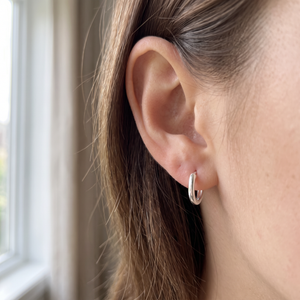
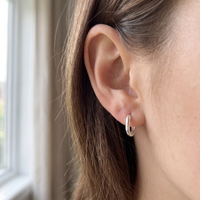
The piece they're describing → Silver Huggie Earrings for Women — 925 Sterling Silver, Hypoallergenic, Minimalist
Personalize Yours


