


Obsidian has been one of humanity's most important materials for 10,000 years — longer than bronze, iron, or steel. The Aztecs built trade networks spanning hundreds of miles to acquire it. Queen Elizabeth I's court astrologer used it to contact spirits. And Apache warriors, in one of the most heartbreaking origin stories in American gemstone history, are said to have wept tears that became the stone's most emotionally resonant variety.
This guide covers the real science behind obsidian's formation and extraordinary sharpness, its documented history across cultures, how to evaluate quality and identify fakes, and what distinguishes it from other protective black stones — plus the crystal healing traditions that have made it one of the most consistently popular grounding stones in the world.
What Obsidian Actually Is
Obsidian is not technically a mineral. A mineral requires a crystalline structure — atoms arranged in a repeating geometric lattice. Obsidian has no such structure because it formed too fast for crystals to develop. It is a natural volcanic glass — a supercooled silica-rich liquid that froze in the same state it erupted. Chemically, it's primarily silicon dioxide (SiO₂), the same compound as quartz, but without quartz's orderly crystal arrangement.
Formation happens when silica-rich lava (rhyolitic magma) erupts and cools so rapidly — by contact with water, air, or cold rock — that the silica molecules lock into an amorphous (non-crystalline) arrangement. The most common sources are lava flows that enter bodies of water, or the edges of lava flows where cooling is fastest. Obsidian is typically jet black because of trace amounts of iron and magnesium; other colors come from other mineral inclusions or gas bubbles.
The sharpness science: Obsidian's most extraordinary property is how it breaks. Unlike most materials, which fracture along crystalline planes or grain boundaries, obsidian breaks with a conchoidal fracture — a smooth, curved break pattern (named for its resemblance to a shell's curved surface). Because there are no crystal boundaries or grain structure to interrupt the fracture, it can be shaped to an edge of near-atomic thinness.
A well-knapped obsidian blade edge can reach approximately 3 nanometers in thickness — roughly 500 times thinner than a surgical steel scalpel blade (which typically holds a 15–20 nanometer edge). Obsidian blades are still used experimentally in microsurgery for procedures requiring absolute precision, because no metal blade matches their cutting-edge geometry. This is the same property that made obsidian the most valued cutting material in the pre-metal world — and why every ancient civilization that found it built trade networks to obtain it.
What Obsidian Means
Obsidian's crystal meaning flows from its physical nature: volcanic, formed from destruction and rapid transformation, with a surface like a mirror and edges sharp enough to cut through anything. In crystal healing traditions, obsidian operates on these same principles — it cuts through, reveals, and transforms.
The core themes of obsidian's meaning are:
- Protection: Obsidian is one of the oldest and most consistently used protective stones in recorded history. It's specifically associated with psychic protection — shielding against negative energy, ill intent, and emotional manipulation. Unlike passive protective stones, obsidian is considered actively protective: it reflects energy back to its source rather than simply absorbing it.
- Truth and self-reflection: Obsidian's mirror-like surface was used literally for scrying and divination in multiple cultures. The crystal healing tradition picks up this quality: obsidian is said to show you what you need to see, not what you want to see. It's recommended for people in self-deception — suppressing difficult truths about themselves, their relationships, or their situations.
- Root chakra grounding: Obsidian anchors to the root chakra — the base of the body's energy system, associated with physical safety, survival, and belonging. When the root chakra is unbalanced, the symptoms are familiar: free-floating anxiety, inability to feel settled, difficulty completing things. Obsidian is a primary grounding stone for these states.
- Emotional purging: Obsidian is often described as an emotional detoxifier — it draws buried resentment, fear, and trauma to the surface where it can be acknowledged and released. Like malachite, it can be intense in this role: it doesn't suppress, it reveals.
- Shadow work: A specific use in modern crystal healing — working with the aspects of yourself you hide from or deny. Obsidian is the shadow work stone by reputation: the volcanic mirror that shows the parts of yourself you've been avoiding.
History and Cultural Significance
The oldest tool material (10,000+ BCE): Obsidian was one of humanity's first truly valued materials — before any metal, before fired pottery. Archaeological sites in Turkey, Mexico, Japan, and Ethiopia contain obsidian tools dating back more than 10,000 years. The Natufian people of the Levant traded obsidian from Anatolia (modern Turkey) across hundreds of kilometers as early as 8000 BCE. For any pre-metal culture, controlling obsidian sources meant controlling the best cutting technology available.
Mesoamerica — the Aztec obsidian empire: No culture made more comprehensive use of obsidian than the Aztecs. Obsidian appeared in every layer of Aztec life: kitchen knives, surgical blades, arrowheads, the macuahuitl (a wooden club with obsidian blades embedded along both edges — among the most fearsome weapons of the pre-Columbian world), ritual sacrificial blades, and mirrors used for divination.
To the Aztecs, obsidian wasn't just a material — it was sacred to Tezcatlipoca, god of the night sky, darkness, and sorcery. His name translates to "Smoking Mirror," a direct reference to obsidian's reflective, smoke-like surface. The obsidian mirror was his symbol and his window into other realms. A 2025 study published by Tulane University analyzed hundreds of obsidian artifacts from Aztec sites and found sourcing from deposits across central Mexico, Puebla, Hidalgo, and Michoacán — evidence of trade networks spanning the entire empire to supply their insatiable demand for the stone.
John Dee and Elizabeth I's Aztec mirror: In 1582, John Dee — mathematician, astronomer, and court astrologer to Queen Elizabeth I — began conducting scrying sessions with an obsidian mirror. This mirror, now in the British Museum collection (catalog number AOA+7825), was originally an Aztec ritual object, brought to Europe following the Spanish conquest of Mexico. Dee, working with a medium named Edward Kelley, believed the mirror allowed communication with angels. Whether you accept the metaphysics or not, the historical fact is striking: an Aztec sacred object traveled from Mexico to Europe and was used for spiritual work by one of the most educated men of the Elizabethan age.
Apache Tears: Apache Tears are a variety of obsidian — small, rounded, translucent nodules formed when obsidian droplets were ejected from a volcano and rounded by weathering. They take their name from a specific historical event. In 1870, a group of approximately 75 Apache warriors of the Pinal band were cornered by US Cavalry near Superior, Arizona. Rather than be captured, the warriors rode their horses off a cliff. When the Apache women came to mourn, their tears are said to have fallen to the earth and become the small dark stones. Whether mythological or based in fact, Apache Tears are among the most emotionally resonant gemstones in Native American tradition — and are specifically recommended for grief, loss, and compassionate emotional release, in contrast to black obsidian's more intense energy.
Ancient Egypt and the Mediterranean: Egyptian artisans used obsidian for surgical instruments and small sculptures. Obsidian eyes appear in several Egyptian statues — the material's dark, reflective quality made it ideal for capturing the appearance of a live eye. Obsidian blades were found in Egyptian archaeological contexts dated to 3000 BCE, sourced from Ethiopian and Arabian deposits.
Obsidian Varieties and Their Meanings
The obsidian family covers several visually distinct varieties, each with different energetic properties in crystal healing traditions:
| Variety | Appearance | Formation | Meaning |
|---|---|---|---|
| Black obsidian | Jet black, highly reflective, glassy | Iron and magnesium give the black color | Protection, truth, shadow work — most intense variety |
| Rainbow obsidian | Black with iridescent bands of color (purple, blue, green, gold) that appear at certain angles | Nanoparticle inclusions create thin-film interference (same physics as labradorite) | Hope in darkness, finding beauty after difficulty, gentle protection |
| Snowflake obsidian | Black with white or grey snowflake-like patterns | Cristobalite (a form of silica) crystallizes within the glass as it slowly devitrifies | Balance of dark and light, purity, releasing unhelpful patterns |
| Mahogany obsidian | Black with reddish-brown or orange streaks and patches | Iron oxide (hematite or magnetite) inclusions create the color | Strength, removing self-imposed limitations, sexual and creative energy |
| Apache Tears | Small, rounded, translucent dark nodules — black when held up to light | Ejected obsidian droplets weathered into rounded shapes | Grief, compassionate emotional release, comfort — gentler than black obsidian |
| Silver sheen obsidian | Black with a silver metallic sheen (not iridescent — uniform reflective layer) | Tiny gas bubble layers create the sheen through reflection | Patience, perseverance, seeing through illusion |
| Gold sheen obsidian | Black with a warm gold metallic sheen | Same gas-bubble mechanism as silver sheen — different bubble size affects color | Personal power, aligned ambition, divine masculine energy |
Obsidian vs Other Protective Black Stones
Four stones dominate the "protective black stone" category in crystal healing — obsidian, black tourmaline, black onyx, and shungite. They're often grouped together, but their energies and practical differences are significant:
| Stone | Protection style | Chakra | Energy intensity | Best for |
|---|---|---|---|---|
| Obsidian | Reveals and reflects — shows what needs to be faced | Root | Very high — intense | Shadow work, truth-facing, deep emotional clearing |
| Black tourmaline | Creates a protective barrier — blocks and transmutes negative energy | Root | High — strong but stable | EMF protection, environmental negativity, daily grounding |
| Black onyx | Absorbs and contains — steady, reliable shield | Root + solar plexus | Moderate — calm and grounding | Sustained strength, endurance, grief and loss |
| Shungite | Purifies and neutralizes — associated with EMF and environmental toxin protection | Root | Moderate — cleansing, not intense | EMF protection, water purification (mineralogically documented), workplace use |
How to choose: If you need the most intense, truth-forcing protection — obsidian. If you want a reliable daily-wear protective stone that won't overwhelm — black tourmaline. If you're working through grief or need sustained endurance — black onyx. If your focus is environmental or electromagnetic — shungite. Many practitioners layer all four for different contexts.
Root Chakra and Grounding
Obsidian's primary chakra is the root chakra (Muladhara) — the first chakra, located at the base of the spine. The root chakra governs your sense of physical safety, your relationship with your body and the material world, and your baseline emotional stability. When it's blocked or unbalanced, the symptoms include: pervasive anxiety with no identifiable cause, difficulty feeling grounded or present, financial fears out of proportion to reality, and a general sense that the floor could drop out at any moment.
Obsidian works the root chakra by first grounding — connecting the body's energy to the earth — and then purging what's been accumulating in that energy center. The volcanic origin matters here: obsidian is literally earth energy in solidified form, cooled from the deepest material the planet produces. Many practitioners place obsidian at the base of the spine during root chakra meditation or hold it in both hands to establish a physical-energetic connection to the ground.
Obsidian pairs effectively with citrine (to bring warmth and forward energy after the root chakra clearing), amethyst (to calm the mind while obsidian works the base), rose quartz (to open the heart once the root is grounded), and hematite (for additional physical-level grounding alongside obsidian's psychic-level work).
Zodiac Associations
| Sign | Why obsidian suits them | Specific benefit |
|---|---|---|
| Scorpio (Oct 23–Nov 21) | Primary association. Scorpio's themes — death, transformation, shadow, hidden truths — are obsidian's themes | Deepens Scorpio's natural capacity for depth and truth without tipping into destructive intensity |
| Sagittarius (Nov 22–Dec 21) | Sagittarius can avoid difficult emotional truths in favor of optimism and forward movement | Grounds idealism; forces honest reckoning with what's actually true vs. what Sagittarius wants to believe |
| Aries (Mar 21–Apr 19) | Aries' fire energy needs grounding — obsidian provides the earth counterbalance | Channels impulsive energy into grounded, strategic action |
| Capricorn (Dec 22–Jan 19) | Capricorn's ambition can create emotional suppression — obsidian clears what's been buried | Emotional clearing; protection during high-stakes professional situations |
How to Use Obsidian
Jewelry: Black obsidian pendants and earrings worn against the skin are the most consistent way to keep its protective energy active. A pendant at the chest or throat keeps it in your energy field throughout the day. AJLuxe carries obsidian pieces set in 18K gold-plated 925 sterling silver — hypoallergenic settings that complement the stone's deep black without overpowering it. Browse the necklace collection and earring collection.
Meditation: Hold obsidian in both hands or place it at the base of your spine during floor meditation. Start with 10–15 minute sessions — obsidian's energy is among the most intense of the protective stones, and longer initial sessions can surface more than you're ready to process at once. As with malachite, build duration gradually. If you want a less intense entry point, Apache Tears or snowflake obsidian are gentler starting varieties.
Scrying: Obsidian mirrors (polished obsidian discs) are used for scrying — a form of meditative divination in which you soften your focus and observe what arises in the reflective surface. This is the oldest documented use of obsidian for spiritual purposes, continuous from the Aztec Tezcatlipoca mirrors through John Dee's scrying mirror to present-day practice. Gaze softly at the mirror's surface for 10–15 minutes in dim lighting. The intent is not to see literal images but to access intuitive clarity.
At home: Placing obsidian near your front door or on windowsills is a traditional protective placement — the stone's energy is said to create a boundary that negative energy cannot easily cross. Near electronics, black tourmaline is generally preferred for EMF concerns; obsidian is better suited for energetic boundary-setting than electromagnetic work.
How to Identify Real Obsidian and How to Care for It
Identifying genuine obsidian vs. fake
Because natural obsidian can be inexpensive, fakes are less common than with rarer stones — but dyed black glass and synthetic glass are sold as obsidian. Key tests:
- Temperature: Real obsidian feels cool when you first pick it up (like quartz), not room temperature. Regular glass heats and cools quickly; natural obsidian retains temperature longer due to its density.
- Conchoidal fracture: The edges of genuine obsidian — if chipped — show the smooth curved shell-like fracture pattern. Dyed glass may show a flat or irregular fracture.
- Variety authenticity: Rainbow obsidian's iridescence only appears at a specific angle to directional light — not in all lighting conditions. "Rainbow obsidian" that shows color from all angles is likely glass with a film coating.
- Weight: Obsidian has a specific gravity of about 2.4 — lighter than most natural gemstones but similar to glass. Weight alone won't differentiate it from glass, but it should feel consistent and substantial.
Care
Obsidian is glass — it's brittle and chips on impact. It handles moderate hardness well (Mohs 5–5.5) but will crack if dropped on hard floors. Store obsidian separately from harder stones and handle pendants with care. Clean with a soft dry cloth or mild soapy water followed by thorough drying — obsidian is water-safe (unlike malachite). Avoid steam cleaners and ultrasonic cleaners, which can cause internal fractures.
Energetic cleansing: Obsidian absorbs significant negative energy by design — it needs regular cleansing to maintain its effectiveness. Monthly cleansing is recommended for frequently worn pieces. Sage or palo santo smudging is the most effective method. Running water works well for obsidian (unlike malachite) — hold it under cool running water for 30–60 seconds while setting the intention to clear accumulated energy. Selenite charging plates also work overnight.
Related reading: Onyx vs obsidian.
Related reading: Black tourmaline vs obsidian.
Related reading: Moldavite vs obsidian.
Frequently Asked Questions
What does obsidian mean spiritually?
Obsidian is the stone of protection and truth. It's specifically a mirror stone — it reflects back what's real rather than what's comfortable to see. Spiritually, it's associated with shadow work (confronting the parts of yourself you suppress or deny), root chakra grounding, and psychic protection. It doesn't gently open or expand — it cuts through illusion and grounds what's been floating. Most crystal healing traditions describe it as one of the most intense stones to work with, particularly effective for people who are ready to face difficult truths but need the energetic support to do so.
What is obsidian made of?
Obsidian is a natural volcanic glass, not technically a mineral. It's composed primarily of silicon dioxide (SiO₂) — the same compound as quartz — but lacks quartz's crystalline structure because it cooled too rapidly from molten lava for crystals to form. The black color comes from trace amounts of iron and magnesium. Other colors in varieties like rainbow obsidian come from nanoparticle inclusions that create thin-film interference effects.
Is obsidian a crystal?
Strictly speaking, no — obsidian is an amorphous natural glass, not a crystal. A crystal requires a repeating internal atomic structure, which obsidian lacks. However, in the crystal healing community, "crystal" is used broadly to include any natural mineral or gemstone used for healing work, and obsidian has always been included under that umbrella. The distinction matters mineralogically but not practically for healing use.
What chakra is obsidian for?
Obsidian primarily works the root chakra (Muladhara) — the first chakra at the base of the spine, governing physical safety, groundedness, and survival energy. It's one of the strongest root chakra stones available. Some practitioners also assign black obsidian to the earth chakra (below the body) for very deep grounding work. Snowflake obsidian and mahogany obsidian can also work the solar plexus chakra, depending on the tradition.
Who should use obsidian?
Obsidian suits anyone who needs grounding, protection, or emotional honesty. It's specifically recommended for people doing shadow work (confronting suppressed aspects of themselves), those experiencing psychic or emotional boundary violations, and anyone feeling ungrounded or disconnected from their physical reality. Because it's intense, it's less suited for people currently in the middle of an acute emotional crisis — in those situations, gentler stones like apache tears, rose quartz, or lepidolite are better starting points.
What zodiac is obsidian for?
Obsidian is most strongly associated with Scorpio — the themes of shadow, transformation, and hidden truth are deeply aligned. It also suits Sagittarius (to ground idealism), Aries (to steady impulsive fire energy), and Capricorn (to clear suppressed emotion during high-achievement focus). Scorpio and Sagittarius are the most frequently cited primary associations across crystal traditions.
Can obsidian go in water?
Yes — obsidian is water-safe. Unlike malachite (which is toxic when wet) or selenite (which dissolves in water), obsidian can be briefly rinsed under cool running water for energetic cleansing without damage. Avoid prolonged soaking, which can affect any polish or settings. For crystal elixirs or gem water, obsidian is generally considered safe to use in the indirect method (stone placed outside a glass vessel rather than in the water directly).
What's the difference between obsidian and black tourmaline?
Both are protective black stones working the root chakra, but they operate differently. Obsidian reflects and reveals — it confronts you with what needs to be faced, making it intense and most powerful for shadow work. Black tourmaline creates a barrier — it blocks and transmutes negative energy coming from outside you, making it better for daily-wear protection and EMF concerns. Many practitioners use both: black tourmaline as a continuous protective shield, obsidian for deeper intentional work.
What is apache tears obsidian?
Apache Tears are small rounded obsidian nodules — typically 1–5cm — that were ejected from a volcano as molten droplets and shaped into rounded forms by weathering. They're translucent when held up to light (unlike most black obsidian) with a brownish-black color. Their name comes from a Native American legend about Pinal Apache warriors who died rather than be captured in 1870 — their mourners' tears are said to have become the stones. Energetically, Apache Tears are considered the gentlest obsidian variety: they carry the same protective qualities as black obsidian but in a softer register, specifically associated with grief, compassionate emotional release, and comfort after loss.
What is snowflake obsidian?
Snowflake obsidian is black obsidian with white or grey snowflake-like inclusions — formed when the volcanic glass slowly devitrifies (recrystallizes) and cristobalite crystals grow within it. The white patterns vary from small speckles to large, clearly defined snowflake shapes. Energetically, snowflake obsidian is associated with balance — the interplay of dark and light, shadow and clarity. It's gentler than pure black obsidian and is often recommended as an entry point for people new to obsidian's energy.
How do you cleanse obsidian?
Obsidian is one of the more flexible stones for cleansing because it tolerates water. You can rinse it under cool running water for 30–60 seconds — this is the most efficient method. Sage or palo santo smudging works well. Moonlight cleansing (full moon, on a windowsill overnight) is a popular monthly practice for frequently worn obsidian jewelry. Placing it on a selenite plate overnight works passively. What to avoid: extended soaking, very hot water (thermal shock can crack the glass), and salt water (which can damage polished surfaces over time).
Is obsidian good for anxiety?
Obsidian addresses anxiety that comes from being ungrounded, unprotected, or suppressing something that needs to be faced — its root chakra grounding and truth-telling properties can reduce the free-floating anxiety that comes from those states. For general anxiety or anxiety during an acute crisis, calmer stones are more appropriate first choices: lepidolite (contains natural lithium), blue lace agate, or amethyst. A useful combination: obsidian for root chakra grounding, paired with amethyst for mental calm — the two work the anxiety from both the base and the mind simultaneously.
Final Thoughts
Obsidian is the stone that doesn't let you avoid yourself. The same volcanic glass that the Aztecs made into ritual mirrors and the sharpest blades in the pre-metal world carries a modern reputation for exactly those qualities — cutting through to truth, reflecting what's real, and grounding what's been floating. It's the most intense of the protective black stones, and the most rewarding to work with if you're ready for what it reveals.
AJLuxe carries black obsidian jewelry in 18K gold-plated 925 sterling silver settings — hypoallergenic, polished, and designed for daily wear. The dark stone in gold-toned settings has been a consistent favorite. Browse the necklace collection and earring collection. Shipping calculated at checkout, with gift-ready packaging included.
Want to see how obsidian stacks up against onyx, hematite, and the rest of the black-stone family? See our black crystals guide.
Written by the AJLuxe team — specialists in personalized sterling silver jewelry. Last updated: July 2026.
All third-party trademarks, brand names and product names are the property of their respective owners. AJLuxe is not affiliated with, endorsed by, sponsored by, or otherwise connected to any third-party brand referenced in this article. Brand names are used solely for accurate comparative reference, and material descriptions reflect each brand's own published product specifications at the time of writing.
You Might Also Like

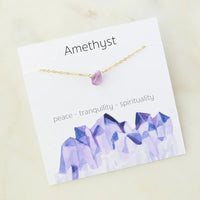
The piece they're describing → Stone Charm Necklace for Women — Raw Natural Gemstone Pendant
Personalize Yours


