



Online engagement-ring communities ask this comparison constantly, and the honest answer is that moissanite and diamond aren't competing on the same axis. One is engineered to maximize brilliance and fire at a fraction of the cost; the other is a natural (or lab-grown) mineral whose value comes from rarity and a centuries-old cultural association. Here's how they actually compare, material fact by material fact.
Hardness and Durability
Diamond is the hardest natural material at Mohs 10, and moissanite is the second-hardest gemstone commonly used in jewelry at Mohs 9.25 — both are hard enough for daily-wear engagement rings with no meaningful scratch risk from normal use. The 0.75-point Mohs gap matters far less in practice than it sounds; you'd need to be handling actual diamonds or sandpaper-grade abrasives to scratch either stone in everyday life. Moissanite is also more fracture-resistant than diamond in some lab tests, since diamond can chip along its cleavage planes under a sharp, direct blow.
Brilliance and Fire
Moissanite actually has more fire (colorful light dispersion) than diamond — its refractive index of 2.65–2.69 exceeds diamond's 2.42, which is why moissanite can look "sparklier" or more rainbow-flashy in direct light. Diamond has a more neutral, white-light brilliance that many buyers associate with the classic "diamond look." Which one reads as more attractive is genuinely subjective: some people love moissanite's extra fire, others find it too flashy and prefer diamond's cooler sparkle.
Price Comparison
Moissanite costs roughly $300–$600 per carat-equivalent versus $2,500–$8,000+ per carat for a comparable-quality natural diamond — moissanite runs about 85–95% less per carat depending on diamond quality and market conditions. A lab-grown diamond narrows that gap somewhat (typically $800–$1,800/carat) but moissanite still undercuts even lab diamonds substantially. This price gap is the single biggest reason moissanite has grown in popularity for engagement rings over the past decade.
Ethical and Environmental Considerations
Moissanite is always lab-created, so it carries none of the conflict-mineral concerns historically associated with mined diamonds, and its production footprint is generally lower than diamond mining. Both lab-grown diamonds and moissanite avoid the supply-chain issues tied to natural diamond mining; natural diamonds carry the most scrutiny here, though the Kimberley Process has reduced (not eliminated) conflict-diamond sourcing since 2003.
What Is the Downside to Moissanite?
The main downside to moissanite is that it can show more rainbow-colored flash ("disco ball" effect) in direct sunlight than some buyers want from an engagement ring, and it carries far less resale value than a natural diamond since it isn't a rare mineral. Moissanite also isn't diamond — for buyers who specifically want the cultural weight and resale market of "a real diamond," no amount of technical similarity changes that. It's an excellent stone on its own merits, not a diamond substitute that fools an expert.
Can a Jeweler Tell If a Diamond Is Moissanite?
Yes — a jeweler can reliably distinguish moissanite from diamond using a thermal/electrical conductivity tester, since moissanite (unlike most simulants) conducts electricity in a way that can trip a standard diamond tester into a false positive, but a proper dual tester or loupe examination under magnification reveals the difference immediately via moissanite's doubling of facet lines (birefringence), which diamond doesn't show. This is a routine, quick check for any jeweler with basic equipment — moissanite was never designed to be undetectable, just to be a strong, honest alternative.
Do Wealthy People Wear Moissanite?
Some do, though it's far less common than natural or lab-grown diamonds among luxury buyers, since moissanite's appeal is largely value-for-money rather than status signaling. Wealthy buyers who choose moissanite tend to do so for its performance (fire, durability) or ethical profile rather than budget, while diamond remains the default for buyers prioritizing resale value and traditional prestige.
Moissanite vs. Diamond: Which Should You Choose?
| Factor | Moissanite | Diamond |
|---|---|---|
| Hardness (Mohs) | 9.25 | 10 |
| Refractive index / fire | 2.65–2.69 (more fire) | 2.42 |
| Price per carat-equivalent | $300–$600 | $2,500–$8,000+ (natural) |
| Origin | Always lab-created | Natural or lab-grown |
| Resale value | Minimal | Retains more value (natural) |
| Best for | Maximum sparkle-per-dollar, ethics-first buyers | Traditional "diamond" cachet, resale, rarity |

Note on material: AJLuxe's own jewelry named "Moissanite" is set with cubic zirconia (CZ), not genuine lab-grown moissanite — a distinct, softer stone (Mohs 8–8.5 vs. moissanite's 9.25). The comparison above describes real moissanite, not this specific piece.
An Affordable CZ Halo Ring, Honestly Labeled
925 sterling silver or 18K white gold, set with cubic zirconia (not genuine moissanite) — $47.99.
Shop CZ Halo Ring →Related reading: a closer look at pave settings specifically, including the honest durability and resizing trade-offs of a fully paved band.
our guide to engagement rings under $200 covers what sterling-silver-and-CZ rings actually look like at this price point, alongside setting styles worth comparing.
Frequently Asked Questions
Straight answers to the questions people actually ask about moissanite vs. diamond rings.
Is it better to buy a diamond or moissanite?
Neither is objectively better — moissanite wins on price and fire (sparkle), while diamond wins on rarity, resale value, and traditional cachet. The right choice depends on whether sparkle-per-dollar or the "real diamond" story matters more to you.
What is the downside to moissanite?
Moissanite can show more rainbow-colored flash in direct light than some buyers want, and it carries far less resale value than a natural diamond since it isn't a rare mineral. It's an excellent stone on its own terms, not a diamond substitute meant to pass as one.
Do wealthy people wear moissanite?
Some do, though it's less common than diamond among luxury buyers, since moissanite's main appeal is value and performance rather than status signaling. Wealthy buyers who choose it typically do so for its fire and durability or its ethical profile, not to save money.
Can a jeweler tell if a diamond is moissanite?
Yes — a proper dual electrical/thermal tester or a loupe check for facet doubling (birefringence) reliably distinguishes moissanite from diamond in seconds. Moissanite was never designed to be undetectable to a jeweler.
Final Thoughts
Moissanite and diamond both make excellent engagement-ring stones — the decision comes down to what you're optimizing for, not which one is "better." If you want maximum fire and durability at a fraction of diamond pricing, moissanite delivers; if resale value and the traditional diamond story matter more, diamond remains the default. Whichever you choose, know exactly what stone you're buying — including checking whether a "moissanite" listing is genuine moissanite or a CZ simulant wearing the name.
All third-party trademarks, brand names and product names are the property of their respective owners. AJLuxe is not affiliated with, endorsed by, sponsored by, or otherwise connected to any third-party brand referenced in this article. Brand names are used solely for accurate comparative reference, and material descriptions reflect each brand's own published product specifications at the time of writing.
You Might Also Like
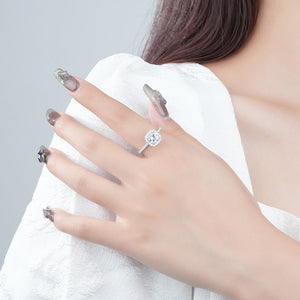
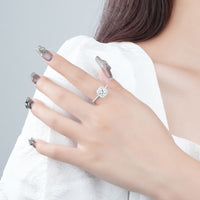
The piece they're describing → Moissanite Halo Ring — Sterling Silver, 18K White Gold, CZ
Personalize Yours


