


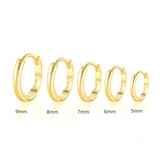
Cartilage piercings and huggie earrings are a natural combination — the close fit of a huggie suits cartilage positions better than a swinging hoop, and the hinged click clasp is more secure than most ring-style alternatives. The key is knowing which size fits which position, when you can safely switch to a huggie after piercing, and which metal to choose. This guide covers all three. For a broader roundup of every cartilage-safe earring style, see our best cartilage earrings guide.
Which Cartilage Piercings Can Wear Huggie Earrings
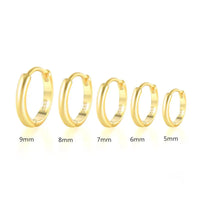
| Piercing position | Huggie size | Notes |
|---|---|---|
| Helix | 8mm | Most common cartilage + huggie combination |
| Forward helix | 6mm | Very limited space — 6mm only for most placements |
| Tragus | 6mm | Small flap in front of ear canal — tight fit needed |
| Conch (inner) | 8–10mm | More room in the ear bowl — 10mm if outer edge |
| Daith | 8mm | Innermost cartilage fold — 8mm standard |
| Anti-tragus | 6–8mm | Small raised cartilage opposite tragus |
| Snug | 6mm | Inner antihelix — very limited space |
Huggie Earrings for Helix Piercings
The helix is the most popular cartilage piercing, and huggie earrings are one of the most popular jewelry choices for it. An 8mm huggie earring sits flush against the cartilage ridge without extending outward in a way that catches on hair or clothing.
Why huggies beat thin hoops for helix piercings:
- The click clasp is more secure than a thin hoop wire closure — less likely to open during sleep or exercise
- The close fit means less leverage on the cartilage than a dangling ring
- Easier to insert solo than a captive bead ring, especially in the mirror
- More refined look than a surgical hoop for everyday wear
For a high helix placement (closer to the top of the ear where the ridge curves inward), 6mm often fits better than 8mm. The positioning determines how much room there is for the hoop arc.
Huggie Earrings for Forward Helix Piercings
Forward helix piercings sit in the small fold of cartilage near the face, just above the tragus. Space here is limited in two directions — toward the inner ear and toward the face. A 6mm huggie is usually the maximum practical size. Anything larger risks pressing against the inner ear or extending toward the face in a way that causes irritation.
Forward helix huggie earrings are particularly popular because they create a minimal stacked look when paired with a helix huggie above and a lobe huggie below — three huggies up the ear in graduated sizes reads as a curated ear without the complexity of mixing different earring styles.
Huggie Earrings for Tragus Piercings
The tragus is the small cartilage flap directly in front of the ear canal. It's one of the tighter placements for any earring style, and a 6mm huggie is the standard choice. The hoop arc needs to clear the antihelix (the ridge behind it) when the clasp is closed — a 6mm fits in this space for most ear anatomies.
One consideration unique to tragus piercings: the position means the huggie sits partially inside the ear. When putting in or taking out a tragus huggie, you'll need good lighting and possibly a mirror — the click mechanism is harder to feel in this position than in a lobe or helix piercing.
When Can You Switch to Huggie Earrings After a Cartilage Piercing?
Wait at least 12 weeks before switching a cartilage piercing to a huggie earring. This is longer than the lobe recommendation (6 weeks) for two reasons:
- Cartilage heals more slowly. Cartilage tissue has less blood supply than lobe tissue, which means the healing process takes 3–6 months for surface healing and up to a year for full internal healing.
- Hinged clasps require manipulation. Opening and closing a click clasp near a fresh piercing can rotate the jewelry and disturb the healing track. A flat-back labret stud is better suited to healing piercings because it stays stationary.
What to use during healing: flat-back labret studs in implant-grade titanium, implant-grade surgical steel (316L), or solid 14K gold. These are specifically designed for fresh piercings. Once the cartilage is surface-healed (12–16 weeks), you can switch to a huggie earring — but handle it gently for the first few months of daily wear.
Which Metal Huggie Earrings for Cartilage
The same metal rules apply for cartilage piercings as for lobe piercings — but cartilage is slightly less tolerant of irritants because it heals more slowly. For recently healed cartilage piercings, the safest choices are:
- 925 sterling silver: Nickel-free, safe for most people, affordable
- 18K gold plated over 925 sterling silver: Gold finish, safe base metal, most popular everyday option
- Solid 14K or 18K gold: Best for very sensitive skin or early healing — most biocompatible at this price tier
Avoid brass-based huggie earrings in cartilage piercings — the slower healing creates more exposure time for any base metal reaction to develop. See our guide to huggie earrings for sensitive ears for the full metal breakdown.
Stacking Huggies Across Lobe and Cartilage Piercings
The graduated stack — larger huggie at the first lobe, stepping down in size toward the cartilage — is the most popular huggie styling approach for multi-piercing ears.
Common lobe-to-cartilage huggie stacks:
- 10mm (first lobe) → 8mm (helix): Classic two-piece huggie stack
- 10mm (first lobe) → 8mm (second lobe) → 6mm (helix): Three-piece graduated stack
- 10mm (first lobe) → flat-back stud (second lobe) → 6mm (forward helix): Mix of styles
- 12mm (first lobe) → 10mm (second lobe) → 8mm (helix) → 6mm (tragus): Full curated ear
Keep the same metal tone (all gold or all silver) for a cohesive look. If mixing metals, one dominant tone and one accent is better than equal parts of two tones.
More stacking ideas and combinations in our huggie earring stacking guide.
Caring for Huggie Earrings in Cartilage Piercings
Cartilage piercings need more care than lobe piercings for the first year. With a huggie earring in a healed cartilage piercing:
- Clean the earring and the area around the piercing with saline spray once a week
- Don't twist or rotate the earring — the rotation technique is outdated and can cause irritation
- Remove before swimming in pools or the ocean — chlorine and salt water affect both the piercing and the earring plating
- If you notice any tenderness returning, switch back to a flat-back stud until it settles
Final Thoughts
Huggie earrings are one of the best choices for cartilage piercings once healing is complete. The close fit, secure clasp, and minimal leverage make them more comfortable and practical in cartilage positions than most hoop alternatives. Use 6mm for tight positions, 8mm for standard ones, wait the full 12 weeks before switching, and choose 925 sterling silver or 18K-plated-over-sterling for the base metal.
Browse AJLuxe huggie earrings in 6mm and 8mm sizes, all 18K gold plated over 925 sterling silver. Or visit our complete huggie earrings guide for everything else about the style.
Cartilage Piercing Jewelry: Every Style, Not Just Huggies
Cartilage piercing jewelry comes in five core styles — flat-back labret studs, hinged clickers (huggies are one type of clicker), captive bead rings, barbells, and seam rings — and the right one depends on whether the piercing is fresh or healed, not just which position it's in. Huggies cover the "healed, everyday wear" case well, but a few positions and situations call for a different style entirely.
| Jewelry style | Best for | Why |
|---|---|---|
| Flat-back labret stud | Fresh or healing piercings (0–12 weeks), sleepers | Stays flush and stationary — nothing to catch on a pillow, no hinge to rotate against healing tissue |
| Clicker / huggie | Healed piercings, everyday wear, stacking | Hinged and secure, but the clasp movement makes it a poor choice before full surface healing |
| Captive bead ring (CBR) | Fresh piercings placed by a piercer | Removable bead lets a piercer take it out with minimal disturbance to the healing track |
| Curved or straight barbell | Industrial piercings, some conch and auricle placements | Spans two entry points or sits flat through thicker cartilage where a hoop shape doesn't fit |
| Seam ring | Helix, conch — once fully healed | Seamless circle with no visible closure; more delicate look than a clicker, but harder to open/close solo |
If you're choosing jewelry for a brand-new cartilage piercing, start with a flat-back labret stud or a CBR your piercer fits at the appointment — not a huggie. Once you've cleared the 12-week mark covered above and the piercing feels fully settled, that's when a huggie, clicker, or seam ring becomes a safe swap. The Association of Professional Piercers is a good reference for jewelry and aftercare standards if you want a second opinion beyond your piercer.
Shopping by style rather than by piercing position? Our full cartilage earrings guide breaks down studs, hoops, and barbells side by side; this article stays focused on huggies specifically.
Frequently Asked Questions
Can you wear huggie earrings in cartilage piercings?
Yes — huggie earrings work well in helix, forward helix, tragus, conch, and daith piercings. Use 6mm for tight positions and 8mm for standard ones. Wait at least 12 weeks after getting a cartilage piercing before switching to a huggie.
What size huggie earrings for a helix piercing?
8mm is the standard size for a helix piercing. It sits close to the cartilage ridge without extending far outward. For a high or tight helix placement, 6mm gives a closer fit.
Can you put a huggie earring in a tragus piercing?
Yes — use a 6mm huggie for a tragus piercing. The tragus has very limited space and 6mm is the maximum practical size for most ear anatomies.
How long after a cartilage piercing can you wear huggie earrings?
Wait at least 12 weeks. Cartilage heals more slowly than lobes and lacks the same blood supply. Your piercer may recommend waiting 4–6 months for full internal healing before making earring style changes.
Are huggie earrings good for a forward helix piercing?
Yes — 6mm huggies are one of the most popular choices for forward helix piercings. The limited space means 6mm is usually the maximum; anything larger can press against surrounding tissue.
Do huggie earrings fall out of cartilage piercings?
No — the hinged click clasp is more secure than CBR rings or thin hoop closures. The click confirms it's locked and reopening requires deliberate pinching. Huggie earrings stay put better than open hoops in cartilage positions.
Can you sleep with huggie earrings in a helix piercing?
Yes, once healed. A healed helix with a 6–8mm huggie is comfortable for most side sleepers because the earring stays close to the ear. Avoid sleeping on fresh (unhealed) cartilage piercings regardless of earring style.
Can you wear huggie earrings in a conch piercing?
Yes — 8mm for an inner conch piercing or 10mm if the piercing is toward the outer edge of the ear bowl. The conch has more room than most cartilage positions so slightly larger sizes work.
What's the difference between a huggie and a CBR for cartilage?
A CBR (captive bead ring) is an open hoop with a removable bead. A huggie is a solid hoop with a permanent hinged clasp. CBRs are often used in fresh piercings; huggie earrings are better for healed cartilage — more secure, easier to insert solo, and more refined for everyday wear.
What huggie earrings are best for newly healed cartilage?
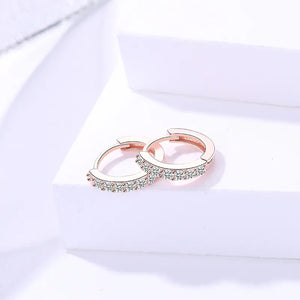
For a recently healed cartilage piercing (12–16 weeks), start with a plain smooth 6–8mm huggie in 925 sterling silver or 18K gold plated over sterling. Avoid embellished styles (pavé, gemstone) until the 6-month mark when healing is more complete.
All third-party trademarks, brand names and product names are the property of their respective owners. AJLuxe is not affiliated with, endorsed by, sponsored by, or otherwise connected to any third-party brand referenced in this article. Brand names are used solely for accurate comparative reference, and material descriptions reflect each brand's own published product specifications at the time of writing.
You Might Also Like
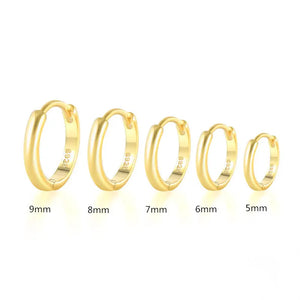
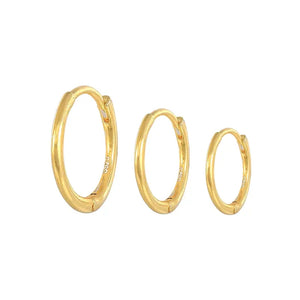
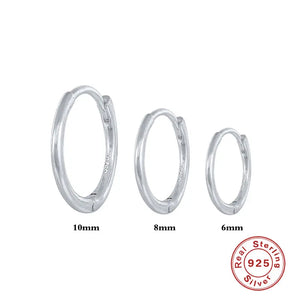
The piece they're describing → Gold Huggie Earrings for Women — 925 Sterling Silver, 18K Gold Plated, Minimalist
Personalize Yours


