Hoop earrings are the most enduring earring design in history — versions have been found in ancient Egyptian, Greek, and Roman artifacts dating back over 4,000 years. They haven't changed fundamental…
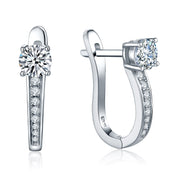
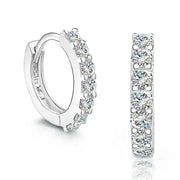
Hoop earrings are the most enduring earring design in history — versions have been found in ancient Egyptian, Greek, and Roman artifacts dating back over 4,000 years. They haven't changed fundamentally because the design is essentially perfect: a continuous or near-continuous ring that frames the face and moves with the wearer. AJLuxe hoop earrings are crafted from 925 sterling silver with 18K gold plating, combining a timeless silhouette with materials safe for sensitive ears.
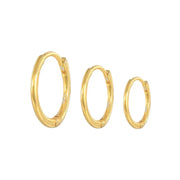
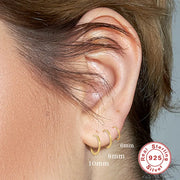
Size is the single most important variable in hoop earring selection. The diameter of a hoop — measured across the widest point — determines the overall effect and appropriateness for different settings. 10–12mm is the huggie zone: hoops so small they hug close to the lobe, visible only up close, suitable for cartilage piercings and first earring looks. 15–20mm is the small classic range: the professional sweet spot, reads as understated and polished, suitable for all face shapes and essentially all settings including the most conservative offices. 25–35mm is medium versatile: the most popular size range globally, transitions from work to casual to smart casual with ease. 40–50mm is large statement: fashion-forward, pairs best with simple outfits so the earring can be the focal point. 60mm and above is editorial — suited to fashion events, creative contexts, and intentional statement dressing.
Post material matters more for hoop earrings than for almost any other earring style. The reason: hoops are inserted and removed through the piercing more than studs (which often stay in place), and the post-to-piercing contact is continuous during wear. The post of a hoop earring is in direct contact with the interior of the piercing canal — living tissue that reacts to metals exactly as skin does. Brass posts (the most common post material in affordable hoops) frequently contain nickel and zinc, both of which cause contact reactions in sensitized skin. AJLuxe hoop earrings use 925 sterling silver posts — the same hypoallergenic sterling silver base as all AJLuxe pieces — ensuring that the post material is safe regardless of how long the earring is worn.
Hoop gauge — the thickness of the wire forming the hoop — affects both the look and wearability of the earring. Fine jewelry hoops are typically 20g (0.8mm wire), creating the most delicate, lightweight appearance. 18g (1.0mm) is slightly thicker, creating a more substantial look while remaining fine. 16g (1.6mm) creates a thick, chunky hoop that reads as a statement. For piercings done with standard needle piercings (the majority), 20g–18g fits without enlarging the piercing. Heavy gauge hoops (14g and below) can gradually stretch the piercing over time with extended wear. For most wearers, 20g–18g provides the ideal balance of visible delicacy and wear comfort.
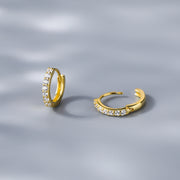
The difference between a hoop, a huggie, and a half-hoop is worth understanding before purchasing. A full hoop is a complete or near-complete circle that passes through the piercing and closes with a click-in back, wire latch, or continuous wire. A huggie is a small hoop specifically designed to hug close to the lobe — usually 10–15mm with a hinged snap closure. A half-hoop is an earring where the front half (visible from the front) is a hoop shape but the backing is a standard post — worn like a stud but with hoop aesthetics from the front. Full hoops have the most motion; huggies are the most secure; half-hoops are the most like a stud in wearability.
| Size | Diameter | Best For | Work Appropriate |
|---|---|---|---|
| Huggie/Tiny | 10–12mm | Cartilage, everyday subtlety, first hoops | Yes — all settings |
| Small Classic | 15–20mm | Professional daily wear, conservative offices | Yes — all settings |
| Medium Versatile | 25–35mm | Everyday casual to smart casual, most popular | Yes — most settings |
| Large Statement | 40–50mm | Evening, creative offices, fashion contexts | Context-dependent |
| Oversized | 60mm+ | Fashion, editorial, statement occasions | Creative/fashion only |
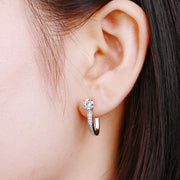
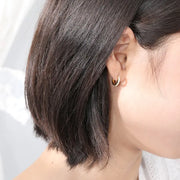
Hair position changes how hoops read dramatically. With hair up — bun, ponytail, or updo — the entire earring is visible and the face framing effect is maximized. Medium to large hoops shine most with hair up because nothing obscures them. With hair down, smaller hoops (under 25mm) stay visible and add sparkle; larger hoops (35mm+) may be partially covered by hair and lose some of their visual impact. If you primarily wear your hair down and want a hoop that's always visible, stay in the 15–25mm range.
Layering hoops in the same ear — ear stacking — is the dominant earring trend and hoops are central to it. A successful hoop stack in one ear typically uses a huggie at the lobe (hugging close, minimal) and a small hoop at a second lobe piercing (slightly more prominent), with a tiny flat-back stud at the cartilage if pierced. The progression is: smallest and most minimal at the lowest piercing, slightly more present moving up. Mixing a hoop at the lobe with a stud at second lobe creates the classic "curated ear" that dominates jewelry styling content. Keep all metals consistent within the stack — mixing gold and silver in the same ear reads as unintentional unless you're deliberately doing it as a design statement.
The choice between gold-plated and sterling silver hoops comes down to the aesthetic and the base metal under the plating. For gold-toned hoops, gold-plated 925 sterling silver is the clear winner over gold-plated brass: the gold surface looks identical, but when the plating eventually wears (and it will, on all plated jewelry), gold-plated sterling reveals a hypoallergenic sterling base rather than a reactive brass base. The piece remains safe and wearable at every stage. For silver-toned hoops, plain 925 sterling silver — without any plating — is the cleanest option: you get the pure bright silver look with no plating layer to wear through and nothing to maintain beyond occasional polishing when tarnish appears.
Medium hoops in the 25–30mm range are the most consistently purchased hoop size globally. This diameter — just over an inch across — is large enough to be clearly visible and have the hoop's characteristic movement and face-framing effect, while small enough to work in professional and casual contexts alike. The 25–30mm range is the size that most people mean when they say "a classic hoop." Within this range, 25mm is the more understated option and 30mm is the more prominent. If you're purchasing your first hoops or buying as a gift and are unsure, this is the size range with the highest likelihood of satisfaction.
Yes — as long as the posts and wire of the hoop are made from hypoallergenic materials. The critical factor is what the hoop is made from, not whether it's a hoop. 925 sterling silver hoops are safe for sensitive ears. Titanium hoops are safe. Solid 14K or 18K gold hoops are safe. Brass hoops cause reactions in sensitive wearers because brass frequently contains nickel and zinc. The post of a hoop (the end that passes through the piercing) is especially important — even if the visible hoop arc is safe, a reactive post material causes problems. AJLuxe hoops use 925 sterling silver posts and bodies, making them appropriate for sensitive ears.
A hoop earring is a ring (full or near-full circle) that hangs through the piercing, creating a visible loop below and around the earlobe. Most hoops range from 15mm to 60mm+ in diameter. A huggie is a very small, tight-closing version of a hoop — typically 10–15mm — specifically designed to fit close against the earlobe with minimal gap between the earring and the lobe. Huggies often have a hinged snap closure rather than the click-in or wire closure of larger hoops. The practical distinction: hoops hang and move; huggies sit still against the lobe. Huggies are often described as the "sleep-safe" hoop because their close fit prevents snagging.
It depends on your workplace culture. Small to medium hoops (15–30mm) are universally appropriate in professional settings including conservative corporate and legal offices. Large hoops (40–50mm) are accepted in creative industries, fashion, media, marketing, and many modern office environments. They may be seen as too casual or fashion-forward for the most conservative formal settings (courtrooms, very traditional corporate environments, medical patient-facing roles). As a general guide: if your workplace has a formal dress code, stay at 25mm or under. If the dress code is business casual, 30–35mm is fine. If you have a creative or casual workplace culture, any size is appropriate.
Small huggies and very small close-fitting hoops (under 15mm) can generally be worn during sleep with minimal risk for healed piercings. Larger hoops (20mm+) are not recommended for sleeping because: the hoop can get caught on bedding or hair, causing the earring to tug on the piercing; the pressure of the hoop against the pillow can press uncomfortably against the piercing canal; and the wire or clasp can open if bent during sleep. If you want to sleep in earrings, huggies are the best choice — their small, close-fitting profile and secure snap closure make them far more sleep-safe than standard hoops.
Yes — with size adjustment for optimal flattery. Round faces look best in larger or slightly elongated oval hoops rather than small round ones (which echo the face's roundness). Oval faces are flattered by all hoop sizes — the most balanced face shape suits all earring types. Square faces benefit from round hoops (the curved shape softens angular features). Heart-shaped faces (wider forehead, narrower jaw) suit medium hoops that add width at the lower face to balance the jaw. Long or oblong faces can wear almost any hoop, but very large hoops further elongate — medium or small is more balancing. The "most flattering" size adjusts based on face shape, but no face shape is unsuited to hoops as a style.
Cartilage piercings require a specific hoop type: a seamless ring or clicker ring in 16g–18g wire that lies flat against the cartilage without protrusion. Standard lobe-style hoops with click-in backs or large-diameter rings don't work well for cartilage because the cartilage is curved and the piercing placement requires a ring that fits the anatomy of the ear's upper structure. For a helix or cartilage piercing, look for: 16g or 18g gauge, 8–12mm diameter (small enough to fit neatly), and a seamless or hinged clicker closure. Avoid very thin 20g wire for cartilage — it's prone to movement that irritates healing cartilage tissue.
If you've never had your piercing gauge verified, the safest assumption for standard lobe piercings is 20g (0.8mm) — the most common gauge used by professional piercing studios. If your piercer told you the gauge when you were pierced, that number is accurate for the initial jewelry. Over time, wearing jewelry in various gauges can slightly change the piercing's comfortable size. If a piece feels tight, it may be slightly thicker than your piercing is used to — stop, don't force it. If a piece feels loose and rotates freely, it's thinner than your piercing's current size. For cartilage piercings done professionally in the last 10 years, 16g is the standard. If uncertain, a professional piercer can measure your piercing quickly and accurately.