


Red garnet and red agate are both deep red stones, but they differ in hardness, price, and origin. Garnet (Mohs 7–7.5) costs $50–$400 per carat and has a glassy inner glow. Agate (Mohs 6.5–7) costs $2–$20 per carat and shows a waxy, banded look — and most red agate sold today is actually dyed grey agate.
TL;DR:
• Garnet has a deep crystalline glow; agate is matte and banded — easy to spot side by side
• Most "red agate" on the market is dyed grey agate — natural red agate is genuinely rare
• Garnet costs 10–20× more per carat and lasts longer in everyday jewelry
If you've ever shopped for red gemstones, you've probably run into both red garnet and red agate — often at wildly different price points with no clear explanation why. Both look rich and bold in photos, both have spiritual symbolism tied to the root chakra, and both show up in sterling silver jewelry. But they're very different stones. One is a precious silicate mineral with deep crystalline fire. The other is a microcrystalline quartz that's almost always treated with dye before it reaches the market. Knowing the difference between red garnet vs red agate can save you real money and help you choose the right stone for your needs.
In This Guide
- What Are They?
- The Dye Problem: Why Most Red Agate Is Treated
- 5 Visual Ways to Tell Them Apart
- Durability Compared
- Price and Value
- Healing Properties and Spiritual Meaning
- Which to Choose?
- Frequently Asked Questions
- Final Thoughts
What Are They?
Red garnet and red agate come from completely different mineral families. Garnet is a group of silicate minerals that crystallize in the cubic system. The red variety most people know is almandine or pyrope garnet — both form under intense heat and pressure deep in the earth. That geological process is what gives garnet its signature inner brilliance and relatively high hardness.
Red agate is a variety of chalcedony, which is itself a form of microcrystalline quartz. Its structure is made up of microscopic quartz crystals packed so tightly that they give the stone a smooth, waxy surface rather than glassy sparkle. Natural red agate gets its color from iron oxide inclusions. The problem? Truly natural red agate is uncommon. Most of what's sold as red agate in bead stores, online marketplaces, and jewelry shops is grey or white agate that has been soaked in iron-salt solutions or dyed red. This is a widespread industry practice that's rarely disclosed.
Here's a quick side-by-side of the core specs:
| Property | Red Garnet | Red Agate |
|---|---|---|
| Mineral Type | Silicate (nesosilicate group) | Chalcedony (microcrystalline quartz) |
| Mohs Hardness | 7.0–7.5 | 6.5–7.0 |
| Luster | Vitreous (glassy) | Waxy to dull |
| Transparency | Transparent to translucent | Translucent to opaque |
| Price per Carat | $50–$400+ | $2–$20 |
| Banding | None | Characteristic banded layers |
| Treatment | Usually none | Often dyed (most on market) |
For a deeper look at garnet's birthstone history and varieties, check out our full garnet birthstone guide.
The Dye Problem: Why Most Red Agate Is Treated
This is the most important thing to know about red agate: the vast majority of red agate sold today is dyed. Natural agate forms in shades of grey, white, brown, and occasionally soft reds or oranges from trace iron. The vivid, saturated red you see in inexpensive beads and cabochons almost always comes from a dyeing process, not nature.
The most common method is soaking grey or white agate in an iron nitrate solution, then heating it to convert the salt to iron oxide — which turns the stone red or reddish-brown. This is a century-old technique first developed in Idar-Oberstein, Germany. More recently, synthetic dyes have also been used to achieve brighter, more uniform reds. Neither process is inherently dishonest, but it becomes a problem when sellers market the stone as "natural red agate" without disclosing the treatment.
How can you check? There are a few home methods. UV light test: dyed agate often fluoresces unevenly or shows abnormal glow patterns under UV. Acetone test: rub a cotton swab dipped in acetone on a hidden part of the stone — if the swab picks up color, the stone is dyed with a synthetic dye. Color distribution: dyed agate often shows color concentrated in surface cracks or around the banding rather than evenly distributed through the stone. Natural garnet never has this issue — its color is inherent to the crystal structure. According to GIA's gem encyclopedia, dyeing is an accepted but disclosure-required treatment in the agate trade.
Why does this matter for buyers? Dyed agate can fade over time, especially with sun exposure or contact with water and cleaning chemicals. If you're buying a piece expecting long-term color stability, natural garnet is the safer bet. If you buy agate knowing it's treated and care for it accordingly, it can still be a beautiful, affordable choice.
5 Visual Ways to Tell Them Apart
You don't need a gemologist to tell red garnet from red agate. Here are five things to look for:
1. The Luster Test
Hold the stone up to a light and look at the surface. Garnet has a vitreous (glassy) luster — it reflects light sharply, almost like glass. Agate has a waxy, slightly matte surface that diffuses light rather than bouncing it back clearly. Garnet almost always wins on sparkle; agate looks comparatively flat.
2. Look for Banding
Agate is a banded stone. Even when dyed to a uniform red, you can usually see concentric rings or parallel layers if you look carefully, especially near the edges. Garnet has none of this. It's a single-crystal mineral with consistent color throughout. If you see layers, it's agate (or possibly jasper).
3. Transparency Check
Hold the stone up to a flashlight or bright lamp. Quality red garnet is transparent to semi-transparent — light passes through and creates a warm glow from within. Agate is usually translucent at best and opaque in thicker cuts. That inner glow is one of garnet's most distinctive features.
4. Color Uniformity
Natural garnet has rich, even color throughout the crystal. Dyed agate tends to show uneven saturation — darker in cracks, lighter in the body of the stone, or with an almost artificial uniformity that looks too perfect. Look at the stone from multiple angles under different lights.
5. Price as a Signal
If a "garnet" necklace costs $8 on a marketplace, it's almost certainly agate (or glass). Genuine garnet set in sterling silver doesn't retail below $30–$50 even for small stones. Inversely, if a seller is charging $80 for what they call "agate," something is off. Price isn't foolproof, but it's a fast reality check.
Durability Compared
Both stones are reasonably hard, but garnet has the edge in everyday wearability. At Mohs 7–7.5, garnet resists scratching from most everyday materials. Dust and dirt particles (mostly quartz-based, around Mohs 7) can scratch lower hardness stones over time, but garnet holds up well. It's a solid choice for rings, pendants, and bracelets that see daily wear.
Agate sits at Mohs 6.5–7, which puts it right on the edge of vulnerability to everyday abrasion. It won't shatter easily — chalcedony is actually quite tough thanks to its microcrystalline structure — but the surface can become dull over time if it contacts harder materials. For rings especially, agate needs more care than garnet. According to the Jewelers of America care guide, stones below Mohs 7 benefit from protective settings and should be removed before physical activity.
Garnet also has better chemical resistance. It's stable against most household cleaning agents and mild acids. Agate — especially dyed agate — can react poorly to prolonged chemical exposure, which can cause color fading or surface dulling. Both stones should be cleaned with mild soap and warm water rather than ultrasonic cleaners, but agate is more sensitive.
For long-term jewelry pieces — especially anything you plan to wear daily or pass down — garnet is the more durable choice. Agate is better suited to occasional-wear pieces or decorative items where it won't take constant abrasion.
Price and Value
The price gap between these two stones is one of the most dramatic in the gem world. Red garnet typically runs $50–$400 per carat for quality specimens, with fine pyrope or rhodolite garnets at the higher end. The price reflects genuine rarity, natural color, and high clarity in better stones. Garnet set in sterling silver jewelry usually retails between $40 and $200 depending on stone size and setting complexity.
Red agate is one of the most affordable stones in jewelry. Beads and cabochons run $2–$20 per carat, and finished jewelry pieces can be found for $10–$40. This low price is partly because agate is abundant and partly because most of the red color is added through treatment. The stone itself — grey agate — is extremely common.
What does this mean for value? It depends on what you're buying for. If you want a statement red stone at a low price point, treated agate delivers visually. If you want lasting value, natural color, and a stone that holds its appearance over years of wear, garnet is worth the premium. The $50–$400 per carat range for garnet reflects a stone that hasn't been altered — its color and beauty are permanent features of the crystal, not added after the fact.
Be careful on online marketplaces. Listings for "natural red agate" at $15 for a pendant are almost certainly dyed agate — that's fine as long as you know what you're getting. The issue arises when sellers call dyed agate "natural" or when buyers assume they're getting untreated stone. For January's birthstone — which is garnet — there's no substitute if authenticity matters.
Healing Properties and Spiritual Meaning
Both stones carry rich symbolic histories, and both are associated with the root chakra — the energy center linked to groundedness, safety, and physical vitality. But their specific energies and traditional meanings differ.
Garnet has been a talisman of passion and protection since ancient times. Roman soldiers wore garnet signet rings. Medieval travelers carried garnet as protection on long journeys. In crystal healing traditions, garnet is associated with vitality, courage, and deep emotional bonds. It's often called a stone of commitment — to people, to work, to personal growth. Its deep red color is tied to the life force, to blood, and to the fire of determination. Garnet is also associated with the sacral chakra, making it a bridge between physical grounding and creative energy.
Red agate brings a different energy: stability, endurance, and quiet strength. Where garnet is intense, agate is steady. Crystal practitioners often recommend agate for people who feel scattered or anxious — it's seen as a grounding stone that builds resilience over time rather than igniting immediate passion. Agate's banded layers are sometimes interpreted as symbolizing the layers of life experience that build character and stability. It's also associated with protection, but more in the sense of emotional shielding than warrior courage.
In terms of chakra work, both stones resonate with the root chakra (Muladhara), connecting the wearer to the earth and to a sense of physical safety. If your practice calls for intense, fiery energy, garnet is the choice. If you're looking for slow-building, stabilizing support, red agate is the better fit. Many practitioners use both — garnet for active manifestation and agate for grounding and consolidation.
Which to Choose?
The right choice depends on what matters most to you. Here's a simple breakdown:
| If You Want… | Choose | Why |
|---|---|---|
| A birthstone gift (January) | Red Garnet | Garnet is the official January birthstone |
| Everyday ring or bracelet | Red Garnet | Higher hardness, natural color won't fade |
| Budget-friendly red jewelry | Red Agate | 10–20× lower price point |
| Crystal healing: passion, courage | Red Garnet | Associated with vitality and commitment |
| Crystal healing: calm, grounding | Red Agate | Associated with stability and endurance |
| A piece to pass down | Red Garnet | Permanent natural color, better longevity |
| Decorative or occasional wear | Red Agate | Excellent look at low cost for light use |
If you're comparing red garnet to other red stones, our garnet vs ruby guide breaks down that comparison in detail, including price, hardness, and how to tell them apart visually.
Frequently Asked Questions
Is red agate the same as garnet?
No. Red agate is a variety of chalcedony (microcrystalline quartz) while garnet is a separate silicate mineral group. They have different crystal structures, hardness, luster, and price. The only similarity is that both can appear red.

How do I know if my red agate is dyed?
Check for uneven color concentration — dyed agate often shows heavier color in cracks or along banding lines. You can also rub a cotton swab with acetone on a hidden area; if it picks up color, the stone uses synthetic dye. UV light can also reveal abnormal fluorescence in dyed stones.
Is natural red agate rare?
Yes. Naturally occurring red agate with vivid, saturated color from iron oxide is uncommon. Most red agate on the market today — especially the bright, uniform red beads sold in bulk — is dyed grey or white agate.
Which is more expensive, garnet or red agate?
Garnet is significantly more expensive. Quality red garnet runs $50–$400 per carat. Red agate typically costs $2–$20 per carat. In finished jewelry, the price gap is similar — garnet pieces cost considerably more.
Can you wear red agate every day?
You can, but it requires more care than garnet. At Mohs 6.5–7, agate can scratch over time with daily exposure to harder materials. Dyed agate may also fade with regular water exposure or cleaning. For daily wear rings especially, garnet is a better choice.
What chakra is red agate associated with?
Red agate is primarily associated with the root chakra (Muladhara), which governs feelings of safety, grounding, and physical stability. It's also connected to the sacral chakra in some traditions, supporting emotional balance and endurance.
What chakra is red garnet associated with?
Garnet resonates strongly with the root chakra and is also connected to the sacral chakra. In crystal healing, garnet is seen as a stone that activates both physical energy and creative passion, making it a bridge between these two energy centers.
Does red agate fade?
Natural red agate from iron oxide is generally stable. However, most red agate sold commercially is dyed, and dyed agate can fade with prolonged sun exposure, contact with cleaning chemicals, or extended water exposure. Always ask sellers whether the stone has been treated.
Is garnet always red?
No. Garnet comes in nearly every color — green (tsavorite and demantoid), orange (spessartine and hessonite), pink (rhodolite), and even colorless. Red is simply the most common and widely recognized variety. The vivid red you see in jewelry is typically almandine or pyrope garnet.
Which stone is better for a gift?
For a meaningful, lasting gift, red garnet is the better choice — especially if the recipient is a January birthday (garnet is the birthstone). Its natural color, durability, and symbolism make it more suitable for heirloom-style gifts. Agate works well for casual or budget-conscious gifts where the look matters more than permanence.
Can I put red agate in water?
Brief rinsing is generally safe for agate, but soaking is not recommended — especially for dyed agate, which can leach color over time. Natural agate at Mohs 6.5–7 is water-resistant but prolonged exposure can affect surface finish. For crystal charging rituals, prefer moonlight or dry methods over water submersion.
Final Thoughts
Red garnet and red agate are both beautiful stones with centuries of history, but they're fundamentally different in structure, price, durability, and authenticity. Garnet is the rarer, harder, and more valuable choice — with natural color that never fades and a glassy brilliance that agate simply can't match. Agate is an affordable, abundant alternative with its own unique banded character, but buyers should know that most red agate they encounter has been dyed.
The most important takeaway: if someone is selling you "natural red agate" at a very low price with vivid, uniform red color, ask questions. Real, untreated red agate is rare, and real garnet costs considerably more than agate ever will. Understanding what you're buying is the first step to building a jewelry collection you'll love for years.
Shop our garnet birthstone necklace in sterling silver.
All third-party trademarks, brand names and product names are the property of their respective owners. AJLuxe is not affiliated with, endorsed by, sponsored by, or otherwise connected to any third-party brand referenced in this article. Brand names are used solely for accurate comparative reference, and material descriptions reflect each brand's own published product specifications at the time of writing.
You Might Also Like
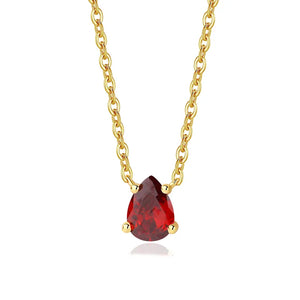

The piece they're describing → Garnet Pendant Necklace for Women — Red Garnet Teardrop, 925 Sterling Silver
Personalize Yours

