


- Opal — the rainbow gem. Famous for its play-of-colour. Mohs 5–6.5 (fragile — pendants and earrings, not daily rings). Price: $10 to $20,000+ per carat depending on type. Symbolises creativity, hope, and love.
- Tourmaline — comes in more colours than any other gem, including neon Paraiba blue and watermelon pink-green. Mohs 7–7.5 (durable for daily wear). Price: $6 to $95,000+ per carat depending on variety. Symbolises balance and protection.
- For everyday rings: choose tourmaline. For a show-stopping pendant or earrings: opal is unmatched.
October has two official birthstones: opal and tourmaline. Opal dazzles with its rainbow play-of-colour — no two stones look alike. Tourmaline offers more colour variety than any gem on Earth, from hot pink to neon blue to watermelon stripes. This guide covers both stones in full: what they are, their real price ranges, which types exist, the famous bad-luck myth about opals, and exactly which stone makes the better gift depending on your budget and the person you're buying for.
October's Two Birthstones — And How They Got Here
Opal is the original October birthstone, recognised on birthstone lists since the modern system was formalized in 1912. Tourmaline was added later as an alternative — originally in 1952 according to the American National Retail Jewelers Association, with the specific addition of pink tourmaline. The American Gem Trade Association (AGTA) later confirmed both stones as official October birthstones.
The reason for two birthstones is practical: opal, while spectacular, is fragile (Mohs 5–6.5) and requires careful handling. Tourmaline offers comparable beauty at greater durability, giving October-born people a genuine choice between the most unique gem in the world and one of the most versatile.
Opal vs Tourmaline: Side-by-Side
| Feature | Opal | Tourmaline |
|---|---|---|
| Mineral type | Hydrated silica | Complex boron silicate |
| Mohs hardness | 5–6.5 (fragile) | 7–7.5 (durable) |
| Colour | All colours via play-of-colour; also fire opal (orange) | Every colour — pink, green, blue, watermelon, red, black |
| Price range | $10–$20,000+/ct (type-dependent) | $6–$95,000+/ct (variety-dependent) |
| Best for | Pendants, earrings, occasional-wear rings | All jewelry types including daily rings |
| Symbolism | Creativity, hope, love, faithfulness | Balance, protection, calm, self-confidence |
| Key risk | Scratches, cracking, absorbs water (Ethiopian opal) | Minimal — durable enough for everyday wear |
| Most prized variety | Australian black opal (Lightning Ridge) | Paraiba tourmaline (neon blue, Brazil/Mozambique) |

Opal — The Gem That Contains All Colours
No gem does what opal does. Its "play-of-colour" — the shifting rainbow fire you see as you turn the stone — comes from light diffracting through microscopic silica spheres stacked inside the gem. Those spheres bend light into spectral colours. The arrangement of the spheres determines which colours flash and in what pattern. Because no two opals have identical sphere arrangements, no two opals look alike. Every opal is, genuinely, one of a kind.
The name comes from the Sanskrit word upala (precious stone), through the Greek opallios — "to see a change of colour." Romans called it opalus and considered it the luckiest of all gems, combining the colours of every other stone. Ancient Arabs believed opals fell from the sky in lightning bolts. Shakespeare called opal "the queen of gems."
Types of Opal — What You'll Find When Shopping
Not all opals are created equal. The type determines both the look and the price dramatically.

- Black Opal — the most valuable opal. Mined almost exclusively at Lightning Ridge, New South Wales, Australia. Dark body tone makes the play-of-colour appear intensely vivid. Price: $500–$20,000+ per carat. The Olympic Australis, the world's largest and most valuable gem-quality opal, is a black opal found in Coober Pedy, Australia, valued at over $2.5 million.
- White / Light Opal — pale body tone with delicate play-of-colour. The most commonly sold opal. Price: $10–$500 per carat. What you'll find in most mainstream jewellery stores.
- Ethiopian Opal — honey-orange to white body, often with brilliant fire patterns. More affordable than Australian opal. Price: $20–$1,000 per carat. Important caveat: Ethiopian opal is hydrophane — see below.
- Fire Opal — translucent vivid orange to red. Often has little or no play-of-colour but is prized for its intense warm hue. Mined primarily in Mexico. Price: $10–$500 per carat.
Opal Doublets and Triplets — What Jewellers Don't Always Tell You
Many opals sold in jewellery aren't solid opal. They're doublets or triplets — layered constructions that use a thin slice of opal bonded to backing material (doublet) or sandwiched between a backing and a clear cap (triplet). This makes them look like solid opal at a fraction of the price.
Doublets and triplets are not fake — they're a legitimate, affordable way to own opal. But you should know what you're buying:
- Solid opal — 100% natural opal throughout. The most durable and most valuable. Can be cleaned with water.
- Opal doublet — thin opal layer on a dark backing. Should not be submerged in water (the adhesive can fail). More affordable than solid.
- Opal triplet — thin opal slice with a dark backing and a clear domed cap (usually quartz or glass). Most affordable. Should never be submerged. Scratches easier than solid opal.
Ask any jeweller which type they're selling before you buy. Solid opal commands a significant premium over doublets and triplets of similar appearance.
Ethiopian Opal: The Hydrophane Warning
Ethiopian opal is affordable and beautiful — but it has one property that most jewellery guides skip entirely. It's hydrophane, meaning it's porous and absorbs water. When an Ethiopian opal gets wet, it temporarily loses its fire and may turn yellow or foggy. Once it dries completely (which can take days or weeks), the fire returns.
The practical warnings: don't wear Ethiopian opal while swimming, showering, or washing hands. Keep it away from perfume, lotion, and cleaning products. These can be absorbed permanently and alter the stone's colour. Australian solid opal doesn't have this issue — it's non-hydrophane and handles occasional moisture without concern.
The Bad Luck Myth — Where It Actually Came From
You may have heard that opals bring bad luck unless October is your birth month. This belief has a specific, traceable origin — and it has nothing to do with the gem's actual properties.
In 1829, the Scottish novelist Sir Walter Scott published Anne of Geierstein. In the story, a character named Lady Hermione wore an enchanted opal in her hair that sparked and flashed with her emotions. When holy water accidentally landed on it, the opal lost its fire. The next morning, only a small pile of ash remained where she had slept. The novel became a sensation across Europe, and opal sales reportedly crashed by 50% in the year following publication.
Before Scott's novel, opals were considered extraordinarily lucky. The Romans wore them as protective amulets. Queen Victoria deliberately wore opal jewellery and gave opal pieces to her daughters, explicitly to counter the superstition that Scott's book had created. The idea that opals are bad luck for non-October people has no historical precedent beyond a 19th-century Gothic novel.
Opals are not unlucky. They are, however, fragile — which may have contributed to the myth, since a dropped opal is more likely to crack than a sapphire or diamond would.
Opal Symbolism
Across cultures that predated Scott's novel, opal was associated with hope, love, faithfulness, and creativity. The Romans called it the stone that combined all colours and therefore embodied all virtues. In the Middle Ages, opal was called Cupid Paederos — "child beautiful as love." Modern crystal traditions associate opal with emotional amplification: it's said to enhance whatever emotions the wearer is already experiencing, making it a stone for the emotionally self-aware.
Opal Care
Opal requires more care than almost any other gemstone. Here's what matters:
- Clean with a soft damp cloth only. No ultrasonic cleaners, no steam — the vibration and heat can cause cracking.
- Store in a cool, moist environment. Extreme dryness can cause crazing — a network of fine surface cracks that permanently damages the stone.
- Remove opal rings before sport, gardening, or manual work. Impact can crack them.
- Ethiopian opal specifically: remove before any water contact including handwashing.
- Australian solid opal: more resilient, but still avoid prolonged water exposure and chemicals.
Tourmaline — The Gem That Comes in Every Colour
Tourmaline holds a record no other gem can match: it occurs in more colours than any other mineral. Pink, red, orange, yellow, green, blue, violet, black, colourless — and combinations of two or three colours within a single crystal. The name comes from the Sinhalese toramalli, meaning "stone of mixed colours," which perfectly describes what makes tourmaline remarkable.
Spanish conquistadors in Brazil famously mistook green tourmalines for emeralds and shipped them to Europe believing they had discovered a new source of the prized gem. The confusion wasn't cleared up until the 1800s. The Chinese Empress Dowager Cixi was so devoted to pink tourmaline from the mines of California that she spent lavishly importing it — and when the Chinese imperial government collapsed in 1912, so did much of the tourmaline trade, bankrupting several California mines overnight.
Tourmaline Varieties — What Each Type Costs

- Pink Tourmaline — the official October birthstone colour. Ranges from pale blush to hot magenta. $60–$600 per carat for gem-quality stones. The most gifted tourmaline in jewellery.
- Rubellite — deep red to raspberry-red tourmaline. The most valuable pink-red variety. $240–$1,200 per carat. Often compared to ruby at a fraction of the price.
- Watermelon Tourmaline — sliced cross-sections reveal a red or pink core with a green outer rind, exactly like a watermelon. $60–$600 per carat. One of the most visually distinctive gems in existence. Usually set as slices rather than faceted stones.
- Green Tourmaline (Verdelite) — ranges from light mint to deep forest green. $25–$120 per carat for common green; chrome tourmaline (vivid emerald-green) runs $300–$1,000 per carat.
- Black Tourmaline (Schorl) — the most abundant variety. $6–$35 per carat. Widely used in crystal healing for its reputed protective properties.
Paraiba Tourmaline — The Most Expensive Tourmaline on Earth
Paraiba tourmaline deserves its own section because nothing else looks like it. Discovered in 1989 in the Brazilian state of Paraíba by miner Heitor Dimas Barbosa after years of digging, Paraiba tourmaline gets its electric neon blue-green colour from traces of copper — a colouring mechanism found in no other tourmaline variety.
The colour is described as "glowing from within" — a luminosity that persists even in dim light. Brazilian Paraiba tourmaline is the rarest, with prices reaching $60,000–$95,000 per carat for fine specimens. Similar copper-bearing tourmalines have since been found in Mozambique and Nigeria at more accessible prices ($500–$5,000 per carat) but Brazilian specimens remain in a category of their own.
For jewellery buyers: you'll encounter Paraiba tourmaline in specialist jewellers and auctions, not mainstream stores. If a stone is described as "Paraiba-style" or "neon blue tourmaline," ask for certification confirming it's copper-bearing (indicolite tourmaline without copper is much cheaper and less rare).
Tourmaline Symbolism
Tourmaline has been associated with protection and balance across multiple traditions. It's said to calm the mind, reduce fear, and foster self-confidence — meanings that align well with October's position at the turning point of the year, a season of transition and reflection. Pink tourmaline specifically is connected to love, compassion, and emotional healing. Black tourmaline is one of the most widely used protective stones in crystal traditions worldwide.
Tourmaline Care
Tourmaline is one of the easier coloured gems to care for. Mohs 7–7.5 makes it suitable for rings and all jewelry types with daily wear. Clean with warm soapy water and a soft brush. Ultrasonic cleaners are generally safe for tourmaline that doesn't have significant inclusions or fractures — check with your jeweller. Store separately from harder gems like diamonds and sapphires to prevent surface scratches.
Which October Birthstone Should You Choose?
| If you want... | Choose | Why |
|---|---|---|
| The most unique, one-of-a-kind gem | Opal | No two opals look identical — the play-of-colour is irreproducible |
| The most durable for everyday ring wear | Tourmaline | Mohs 7–7.5 handles daily contact; opal (Mohs 5–6.5) does not |
| A show-stopping pendant or earrings | Opal | Opal's fire is unmatched for pendants and earrings where it won't be struck |
| The most colour variety | Tourmaline | Pink, green, watermelon, neon blue — no gem offers more choice |
| A budget gift under $100 | White opal or pink tourmaline in sterling silver | Both widely available in elegant settings under $100 |
| A luxury milestone gift | Black opal or Paraiba tourmaline | Both are genuinely rare and command collector attention |
| Something with a great story | Opal (bad luck myth) or watermelon tourmaline | Both have fascinating histories that make gift-giving more meaningful |
October Birthstone Gift Ideas
An opal or tourmaline necklace is the safest October birthday gift. Pendants protect the stone from the impact and friction that rings face, making them ideal for opal especially. A white opal pendant in 925 sterling silver sits at an accessible price point while delivering genuine visual impact — the play-of-colour is visible even in small stones.
For pink tourmaline: earrings and rings both work well given the stone's Mohs 7–7.5 durability. A pink tourmaline ring in sterling silver is a meaningful, wearable daily piece. For a more distinctive gift, a watermelon tourmaline slice pendant is genuinely rare-looking and always generates conversation.

Gift ideas by budget:
- Under $80 — white opal or pink tourmaline pendant in 925 sterling silver. Both deliver visual impact at an accessible price.
- $80–$200 — Ethiopian opal earrings (vivid fire at lower cost than Australian opal) or pink tourmaline drop earrings in gold-plated sterling.
- $200–$500 — Australian solid opal pendant in sterling silver, or a pink tourmaline ring in 14K gold or sterling with bezel setting.
- $500+ — black opal set in gold, or rubellite (deep red tourmaline) pendant. These are collector-level pieces that most people have never received as a gift.
Browse our October birthstone necklace collection at AJLuxe — handcrafted in 925 sterling silver, designed for everyday elegance.
Frequently Asked Questions
What is the birthstone for October?
October has two official birthstones: opal and tourmaline. Opal is the traditional stone, recognised since the modern birthstone list was formalised in 1912. Tourmaline — specifically pink tourmaline — was added later as a more durable alternative. Both are recognised by the Jewelers of America and the American Gem Trade Association (AGTA).
Does October have two birthstones?
Yes — October has two official birthstones: opal and tourmaline. Opal is the original, celebrated for its play-of-colour. Tourmaline was added as an alternative partly because opal's relatively soft Mohs rating (5–6.5) makes it less practical for everyday ring wear. Tourmaline at Mohs 7–7.5 fills that gap while offering extraordinary colour variety.
What colour is the October birthstone?
Opal displays all colours simultaneously through its play-of-colour — flashes of red, green, blue, orange and violet shift as you move the stone. It has no single colour. Tourmaline comes in every colour, with pink tourmaline being the officially designated October birthstone colour. Both stones are known for their exceptional colour range, making October one of the most visually diverse birthstone months.
Is opal bad luck if it's not your birthstone?
No — this is a superstition with a specific literary origin. The "bad luck" belief traces directly to Sir Walter Scott's 1829 novel Anne of Geierstein, in which a character's enchanted opal crumbles after contact with holy water. Before the novel, opals were considered extraordinarily lucky across Roman, Greek, and Arab cultures. Queen Victoria deliberately wore opal jewellery to counter the superstition Scott's novel created. There is no historical or scientific basis for the belief.
Which October birthstone is better for everyday wear?
Tourmaline is significantly better for everyday wear, especially in rings. It scores 7–7.5 on the Mohs scale, making it resistant to scratching from everyday contact. Opal scores only 5–6.5, which means it scratches easily and can crack from impact. For daily pendants and earrings, opal is fine — it's rings where opal's fragility becomes a practical concern. Choose tourmaline if you need a stone that can handle a ring worn daily without worry.
What is the difference between opal and tourmaline?
Opal and tourmaline are completely different minerals with different properties. Opal is a hydrated silica with a play-of-colour created by light diffracting through silica spheres (Mohs 5–6.5). Tourmaline is a boron silicate that occurs in virtually every colour (Mohs 7–7.5). Opal is more fragile but visually unique — no two stones look alike. Tourmaline is more durable and comes in more colour options. They share only their October birthstone status.
What does the October birthstone symbolize?
Opal symbolises creativity, hope, love, and faithfulness. Romans considered it the luckiest of all gems because it contained the colours of every other stone. Tourmaline symbolises balance, protection, and emotional calm — qualities associated with October's place at the turning point of the year. Pink tourmaline specifically is connected to love and compassion. Both stones are associated with amplifying positive emotional energy.
How much does an opal birthstone cost?
Opal prices vary dramatically by type. White opal (the most common type in jewellery) costs $10–$500 per carat. Ethiopian opal runs $20–$1,000 per carat. Australian black opal — the most prized — starts around $500 per carat and can reach $20,000+ per carat for exceptional specimens. In finished sterling silver jewellery, a white opal pendant typically retails from $40 to $200. Ethiopian opal pendants and earrings are often the best value for a gift budget of $50–$150.
Can I wear an opal ring every day?
You can, but it requires care and the right setting. Opal is soft (Mohs 5–6.5) and can scratch from everyday contact with surfaces harder than itself, including dust particles containing quartz. A bezel setting fully encasing the opal protects it far better than prongs. Remove opal rings before sport, manual work, or gardening. If your stone is an Ethiopian opal, also remove it before handwashing — its hydrophane nature means it absorbs water, which can temporarily dull its fire. For a truly maintenance-free daily ring, tourmaline is the better choice.
What is Paraiba tourmaline and why is it so expensive?
Paraiba tourmaline is a rare variety of tourmaline coloured by copper, discovered in 1989 in the Paraíba state of Brazil. Its neon blue-green colour — described as "glowing from within" — is produced by copper and manganese impurities and cannot be replicated by any other gem or treatment. Brazilian specimens are exceptionally rare, with prices reaching $60,000–$95,000 per carat for fine stones. Similar copper-bearing tourmalines from Mozambique and Nigeria are more accessible at $500–$5,000 per carat, but Brazilian Paraiba remains the most coveted. GIA certifies the copper content to confirm origin.
Two Very Different Gems for One Special Month
Opal and tourmaline don't compete — they serve different people. Opal is for the person who wants something truly one-of-a-kind, a gem that no one else owns in exactly the same form. Tourmaline is for the person who wants colour choice, durability, and the freedom to wear it daily without thinking twice.
For an October birthday gift, either stone works beautifully. A white opal pendant in sterling silver is stunning and affordable. A pink tourmaline ring is practical and deeply personal. Both carry genuine symbolism — and a story worth telling.
Explore our October birthstone necklaces at AJLuxe — crafted in 925 sterling silver, made to be worn every day.
Written by Vaishakhi Ajmera — founder and jewelry specialist at AJLuxe. — specialists in personalised sterling silver jewellery. Last updated: May 2026.
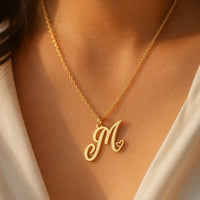
The piece they're describing → Heart Initial Necklace for Women — 18K Gold Plated, Personalized Letter + Heart Pendant
Personalize Yours

