


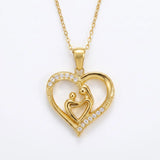
Quick answer: A mother-son necklace usually means one of two things: a matching two-piece set worn by both mother and son, or a single pendant a mother wears that symbolizes her son through its design (a mother-and-child motif, his birthstone, or his initial). The single-pendant style is more common in practice, since most sons — especially older ones — don't wear pendant necklaces day to day.
"Mother son necklace" most often means a piece the mother wears that represents her son, not a literal matching set -- his birthstone, his initial, or a mother-and-child design. A true two-piece matching set exists but is a smaller, younger-skewing category since most sons don't wear pendants daily. The mother-and-child pendant style works for any child's gender, which is worth knowing if the design itself doesn't specify.

Search "mother daughter necklace" and you'll find hundreds of matching-set options built specifically around that pairing. Search "mother son necklace" and the results thin out fast — not because the sentiment is less real, but because the jewelry industry has built far more literal matching-set products for mothers and daughters than for mothers and sons. That doesn't mean there's nothing here; it means the right piece looks a little different. For more ideas from a son, see our guide to sentimental gifts for mom, or the shorter pick-by-budget guide written for sons, gifts for mom from son.
This guide covers what a mother-son necklace actually is in practice, the two real categories to choose between, and what to look for so the design doesn't accidentally read as daughter-specific when that's not the intent.
What "Mother Son Necklace" Actually Means
In practice, a mother-son necklace is almost always a piece the mother wears that represents her son — not a pendant given to the son himself. This is different from the mother-daughter category, where matching two-piece sets (one for mom, a smaller one for daughter) are a real, established product type. Sons — particularly past early childhood — are far less likely to wear a pendant necklace day to day, so the market has settled on mom wearing the symbol rather than both of them wearing coordinated pieces.
The meaning behind it is straightforward: a heart, an infinity symbol, or a mother-and-child silhouette worn by mom, standing in for the bond itself rather than requiring both people to wear jewelry for the symbolism to land.
The Two Real Categories
A Single Pendant Mom Wears
The far more common style: mom wears one necklace that symbolizes her son through its design, his birthstone, or his initial. This is what most people searching "mother son necklace" are actually looking for, whether or not the phrasing implies two pieces. It works for any age son, doesn't require him to wear anything, and doesn't need updating as he grows.
A Literal Matching Two-Piece Set
Less common, and mostly aimed at younger boys who'll still wear a pendant — coordinating pieces where mom wears the full-size version and a smaller matching piece is sized for (or kept for) her son. Worth knowing before you shop: if a listing shows a "set," check that it's genuinely two wearable pieces and not one piece photographed with a prop.
What to Look For
Gender-neutral design. Many "mother-child" pendants use a rounded, ungendered silhouette rather than anything specifically coded as daughter or son — worth checking a product's actual images rather than assuming from the collection name it's filed under, since mother-daughter collections often carry pieces that work equally well for a son.
Material honesty. Check whether a "hypoallergenic" claim means genuinely nickel-free (true of 925 sterling silver) or nickel-safe (true of 316L stainless steel, which resists tarnish and water but isn't literally nickel-free — no stainless steel is). Both are safe for the large majority of wearers; only someone with a diagnosed severe nickel allergy needs to draw the distinction.
Chain length. 16–18 inches sits at or just below the collarbone and suits most adult women buying this for themselves — the length matters more than the pendant style for everyday comfort.
The Right Pick
For a mother-son necklace that doesn't read as daughter-specific, AJLuxe's Mom Heart Necklace uses a rounded, gender-neutral mother-and-child silhouette cut into an open heart pendant, pavé CZ stones lining both edges — a single piece mom wears, not a matching set. 6 grams on a 16"+2" chain, 18K gold plated or 316L stainless steel, $36.99, hypoallergenic and nickel-safe.
See also: heart necklace for mom and mother & daughter jewelry for related styles.
Frequently Asked Questions
What are some good matching necklaces for my mom and son?
True matching sets for mom and son are a smaller category than mother-daughter sets, mostly aimed at younger boys who'll still wear a pendant. For an older son, a single piece mom wears — his birthstone, his initial, or a mother-and-child design — is the more common and practical choice, since he's unlikely to wear a matching pendant daily.
What are the latest trends in mother necklaces?
Open-heart and mother-and-child silhouette pendants are currently the most popular styles, favored over solid hearts because the cutout design reads as more modern and layers more easily. Gender-neutral designs -- ones that don't specify daughter or son through the imagery -- are also trending, since they work regardless of which child the piece represents.
What is a good jewelry gift for a first-time mom?
A mother-child pendant, a birthstone piece matched to the baby's exact birth month, or a personalized name necklace are the three strongest categories -- see our first Mother's Day gift guide for the full breakdown by occasion and timing.
What's the meaning behind a mom necklace?
A mom necklace typically symbolizes the parent-child bond through a shared motif -- a heart, an infinity symbol, or a literal mother-and-child silhouette -- worn by the mother as a permanent, everyday reminder rather than something reserved for special occasions.
All third-party trademarks, brand names and product names are the property of their respective owners. AJLuxe is not affiliated with, endorsed by, sponsored by, or otherwise connected to any third-party brand referenced in this article. Brand names are used solely for accurate comparative reference, and material descriptions reflect each brand's own published product specifications at the time of writing.
You Might Also Like
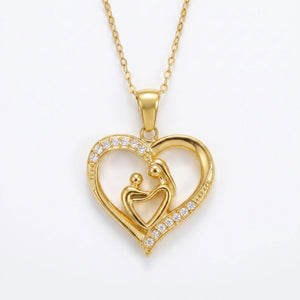
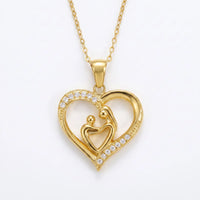
The piece they're describing → Mom Heart Necklace — 18K Gold Plated Stainless Steel, Mother & Child Pendant, CZ Stones
Personalize Yours


