


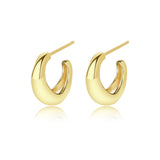
- Gold plating is real gold, measured in microns, bonded onto a base metal. It is not fake gold; it is just a thin surface layer rather than solid gold.
- Standard gold plating is typically 0.5 microns or less over brass, copper, or stainless steel, and a plain "gold plated" label does not promise any particular thickness.
- Gold vermeil is a legally regulated step up: real gold of at least 10K, at least 2.5 microns thick, over a sterling silver base (under US federal marking guidelines).
- Gold filled uses a thicker, mechanically bonded gold layer that must legally equal at least 1/20th (5%) of the item's total weight, and generally outlasts both plating and vermeil.
- Most of AJLuxe's women's jewelry is 18K gold plating over 925 sterling silver, a real and higher-karat gold layer over a sterling silver core, one step above generic gold-plated-over-brass costume jewelry, though thinner than true vermeil. A few styles use a 316L stainless steel base instead, and each product page names the base metal.
If you've ever bought a gold-colored ring or necklace online and wondered whether it's actually gold plated jewelry real gold or just a clever imitation, you're asking the right question. The short answer is yes: gold plating is a genuine, measurable layer of gold, applied by electroplating onto a base metal underneath. What trips people up is not whether the gold is real, but how thin that layer is, what it's plated over, and how that compares to gold vermeil, gold filled, and solid gold. This guide breaks down exactly what's happening at the microscopic level, what the law actually requires, and how to tell a well-made plated piece from a cheap one.
What Gold Plating Actually Is
Gold plating is created through electroplating: a piece is submerged in a gold-ion solution, and an electric current draws a thin layer of real gold atoms onto the surface of a base metal. The gold in that layer is genuine gold, typically 10K to 24K fineness depending on the manufacturer, not a paint, dye, or gold-colored alloy. What makes plating different from solid gold is thickness, not authenticity.
That thickness is measured in microns (millionths of a meter), and it is the single biggest factor in how long a plated piece looks good. These lifespans are rough rules of thumb, not guarantees:
- Flash plated (under 0.5 microns): The cheapest tier, common in fast-fashion costume jewelry. Can fade within days to a few weeks of regular wear.
- Standard plated (0.5 to 1.0 microns): The most common commercial grade. Typically lasts a few months to about a year with normal care.
- Heavy or thick plated (1.0 to 2.5 microns): A noticeably better tier, often lasting 1 to 2 years.
- Vermeil-grade plating (2.5 microns and above): The federal minimum for calling a piece "vermeil," and the thickest common plating tier, lasting several years with care.
The base metal underneath matters just as much as the gold layer on top. The most common bases are:
- Brass: Cheap and widely used, but can contain nickel and cause skin reactions once the plating wears through.
- Copper: Conducts well for plating but can also trigger skin discoloration ("green finger") as the gold thins.
- Stainless steel: More durable, and the 316L grade is low in nickel, a common upgrade base for better-made plated jewelry.
- Sterling silver (925): The base used for gold vermeil, and the highest-quality base commonly used under gold plating, hypoallergenic and valuable in its own right.
So when you ask whether gold plated jewelry is real gold: the gold is real. The question that actually determines quality is how many microns thick it is, and what precious or non-precious metal is sitting underneath it.

Gold Plated vs. Gold Filled vs. Gold Vermeil vs. Solid Gold
All four constructions use real gold; they differ in thickness, bonding method and base metal. "Is it real gold" and "how long will it last" are two different questions, so here is how the four stack up side by side:
| Type | Gold Layer | Base Metal | Typical Lifespan | Relative Price |
|---|---|---|---|---|
| Gold plated | Real gold, usually under 1 micron, thickness not stated on the label | Brass, copper, stainless steel, or sterling silver | Months to about 1 year | Lowest |
| Gold vermeil | Real gold, at least 10K, minimum 2.5 microns (federally defined) | Sterling silver (925) only | Roughly 1 to 3 years with care | Lower mid |
| Gold filled | Real gold, mechanically bonded, at least 1/20th (5%) of total weight | Brass (usually) | Roughly 3 to 5+ years | Mid |
| Solid gold (10K to 18K) | Gold all the way through, no plating | None, solid gold throughout | A lifetime, heirloom-grade | Highest |
Every row in that table involves real gold; none of it is fake. The differences are thickness, bonding method, and what's underneath. For a deeper look at where the plated and filled tiers diverge, see our full guide on gold plated vs. solid gold and our head-to-head on solid gold vs. gold filled.
What "Gold Vermeil" Legally Requires (and Plating Doesn't)
In the US, "gold vermeil" is defined by federal marking guidelines, while a plain "gold plated" label does not tell you how thick the layer is. A seller can call a piece "gold plated" whether the layer is 0.05 microns or 3 microns. To be sold or stamped as vermeil in the US, a piece must meet all three conditions at once:
- A sterling silver base: the core must be 925 sterling silver, not brass, copper, or stainless steel.
- Gold of at least 10 karat fineness: the coating must be genuine 10K+ gold, not a lower-karat gold wash.
- A minimum thickness of 2.5 microns: applied consistently across all significant surfaces of the piece.
Miss any one of those three, and a piece cannot legally be marketed as vermeil in the US, no matter how it looks. Gold filled jewelry has its own separate federal standard: the bonded gold layer must equal at least 1/20th, or 5%, of the item's total metal weight to use the "gold filled" or "1/20 gold filled" designation. Plain "gold plated" jewelry carries no such stated minimum on its label, which is exactly why plating quality varies so widely between brands.
How Long Gold Plating Actually Lasts, and How to Care For It
Plating lifespan comes down almost entirely to two variables: micron thickness and base metal, not the karat number people usually fixate on. A well-made piece with 1+ micron plating over stainless steel or sterling silver can look great for 1 to 2 years; a flash-plated piece over bare brass can show base metal within weeks. A few care habits meaningfully extend any plated piece's life:
- Remove it before water contact. Showering, swimming, and washing dishes are the fastest way to strip a thin gold layer. Our guide on whether gold filled jewelry tarnishes covers water exposure in more depth for that tier.
- Apply products before you put jewelry on, not after. Perfume, lotion, and sunscreen all contain chemicals that accelerate plating wear.
- Store it dry and separately. Tossing plated pieces in a drawer where they rub against each other scratches through the gold layer faster than normal wear.
- Wipe with a soft cloth after wearing. Removing sweat and oils before storage slows tarnishing of the base metal underneath.

Where AJLuxe's Jewelry Sits on This Spectrum
We want to answer this honestly rather than oversell it. Most of AJLuxe's women's jewelry is 18K gold plating over 925 sterling silver. A few styles, and our men's line, use a 316L stainless steel base instead, and each product page names the base metal. On the sterling silver pieces, two things are true at once: the gold layer is real 18K gold (a higher karat than vermeil's 10K legal minimum), and the base underneath is genuine sterling silver, the same precious-metal core that gold vermeil uses, not brass.
What that means in practice: a sterling silver AJLuxe piece is a real step up from generic gold-plated-over-brass costume jewelry, because even as the gold surface naturally wears with use, what's underneath is a precious metal rather than cheap base metal that can tarnish or irritate skin. The micro pavé heart infinity necklace is one example: 18K gold plated over a 925 sterling silver base, not a brass alloy dipped in gold. What it is not, and we say this plainly, is legal vermeil. Our standard plating thickness runs thinner than the 2.5-micron vermeil minimum, so while we share vermeil's sterling silver base and use a higher-karat gold, we don't stamp our pieces "vermeil." If plating longevity above all else is your priority, true vermeil or gold filled will outlast us; if you want the gold look and a sterling silver core at a lower price point, that's exactly the tier we're built for. Our companion guides on 14K gold plated jewelry and whether gold vermeil is worth it walk through the value case for each tier in more detail, and our gold filled worth-it review covers the more durable alternative.
Shop the AJLuxe Circle Heart Necklace
925 sterling silver, an open heart linked to a small pave-set ring, 18K gold plated or left unplated, CZ pave.
Shop the Circle Heart Necklace →Shop AJLuxe Birthstone Clover Necklace
925 sterling silver, 18K gold plated, four-leaf clover set with a CZ stone color-matched to your birth month, all 12 months.
Shop the Birthstone Clover Necklace →Shop AJLuxe's Initial Tag Necklace
925 sterling silver tag on a box chain, 26 letters -- 18K gold plated or left unplated in a Silver colorway.
Shop the Initial Tag Necklace →Shop the AJLuxe Gold Serpentine Anklet
18K gold plated, flat herringbone/snake chain, lobster clasp with a 1 to 1.5 inch extender, $32.99.
Shop the Gold Serpentine Anklet →Shop AJLuxe Thin Rope Chain Hoop Earrings
18K gold plated, twisted-rope texture, a small hinged huggie hoop that sits close to the lobe.
Shop the Rope Chain Hoop Earrings →Shop AJLuxe Crown Stud Earrings
925 sterling silver, 18K gold plated, with a clear cubic zirconia set in an openwork crown gallery, hypoallergenic.
Shop the Crown Stud Earrings →Shop AJLuxe Micro Pave Huggie Hoop Earrings
316L stainless steel, 18K gold plated, with micro-pavé CZ set across the front arc and a hinged snap closure.
Shop the Micro Pavé Huggie Hoops →Shop AJLuxe 18K Gold Huggie Hoop Earrings
A 2.5mm 18K gold plated band in three sizes -- 15mm, 17mm, or 21mm -- with a hinged snap closure, sold as a pair.
Shop the Gold Huggie Hoop Earrings →Shop AJLuxe White Enamel Gold Hoop Earrings
A white fired-enamel inlay set in an 18K gold plated huggie hoop, over a 925 sterling silver base -- hinged snap closure, sold as a pair.
Shop the White Enamel Hoop Earrings →Shop AJLuxe Alexandrite Teardrop Pendant Necklace
925 sterling silver, 18K gold plated, set with a lab-created alexandrite teardrop that genuinely shifts from green in daylight to red-violet under incandescent light, June birthstone.
Shop the Alexandrite Necklace →Shop the July Birthstone Necklace
925 sterling silver teardrop pendant, 18K gold plated, set with a ruby-red cubic zirconia, disclosed as simulated, $34.99.
Shop the July Birthstone Necklace →Frequently Asked Questions
Is gold plated jewelry considered real gold?
Yes, the coating is genuine gold, typically applied by electroplating at a stated karat purity. It is not solid gold all the way through, but the surface layer itself is real gold, not an imitation or gold-colored paint. If you are choosing a gift for a golden anniversary, our 50th anniversary gift ideas explain how to describe plated gold honestly.
Does gold plated jewelry contain any actual gold?
Yes. Every legitimate gold-plated piece has a measurable layer of real gold bonded to its surface, usually under 3 microns thick. The amount of gold is small compared to solid gold, but it is genuine.
How does gold plated jewelry compare to gold vermeil?
Gold vermeil is a regulated, higher-quality version of plating: it requires a sterling silver base and a minimum 2.5-micron layer of at least 10K gold. Standard gold plating states no such minimum on the label and can be applied over brass, copper, steel or sterling silver at any thickness, which is why vermeil generally lasts longer.
What is the difference between gold plated and gold filled jewelry?
Gold plating uses electroplating to deposit a thin gold layer, with no thickness stated on a plain label. Gold filled uses heat and pressure to mechanically bond a much thicker gold layer, which must legally equal at least 1/20th (5%) of the item's total weight, so it typically lasts several years longer than plating.
Is gold plated jewelry the same as solid gold?
No. Solid gold is gold all the way through, with no base metal underneath. Gold plated jewelry is a base metal, such as brass or stainless steel, with only a thin surface layer of real gold. Solid gold costs significantly more and never shows base metal underneath, since there isn't any.
Are there federal rules for gold plated jewelry?
A plain "gold plated" label does not state a minimum thickness. US federal marking guidelines do define the related terms "gold vermeil" (10K+ gold, 2.5 microns minimum, over sterling silver) and "gold filled" (bonded gold layer at least 5% of total weight), so those specific labels carry legal meaning that plain "gold plated" does not.
How long does gold plating last on jewelry?
It depends heavily on thickness and base metal: flash-plated pieces under 0.5 microns can fade within weeks, standard 0.5 to 1.0 micron plating lasts several months to a year, and heavier 1 to 2.5 micron plating over sterling silver or stainless steel can last 1 to 2 years or more with careful wear.
Can gold plated jewelry be tested to confirm if it contains real gold?
Yes. Jewelers use acid testing, electronic gold testers, or X-ray fluorescence (XRF) analysis to confirm both the presence of gold and its approximate karat. These tests can detect the plated layer, though they typically cannot measure exact micron thickness without more specialized equipment.
Is gold plated jewelry worth any money?
Not for its gold content. The amount of gold in a plated piece is too small to have meaningful scrap value, so gold-plated jewelry should be bought and valued for its look and craftsmanship, not as an investment or resale asset.
Does gold plated jewelry tarnish or fade faster than solid gold?
Yes, significantly. Solid gold doesn't tarnish because it's gold throughout. Plated jewelry fades as the thin gold surface wears away with friction, water, and chemical exposure, eventually exposing the base metal underneath, which can then tarnish or discolor on its own.
What markings indicate gold plated versus solid gold jewelry?
Solid gold is typically stamped with a karat mark alone, like 14K or 18K. Plated jewelry is usually marked "GP" (gold plated), "HGE" (heavy gold electroplate), or "GEP" (gold electroplate), sometimes alongside a karat number describing the plating's purity, not the whole piece.
Why is gold plated jewelry cheaper than gold vermeil or solid gold?
Because it uses far less actual gold. A plated piece's gold layer can be a fraction of a micron over inexpensive base metal, while vermeil requires a thicker, regulated gold layer over sterling silver, and solid gold is gold throughout. Less gold and a cheaper base metal both drive the price down. For the deeper economics of why gold itself costs what it does right now, see our gold price breakdown.
Final Thoughts
So, is gold plated jewelry real gold? Yes: the gold in a plated piece is genuine, just applied as a thin surface layer rather than running all the way through. Whether that's the right choice for you comes down to what's underneath the plating and how thick that layer actually is. Generic gold plating over bare brass is the entry tier; gold vermeil (regulated, sterling silver, 2.5+ microns) and gold filled (thicker, mechanically bonded) both sit above it in durability; solid gold sits at the top. On most of our women's pieces, 18K gold plating over 925 sterling silver lands above generic costume plating: real 18K gold over a precious-metal core, while staying honest that it's not legally vermeil. Match your expectations to the tier and you'll never feel misled by what "gold plated" actually means.
Shop AJLuxe's 18K gold-plated sterling silver jewelry
Shop the C-Shaped Stud EarringsShop This Guide
Browse our full jewelry collection to find 18K gold plated rings, necklaces, and earrings, most of them over a 925 sterling silver core, with a real gold surface.
More Gold & Metal Guides
AJLuxe Team. Last updated: October 2026. Most AJLuxe women's jewelry uses 18K gold plating over 925 sterling silver, and we do not sell gold vermeil.
All third-party trademarks, brand names and product names are the property of their respective owners. AJLuxe is not affiliated with, endorsed by, sponsored by, or otherwise connected to any third-party brand referenced in this article. Brand names are used solely for accurate comparative reference, and material descriptions reflect each brand's own published product specifications at the time of writing.
You Might Also Like
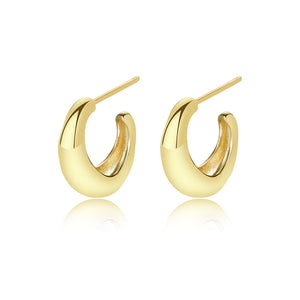

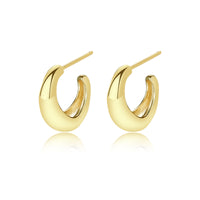
The piece they're describing → C-Shaped Stud Earrings for Women — 925 Sterling Silver, 18K Gold Plated, Lightweight
Personalize Yours


