


TL;DR — Celestial Jewelry at a Glance
- Sun jewelry symbolizes energy, confidence, and vitality — worn for strength and new beginnings.
- Moon jewelry represents intuition, femininity, and cycles — crescent = new beginnings, full moon = completion.
- Star jewelry stands for guidance, hope, and wishes — North Star = purpose, shooting star = change.
- Constellation jewelry connects your zodiac identity to the sky — deeply personal and increasingly popular.
- Sun + moon together = duality, balance, masculine/feminine harmony, yin and yang.
- Celestial jewelry is trending in 2026 because of astrology's mainstream revival and the spiritual-aesthetic movement.
- Best metals: sterling silver for moon/star energy; gold-plated silver for sun pieces.
Look up on a clear night and you will find the oldest jewelry inspiration in human history. Every culture — from ancient Egypt to the Aztec empire, from Mesopotamia to Renaissance Europe — has turned the sky into symbols worn close to the body. In 2026, that instinct is stronger than ever.
Celestial jewelry — pieces shaped like suns, moons, stars, planets, and constellations — has become one of the most significant jewelry trends of the decade. But these pieces are not simply fashionable. Each symbol carries centuries of meaning, and understanding that meaning transforms a necklace from an accessory into something with real personal weight.
This guide covers every major celestial symbol in depth, explains why the trend is surging right now, tells you how to style and layer celestial pieces, and points you to deeper reading on each individual motif. Whether you are buying your first sun necklace or building a full celestial layering stack, this is your complete reference.
What Is Celestial Jewelry?
Celestial jewelry refers to any piece — necklace, earring, ring, bracelet, or charm — that draws its design from astronomical or astrological imagery. This includes literal depictions of the sun, moon, stars, planets, and constellation patterns, as well as symbolic combinations like the sun-and-moon pairing or the crescent-and-star motif.
The category sits at the intersection of fine jewelry design and spiritual symbolism. A celestial piece can be worn purely for its aesthetic — the clean geometric lines of a crescent moon, the radiating symmetry of a sun — or it can be chosen for its meaning, acting as a daily talisman that anchors the wearer to a set of values or intentions.
In practice, most people who wear celestial jewelry are drawn to both dimensions at once. The symbol looks beautiful and it means something. That dual appeal is exactly why celestial jewelry has crossed from niche spiritual shops into mainstream fine jewelry stores worldwide.
Sun Jewelry: Energy, Confidence, and Vitality
The sun is the most universally recognized symbol of power in human history. Across ancient Egypt (Ra), ancient Greece (Helios), Aztec civilization (Tonatiuh), and Norse mythology (Sol), solar imagery stood for the same cluster of qualities: life force, creative energy, leadership, and masculine power. That symbolic weight has carried forward into modern jewelry almost without dilution.
When someone wears a sun necklace today, they are reaching for what those qualities represent in contemporary life: confidence, vitality, optimism, and the drive to take up space. Read the full breakdown of what a sun necklace means and why people wear one.
Key Sun Symbolism
- Energy and life force — the sun is the source of all biological life on Earth; wearing it is an act of alignment with that creative force.
- Confidence and leadership — solar imagery has historically marked kings, gods, and high-status individuals; it carries an assertive, outward-facing energy.
- Masculine energy — in astrological and esoteric traditions, the sun governs masculine/yang energy: action, output, self-expression.
- Warmth and generosity — the sun gives light and warmth freely, making sun jewelry a symbol of open-heartedness and abundance.
- New beginnings — every sunrise marks a fresh start; a sun piece worn in the morning can function as a daily intention-setter.
Sun Jewelry Design Styles
Sun pieces range from minimalist discs with fine radiating lines (best for layering) to bold celestial suns with detailed ray patterns, faces, or sunburst motifs. Gold-plated sterling silver captures the warmth of solar symbolism without the price of solid gold. The sun pendant pairs naturally with other celestial pieces, particularly moon charms — which leads to one of the most popular combinations in modern jewelry.
Moon Jewelry: Intuition, Femininity, and Cycles
If the sun represents outward energy and action, the moon governs the interior world — intuition, emotion, the unconscious, and the rhythmic cycles of nature. Moon jewelry is among the most emotionally resonant celestial symbols precisely because its meaning is layered across multiple moon phases, each with its own intention.
For a complete deep-dive into moon necklace symbolism, read the moon necklace meaning guide. Here is a phase-by-phase breakdown:
Crescent Moon
The crescent moon — either waxing (growing) or waning (shrinking) — is the most widely worn moon symbol in jewelry. A waxing crescent points right and represents new beginnings, intention-setting, and fresh starts. It is the moon phase of planting seeds and making wishes. A waning crescent points left and represents release, letting go, and completion of a cycle.
Because many crescent pieces do not specify direction, they carry both meanings simultaneously: the promise of new beginnings and the wisdom of release. This makes the crescent one of the most universally meaningful symbols in celestial jewelry. For the full story, see the dedicated crescent moon necklace meaning guide.
Full Moon
The full moon represents completion, manifestation, peak energy, and illumination. What you set as an intention at the new moon is revealed and brought to fullness at the full moon. Full moon jewelry — circular, complete disc pendants — is worn as a symbol of abundance and accomplished goals.
Moon Phases Combined
Moon phase jewelry showing multiple phases in sequence represents the full cycle of life: birth, growth, peak, decline, and rebirth. These pieces are particularly meaningful as gifts for someone navigating a major transition — a new job, a relationship change, a move, or a period of personal reinvention.
Moon Symbolism Across Traditions
In Greek mythology, the moon was governed by three goddesses: Artemis (new/waxing), Selene (full), and Hecate (waning/dark). In Hinduism, the moon (Chandra) governs the mind and emotions. In Celtic tradition, the triple moon (waxing, full, waning) represents the maiden, mother, and crone — the three stages of womanhood. Across virtually every tradition, the moon is associated with feminine energy, the tides, fertility, and psychic perception.
Star Jewelry: Guidance, Hope, and Wishes
Stars have guided sailors, shepherds, and travelers for millennia. Before GPS and compasses, the night sky was the only reliable navigation system on Earth — and the star as a symbol of guidance, reliability, and hope is embedded in the meaning of star jewelry today.
Read the full exploration of star necklace meanings for a deep look at each star motif. The key symbols are:
The North Star (Polaris)
The North Star holds its position fixed in the northern sky while every other star appears to rotate around it. In jewelry, the North Star represents constancy, direction, purpose, and unwavering guidance. A North Star necklace is often given as a gift to someone beginning a major new chapter — a graduation, a career change, a move to a new city — as a symbol that they will find their way.
Shooting Stars
A shooting star (actually a meteor) is a brief streak of light across the sky, appearing suddenly and burning brightly before fading. The tradition of making a wish on a shooting star appears in cultures worldwide. In jewelry, shooting star motifs represent wishes, spontaneous change, rare opportunity, and the courage to leap.
Five-Pointed Star (Pentagram)
The five-pointed star is the most common star shape in jewelry. In secular use it represents excellence, achievement, and aspiration. In spiritual traditions it represents the five elements (earth, water, fire, air, spirit) and protection. Star earrings and star pendants in five-pointed form are among the most wearable and versatile celestial pieces — simple enough for everyday wear, meaningful enough to carry intention.
Six-Pointed Star (Star of David / Hexagram)
The six-pointed star carries deep significance in Judaism and has broader geometric resonance — in sacred geometry it represents the integration of opposites (upward and downward triangles) and the balance of masculine and feminine energy.
Sun and Moon Together: Duality and Balance
The sun-and-moon pairing is one of the most emotionally complex and enduringly popular motifs in all of jewelry. See the complete guide to sun and moon necklace meaning for a full exploration — here is a summary of the core symbolism.
The sun and moon represent complementary opposites held in balance. This is the same principle as yin and yang: two forces that are not antagonistic but interdependent, each containing the seed of the other. Together, sun-and-moon jewelry symbolizes:
- Masculine and feminine energy in harmony — the solar/yang and lunar/yin principles united rather than opposed.
- Balance of opposites — day and night, active and receptive, outer and inner, logic and intuition.
- Wholeness — the wearer contains multitudes; they are both the burning brightness of the sun and the quiet depth of the moon.
- Partnership and soul connection — many couples choose sun-and-moon pieces as a symbolic pairing, one wearing the sun and the other wearing the moon.
- Cycles and constancy — the sun rises, the moon waxes and wanes, but both return; a symbol of endurance through change.
In alchemical tradition, the sun (Sol) and moon (Luna) were the foundational duality of all matter. Their union — the alchemical marriage, or "coniunctio" — represented the highest form of integration and wholeness. That depth of meaning is why a simple sun-and-moon pendant can feel so emotionally resonant even to someone who has never read a word of alchemy.
Constellation Jewelry: Your Personal Sky
Constellation jewelry takes celestial symbolism to its most personal level. Rather than a universal symbol like a sun or moon, a constellation piece depicts the specific pattern of stars that marked the sky at or near your birth — your zodiac constellation. For everything about what these pieces mean and how they work, read the full constellation necklace meaning guide.
The twelve zodiac constellations (Aries, Taurus, Gemini, Cancer, Leo, Virgo, Libra, Scorpio, Sagittarius, Capricorn, Aquarius, Pisces) each correspond to a section of the ecliptic — the apparent path of the sun across the sky over the course of a year. Your "sun sign" is the constellation the sun was passing through when you were born.
Why Constellation Jewelry Feels So Personal
Most jewelry is chosen for its aesthetic or its general meaning. A constellation piece is chosen because it maps to your identity — your birth chart, your astrological personality, your specific place in the cosmic order. That level of personal specificity is rare in jewelry, and it explains why constellation necklaces are among the most popular gift choices for birthdays and milestone celebrations.
Constellation Jewelry Beyond the Zodiac
Not all constellation jewelry depicts zodiac signs. Orion (the hunter), Cassiopeia (the queen), Ursa Major (the great bear), and Pleiades (the seven sisters) all appear in celestial jewelry because of their cultural prominence and visual distinctiveness. These non-zodiac constellations are often chosen for their mythological associations rather than astrological ones.
If you want to understand how your zodiac sign connects to specific crystals, the crystals for your zodiac sign guide is an excellent companion resource — many people layer constellation jewelry with their zodiac crystal for a fully personalized celestial look.
Crescent Moon with Star: Spiritual and Cultural Layers
The crescent moon paired with a five-pointed star is one of the oldest symbol combinations in jewelry. It appears on flags, ancient coins, and religious iconography across the Middle East and Mediterranean. In Islamic tradition, the crescent and star is a widely recognized emblem — though it predates Islam and appears in Byzantine, Ottoman, and even pre-Islamic Mesopotamian contexts.
In contemporary spiritual jewelry, the crescent-and-star pairing carries layered meaning independent of any single religious tradition:
- The crescent represents new beginnings and the receptive lunar feminine energy.
- The star represents guidance, aspiration, and the spark of divine light.
- Together they symbolize the illuminated path: moving toward your goals guided by inner wisdom.
This is one of the most visually balanced celestial combinations in jewelry design — the open curve of the crescent and the geometric point of the star create natural visual tension and harmony.
Planet Jewelry: Saturn, Venus, and Jupiter
Planet-specific jewelry is a growing corner of the celestial category, driven largely by astrology's revival. While planet pendants are less common than sun, moon, and star pieces, they carry precise astrological meaning that makes them deeply appealing to astrology-informed wearers.
Saturn
Saturn — recognizable by its iconic ring system — governs discipline, time, structure, and hard-earned achievement. In astrology, Saturn is the planet of lessons and limits: it demands effort, but rewards perseverance. Saturn jewelry is worn as a talisman for long-term goals, career ambitions, and the kind of patient discipline that builds lasting foundations.
Venus
Venus governs love, beauty, pleasure, relationships, and aesthetic sensibility. It is the planetary ruler of Taurus and Libra. A Venus-symbol pendant (the circle-with-cross also used as the female symbol) or a planet piece representing Venus carries energy associated with attracting love, deepening relationships, and cultivating beauty in everyday life.
Jupiter
Jupiter is the planet of expansion, abundance, growth, optimism, and good fortune. As the largest planet in the solar system, it governs bigness in all forms — big ideas, big opportunities, big blessings. Jupiter jewelry is worn as a symbol of abundance consciousness and the willingness to receive growth.
Why Celestial Jewelry Is Trending in 2026
Celestial jewelry has been building in popularity for nearly a decade, but its current moment is the result of several converging forces:
The Astrology Revival
Astrology has undergone a full mainstream rehabilitation over the past decade. What was once considered fringe is now a legitimate cultural language — Co-Star has been downloaded over 25 million times, astrology content drives billions of views on TikTok, and "what's your sign?" is a standard opener in dating profiles and friend groups. As astrology has normalized, so has celestial symbolism. Constellation necklaces and moon pendants are no longer coded as "woo" — they are simply sophisticated.
The Spiritual Aesthetic Movement
The broader spiritual aesthetic — sometimes called "witchy," sometimes "cottagecore," sometimes simply "mystical" — has moved from subcultural to mainstream over the same period. Crystals, tarot cards, moon rituals, and celestial imagery are now regular features of mainstream lifestyle content. Celestial jewelry sits perfectly at the center of this aesthetic: visually beautiful, spiritually resonant, and not affiliated with any specific religious tradition.
The Meaning Economy
Consumers increasingly want products that mean something. The trend away from fast fashion and toward intentional purchasing has made symbolic jewelry — pieces chosen for their meaning, not just their appearance — far more appealing than purely decorative accessories. A celestial piece lets the wearer make a statement about their values, their spiritual life, and their relationship to the cosmos.
Celebrity and Cultural Influence
Taylor Swift's "Midnights" era — imagery saturated with moon, star, and celestial motifs — introduced an entire new audience to celestial aesthetics. SZA, Doja Cat, and a wave of spiritually-minded influencers have incorporated celestial jewelry into their public visual identity. When cultural icons wear something with conviction, it moves from trend to cultural touchstone.
How to Style Celestial Jewelry
The Core Celestial Layer Stack
The most popular celestial styling approach is a three-necklace stack at different chain lengths:
- 16-inch choker length — a delicate star or moon charm sits at the collarbone. This is the first piece the eye catches.
- 18-inch pendant length — a sun pendant or crescent moon falls at the top of the chest. The centerpiece of the stack.
- 20–22-inch layer — a constellation pendant or simple bar necklace with a planet charm drops below the collarbone. This anchors the stack.
Mixing Celestial Metals
Traditional jewelry advice says to stick to one metal family, but celestial jewelry breaks this rule beautifully. Gold-plated pieces for sun and star motifs mixed with silver-toned moon pieces creates a deliberate day/night duality that enhances the symbolism. The key is consistency of quality — all pieces should be sterling silver-based, whether yellow gold plated, rose gold plated, or left in classic silver.
Day vs. Night Celestial Dressing
Sun pendants and star charms wear well in daylight — their radiating, outward energy suits active daytime energy. Moon pendants and crescent pieces come into their own in the evening, when their quieter, more introspective symbolism aligns with the energy of winding down. Wearing a full celestial stack day-to-night means you carry both energies at once — which is precisely the point.
The Zodiac Anchor Piece
If you wear a constellation necklace, let it be the anchor of the look and build around it rather than competing with it. A constellation pendant at 18 inches, a simple crescent moon stud earring, and a star ring on your index finger creates a cohesive celestial identity without visual noise.
Celestial Jewelry as a Gift
Celestial pieces are among the easiest jewelry gifts to choose meaningfully. A sun necklace for someone who needs more confidence, a moon piece for someone going through a transition, a shooting star for someone making a big leap, a constellation necklace for a birthday — the symbolism does the work of communicating care and intention. Pair with the birthstone jewelry guide to add a second personal layer.
What Metal Is Best for Celestial Jewelry?
Sterling silver (925 silver) is the most popular metal for celestial jewelry, and for good reason. The cool, luminous quality of silver mirrors the visual quality of moonlight and starlight — it photographs beautifully, reflects light in ways that gold does not, and its associations with the moon run deep across multiple traditions.
Gold-plated sterling silver is the best choice for sun pieces specifically. It captures solar warmth and the historical association of the sun with gold (in alchemy and mythology, gold was literally called "the sun metal") without the cost of solid gold. The key is choosing 18K gold plated over 925 sterling silver base — this gives you both durability and genuine quality.
Rose gold-plated sterling silver suits Venus-related and moon pieces particularly well, adding a warmth and softness that the cooler silver alone does not have. It also photographs exceptionally well against skin tones of all depths.
Avoid base metal celestial jewelry (brass or zinc alloy) — these tarnish quickly, can cause skin reactions, and do not hold their plating well. Given that you are wearing this piece as a meaningful symbol, the material quality matters as much as the design.
Featured Celestial Piece
Amethyst Water Drop Pendant Necklace
Sterling silver celestial necklace with genuine amethyst — the spiritual stone that bridges the earthly and cosmic. Pairs beautifully with any celestial layering stack.
Shop the NecklaceFrequently Asked Questions
What is celestial jewelry?
Celestial jewelry refers to any piece — necklace, ring, earring, or bracelet — that draws its design from astronomical or astrological imagery, including suns, moons, stars, planets, and constellations. These pieces are worn for their aesthetic beauty and their symbolic meaning, which spans ancient mythology, astrology, and modern spiritual practice.
What does celestial jewelry symbolize?
Celestial jewelry symbolizes a connection to the cosmos and the forces it represents: the sun stands for energy, confidence, and life force; the moon stands for intuition, femininity, and cycles; stars represent guidance and hope; constellations connect to your astrological identity; and planet symbols carry specific astrological meanings like love (Venus), discipline (Saturn), or abundance (Jupiter).
What does a sun and moon necklace mean?
A sun and moon necklace symbolizes duality, balance, and the harmony of opposites. The sun represents masculine, active, outward energy (yang), while the moon represents feminine, receptive, inward energy (yin). Together they signify wholeness — the integration of opposites — and are often worn as a symbol of balance, partnership, or the acceptance of all aspects of one's own nature.
What does a crescent moon necklace mean?
A crescent moon necklace symbolizes new beginnings, intuition, and feminine energy. The waxing crescent (pointing right) represents setting intentions and fresh starts; the waning crescent (pointing left) represents release and letting go. Most crescent necklaces carry both meanings simultaneously, making them symbols of the full cycle of growth and release.
What does a star necklace mean?
A star necklace symbolizes guidance, hope, wishes, and the light that leads you forward through darkness. The North Star in particular represents constancy and purpose — the fixed point you navigate toward. A shooting star represents wishes, rare opportunities, and the courage to embrace sudden change. Five-pointed stars carry associations with aspiration, protection, and the five elements.
What does constellation jewelry mean?
Constellation jewelry maps your personal astrological identity onto a wearable piece. Your zodiac constellation — the star pattern associated with your birth month — connects to your sun sign and the personality traits, strengths, and themes associated with it. Constellation necklaces are among the most personalized forms of celestial jewelry, making them popular birthday and milestone gifts.
Who should wear celestial jewelry?
Celestial jewelry suits anyone drawn to its symbolism or aesthetic — there are no rules about who "can" wear it. People choose celestial pieces for their astrological identity (constellation jewelry), for specific intentions (sun for confidence, moon for intuition), for milestone moments (shooting star for a new beginning), or simply because the designs are beautiful. The symbolism amplifies whatever personal meaning you bring to the piece.
What does a sun necklace mean?
A sun necklace symbolizes energy, vitality, confidence, and life force. Drawing on thousands of years of solar symbolism across Egyptian, Greek, Aztec, and Norse traditions, sun jewelry is worn by people seeking to amplify their confidence, express warmth and generosity, or connect to a sense of power and self-expression. It is particularly meaningful as a gift for someone beginning something new or stepping into a leadership role.
How do I style celestial jewelry?
Layer celestial pieces at three chain lengths — choker (16 in), pendant (18 in), and long (20–22 in) — for maximum visual impact. Mix sun (gold-toned) and moon (silver-toned) pieces intentionally to express the duality theme. Use a constellation or planet pendant as an anchor piece and build smaller star or moon charms around it. For gifts, choose the celestial symbol that matches the recipient's current life theme: moon for transition, sun for new beginnings, star for guidance.
What metal is best for celestial jewelry?
Sterling silver (925) is the most popular metal for celestial jewelry because its cool luminosity mirrors moonlight and starlight. Gold-plated sterling silver works best for sun pieces. Rose gold-plated sterling silver suits Venus and moon pieces with extra warmth. Always choose sterling silver base (not brass or zinc alloy) for durability, skin safety, and quality that holds its finish over time.
All third-party trademarks, brand names and product names are the property of their respective owners. AJLuxe is not affiliated with, endorsed by, sponsored by, or otherwise connected to any third-party brand referenced in this article. Brand names are used solely for accurate comparative reference, and material descriptions reflect each brand's own published product specifications at the time of writing.
You Might Also Like
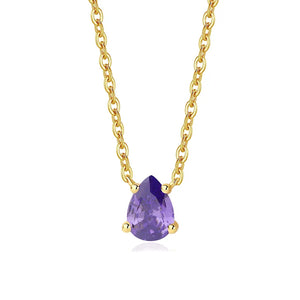

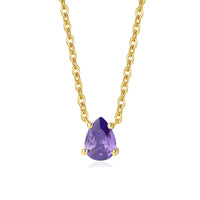
The piece they're describing → Amethyst Pendant Necklace for Women — Teardrop Amethyst Stone, 925 Sterling Silver
Personalize Yours


